



AI-Powered Fashion E-commerce App Development with AR Virtual Try-On
FASHION TECHNOLOGY
Location: USA
Services Provided
- Fashion Clothing App UI/UX Design & Development
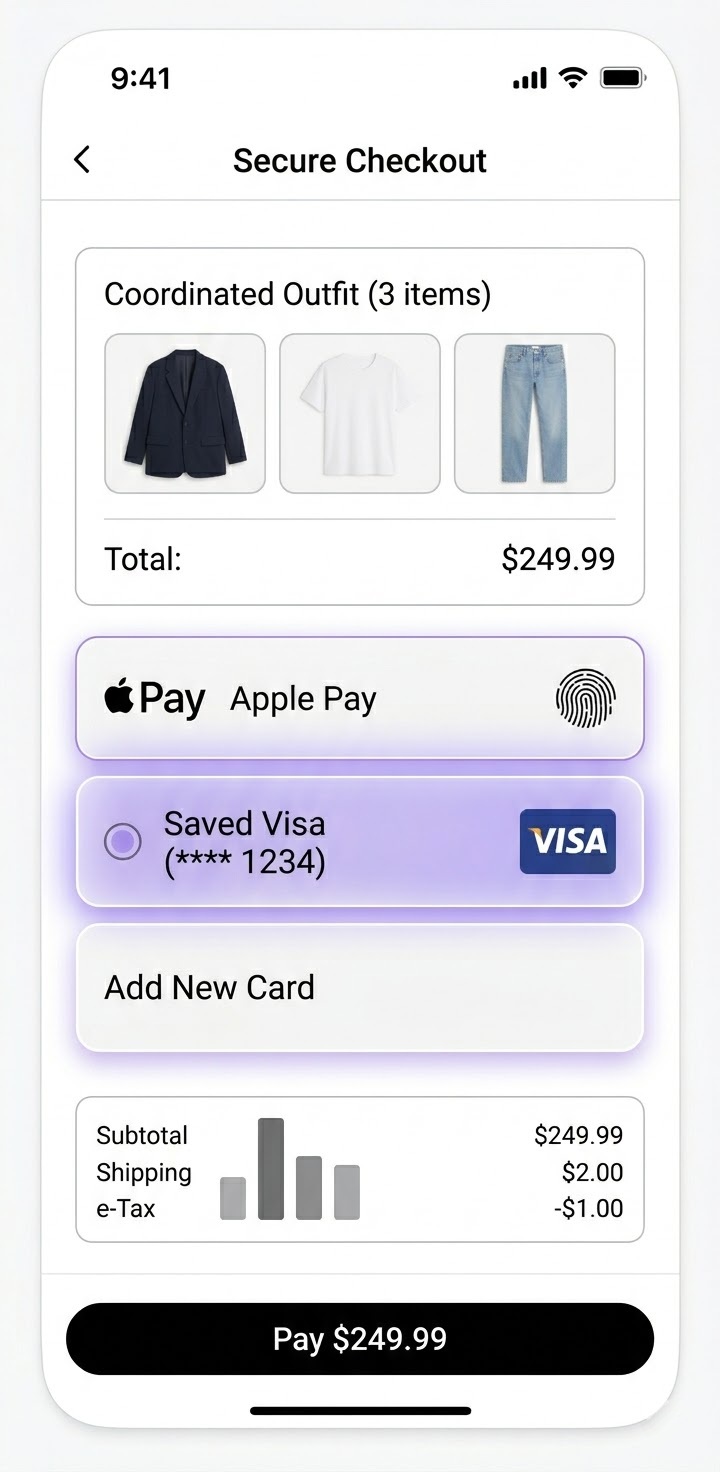
- Payment Integration
Client Overview
The client is an US based fashion retail start-up company that specializes in sustainable clothing and DTC distribution. They wanted to create a mobile-first platform of commerce that lowers the rates of returns, enhances size precision, and promotes responsible buying.
The brand aims at individuals who are digitally engaged and require real-time individualization and access to product insights. They wanted a reliable development partner, and thus, they found us to be the most suitable fit for that. They hired our dedicated developers to work on the project on a signed NDA, which guarantees the long-term cooperation, safety of the data and the secrecy of proprietary retail logic.
The answer entailed the need to support big catalogs, machine-learned recommendations, and high U.S. shopping traffic without affecting performance.
Business Challenges
The client had structural and commercial limitations before development:
- The product has a high rate of returns because of the variation in the sizing rates among brands.
- Lack of visual preview of the body before checkout.
- The claims of sustainability were not standardized and verifiable in the catalog.
- Challenge in maintaining users because of generic product feeds.
- The problem of scalability during seasonal traffic jumps in the U.S. market.
These issues directly affected the cost of logistics, customer loyalty, and customer loyalty.
The Big Idea
It aimed to develop an artificial intelligence sustainable fashion retail environment that would combine the notions of fit intelligence, augmented reality, and behavioral customization into one commerce experience.
The vision:
An online fashion platform, allowing users to see the clothes on their body, predictive suggestions, and search for outfits based on their buying behavior and sustainability choices.
Being a fashion and clothing app design and development company, the emphasis was aimed at minimizing the uncertainty in the measurement of fashion purchases over the internet and converting technology into quantifiable metrics of retail performance.
Solution Overview
We planned and implemented a fashion business centralized online system based on AI, which supports:
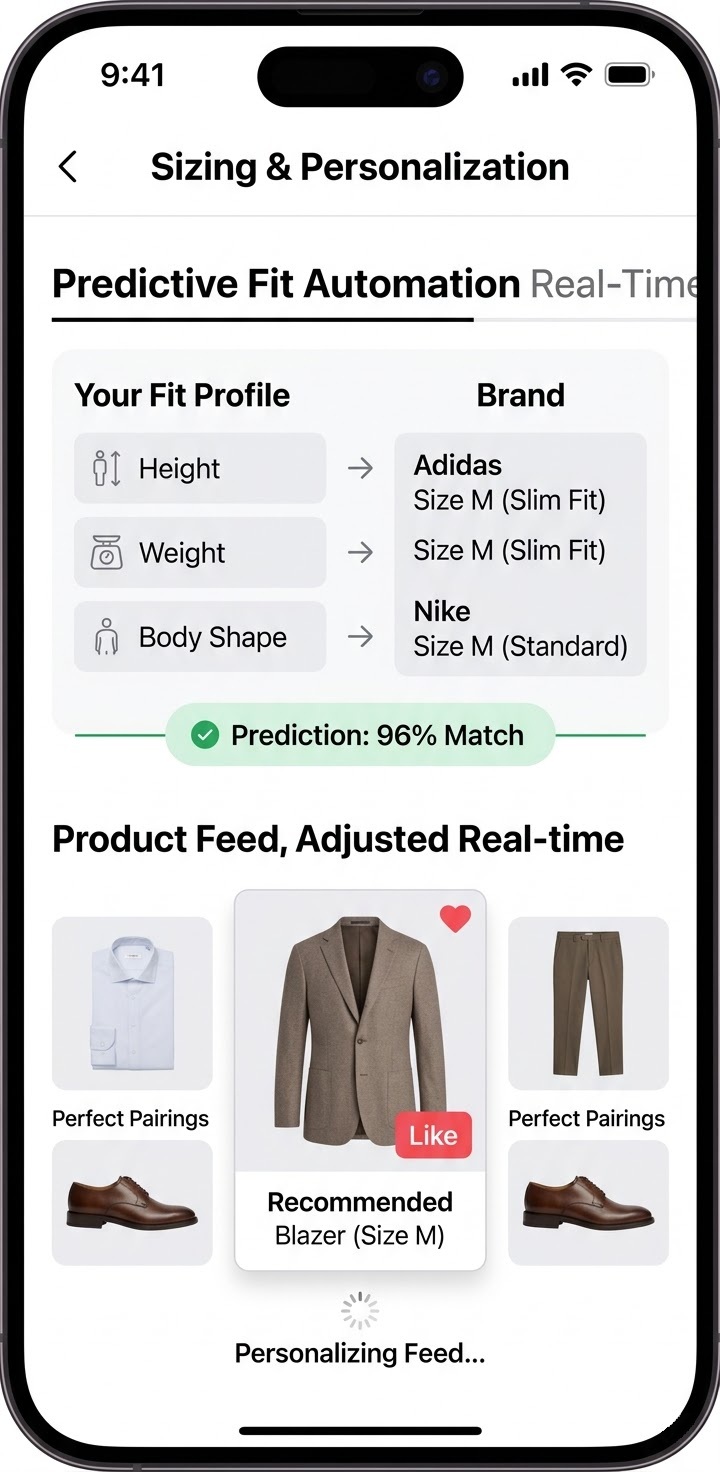
- Exact size prediction based on brand-specific measurement mapping.
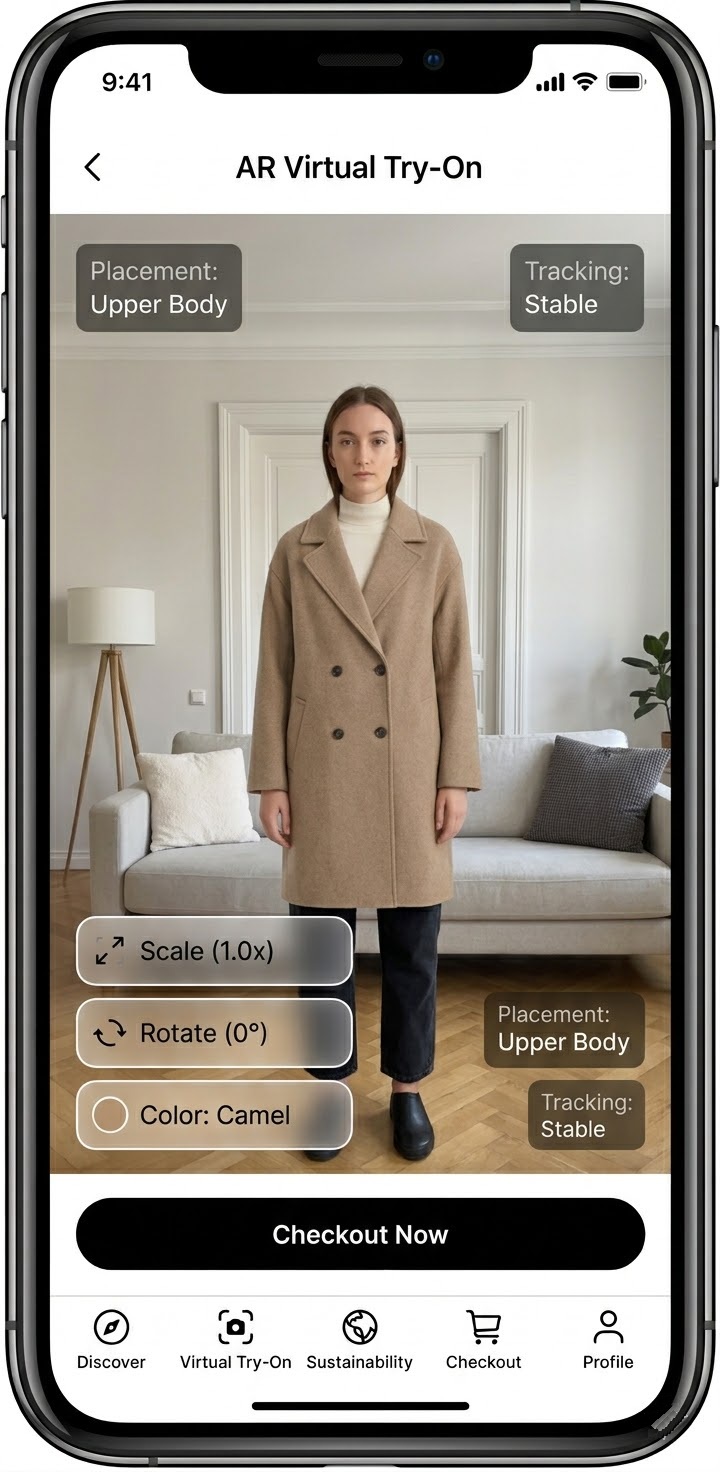
- AR-based virtual garment try-on with real-time visual validation.
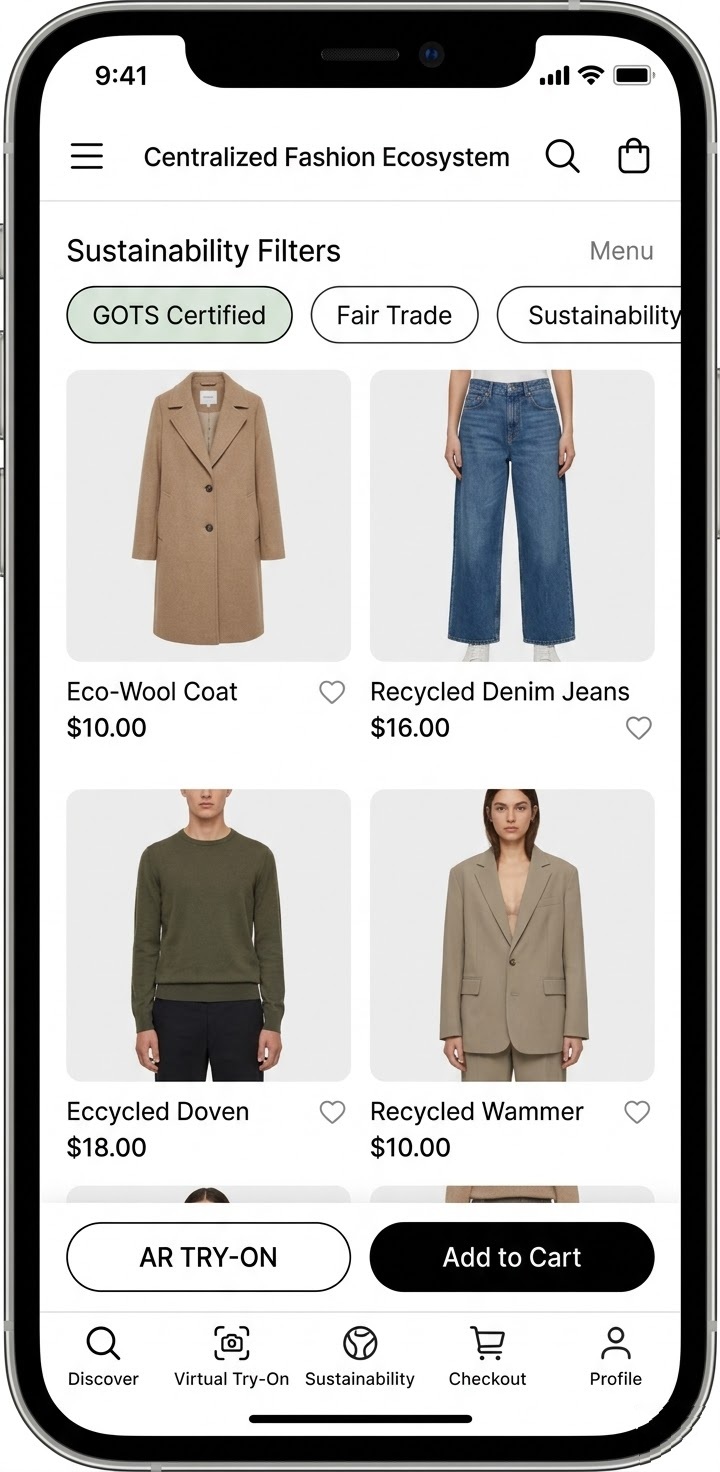
- Assigning sustainability tags to all product lines to be filtered transparently.
- Customized outfit as per customer engagement patterns.
The platform will allow fashion consumers in the U.S. to make informed purchase decisions in a single platform, decrease the rate of returns, enhance purchasing confidence, and ensure uninterrupted performance even when there are spikes in retail.
Technology Stack
Mobile App: React Native, high-performance AR modules
Backend: Node.js, microservices architecture, REST APIs
AI / ML: Fit prediction engine, recommendation algorithms, behavior modeling
Cloud: AWS scalable infrastructure with auto-scaling
Security: PCI-compliant payment gateway, encrypted data storage, secure APIs
Our Design & Development Process
- Research & Consumer Behavior Analysis: To set predictive logic parameters, we examined U.S. fashion purchasing behavior, the rates of return, and inconsistencies in sizes of mid-tier and high-end brands.
- Product & Data Architecture Planning: The system had been designed to accommodate large apparel catalogs with overlaying metadata to sustain scoring in the form of size calibration of brands.
- AR Experience Mapping: Frictionless virtual try-on processes were created to enable users to test clothes with just one or three taps without compromising the performance.
- Personalization Logic Development: Outfit feeds based on behavioral data were set with the help of user engagement, buying habits, and preferences by season.
- Cross-Device Testing: The application was tested with various device types in the U.S. to provide the stability of AR rendering, feed reactions, and checkout stability.
- Deployment, Optimization of performance: The implementation involved gradual catalog integration and a stress test to model peak seasonal-level demand conditions.
Challenges
- Standardizing Size Prediction Across Brands: Each brand adheres to the various measurement grids. Our standardization layer was able to transform the differently sized charts into a single model of prediction.
- Real-Time AR Rendering Without Lag: The optimization of the performance and the structuring of the assets into lightweight assets were demanded by the necessity to balance garment visualization and mobile processing limitations.
- Preventing Personalization Fatigue: There is excessive repetition of algorithms, and this lowers the retention of users. The feed engine was created to provide relevant discovery with controlled discovery.
- Making Sustainability Data Actionable: Sustainability tags were designed to manipulate the logic of filtering, sorting, and recommendation instead of using symbolic badges.
- Scaling for Seasonal Demand: The backend infrastructure was constructed to withstand traffic bursts during promotional periods, and this would not impact its reliability in checking out.
Results & Business Impact
After launching the fashion mobile app of our client to the right market:
- Lower logistics and reverse shipping, which is made possible by the better fit accuracy.
- The decrease in product returns was 28% because of the use of AI-based size prediction.
- Enhanced retention of customers through behavior-based personalization.
- Consistent system performance in peak seasonal traffic in the U.S.
- 22% growth in repeat purchases as a result of personalized outfit feeds.
- Better buy trust with AR-based virtual testing before purchase.
Final Outcome
The platform became a data-driven fashion business ecosystem, instead of a regular shopping application.
Retail Operations Achieved
- Reduced costs of logistics due to decreased returns.
- Taxonomy of products that allow brand onboarding at scale.
- Stable system performance when campaigns are in heavy traffic.
Consumers Gained
- Having a visual assurance of size before buying.
- AR mirroring visual garment preview.
- Individualized outfit feeds were in tandem with the shopping habits.
- Harmonious sustainability presence.
Looking to Build a Fashion Commerce Platform?
We develop AI-powered retail networks that combine predictive and AR visualization systems and scalable personalization systems for the American market. Let’s build a performance-driven fashion shopping experience tailored to your brand.
Centralized Fashion Ecosystem
Predictive Fit Automation
Sustainability Classification Engine
Real-Time Outfit Personalization
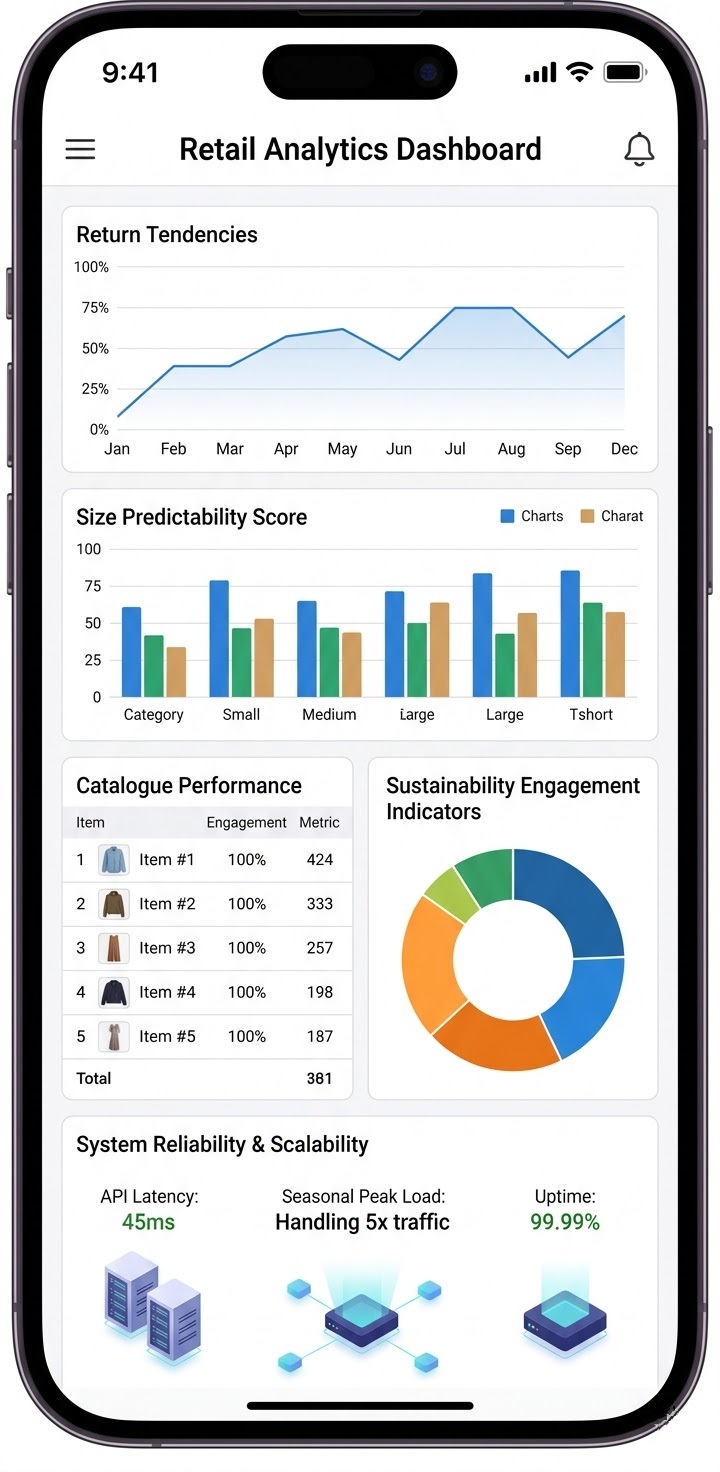
Retail Analytics Dashboard
System Reliability & Scalability
Gallery

Let's build your next digital product together.
Get Started