



Flutter App Development Services
Take your mobile presence to the next level with our advanced Flutter app development services. As a leading Flutter app development company, we’ve successfully built powerful, scalable apps for global brands. Our skilled flutter developers create high-performing iOS & Android tailored to businesses that lead the digital landscape.


Years in Business

Team Strength

Repeat Business

Ontime Delivery
Advanced Flutter Development
In today's digital-first world, speed, performance, and cost-efficiency define your app's success. As a top Flutter app development agency, we have deep expertise in Dart, Firebase, and advanced UI frameworks to create scalable mobile apps that deliver unmatched user experiences. Whether you're a startup testing an MVP or an enterprise launching a mobile solution, our expertise in Flutter SDK and custom widget development helps you to launch impactful, future-ready mobile applications.


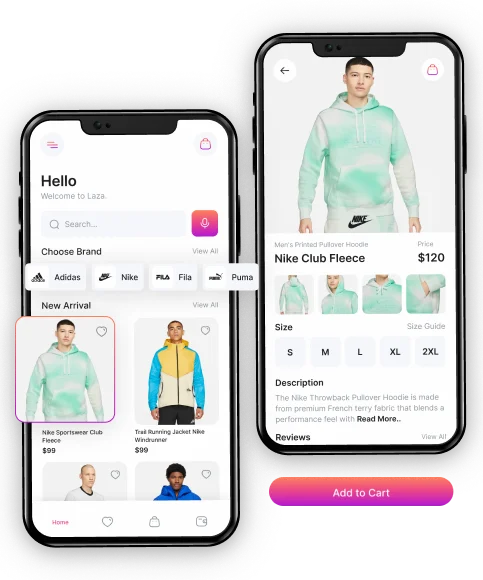
Custom Flutter Development That Speaks for Your Brand
With over 2 million users and 39% of developers choosing Flutter, it's clear why businesses are turning to custom Flutter development. A custom flutter app is important if you want to deliver a unique user experience and drive profitable business results.
At Expert App Devs, we use the most relevant flutter tech stack to create custom mobile solutions that feel native on both iOS and Android. Our experts Firebase, AWS, and Google Cloud for secure, scalable, and high-performing solutions, and make the most use of a single code library to maintain top-tier functionality and a fair budget.
We focus on rapid development, cost savings, and frictionless user experience for quick market entry and to stay ahead in the digital race.
Flutter Apps That Scale
With 16 years of expertise, our Flutter app development services have helped businesses launch cost-effective and engaging mobile apps that are unique and drive the best business results. Explore our portfolio and see how we deliver success your app could be next!

Why Do Top Businesses Trust Expert App Devs For Flutter App Development?
Why Choose Expert App Devs for your Project Development
As a leading Flutter app development company, you can ensure that your Flutter app project is in the hands of industry experts. Every Flutter app we create, whether for iOS or Android, is designed to mirror your brand identity; hence, we develop high-performing, future-ready apps to grow across various industries.

We have experienced in-house dedicated Flutter app developers to fulfill your industry-specific app needs.

When you work with us, you also get access to other experts like UI UX designers, strategists, QA engineers, testers, and many more to secure your app from all sides.

Our designers prioritize user-centric designs while developing your visually appealing and brand-reflective flutter apps.

We use advanced tech stacks such as blockchain, AI, metaverse, cloud, AR/VR, and much more to build scalable, high-performance apps.

We follow Agile methodologies and efficient workflows to consistently deliver feature-rich Flutter apps quickly without compromising quality.

We utilize the best features of Flutter such as hot reload and a single codebase to avoid post-launch expenses and maintain a fair app budget.
Our Flutter developers use end-to-end encryption, secure authentication, and data protection, by using HTTPS, SSL, and other protocols to keep your app and users safe.
We are known for the best post-launch support. Our team is always available in case you find any update issues or need future enhancements in your Flutter app.
Flutter brilliance at its best! Engaging, scalable, and high-performance apps tailored to fuel your business growth.

App Prototyping

Design System

Team Collaboration

UI Interaction

User Journey

Wireframe Design
Discovery, Strategy and UI/UX Design
This phase includes planning, ideation, and designing where our experts analyze your app idea and other business requirements to decide the best strategies, technologies, methodologies, required tools, and overall roadmap for easy execution. Keeping customer journey and user flow in mind, we create a user-friendly design that is easy to navigate, responsive to any screen size and aligns perfectly with your business idea.

Agile Delivery

API Integration

Code Development

Cross Platform

Full Stack

Live Deployment
Agile Flutter Development and Rapid Delivery
As a top Flutter app development services India, our Flutter team uses agile methodology to convert the design to various blocks. To make sure we align the app expectations precisely, we deliver developed blocks every week or two weeks for approval and suggestions. Plus, we use the best of Flutter functionalities like code reusability, lazy load and more to reduce cost as well as development time while having a good balance of app quality.

Automated Testing

Bug Tracking

Device Testing

Performance Analysis

Screen Testing

Speed Optimization
Quality Testing & App Launch
At Expert App Devs, we are more concerned about app quality hence we follow rigorous quality assurance procedures, including infrastructure testing, usability, functional testing, performance and whatever other tests are required. Our goal is to identify and solve any bug before the app launch so your users have a guaranteed smooth experience.
Once we get a green signal from our expert QA and testing team, we launch your app and deploy it in suitable stores.

App Monitoring

Lifecycle Management

Ongoing Support

Performance Enhancement

Security Protection

Server Maintenance
Ongoing Support & Optimization
So, your app is launched, but our job does not end here because the real game begins after launching. We provide ongoing support to maintain the app's performance and we monitor and guide you about the next upgrades and other necessary things.
In case of any technical glitch or if you need future advancement due to market change, our team helps you to adapt and fix the issues as soon as possible.

Business Strategy

Client Collaboration

Digital Transformation

Growth Strategy

Solution Planning

Tech Roadmap
Flutter Consulting & Strategy
Your app's success depends on the right strategy. Our flutter consultants understand your business goals, target audience, technical and non-technical requirements and overall expectations from the app. Doesn't matter whether you are a startup or an enterprise; taking the right decisions at the right time matters.
Hence, our experts guide you on cost optimization, performance scalability and future updates to ensure your Flutter app aligns with your vision and delivers long-term value.
Our Projects Our Projects Digital Excellence Through Expert Engineering.





















Flutter Development Explained: What Decision-Makers Must Consider
Brief into flutter technology
Flutter is an open-source UI software development toolkit developed by Google to allow developers to create native-complied applications using a single codebase. It uses DART programming language which is known for fast and flexible development. Developers love Flutter because of its write-once-and-run-anywhere concept, which makes making cross-platform web, mobile, and desktop applications much easier.
Flutter was introduced in 2015 by Google as an experimental project named Sky. The motive behind developing Flutter was to give users a unified app experience across all devices and platforms. From its launch, it became popular among the industry due to its amazing features and functionality. Further, it evolved and was modified into a cross-platform UI toolkit to allow developers to build apps using a single code. It was then released as Flutter version 1.0 in 2018.
Understanding Flutter’s Architecture: Widgets, Dart, and State Management
Flutter includes various components that make the developer's job easier and help in creating high-performance and visually appealing mobile apps. Let's explore all the components of Flutter one by one.
- Widgets: Widgets are the building blocks of the app; everything you see on a screen is a widget. The layout elements, UI elements, buttons, text boxes, etc, are the widgets that make the app interactive and enjoyable. Flutter has both stateless (unchanging) and stateful (dynamic) widgets hence, it is best for making highly-responsive and eye-catching mobile apps.
- DART(programming language): Flutter runs on DART language which is basically an object-oriented programming language. The reason Flutter is developed using DART is fast, secure, and optimized for Flutter’s reactive framework. Dart’s Just-in-Time (JIT) compilation works as a hot reload that helps to do instant changes.
- State management: It offers various statement management methods like setstate(), provider, Getx, MVVM and more to handle the data efficiently.
- Rendering engine: it is used to render input and graphics library to have a smooth animation, transition, and operations for the app.
- Flutter dev tools: Developers can inspect the widget elements and check the app performance in real-time using Flutter dev tools.
- Package and plugins: This helps to add extra features and functionalities to the Flutter app via packages and plugins.
Why choose Flutter for your business?
Let's look at some of the useful statistics related to Flutter to understand what makes Flutter the best choice for business.
According to a recent survey, 93% of developers are happy with the Flutter framework due to its single codebase and performance. Currently, over 2 million developers are using Flutter, and the numbers are constantly increasing in upcoming time.
In fact, some of the world’s top companies, like BMW, Google, YouTube, eBay, Alibaba, and more, use Flutter due to its high performance and robust features. Hence, you must also use Flutter for your app development project for the best results.
Below are the benefits of Flutter
- Single codebase: This is one of the top benefits! It allows you to develop iOS, Android, web, and desktop apps using the same codebase. And all can be launched together to reach a broader audience.
- Rapid development: It helps to speed up the development process due to its hot reload feature. It allows developers to see the changes in real time and speed up things for a faster time-to-market.
- Beautiful and custom UIs: Its rich widget library and tools allow you to fully customize the app to create brand-consistent designs.
- Flexibility: Flutter apps are easy to scale due to their widget-based architecture and single codebase. Adding new features and functionalities is easy.
- Cost-effective: One codebase means fewer resources, less maintenance, and lower costs. Hence Flutter is best for startups and enterprises who want to maintain the budget throughout.
- Strong community and Google support: as it is developed by Google, it has huge community support to ensure long-term app stability.
Flutter vs. React Native: A Detailed Comparison for Business Owners
| Feature | Flutter | React Native |
| Developed by | Meta(Facebook) | |
| Programming language | DART | javascript |
| UI components | Rich set of pre-built widgets for a fully customizable UI | Uses native components. Might need third-party libraries for customization |
| Time to market | Faster due to a single codebase and hot reload | Fast but depends on third-party libraries |
| Community & Support | Strong Google backing | Larger community with extensive third-party libraries |
| Best Use Cases | Startups, enterprise apps, high-performance, custom UI apps | Social media apps, e-commerce, MVPs, apps leveraging JavaScript ecosystem |
| Performance | Near-native, thanks to Dart’s AOT compilation and Skia rendering engine | Relies on native modules, but may experience performance issues due to the JavaScript bridge |
How to Build a High-Performance Flutter App: Best Practices
The best results can only be achieved by using best practices. Here are some of the useful best Flutter practices that can give amazing app results if implemented.
Let's start with basic things like-
- Follow the clean code principle and reuse code wherever possible to avoid confusion and wasting time.
- Structure your project properly, i.e., using the Feature-First or Layered Architecture approach.
- Regularly update Flutter SDK and third-party packages.
- Use suitable state management techniques (Provider, Riverpod, BLoC, GetX) based on your app’s complexity.
- Use operators smartly and use streams only when needed.
- Use dart analysis and use their suggestions for the best outcome.
- Implement unit, widget, and integration tests for bug-free applications.
- Use tools like Firebase Performance Monitoring and DevTools to analyze and optimize performance
Integrating AI and Machine Learning in Flutter Apps
Using AI and ML in mobile apps has become important in today’s time to offer users personalized experiences. This offers multiple benefits to developers as well as users by automating repeat tasks and making the app development process more systematic.
If you want to integrate AI in your Flutter app development, here is how you can do that.
- First, define your goals like whether you want voice recognition, text translation, predictive analytics, or anything else.
- Based on your goal, you need to select an AI framework, such as TensorFlow Lite, Firebase ML Kit, PyTorch Mobile, etc.
- Prepare the development environment using suitable AI tools, plugins, and dependencies.
- You can develop or choose to train your AI model depending on your app development requirements. For example, if your app includes text recognition, speech processing, etc, TensorFlow Lite works best, in case of customized needs, you can train the AI model accordingly.
- Now, integrate your AI model into the Flutter app. This is the step where your AI functionality will show in the Flutter app.
- Test your AI features and functionalities to see whether they are working as you trained the AI model.
- If everything is good, deploy your app and keep an eye on user feedback to see what they feel about your AI-features flutter app.
Future of Flutter: Trends & Innovations
Flutter has been constantly evolving and improving since its launch in 2015. Currently, the Flutter 3.+ version is live, and the upcoming is Flutter 4.0. Here are some flutter trends and future innovations.
#1. Adapting web and desktop applications
Flutter is no longer just for mobile apps! With better web and desktop support, now businesses can also build high-quality apps for the web and desktop using a single codebase. The Flutter team is working on better enhancement towards the desktop by integrating native components, advanced keyboard, pointer interaction, and much more.
#2. AR/VR
Today, AR/VR is widely used in every business such as corporate office, gaming, education, showrooms, and more. With advancements in rendering and graphics, it allows businesses to create immersive experiences and make apps more engaging and interactive.
#3. Business Consideration and ROI
Every business first prioritizes to save cost and faster development, and Flutter fulfills that. Due to cross-compatibility, a single codebase, rapid development, and efficiency, more and more companies are adopting Flutter due to better ROI and performance.
#4. Better UI/UX
Flutter has flexible widgets and in the future also design systems are going to get more improved to offer developers more customization. That means businesses can now create more pleasing UI/UX for their app.
#5. Enhanced tools and automation
New automation tools in Flutter will provide more speedy development. Features like code generation, debugging improvements, and CI/CD integrations will help developers automate lengthy tasks and deliver apps faster.
#6. Advanced widgets
Flutter’s widget list is continuously growing such as motion widgets, adaptive widgets, custom widgets, and more. This will offer more freedom to developers to customize and create modern, high-performing apps with smooth animations and adaptive layouts that fit various screen sizes.
#7. Generative AI in Flutter
Gen AI is the future of app development and there is no denying this fact. This will allow developers to write code, integrate chatbots, get personalized recommendations, and predictive analytics, and modify the app however the user likes.
#8. Developer-centric approach
The flutter ecosystem gives priority to the developer-centric approach along with the user-centric. With the enough availability of tools, resources, documentation, and community, it's easy for developers to debug and follow the best practices.
Hire Flutter App Development Agency for Startups, Product Teams and Enterprises
Choosing a Flutter app development agency is about more than finding developers who know Dart. You need a team that understands your product goals, makes sound architecture decisions, integrates with your existing systems, and supports your application after launch.
At Expert App Devs, we bring together Flutter developers, UI/UX designers, QA engineers and other technical specialists to support cross-platform application development. Our approach combines product planning, custom interface development, backend integration, testing, deployment and ongoing improvements.
What You Can Expect From Our Flutter Engineering Team
Cross-platform application development: Build applications for iOS and Android using a shared Flutter codebase where appropriate, while accounting for platform-specific features and user expectations.
Product-focused engineering: Align application architecture, user journeys, integrations, and functionality with your product requirements rather than relying on generic templates.
Collaborative delivery: Work through defined milestones, development reviews, testing, and feedback so your team can assess progress throughout the project.
Integrated technical expertise: Bring together mobile development, UI/UX design, backend engineering, and quality assurance according to your project needs.
Long-term application support: Plan for bug fixes, dependency updates, new features, performance improvements, and evolving business requirements after launch.
Whether you are validating a new product idea, expanding an established application or looking for additional engineering capacity, our Flutter app development services can be tailored to your delivery requirements.
- Brief into flutter technology
- Understanding Flutter’s Architecture: Widgets, Dart, and State Management
- Why choose Flutter for your business?
- Flutter vs. React Native: A Detailed Comparison for Business Owners
- How to Build a High-Performance Flutter App: Best Practices
- Integrating AI and Machine Learning in Flutter Apps
- Future of Flutter: Trends & Innovations
- Hire Flutter App Development Agency for Startups, Product Teams and Enterprises
Common Questions Answered
Get in touch with our experts
First thing, the time to develop any Flutter app depends on complexity, design, features, functionality, any special tools or tech stack requirements, customization, and many other factors. It usually takes 3 to 6 months or up to a year or more depending on the entire process and changing needs.
Yes, we can migrate your existing native app to Flutter with all features preserved. This includes UI redesign, backend integration, and data migration, and we are expertly handling this process.
Your Flutter app needs regular updates, bug fixes, security patches, and performance optimization. Other than this, it needs to be continuously monitored, check for feature enhancements, and run OS compatibility checks to avoid future issues.
You can make any type of high-performance mobile, web, and desktop applications through Flutter. Whether it's e-commerce, fintech, healthcare, travel, social media, or enterprise apps.
First make a list of your app requirements, and future goals, this will help you find the best flutter development services that align with your goals.
- Look at their flutter expertise, portfolios, and case studies.
- Analyze their app development method, working style, and communication methods.
- Study their engagement models.
- Make sure they have strong UI/UX skills, and QA and testing teams.
- Look for the best post-launch and maintenance support.
Yes, flutter is a highly flexible framework and at Expert App Devs, we have completed many custom Flutter app projects successfully in our 16 years of journey. Send us your app requirements to discuss more and get started ASAP.
Yes, flutter is the best choice for enterprise-level apps because of its single codebase, AI integration, improved security features, widget-based architecture, and lots of customization options.
We use reputed project management tools like Slack, Skype, and Trello. Other than this, you'll get real-time progress reports, through developers with timely meetings.