


- Offshore Engineering Market: Key Statistics
- Why Does Staff Augmentation Matter?
- What Has Changed in Offshore Engineering?
- Comparing the Offshore Engineering Models
- Which Offshore Engineering Model Is Right for You?
- What Should You Look for in an Offshore Engineering Partner?
- Expert Quote
- How Is AI Changing the Way Offshore Teams Work?
- What Will Offshore Engineering Look Like in the Future?
- A Practical Offshore Engineering Example
- Final Buyer Checklist
- Conclusion
Ready to transform your vision into reality?
Get Started
Beyond Staff Augmentation: The Evolution of Offshore Engineering
 26
26
 2
30 Sep 2026
34 Min Read
2
30 Sep 2026
34 Min Read


 Share
Share

 Download PDF
Choosing an offshore engineering model depends on what your business actually needs. You may need a few developers, a complete engineering team, ongoing application support or a partner to manage product development. This guide explains the major offshore engineering models and how they work, including dedicated developers, dedicated teams, managed services, fixed-price development, ODC/GCC and AI adoption services.
Previously, offshore engineering was traditionally viewed as a practical way to reduce development costs or handle workloads when internal teams needed additional support. A company simply used to hire offshore developers, add them to its existing team and increase development capacity without making large investments in local hiring.
Today, that approach is only part of the picture. Businesses depend more heavily on software, applications and digital platforms, which need continuous development, maintenance, security, cloud operations and modernization. At the same time, technologies such as AI are creating new opportunities and new engineering requirements.
This makes the quality and scope of an offshore engineering partnership more important. Companies need to understand how many developers they can add, who manages delivery, how teams collaborate, how knowledge is retained, how security is handled and many more things.
Understanding offshore models gives a clearer view of what you can expect from an offshore engineering partnership.
Offshore Engineering Market: Key Statistics
- Do you know that enterprise IT downtime can cost an average of $5,600 per minute? This is one reason managed services and continuous application support are becoming more important.
- Global IT spending is expected to reach $6.37 trillion in 2026 as businesses continue investing in software, cloud, infrastructure, and AI.
- The global IT outsourcing market will grow up to $618.36 billion in 2026.
- 70% of organizations choose offshore to reduce costs.
- As companies are investing more in AI products and development, Global AI spending is forecast to reach $2.7 trillion in 2026.
- Research says there are now 6,350+ Global Capability Centers across offshore and nearshore locations.
- The provider-supported GCC market is expected to grow by around 25% each year, reaching nearly US$40 billion by 2027.
Why Does Staff Augmentation Matter?
Staff augmentation is one of the best investments any business can make because it allows to access additional developers without expanding your permanent workforce. It is a good fit for companies with an existing engineering team that needs extra capacity, specific technical skills or temporary support for a project.
Here are some situations where staff augmentation can be a good fit:
- Fulfill internal capacity: If your internal team has more work, staff augmentation can provide additional developers without changing the existing team structure. Offshore developers can work alongside the in-house team and help manage growing workloads or meet important deadlines.
- Short-term skill gaps: You may sometimes need expertise that is not available within your team. By hiring offshore developers with specific technical skills, you can fill desired gaps according to your project needs without hiring a permanent expert.
- Product team needs extra developers: A product team may need additional developers when launching new features, preparing for a major release, or working on multiple initiatives at once. Staff augmentation lets the team add the required technical support while keeping product decisions and management in-house.
- Flexible hiring: Staff augmentation gives more flexibility. You can add developers when demand increases and adjust team size as project requirements change, instead of committing to permanent hires for every need.
- If you already have technical expertise: Staff augmentation works well when you already have experienced technical leaders who can manage the offshore developers. This way, you can handle priorities, architecture, task allocation, and delivery.
What Has Changed in Offshore Engineering?
Today, businesses have more complex technology needs and often require different levels of expertise, ownership, and support. The biggest change in offshore engineering is not simply the technology being used; it is what businesses expect from their engineering partners.
Earlier, the need was straightforward: add developers, manage excess workload, and reduce development costs, but today, companies need much more. Firms need someone who can handle full responsibility for an entire product and provide continuous support for a live application.
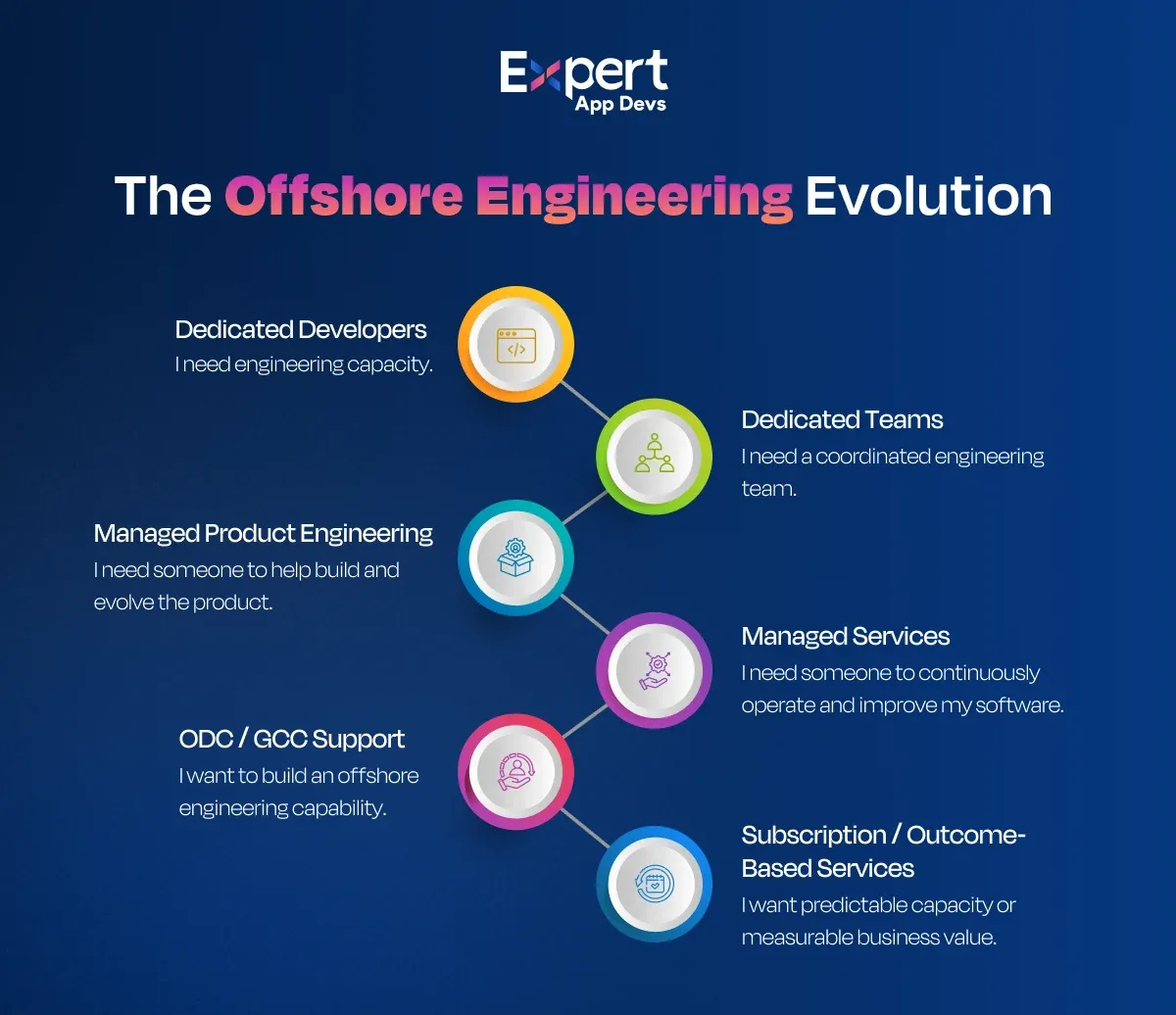
Hence, the offshore model has expanded from people to teams, products, operations and broader technology capabilities.
#1. Dedicated Developers
This model is a good fit when you already have an engineering team but need additional developers. You can hire developers with specific skills, such as Flutter, React Native, or Node.js, and have them work as an extension of your existing team. You continue to manage their tasks, priorities, and product roadmap, while your offshore partner takes care of hiring, HR, and operational support. It gives you the flexibility to add technical talent when you need it.
#2. Dedicated Teams
If you need more than individual developers, Hire a dedicated team can give you a complete set of skills under one engagement. Your team can include developers, UI/UX designers, QA engineers, and project managers based on your project needs. The team works closely with your business and follows your goals while handling development as a coordinated unit. This model is useful when you want to increase development capacity without hiring and managing every role separately.
#3. Managed Product Engineering
This model works well when you want an engineering partner to take greater responsibility for building your product. You share your business goals and product requirements, while the engineering team handles areas such as architecture, development, testing, DevOps, and delivery. It can be useful for building a new product, adding major features, or modernizing an existing application. You get a more complete engineering setup without having to manage every technical activity internally.
#4. Managed Services
Once your application is live, it still needs regular maintenance and technical support. Managed services give you an ongoing engineering team to handle updates, bug fixes, performance improvements, security patches, monitoring and other maintenance needs. This model is useful when you want to keep your application reliable and updated without building a separate support team. You can choose the level of support based on your application and business requirements.
#5. Fixed-Price Projects
A fixed-price model works well when your project requirements and deliverables are clearly defined from the beginning. You agree on the project scope, timeline, milestones and cost upfront, and the engineering team delivers according to the agreed requirements. This can be a suitable option for well-defined websites, applications, features or integrations. It is less suitable when requirements are likely to change frequently during development.
#6. ODC/GCC Support
If you want to build a long-term engineering presence in India, an ODC or GCC can be an option. An experienced engineering partner can help you set up and grow your offshore team while supporting areas such as hiring, operations, infrastructure and local processes. This model gives larger organizations a way to build their own technology capability while getting support with the practical challenges of establishing an offshore center.
#7. AI & Automation Services
If you want to add AI to your products or automate repetitive business processes, AI and automation services can help. You can work with an engineering team to build AI-powered features, integrate LLMs, create AI workflows, connect business data or modernize existing applications. This model is useful when you want to introduce AI into your software without building a specialized AI team entirely in-house.
#8. Subscription & Outcome-Based Services
This model is useful when you have ongoing engineering needs and want a more predictable way to access technical support. With a subscription, you can get a set amount of engineering capacity each month for development, maintenance or improvements. Outcome-based services can instead focus on clearly defined results and agreed metrics. These approaches can work well for businesses that need continuous support rather than a one-time project.
Comparing the Offshore Engineering Models
|
Model |
Primary Value |
Client Involvement |
Partner Responsibility |
Best Fit |
|
Dedicated Developers |
Add specific skills or capacity |
High |
Talent, HR and operational support |
Existing engineering teams |
|
Dedicated Teams |
Increase engineering capacity |
High |
Team coordination and delivery support |
Growing product teams |
|
Managed Product Engineering |
Build or modernize products |
Medium |
Engineering execution and delivery |
New products and major modernization |
|
Managed Services |
Ongoing application operations |
Medium |
Maintenance, monitoring and support |
Existing live applications |
|
ODC / GCC Support |
Build long-term engineering capability |
Strategic |
Setup, talent and operational enablement |
Large enterprises |
|
AI & Automation |
Improve workflows and introduce AI capabilities |
Medium–Strategic |
AI implementation and integration |
Mid-market and enterprise businesses |
|
Subscription / Outcome-Based |
Predictable capacity or outcome-focused delivery |
Varies |
Capacity or agreed outcomes |
Mature technology buyers |
Which Offshore Engineering Model Is Right for You?
There is no single offshore engineering model that works for every business. The right choice depends on your existing team, project requirements, level of involvement and the type of support you need. The following questions can help you narrow down the model that fits your situation.
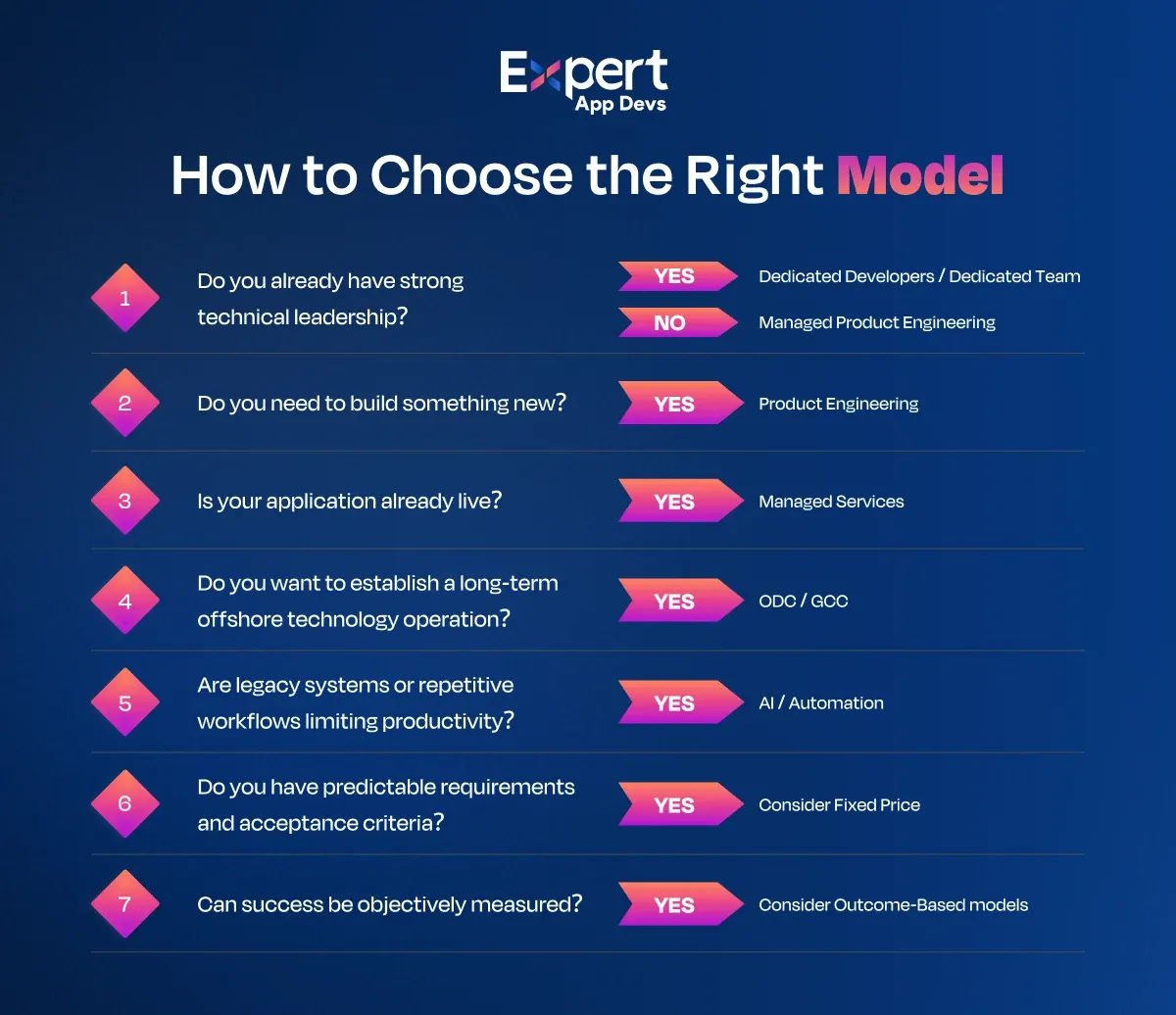
Do you already have strong technical leadership?
If you already have a CTO, engineering manager or technical team that can manage developers, Dedicated Developers or Dedicated Teams may be a good fit. You can add the skills you need while keeping product decisions and technical management in-house.
If you do not have enough technical leadership, Managed Product Engineering can give you greater support with planning, architecture and delivery.
Do you need to build something new?
If you are starting a new application, SaaS product or digital solution, Managed Product Engineering can help you manage the complete development process. You can share your business goals while the engineering team handles the technical execution.
Is your application already live?
If your application is already in use and needs regular updates, bug fixes, monitoring or performance improvements, Managed Services may be a better fit. It gives you ongoing technical support after the initial development is complete.
Do you want to build a long-term offshore technology operation?
If your goal is to build and scale your own engineering presence in India, consider ODC or GCC support. This approach is more suitable for businesses looking for a long-term offshore capability rather than support for a single project.
Are legacy systems or repetitive workflows limiting productivity?
If outdated systems are slowing your business down or your teams spend too much time on repetitive tasks, AI and Automation Services can help. You can use AI to modernize applications, automate workflows and improve existing processes.
Are your requirements clear and predictable?
If your project has a clearly defined scope, deliverables, timeline and acceptance criteria, a Fixed-Price Project can provide greater cost and scope clarity. It works best when major requirements are unlikely to change during development.
Can you clearly measure the expected results?
If you can define and measure specific results, you may consider an Outcome-Based Model. This approach works when both sides can agree on clear goals, measurement methods and responsibilities from the beginning.
What Should You Look for in an Offshore Engineering Partner?
Once you understand the different offshore models, the next step is knowing how to evaluate the companies who are offering offshore services.
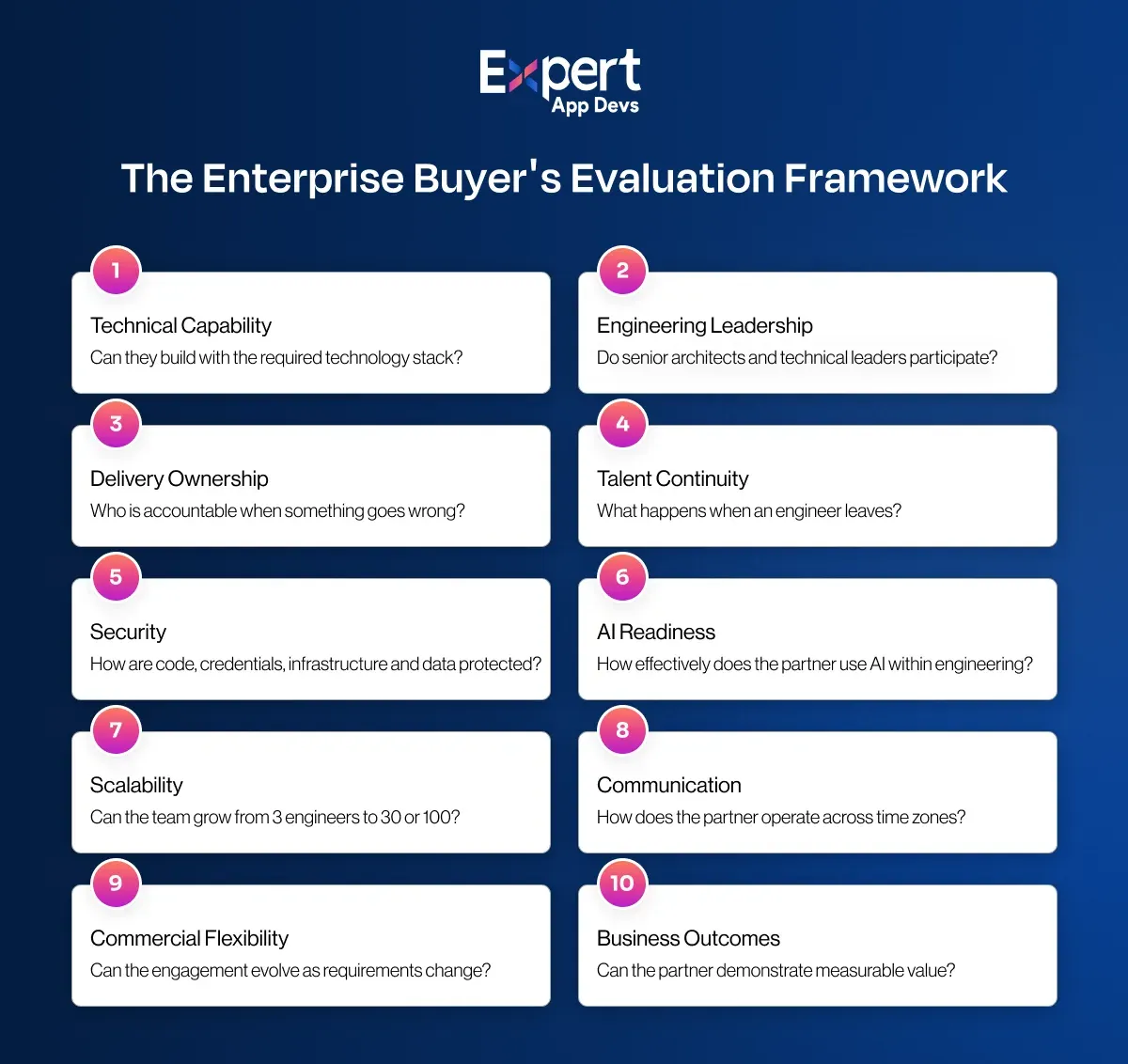
#1. Technical Capability
Start by checking whether the partner has experience with the technologies your project requires. Look at their experience with your technology stack, similar applications and the type of engineering work you need.
Ask: Do they have the right technical skills for my project?
#2. Engineering Leadership
Developers are important, but complex projects also need experienced technical leadership. Check whether senior developers, architects or engineering leaders are involved when important technical decisions need to be made.
Ask: Who will guide the technical direction of my project?
#3. Delivery Ownership
Be clear about who is responsible for planning, tracking progress, handling risks and solving delivery issues. The more ownership you expect from the partner, the more important this becomes.
Ask: If there is a major delivery issue, who takes responsibility for resolving it?
#4. Talent Continuity
People can leave, so understand how the partner handles employee changes. Ask whether they have a replacement process and how they transfer project knowledge when someone leaves.
Ask: What happens to my project if an important team member leaves?
#5. Security
Your engineering partner may have access to source code, business data, credentials and cloud infrastructure. Review how they protect this information and what security processes they follow.
Ask: How will my code, data, credentials and intellectual property be protected?
#6. AI Readiness
AI is becoming an important part of modern software development. Check whether the offshore developer you hire is knowledgeable regarding AI development, testing, documentation, automation and product features.
Ask: How can AI improve my development process or product?
#7. Scalability
Your requirements may change over time. A team must be able to expand skills and resources according to evolving business needs.
Ask: Can the team scale when my project needs more developers, QA, designers, or other specialists?
#8. Communication
Offshore teams often work across different locations and time zones. Check how they handle meetings, reporting, task updates and urgent communication.
Ask: How will our teams communicate and stay aligned during the project?
#9. Commercial Flexibility
Incase if there is a major change in the project which need engagement model changes. See whether the engagement can move from one model to another or the team size can be adjusted.
Ask: What happens if my project requirements or team needs change?
#10. Business Outcomes
Finally, also look beyond development activity and consider what the engagement is helping your business achieve.
Expert Quote
“Businesses should look beyond development cost and consider management effort, communication, cybersecurity, resilience, and supply chain risk. For automation, start with a clear business bottleneck and choose a partner that can integrate with existing systems, reduce repetitive work, and manage the solution after implementation.”
Teresa Tran, Chief Operating Officer, LaGrande Marketing
How Is AI Changing the Way Offshore Teams Work?
Offshore engineering is also changing with the growth of AI. As your business grows, this engineering partnership can expand to support more complex technology needs from adding developers to building complete products, managing engineering delivery, and supporting a broader offshore capability.
AI can support your team at different stages with various tasks
- Writing and improving code
- Finding and debugging issues
- Creating and automating tests
- Preparing technical documentation
- Supporting code reviews
- Automating DevOps tasks
- Organizing and accessing technical knowledge
- Analyzing product and user data
AI is not eliminating the need for developers; instead, it helps teams use offshore teams more effectively, save time by reducing repetitive work, and focus on complex problems, architecture, innovation, and product decisions.
What Will Offshore Engineering Look Like in the Future?
Earlier, the main reason to go offshore was mainly to fulfill the developers' needs, resources, skills, or manage the cost of development. But today, the decision can be much more detailed.
Here are some changes shaping the market:
#1. From Headcount to Capability
Businesses are now more concerned about what an offshore team can do than simply how many developers it can provide.
A company may need developers today, but later require QA, UI/UX, DevOps, architecture, product management or AI expertise. Hence, offshore partnerships must also fulfill additional requirements of the company.
#2. AI-Native Engineering
AI is everywhere today. Developers can use AI for coding and debugging, QA teams can use it for test generation and automation, and engineering teams can apply it to documentation, code reviews, and DevOps.
The important change is that AI has become a development process itself, rather than being treated as a separate service. At the same time, companies still need skilled engineers to review AI output, make technical decisions, and manage quality and security.
#3. GCCs Become More Strategic
GCCs(Global Capability Centers) are also changing. They are increasingly being used for product engineering, AI, analytics, R&D and global technology operations, rather than only for back-office or cost-saving work.
For enterprises, this means an offshore center can become a long-term part of the company's technology organization, with ownership of products, platforms and specialized capabilities.
#4. Hybrid Delivery Models
Today, businesses also have the flexibility to choose a hybrid model while working with offshore partners. They can combine different resources based on the work involved.
For example:
- Internal team: Product strategy and business decisions
- Offshore developers: Additional engineering capacity
- Dedicated team: Product development
- Specialist partner: AI, cloud or modernization
- GCC: Long-term engineering capability
- AI tools: Automation and productivity
This gives more flexibility to use the right combination of people, partners, and technology.
#5. More Focus on Business Outcomes
Enterprise focus is moved from hours worked/ number of developers to what is actually achieved. In short, businesses are more concerned about results and benefits like.
- Faster product releases
- Better application performance
- Lower cloud costs
- Successful modernization
- Improved automation
- Better customer experience
- Faster time to market
This does not mean every engagement needs outcome-based pricing. It simply means businesses are becoming more interested in creating value through offshore engagement.
#6. Security and AI Governance Become Part of Engineering
As offshore teams gain access to source code, cloud infrastructure, business data and AI systems, security cannot remain a separate consideration. Companies will increasingly need clear processes around access control, IP protection, data handling, AI usage, testing and compliance.
This is especially important as AI moves into real business workflows. The more responsibility an offshore team takes on, the more important governance, security, and accountability become.
A Practical Offshore Engineering Example
Let's understand in detail through this scenario. Imagine a global company that has been running the same mobile application for years. Its backend still depends on legacy systems, the internal engineering team is small, cloud expenses are increasing, and customer-support teams spend significant time handling repetitive tasks manually.
The obvious solution is to hire more developers. But the company does not have only a developer shortage. It has different engineering problems that require different capabilities.
|
Business Problem |
Required Capability |
|
Small engineering team |
Dedicated Engineering Team |
|
Aging application |
Managed Product Engineering |
|
Legacy backend |
Modernization expertise |
|
Rising cloud costs |
Cloud and infrastructure optimization |
|
Manual support workflows |
AI & Automation |
|
Ongoing application needs |
Managed Services |
Hence, they can create an engagement model and develop it in stages such as,
- Assess → Understand the current state
The engineering partner evaluates the application, architecture, infrastructure, security, technical debt and business processes. - Stabilize → Fix critical issues
The team addresses security gaps, infrastructure problems, reliability issues and high-priority technical debt. - Modernize → Build for the next stage
Legacy APIs, backend components, cloud infrastructure and application architecture are gradually modernized. - Automate → Reduce repetitive work
AI and automation are introduced into customer support and other repetitive workflows where they can create measurable efficiency. - Operate → Maintain and improve
Managed services provide continuous monitoring, maintenance, support, optimization and engineering improvements.
READ MORE: Agile Pods for Product Development
Final Buyer Checklist
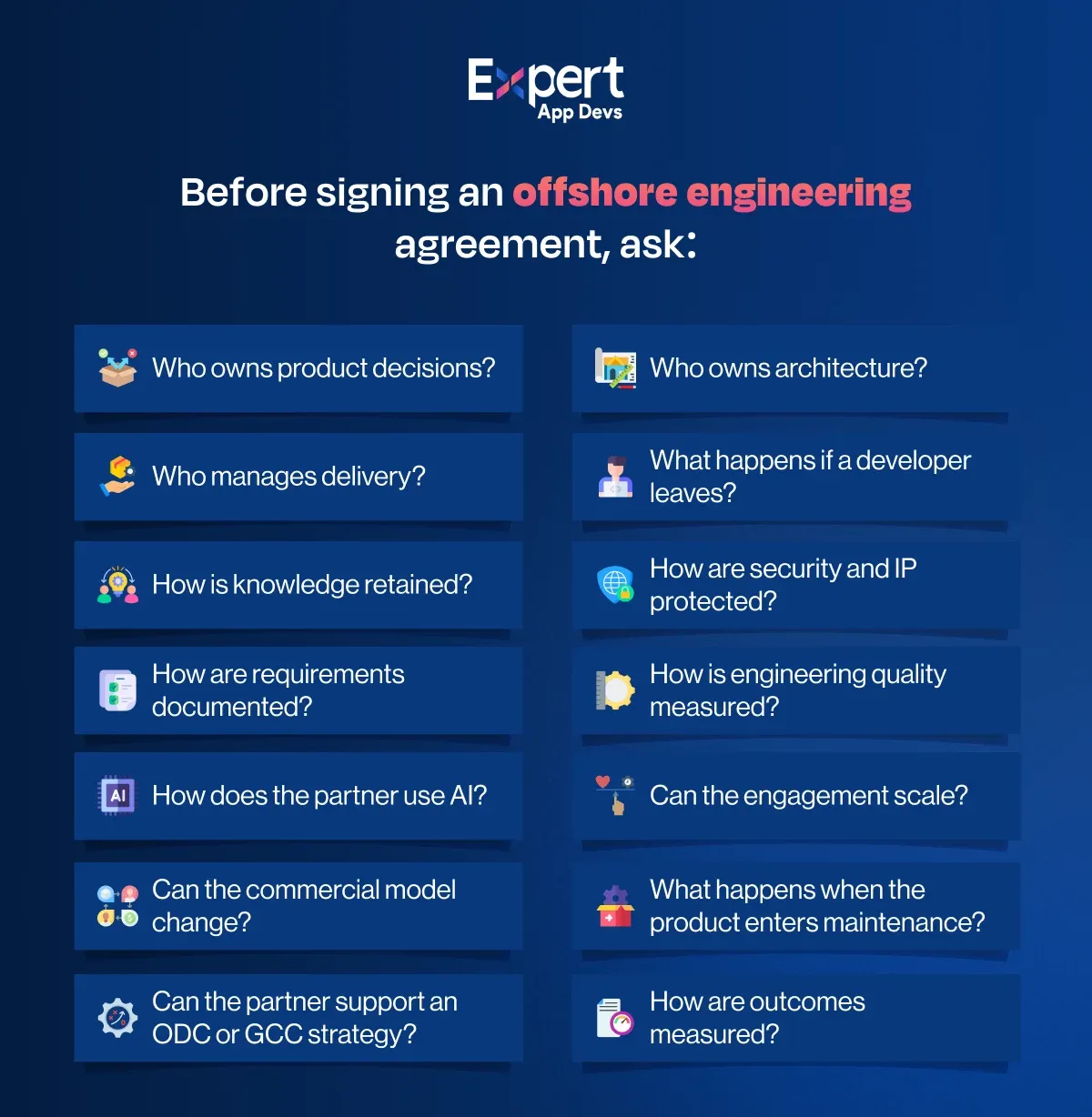
Before you sign an offshore engineering agreement, look beyond the proposed team and pricing.
- You need to understand exactly what you are getting, who is responsible for what, and how the relationship will work as your business grows.
- Start with ownership: who makes product and architecture decisions, and who is responsible for delivery? Then check continuity; if a developer leaves, how will knowledge be retained and transferred? Ask how requirements are documented and how engineering quality is reviewed.
- Security should also be clear. Understand how the partner protects your code, data, intellectual property and access credentials. Ask how AI is used during development and what controls are in place.
- Finally, discuss the future. Can the team scale when required? Can the engagement or pricing model change? Can the partner support ongoing maintenance, an ODC or a GCC strategy?
These questions help you evaluate whether an offshore partner can support your business beyond the initial project.
Conclusion
As we have seen throughout this guide, the right offshore engineering model depends on many factors apart from developers. Your business may need additional developers today, but might need an urgent, complete engineering team tomorrow. Hence, you should always choose an offshore partner that can support you throughout your changing needs. Consider your product complexity, technical leadership, risk, scale, AI readiness and long-term technology strategy before making a decision.
Not sure whether your business needs dedicated developers or a complete engineering team? Get Your Free Offshore Engineering Model Assessment. Talk to our experts for an Offshore Engineering Model Assessment and understand which model, capabilities, and next steps fit your business.




 206
206

 0
0


 177
0
177
0
 340
0
340
0
 289
0
289
0