



- Introduction: Why Software Outsourcing Is Changing
- #1. What Is an Agile Pod?
- #2. Why Traditional Outsourcing Is No Longer Enough
- #3. Agile Pods vs. Other Engagement Models
- #4. Agile Pod vs. Other Models: At a Glance
- #5. When Should You Build an Agile Pod?
- #6. A Simple Agile Pod Decision Framework
- #7. Agile Pod Models: Designing the Right Team Size
- #8. Product Ownership & Delivery Framework
- #9. Agile Delivery Process
- #10. Communication & Governance
- #11. Security & Compliance
- #12. Measuring Success: KPIs That Matter for Agile Pods
- #13. Growing from One Pod to Many
- #14. Agile Pod Cost Comparison
- #15. ROI of Agile Pods: Measuring the Business Impact
- #16. Common Mistakes When Building Agile Pods
- #17. Case Study: Applying the Agile Pod Model in Practice
- #18. Why Choose Expert App Devs for Agile Product Development?
- Frequently Asked Questions about Agile Pods
- Final Takeaway: Agile Pods Are About Ownership, Not Just Outsourcing
Ready to transform your vision into reality?
Get Started
Building Agile Pods: The 2027 Strategic Guide to Outsourced Product Ownership
 524
524
 2
31 Aug 2026
101 Min Read
2
31 Aug 2026
101 Min Read


 Share
Share

 Download PDF
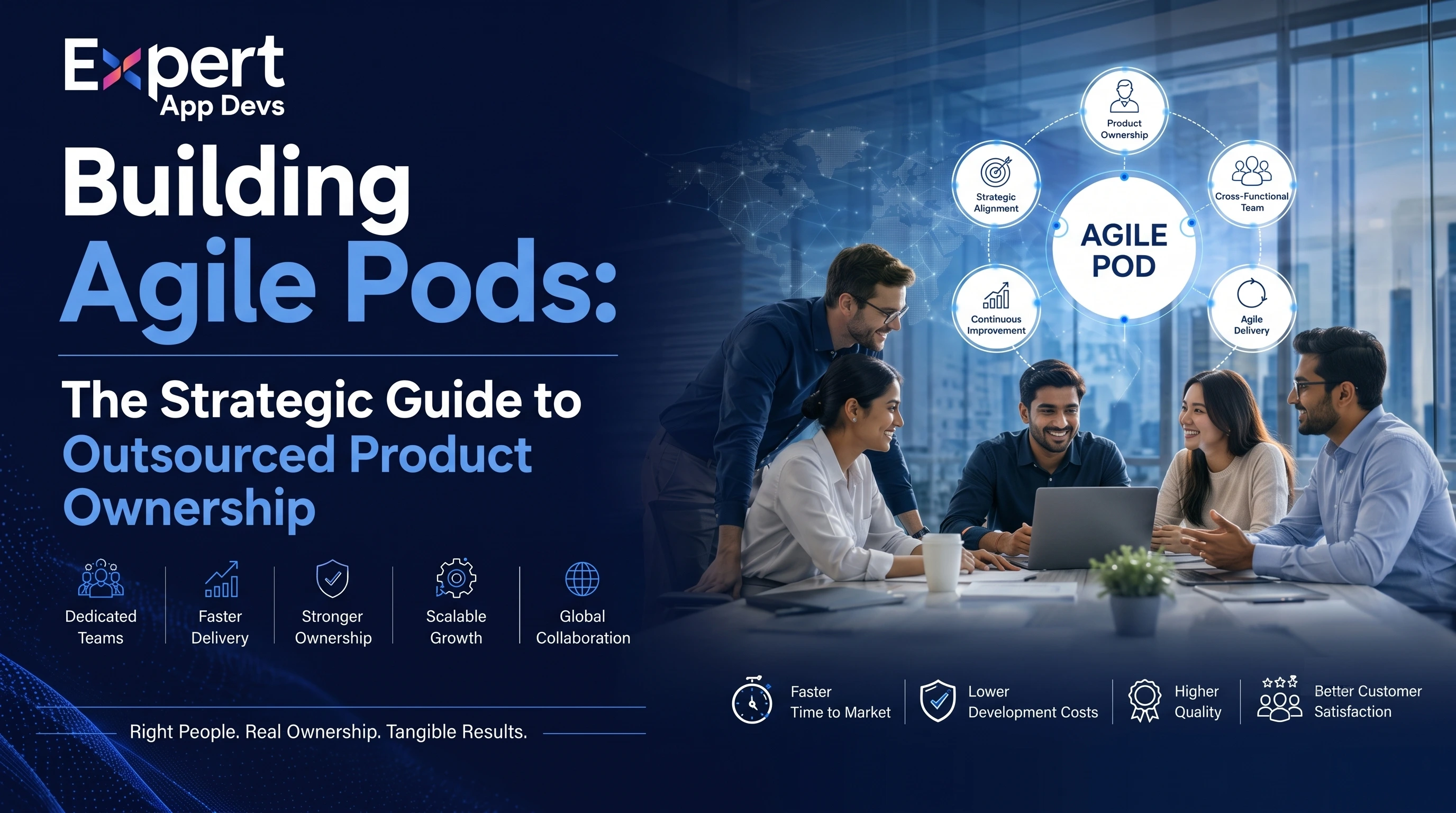
An Agile Pod is a lean cross-functional team responsible for product engineering that will have a dedicated focus on taking care of product, feature sets or business capability throughout the whole project lifecycle. Unlike classical outsourcing when a vendor might be hired for one project or to provide separate resources, an Agile Pod will unite the aspects of product ownership, engineering, design, quality assurance and delivery around measurable business outcomes.
Businesses are turning to Agile Pods due to the fact that modern software development needs continuity, quick decision making, profound knowledge of the product and possibility to grow engineering teams without bearing full organizational overhead of maintaining in-house resources. Outsourcing projects may cause communication gaps, knowledge loss, delays in handovers and lack of accountability.
An Agile Pod solves the above-mentioned issues with help of building a stable team which acts as an extended part of the client's product team. The benefits of this approach can be utilized by startups, SaaS businesses, enterprises that update their legacy systems and companies working on AI, marketplace, mobile or cloud products.
In terms of organizations considering Offshore Product Development, this solution will provide access to specialized engineering resources in addition to maintaining continuity of the product. The right pod may include Product Owner, Scrum Master, Tech Lead, developers, QA engineers, DevOps engineers, designers, business analysts, and other specialists depending on the needs of the product.
For those companies which are contemplating adopting the solution, the goal should not be about just outsourcing the development, but creating the capacity to create the product engineering capability which would plan, develop, test, release, measure, and improve the software continuously.
Introduction: Why Software Outsourcing Is Changing
Outsourcing of software is moving away from the typical approach when the project is outsourced to another software development company and all that remains is to wait until the deliverables are delivered. Technology products nowadays are evolving continuously. Customers' expectations are changing, there is continuous competition in adding new features fast, and security concerns are increasing.
It can be necessary to have more developers at first, but the actual need for the company will always go beyond: product knowledge, technical expertise, QA, DevOps, design, business analysis, and proper delivery. When these competencies are distributed among different vendors or subcontractors, it becomes impossible to have continuity with the product.
That is why an organization has to think about creating dedicated team setups like Dedicated Development Teams, Offshore Development Centers, and Agile Pods.
It matters a lot when it comes to products and not software development projects. Products always need constant attention. The backlog keeps changing. Priorities change. New technical issues arise after each release. Feedback affects the roadmap. It is necessary to deal not only with new developments, but also with technical debt. Security and infrastructure require attention too.
A conventional outsourcing model, which focuses on completion of predefined tasks, finds it hard to work in this environment.
Agile Pods are created based on the opposite approach: the team stays aligned with the product and its results.
Rather than continually building a new team for each project, the company builds a dedicated cross-functional team with clear roles. The pod can contribute in the areas of discovery, planning, development, testing, release, monitoring, and continuous improvement.
The 2027 Outsourcing Landscape
The context is the movement towards long-term product teams and new outsourcing models.
This requires for CTOs, CIOs, engineering managers, product managers and entrepreneurs that the issue of outsourcing isn’t about locating developers at a decent price per hour. But rather it is:
- Who owns delivery?
- How would you preserve the product knowledge?
- How soon can you change priorities?
- Who takes the technical decisions?
- How do you assess the quality?
- And how well would the team scale with the product?
And thus organization design becomes as significant as technical expertise.
Hence, an efficient offshore product engineering approach has to do much more than deliver developers.
This is where the importance of Agile Pods comes into play.
#1. What Is an Agile Pod?
An Agile Pod is a cross-functional team of software engineers built around a particular product, area of the product, feature-set or a business capability. The pod usually consists of several different disciplines, allowing the team to carry out projects from planning through delivery without overreliance on other departments outside of the team.
The composition of the pod varies depending on the product. An Agile Pod may include the Product Owner, Scrum Master, Tech Lead, frontend/backend engineers, QA engineer, DevOps engineer, UI/UX designer, and Business Analyst. In case of the use of AI within the product, there may be an AI engineer added to the team as well.
How an Agile Pod Works?
The principle behind Agile Pods is rather simple; one team for one product/business capability.
The Product Owner assists with the creation of the vision, prioritization, and management of the backlog. Engineering specialists work on converting priorities into technical solutions. Designers focus on user experience. QA ensures that the product works and its quality. DevOps deals with infrastructure, deployment, and operational issues.
Instead of approaching every role as a service, pod works in cooperation through the Agile delivery process.
Thus, companies receive a more interconnected model of operations.
For instance, when a SaaS company chooses to implement a new subscription feature, the pod can examine the requirement from several angles prior to development. The Business Analyst understands the requirements, the designer defines the user experience, the Tech Lead checks architecture, developers estimate implementation, QA thinks about validation, and DevOps examines deployment needs.
In other words, the pod will be able to make decisions as a whole unit, rather than having to wait for several disconnected suppliers.
Why Do Companies Use Agile Pods?
The main reason why companies use Agile Pods is continuity.
Such a team will have knowledge about the product, architecture, customers, technology stack, deployment environment, and business priorities. Such knowledge will be useful in minimizing the disruption that may arise when changing vendors or developers.
Furthermore, Agile Pods can be quite flexible. A company can start with a smaller pod and scale it up if the product becomes successful. For larger companies, it is possible to run several pods for different domains or products.
Thus, this approach can address both start-up-level product development and enterprise-level product engineering needs.
There is another very important advantage in this case; accountability. If the team is organized around a product or business goal, then its performance can be measured in terms of product delivery and other product-oriented metrics, not in hours spent on development.
And this difference does matter.
An effective outsourcing partnership is supposed to help the business to release better software faster, become more responsive to customers' needs, and develop engineering competence.
And this is what Agile Pod can do in the world of Agile Software Outsourcing.
#2. Why Traditional Outsourcing Is No Longer Enough
Traditional outsourcing allowed organizations to engage development resources, avoid the initial effort in recruiting them and finish software projects without forming their own significant engineering staff. However, the approach becomes problematic when the software development becomes not a project with a finite end but a product that should constantly be improved.
The most significant problem here is that traditional outsourcing is still project-oriented. Indeed, a typical outsourcing arrangement implies that the scope, timeline and deliverables are known in advance. It works quite effectively for a clearly defined application and a limited implementation timeframe. However, modern products are dynamic and rarely static. Requirements get changed by customer feedback, market dynamics, changing priorities and so on.
In other words, when the primary purpose of an outsourcing engagement is to deliver a predefined scope of work, the team has no incentives and motivation to look further.
Communication Becomes a Delivery Risk
Another common issue is communication. In cases where the client, project managers, developers, designers and QA resources work within different organizations, the information becomes fragmented.
There could be a requirement that moves from a business stakeholder to a project manager and then to a development team, and there will be an opportunity for misinterpretation. Also, time zones play a role in slowing down the process of communication and making decisions.
However, the real issue is not the geographical separation of the teams but the lack of the highly-integrated operating model.
Knowledge Loss Creates Long-Term Costs
Software products acquire knowledge as time goes on. Developers learn why some architectural decisions have been made, what areas of the application are fragile, how integrations function, and what customers expect.
In cases where there is a lot of resource turnover or project handoff, there will be a loss of knowledge.
Such knowledge loss leads to extra on-boarding activities and increased chances of defects, delays, and rethinking of technical decisions. With a stable team, one can keep the technical and product context in the course of development of the product.
Slow Delivery and Limited Product Ownership
Traditional outsourcing also causes delays in case any changes require further coordination, estimation, approval, and transition processes.
But even more important, the external team might be responsible for development work but lack proper product ownership. Developers could finish their tickets, but somebody should know why these features are necessary, what impact on the roadmap they have, and what trade-offs should be made.
It means that we can deliver software but miss the part of creating the right software.
Scaling Can Become Complicated
Scaling of the traditional outsourced project could include hiring more developers, revising contract terms, forming new teams or changing the scope. However, simply hiring more people does not always mean increased delivery capabilities.
Scaling of an Agile Pod looks quite different. Unlike hiring people, it forms a team, which has complementary skills and clear responsibilities, allowing it to increase capacity while keeping product context and cooperation.
Thus, the outsourcing approach should be shifted from “build our requirements” to “build our product with us continuously”.
It is one of the key aspects of outsourced product ownership.
#3. Agile Pods vs. Other Engagement Models
Not every company requires an Agile Pod. Each software development framework serves a particular business challenge and depends on a degree of ownership, collaboration, agility and scalability that the client requires.
The typical alternative solutions are freelance engineers, Staff Augmentation, Dedicated Development Team, Agile Pod, and Managed Services.
Freelancers
A freelance engineer is usually a good fit for a company when there is a specific need for a specialist's skills on a temporary basis. Freelancers can be flexible and do not require a long-term commitment to the organizational process.
But freelancers often offer individual capacity rather than full product engineering services. And the company still might need coordination of development, design, testing, project management, and infrastructure.
It may become a drawback for those products that require ongoing cross-functional delivery.
Staff Augmentation
Staff Augmentation gives an opportunity to augment the client's team with additional external developers or specialists. Such a solution will work well when a company already has good product leadership and engineering processes internally but needs more capacity.
For instance, an engineering manager needs three extra backend developers for six months to speed up a significant release.
The benefit here is flexibility. The disadvantage here is that ownership does not change hands and stays within the client's internal organization. External resources provide additional capacity but do not necessarily create an independent product team.
Dedicated Development Teams
Dedicated Development Teams offer a somewhat more stable engineering team setup over time. Instead of adding resources on demand, the company works with the dedicated development team and specialists who stay committed to the product.
This approach can be especially helpful when it comes to long-term software development projects that require retaining engineering expertise.
However, the degree of product ownership can still differ. The dedicated team will implement requirements provided by the client's internal product team, while an Agile Pod will focus explicitly on delivering a product.
Agile Pods
Agile Pod takes the next step towards providing both continuity of team members and product-oriented ownership and cross-functional collaboration.
Pod may include all the skills needed for moving tasks from discovery to development, testing, implementation, and improvements. Instead of just having developers in place, it creates a product engineering team.
This is why Agile Pods become very relevant in cases where a company seeks to hire an external team that acts as an extension of their internal product team.
Managed Services
Managed Services typically concentrate on providing and sustaining certain services or capabilities. They can be useful for managing infrastructure, maintaining applications, providing support, monitoring, or any other technical activities.
Their main goal is often the reliability and performance of the service, not the discovery and delivery of new product features.
#4. Agile Pod vs. Other Models: At a Glance
|
Model |
Cost |
Flexibility |
Ownership |
Team Collaboration |
Scalability |
Best Use Case |
|
Freelancers |
Low |
High |
Low–Medium |
Low |
Medium |
Small tasks or specialist work |
|
Staff Augmentation |
Medium |
High |
Client-led |
Medium |
High |
Adding capacity to an existing team |
|
Dedicated Team |
Medium–High |
Medium–High |
Shared |
High |
High |
Long-term product development |
|
Agile Pod |
Higher |
High |
High |
Very High |
High |
Product ownership and continuous delivery |
|
Managed Services |
Variable |
Medium |
Service-led |
Medium |
High |
Ongoing operational services |
In summary, what matters here is not just the price point.
Where the accountability lies and how the team operates become critical at play here.
Staff Augmentation could very well be enough if the only goal is to get more developers. In case a client wants a reliable development capacity in the long run, a Dedicated Development Team would be a good choice. And if an organization needs a holistic team, which would be able to make an impact within the product decision-making and take full responsibility for delivery, the Agile Pod solution makes even more sense.
This way, CTOs and product owners will avoid a typical mistake of many outsourcing projects - choosing the right hiring model depending on the number of people and hourly rate, but not on the needed level of ownership.
Agile Pods vs. Other Engagement Models: Choosing Based on Business Need
The optimal approach to choosing an outsourcing model is to start with the business issue itself, not with the staffing model. A firm which requires temporary engineering resources will have another problem from a company starting a SaaS application or revamping an existing enterprise-level solution.
That is why comparing Agile Pods with other models based on hourly rates alone is misleading.
In reality, when comparing engagement models, one has to take into account such criteria as cost, flexibility, ownership, cooperation, scalability and complexity of the product.
For instance, a start-up having a technical co-founder will require more developers for a certain release. Staff Augmentation would work well in this case. Ownership of the product remains in-house, whereas the external developers expand execution capacity.
But in the case of a rapidly developing SaaS company, there might be a need for a stable team aware of product roadmap, customers' demands, architecture, testing, deployment, and constant improvement of the solution.
It is all the more important in cases where product ownership is part of the requirement.
Where the organization prefers retaining full ownership of requirement definition while outsourced only development activities, then a traditional dedicated team makes more sense. Where the organization requires a cross functional external team which can help in planning, decision making, delivery, and continuous improvement, then a strong case is made for an Agile Pod.
Cost Should Not Be the Only Decision Factor
An Agile Pod may seem to be more costly as compared to a freelance individual developer or even a couple of developers who could have been engaged under Staff Augmentation Model. The comparison shifts completely in favour of an Agile Pod when the organization takes into consideration the entire delivery process.
It allows for bringing different skill sets on a single platform rather than forcing the client to coordinate different developers, QA staff, designers, DevOps, and project coordination separately.
It is not about minimizing the cost of development then.
It is about optimizing the delivery capacity and other aspects of the same.
This makes Agile Pods all the more suitable for organizations where delays, lack of knowledge transfer, poor quality, and fragmentation of ownership result in more financial risks than the disparity in the pace of development.
#5. When Should You Build an Agile Pod?
The concept of the pod is most relevant if your software development process is not a one-off but an ongoing process. It may be considered for implementation if you have a need for a reliable and cohesive team that will be aligned with your product vision for a prolonged period of time.
This approach will work particularly well for start-ups, SaaS companies, AI solutions, marketplaces, enterprise software, digital transformation, and modernization projects.
Start-up Growth
When working on a start-up, it is often hard to keep the balance between speed of progress and engineering costs. Establishing an internal engineering department may require quite substantial expenses related to hiring, building infrastructure, management and retaining talent.
Using the concept of the pod, you will get a ready product engineering solution without having to give up strategic control over your product.
The pod can grow with the business as well; additional software developers, QA professionals, designers or DevOps professionals can be added as needed.
SaaS Products
There is very little final development with SaaS products. There will always be more features to add, new integration possibilities, better security, improved performance, customer requests and infrastructure needs.
Thus, SaaS products present a perfect scenario for the application of Agile Pods.
With a consistent team, there is institutional knowledge built up around the application and product backlogs can be consistently worked through, without needing to repeatedly on-board new vendors for each release.
AI Applications
It is common for AI products to require many technical skills. Software engineers, AI engineers, data experts, frontend developers, QA, cloud infrastructure and product management can all be required based on the AI product that is being created.
The Agile Pod model allows you to bring all these different capabilities together in one team cantered on the AI product or use case.
In particular, this is useful when AI functionality is to be integrated into an existing software product, not just done as an experiment.
Marketplace Platforms
Products in marketplaces require a combination of experiences like buyers, sellers, admins, payments, search, notifications, logistics, analytics, and integrations.
A change in one experience will likely impact multiple users.
Consistent and cross-functional pods can assist in keeping coordination between these product areas and continually prioritizing changes based on the needs of the business and customers.
Enterprise Software
Enterprises tend to have complicated technology ecosystems, many stakeholders, governance, and integration needs.
Pods may be formed by domains or product capabilities that allow enterprises to scale up their ability to deliver without having to reorganize their engineering organization internally.
Pods can collaborate together using consistent architecture, security, DevOps, and governance principles.
Digital Transformation
Digital transformation projects typically involve automating manual processes, upgrading legacy applications, adopting cloud-based platforms, and implementing digital customer experiences.
These initiatives might take several years instead of just several months.
An Agile Pod offers a consistent team that can retain context throughout the transformation rather than sharing context among project teams constantly.
Legacy Modernization
More than mere rewriting is involved in legacy modernization. It requires an understanding of legacy architecture, dependency, business rules, integration, technical debt, and operational risks, all at the same time that one constructs the replacement architecture.
A specialized Agile Pod can be key to this process.
The team can iteratively modernize components, add new services, improve test and release practices, and deal with technical debt, while maintaining business continuity.
#6. A Simple Agile Pod Decision Framework
There are five basic questions that can guide leadership decisions before the model selection:
- Does the product evolve continuously?
If requirements and priorities are constantly changing, then the best model will be an ongoing product team rather than project-based outsourcing.
- Do we require cross-functional capabilities?
If development, testing, design, Dev-Ops, business analysis, and product coordination need to cooperate, the Agile Pod can eliminate duplication.
- Is the product knowledge strategic?
If the loss of the technical and business context poses any considerable risks, team continuity becomes a critical issue.
- Is the engineering requirement expected to expand?
If it is expected that the product will require more capability in the future, a scalable pod approach could be more efficient than hiring individual resources each time.
- Is it necessary to have stronger ownership from the external team?
If the aim is not just to complete tickets but to accomplish concrete product goals, then an Agile Pod might be the right operating model to use.
Agile Pod Decision Chart
Need just a couple of specialists for a temporary assignment?
→ Hire Freelancers
Already have a product team internally but require additional development capability?
→ Hire Staff Augmentation
Require a stable external engineering team for development in the long run?
→ Hire Dedicated Development Team
Require a cross-functional team that aligns with product goals and delivery?
→ Hire an Agile Pod
Need the operation and maintenance of a particular technical service?
→ Hire Managed Services
It boils down to one critical decision:
Is it people, development capacity, or product development responsibility that is being outsourced?
In cases where the key is primarily in people or capacity, a more straightforward engagement model will work fine. But if the goal is to create a fully functional external team that will serve as a long-term extension of the product organization, then an Agile Pod would become a much better strategic choice.
Is an Agile Pod Right for Your Business?
An Agile Pod could be the right choice for your business if it:
- has a product that needs constant development
- needs several technical disciplines to work in concert
- needs to preserve the continuity of product and organizational knowledge
- needs to grow its engineering capacity without forming an entire team in-house
- anticipates changing requirements and priorities
- needs more clarity in delivery responsibilities
- considers a long-term offshore product development in the pipeline
- needs a scalable model for future engineering growth.
If most of these factors apply, then the conversation about whether you need more developers changes to a discussion about product engineering capability that is required.
Anatomy of an Agile Pod: Roles, Responsibilities, and Team Design
It is not the number of people that makes an Agile Pod effective but the presence of all product, engineering, design, quality, and delivery competences on the team. The properly assembled Product Engineering Team must be able to deliver requirements through development, testing, deployment, and continuous improvement without creating excessive dependencies on other external teams.
The actual make-up of the team will depend on the complexity of the product, technology stack, its maturity level, and business needs. A start-up developing an MVP may have a small team, whereas a large enterprise platform may require multiple pods.
Product Owner
Product Owner bridges business goals and engineering efforts. This function includes keeping track of product vision, maintaining backlog, defining requirements, prioritizing features, and making sure that the team works on the most valuable tasks.
In case of outsourced product development, strong Product Ownership is crucial as it keeps engineering efforts from losing the business context.
The Product Owner does not only delegate tasks to the team members. It is the task of the role to be able to answer a crucial question: what should be developed next and why?
Scrum Master
The Scrum Master supports the team in delivering the project in an agile manner and helps the team to establish its working rhythm.
This can include facilitation of ceremonies, resolution of blockers, better collaboration, process improvement, and everything else that is necessary.
In case of an offshore Agile Pod, the Scrum Master may also be helpful in reducing friction during the communication between the client organization and the team.
Tech Lead
The Tech Lead helps with setting up the right technical course in order to provide a proper implementation in the future.
This includes such things as architectural decisions, code quality, technical standards, integration strategy, performance aspects, developer mentoring, etc.
A good Tech Lead can help in finding the balance between implementation speed and technical soundness. Otherwise, fast feature implementation can lead to growing technical debt.
Frontend Developer
Frontend Developers develop user interfaces based on product requirements and designs.
The roles include application interfaces, responsive design, frontend architecture, performance, accessibility, and integration with backend services.
The required frontend skills will depend on the particular product.
The web application, the enterprise-level platform, the SaaS solution, and the customer-facing portal might all involve different technologies and architectural considerations.
Backend Developer
Backend developers implement the services and systems behind the application core functionality.
The work of backend developers includes APIs, databases, authentication, business logic, integration, data processing, and backend architecture.
In the case of products with sophisticated business rules and many transactions, backend engineering becomes a key part of the technical stack of the pod.
Mobile Developer
If the product requires mobile or cross-platform applications, the Mobile Developer role will be added to the pod.
The responsibilities might include mobile architecture, mobile application development, API integration, performance, compatibility with devices, security, and app store release process.
The inclusion of this role depends on whether the mobile applications are a core component of the product development strategy.
QA Engineer
Quality assurance should not be considered a last step before release.
A QA Engineer is involved during the entire development lifecycle to discover defects, verify requirements, design test strategies, and contribute towards setting up release processes.
In accordance with the nature of the product, the tasks performed by QA engineers may include functional testing, regression testing, integration testing, automation, performance testing, etc.
Integration of QA into the pod allows collaboration between developers and QA testers rather than discovering critical problems only at the end of the sprint.
DevOps Engineer
A DevOps Engineer provides support for systems necessary for building, deploying, operating, and monitoring the product.
The job description may consist of CI/CD pipeline, cloud infrastructure, environment management, deployment, observability, infrastructure security, and operational reliability.
DevOps capabilities can have an important impact on the pace of release process for frequently released products.
UI/UX Designer
A UI/UX Designer is responsible for transforming product functionality into an intuitive user experience.
The responsibilities can consist of user research, information architecture, wireframes, prototypes, interface design, usability factors, design systems.
Design inclusion into the pod allows making sure that decisions regarding user experience are aligned with product and engineering needs.
Business Analyst
A Business Analyst assists in translating the business objectives into meaningful requirements.
Such activities can include stakeholder meetings, process modelling, documenting requirements, acceptance criteria, workflows, and explanation of complicated business rules.
It is especially helpful for enterprise-level products where the requirements will have to involve several departments and stakeholders.
AI Engineer
An AI Engineer is an additional role that can be included in the case the product includes any machine learning, generative AI, intelligent automation, recommendation, or predictive features.
It is not a mandatory role; its inclusion needs to depend on the real architecture of the product.
#7. Agile Pod Models: Designing the Right Team Size
There is no one-size-fits-all Agile Pod model. The right model depends on product maturity, technological complexity, delivery expectations, and the amount of business capabilities being built.
Start-up Small Pod
For a start-up, a small cross-functional team working on building the product can be considered.
Some examples of team roles include:
- Product Owner
- Tech Lead
- Frontend Developer
- Backend Developer
- QA Engineer
- UI/UX Designer
Some of these roles can be part-time or can overlap depending on the product.
In the case of a start-up, it is not about building a massive company but rather building the right product and engineering capabilities that would allow the start-up to act fast while keeping the high-quality standards.
Pod can focus on MVP creation, product-market fit, core architecture, and initial user feedback.
Growing Company Growth Pod
As the product grows users and gains traction within the business, engineering needs tend to increase in complexity.
Examples of a growth pod are:
- Scrum Master
- Additional frontend/backend developers
- Automation for QA
- DevOps Engineer
- Business Analyst
- Mobile Developer
- Additional design roles
At this point, the focus is not just about developing new features but also about building a scaling delivery system.
It means managing more backlogs, multiple product initiatives, automation, observability, engineering practices, etc.
Enterprise Multiple Pods
Organizations might need several pods to run simultaneously.
Rather than having a huge development pod, an organization can have pods based on product, business capabilities, or technical areas.
In this case, an enterprise platform would be made up of distinct pods covering:
- Customer Experience
- Payments
- Identity and Authentication
- Analytics
- Mobile Applications
- Internal Operations
Each pod will be able to maintain its own backlogs and delivery responsibilities according to enterprise standards.
It may promote better ownership as there is an identifiable area of ownership for each team.
Large Enterprise: Platform + Domain Pods
The most expansive setup would include both platform engineering and domain-based Agile Pods.
The Platform Pod can offer shared services such as cloud infrastructure, DevOps, security architecture, observability, developer tools, and other services.
It helps to avoid the scenario where all product teams independently build out the same infrastructure and technical capability.
The outcome would be an ecosystem for scalable product engineering where each pod maintains their independence but the architecture, security, and engineering standards are coordinated.
Designing for Scale
The basic idea is that teams need to be scaled according to product boundaries, not just added to existing teams.
Indefinite additions of developers to one pod might also lead to increased communication load and unclear ownership. The solution is to create more pods when the product includes several autonomous domains or when the current team becomes too cumbersome due to coordination needs.
The goal here is to maintain the benefits that make Agile Pods so efficient: clear ownership, collaboration, product knowledge and rapid decision making.
#8. Product Ownership & Delivery Framework
Creating an Agile Pod is just one part of the process. What matters is creating a framework for product ownership and delivery, which ensures alignment of the team with business goals. Otherwise, even the most talented offshore product engineering team will work only on tickets.
Product ownership is the mechanism through which business strategy and engineering decisions are integrated.
Product ownership tells the team what needs to be built, why it’s needed, what priorities should apply, and when it should be delivered.
In the case of an outsourced Agile Pod, the importance of this framework becomes even more apparent as both the client and the external team need to act like one product organization.
Product Vision
Each Agile Pod should have a product vision.
Product vision defines the problem that the product solves, its customers, and what business impact the organization is seeking. The vision provides context for the engineering decisions and avoids feature-focused silo thinking.
Having such a vision is also useful for the Product Owner in terms of making hard prioritization decisions, as the team will know what criteria to use in order to prioritize the different requests made by various stakeholders.
That means that everyone on the Pod should have this knowledge, not just the Product Owner.
Backlog Management
The product backlog transforms the product vision into executable work.
It includes features, enhancements, technical requirements, bugs, research tasks, and any other work that needs to be done to progress with the product. Nevertheless, it should not turn out to be a mere list of all requests of stakeholders ever made.
The Product Owner has to keep on top of it and prioritize it all.
The requirements should be clear enough for the development team to know what result it is supposed to achieve, how to accept it, what dependencies it has, and what business value it has. The backlog should be flexible to change in accordance with newly available data.
Sprint Planning
Sprint planning turns priorities into a feasible commitment to deliver.
The Agile Pod analyses high-priority backlog items, assesses their technical complexity, dependencies, and decides what it can realistically deliver in the sprint.
The Tech Lead and developers bring technical expertise, QA takes care of testing considerations, and the Product Owner brings business perspective.
This way, it results in a common understanding of what the team wants to do, not task assignment to developers.
Priority Management
Product priorities should take into account impact on the business, customer needs, technical risks, and company’s strategy.
Not all requested features need to be developed immediately.
A good Product Owner may have to balance revenue and technical debt, customer experience and infrastructure projects, etc. This is especially important in case of outsourced development when the external vendor needs to have sufficient product knowledge in order to understand the reasons behind the changed priorities.
Stakeholder Communication
Stakeholder communication aligns executives, product management, engineering, and other business areas.
Agile Pod should deliver visibility of progress, risks, dependencies, planned releases and other relevant information. It does not mean involving all stakeholders into each technical decision.
Transparent communication is one of the cornerstones of the trust-based offshore product development process.
Release Planning
Release planning aligns sprint execution with overall product goals.
The team should know which capabilities need to be delivered, what are the dependencies, quality requirements and relevant release milestones.
There should always be some flexibility when it comes to the release plans. If there are changes in the customer feedback or the market situation, there should also be changes in the roadmap.
#9. Agile Delivery Process
The mature Agile Pod must work within a repeatable lifecycle of delivery instead of viewing development as a list of separate activities.
The full delivery workflow recommended is:
Discovery → Planning → Development → Testing → User Acceptance Testing → Deployment → Monitoring → Continuous Improvement.
1. Discovery
The process starts with defining the business challenge.
The team defines the requirements of users, the business goals, any technical limitations, dependencies and possible risks. In case of complex requirements, discovery may include stakeholder interviews, technical research, prototypes and feasibility studies.
The goal is to reduce the level of uncertainty before committing engineering resources to the challenge.
2. Planning
After the requirement is defined, the pod decides on how to deliver it.
Tech Lead will be able to consider architectural implications while the Product Owner takes care that they align with business needs.
3. Development
The development phase transforms the validated requirements into operational software.
Given the nature of cross-functionality of the pod, developers are able to interact with designers, QA engineers, business analysts and product owners directly.
This will eliminate long handovers and facilitate prompt question clarification during the implementation process.
Code reviews, coding standards, testing, and version control are supposed to be parts of the engineering process instead of quality activities.
4. Testing
Testing will help to ensure that the developed software works as required and no regressions were made during the development process.
QA engineers will be able to conduct functional and regression testing while automation can be used in repeatable cases.
It will be better to conduct a testing process continuously during development when it is possible. It is always better to detect defects earlier rather than right before releasing.
5. User Acceptance Testing
The User Acceptance Testing (UAT) checks that the delivered functionality meets the business requirements.
A feature may pass the tests and still fail to address the business issue for which it was built. UAT offers stakeholders a chance to verify the real result prior to production deployment.
6. Deployment
Once the release fulfils the set requirements and passes quality criteria, it is ready for deployment.
With DevOps and CI/CD automation, deployment becomes more predictable and consistent. Based on the product type, teams may apply various strategies for controlled release like staged deployments, feature flags, canary deployments, etc.
7. Monitoring
Deployment does not signify the end of delivery.
Teams have to monitor application performance, infrastructure health, errors, availability, security events and other metrics.
In case of customer-facing products, users' activity and feature performance can be tracked as well.
8. Continuous Improvement
The last step brings knowledge gained to the next product development cycle.
Improvements can come from customers' feedback, production metrics, support tickets, observations, team's retrospectives, etc.
It starts a continuous improvement loop:
Build → Release → Measure → Learn → Improve → Repeat
The continuous improvement loop is one of the key differences between product-oriented Agile delivery model and project outsourcing.
In order for an Agile Pod to be successful, it does not only deliver the software according to an initial specification, but continually evolves the product based on evidence.
Building an Outcome-Oriented Delivery System
The pairing of product ownership and Agile delivery creates a framework where business priorities stay aligned with engineering execution.
Product Owner identifies what creates value. Agile Pod figures out how to deliver that value. QA ensures quality. DevOps ensures reliable delivery. Stakeholders ensure business relevance and feedback. Monitoring provides evidence of what happens post-deployment.
This common framework is the key enabler of an outsourced team being able to act as a true extension of the client’s product organization as opposed to being just another outsourcing vendor for ticket-based operations.
#10. Communication & Governance
An Agile Pod can operate as an extension of the client’s product organization only if communication and governance are thoughtfully designed. That becomes even more critical for Offshore Product Development where teams might operate in different countries, time zones, organizational frameworks, and communication cultures.
The goal is not to add more meetings.
Daily Stand-Ups
Daily stand-ups offer a brief and specific chance for the Agile Pod to coordinate.
Participants can talk about their progress, ongoing priorities, obstacles, and interdependencies. It is important to keep the focus on coordination and avoid detailed status reports.
For distributed teams, daily stand-ups offer a predictable communication routine that decreases the chances of the team working under false assumptions.
Sprints
Sprints, specifically planning, reviewing, and retrospect, form an agile governance cycle.
Sprints help the team align around future tasks, sprint review allows stakeholders to see how the functionality has been developed and give feedback on it, while retrospectives help improve processes, communication, and engineering.
This set of meetings allows for forming a feedback loop between delivery and governance.
Documentation
The question of documentation becomes especially acute for remote teams.
Critical decisions regarding the product, technical architecture, requirements, acceptance criteria, API data, and procedures for deployment and operation have to be available in accessible documentation systems.
Such documentation will decrease dependency on certain employees and reduce risks of loss of knowledge during team members' rotation.
Moreover, it will serve as an agreement basis for stakeholders when the need for decision-making appears.
Collaboration Tools
An Agile Pod usually needs tools for source code management, project tracking, documentation, communication, design collaboration, and incident management.
The specific set of tools can differ. The key aspect is that the company should have defined guidelines on where information will be stored.
For instance, an important decision regarding the product must not reside only in a personal chat conversation. It must be moved to appropriate documentation or project management systems so that other members of the team can see the background.
Collaboration across Time Zones
Time zones can be both the delivery advantage and the governance challenge.
In the case of poor management, a team can spend several hours waiting for the answer to quite simple questions. In case of proper management, overlap time zones can be utilized for collaboration, while asynchronous hours are dedicated to development.
One possible way to solve this is to define overlap hours for discussions and decisions, and documentation of non-urgent communication.
It is also worth defining escalation scenarios for critical issues that require urgent resolution.
Governance and Stakeholder Visibility
Governance is about providing leaders with necessary visibility but not creating extra bureaucracy.
The CTO, CIO, or product managers need to know:
- What is being delivered?
- What will be delivered next?
- What are the risks or blockers?
- Whether quality is getting better or worse?
- What decisions need leadership involvement?
- Whether the delivery is consistent with organizational goals?
This will provide visibility without making the executives involved in individual engineering tasks.
Thus, the optimal approach will balance autonomy and accountability.
#11. Security & Compliance
Security should be built into the operating model of the Agile Pod right at the beginning and not as part of a review phase.
This is especially true for those companies that use offshore engineering teams as source code, infrastructure access, business knowledge, customer data and intellectual property can be spread out between various environments.
There are many security and compliance aspects, among which are NDA, IP Ownership, Secure Coding, GDPR, SOC 2, ISO 27001, Code Security, and Cloud Security.
Non-Disclosure Agreement (NDA)
A NDA can define the contractual requirements regarding business and technical confidential information.
Before sharing product documentation, source code, customer data, or any proprietary processes with an external Agile Pod, appropriate confidentiality requirements must be put in place.
The NDA needs to become one of the components of a secure environment and not be perceived as a sole security measure.
Intellectual Property Ownership
IP ownership must be explicitly stated in the commercial contract.
It is crucial for the organization to know who owns source code, documentation, design, technical materials, etc., created throughout the cooperation period.
Any ambiguity regarding intellectual property may result in significant risks in the future especially if the product becomes commercially viable and the relation with the outsourcing partner changes.
Secure Coding
Security considerations must be included in routine development activities.
They may consist of proper authentication and authorization, input validation, secrets management, dependency management, code review, and vulnerabilities detection.
Security requirements must be taken into account when adding new features are discussed, not just prior to delivery.
GDPR and Data Protection
Products that process personal information belonging to individuals governed by the General Data Protection Regulation (GDPR) must have development and operational processes that incorporate any pertinent data protection considerations.
The Agile Pod needs to know which data can be accessed, how it should be processed, and what security and privacy controls will be necessary.
Depending on the organization's situation, there will be different compliance requirements.
SOC 2
The SOC 2 certification becomes relevant for organizations that need assurance about controls related to aspects like security and others that fall under the trust services domain.
For organizations considering an outsourced partner, having assurance over the controls of the provider could become one of the factors during the vendor selection process.
Nevertheless, certification or compliance should not substitute security assessment made by the organization.
ISO 27001
The ISO 27001 certification helps organizations implement an Information Security Management System (ISMS).
In the case of selecting an Agile Pod provider, organizations might want to evaluate whether the provider implements the SMS framework.
It is especially important for companies that have formalized vendor risk management processes.
Code Security
Source code needs to be secured with proper access controls and secure development processes.
Organizations need to implement the least privilege approach whereby users get access that is necessary for their tasks only.
Source code repositories, credentials, build pipelines, dependencies, and development environments are also part of the organization’s security perimeter.
Cloud Security
Modern Agile Pods usually use cloud infrastructure; thus, cloud security becomes a crucial aspect of the delivery process.
Access management, identity controls, environment isolation, secrets management, monitoring, logging, backup approaches, and infrastructure configurations need to be managed as part of the product’s engineering lifecycle.
DevOps and security processes need to become aligned and not remain two independent domains.
Security as a Shared Responsibility
Outsourced product development does not allow transferring all the security responsibilities to an external organization.
It is necessary to define responsibilities in terms of access control, infrastructure, data management, application security, incident response, and compliance.
Responsibility for Security
For outsourced product development, security can’t be offloaded to the external organization.
The client and Agile Pod need to define their roles in relation to access governance, infrastructure, data handling, application security, incident response, and compliance.
The best way forward is to incorporate security into the product engineering workflow from discovery all the way to deployment and monitoring.
This makes security not a check point but a part of engineering work.
#12. Measuring Success: KPIs That Matter for Agile Pods
It doesn’t make sense to judge an Agile Pod by the number of developers in it or by billable hours. Instead, it is better to judge it based on whether the team delivers more quickly, produces higher-quality code, adopts products faster, and produces results.
There are several KPIs that can be used to assess the performance of Agile Pods, such as sprint velocity, lead time, release cadence, bug rate, customer satisfaction, retention, and feature adoption.
These measurements need to be considered as a whole. There isn’t any single KPI that will give you an overview of how well your product engineering is doing.
Sprint Velocity
Sprint velocity shows how much work was planned to be done by a team within one sprint and calculated according to the estimation technique that the team uses.
This measurement can help both the Product Owner and engineering management to assess the capacity of delivering and plan accordingly.
But speed shouldn't turn into some kind of goal that can be faked to show productivity. An increase in numbers doesn't necessarily indicate an increase in the value that the business receives.
The right question to ask here would be whether velocity becomes more predictable while keeping the quality constant.
Lead Time
Lead time is the measurement of how much time a piece of work needs to travel from the start until its completion in terms of delivery.
Reduction of unnecessary lead time allows responding faster to customer needs and market conditions.
If your feature is sitting somewhere waiting for approval or dependency resolution, you don’t have to ask developers to go faster but look into where the bottleneck is.
Release Frequency
Release frequency refers to the ability of the organization to regularly deploy successful updates to production.
High release frequency can help facilitate fast customer feedback and shorter product learning loops when coupled with proper quality and deployment controls.
Release frequency can therefore be a valuable metric for measuring delivery maturity of the Agile Pod.
Bug Rate
The quality of the software should continue to play a role in the performance formula.
The bug rate metric can help organizations determine if their speed of development is done at the expense of reliability.
An Agile Pod that rapidly deploys features but produces more and more defects in production might not necessarily be enhancing its engineering performance.
Customer Satisfaction
Customer satisfaction brings an external perspective into play and allows us to determine if product improvements address real customer problems.
Depending on the product, organizations could use various methods to measure customer satisfaction such as surveys, support feedback, retention, reviews, and others.
This will help shift the focus from “Is the feature delivered?” to “Is the customer better off because of it?”
Team Retention
Retaining a team could be especially crucial for outsourced product development in the long run.
Where engineers stay with a product, they gain technical and business knowledge. High turnover increases on-boarding needs and knowledge transfer risks.
A constant Agile Pod could thus serve as an organizational knowledge asset.
Feature Adoption
Feature adoption gauges how successfully released features are used by customers.
A feature could be successful technically but commercially unsuccessful if it is neither known nor needed or helpful to customers.
Monitoring adoption enables evidence-driven decision-making regarding further investments.
#13. Growing from One Pod to Many
As organizations grow, one Agile Pod can eventually evolve into many pods. The key here is to scale engineering resources while retaining consistency, visibility, and technical integrity.
A number of criteria that should be met at this phase: multiple teams, shared services, technical standards, DevOps automation, and architecture management.
Multiple Teams
Extra pods could usually be formed along some product/business boundaries.
It would be better to create several pods rather than simply enlarge existing teams.
Pods have the ability to own their backlogs while working together with other teams if there is any dependency among them.
Shared Services
There are some technical capabilities that need to be owned centrally.
Services like cloud infrastructure, security tools, observability services, identity systems, developer platforms, and other shared capabilities might serve multiple pods.
That way, there will be no duplication, and product teams can stay focused on their business responsibilities.
Technical Standards
With more and more teams, it is important to have common engineering standards.
Coding standards, architecture standards, security standards, testing standards, documentation standards, and deployment standards can give consistency among teams.
We do not want to make teams lose their autonomy; we only want to have a common ground technically.
Dev-Ops Automation
Deployment and infrastructure operations become harder and harder with increasing numbers of teams.
CI/CD automation, infrastructure automation, monitoring, testing automation, and standardization of environments can help us with that.
We can automate many things for multiple pods, and that will allow pods to continue their fast deliveries without increasing operation coordination.
Architecture Management
One of the biggest governance challenges is architecture with multiple teams.
There is a need for architectural accountability in areas of ownership, integration approaches, shared services, APIs, data boundaries, and technical standards.
Failure to coordinate architecture results in duplication, inconsistency, and complexity by various independent teams over time.
It is, therefore, important to find the right balance between team freedom and enterprise-level technical governance when scaling Agile Pods.
#14. Agile Pod Cost Comparison
While cost is one of the early considerations in any outsourcing approach, it needs to be evaluated together with other factors such as ownership, delivery capabilities, flexibility, and sustainability.
Below is the comparison of cost at a high level: Freelancer for low cost of small work items, Staff Augmentation for medium cost of extra developers, Dedicated Development Teams for medium–high cost of extended periods, Agile Pods for a high cost of product ownership and ROI, and in-house development for high cost of key business skills.
|
Model |
Relative Cost |
Best For |
|
Freelancer |
Low |
Small tasks |
|
Staff Augmentation |
Medium |
Additional developers |
|
Dedicated Development Team |
Medium–High |
Long-term projects |
|
Agile Pod |
High |
Product ownership and ROI |
|
In-house Team |
Highest |
Core business capabilities |
Freelancer: Inexpensive Individual Skill Provision
Freelancers can give access to individual skill provision at lower costs.
For instance, there could be an urgent need for help in dealing with certain elements of a website, bug fixes, designs, or any other technical skill.
Low cost becomes a great advantage in case the need is very clear and specific.
Nevertheless, usually, it is the responsibility of the company to take care of the general coordination process.
Staff Augmentation: Capacity Flexibility
Staff Augmentation is normally considered a compromise.
The company can hire more developers and/or specialists, but without taking any commitments to make any hiring inside the company. It can work well if product ownership, architecture, project management, and engineering leadership are available internally.
In this way, the company gains the needed capacity without outsourcing responsibilities.
Dedicated Development Team: Engineering in the Long Term
Dedicated Development Team tends to be more sustainable than individual resource provision.
It might work well for companies that need some development capacity and have a desire to have an established team of external engineers working on the product.
Overall cost will be higher compared to the provision of individual resources.
Cost of an Agile Pod: Product Focused Investment
The cost of the Agile Pod may also be higher as it involves complementary competencies as opposed to just individual developers.
Yet, this cost needs to be compared to the value added in terms of speed of deployment, reduction in coordination cost, product continuity, quality and ownership.
In-House Team: Maximum Control
While an internal team of engineers offers maximum control, yet this is the team that involves maximum organizational commitment.
From recruitment to salary and from benefits to infrastructure and everything else involved in running such a function adds up to its cost.
When engineering is considered to be an important competency for the organization, then this might make sense. Otherwise, outsourcing will make more sense for such organizations.
Total Value vs. Hourly Rate
The best way to compare the cost is thus not:
"Which model has the lowest hourly rate?"
But rather:
"Which model can deliver the product value at the lowest sustainable cost?"
An inexpensive engagement, which leads to delays, multiple on-boarding processes, poor quality, or weak product ownership will end up being expensive.
In contrast, a more expensive Agile Pod will bring greater economic benefits if it helps accelerate the development process, retains product knowledge, saves on coordination efforts, and promotes continuous improvement of the product.
In conclusion, for CTOs and other corporate stakeholders, the optimal outsourcing choice requires taking into account not only the initial speed of the development but also total cost of ownership, delivery risk, scalability, governance maturity, and business impact.
#15. ROI of Agile Pods: Measuring the Business Impact
The business outcome is what must be taken into consideration when analysing the return on investment from using an Agile Pod. The pod is likely to be more expensive compared to a freelancer or single Staff Augmentation specialists. However, its value will be derived from the increased speed of the delivery, product continuity, software quality, and lower operational inefficiency.
Possible business benefits: accelerated release cycles, decreased recruiting cost, improved software quality, as well as increased efficiency, productivity, and customer satisfaction.
Faster Releases
Cross-functional teams can minimize dependencies among the functions of development, QA, design, product, and infrastructure.
As such, when this set of skills comes together within one pod, it becomes easier for the needs to flow through the delivery cycle without going through any handovers from outside.
Faster cycles have the potential to bring about direct economic benefits. The organization will be able to meet its customers' demands faster, evaluate innovative ideas quickly, and deploy money-making features sooner.
This benefit does not only come from developers being faster, but rather, it comes from the entire delivery system becoming faster.
Hiring and Recruitment Costs Reduction
Having an in-house product engineering team means making continuous investments in hiring, interviewing, on-boarding, retention, management, and development of employees.
For organizations that need specialized skills quickly, setting up an Agile Pod can help reduce the need to hire everyone immediately.
This is especially beneficial to organizations that require a set of skills, including cloud engineering, QA automation, mobile engineering, UI/UX, AI, and backend engineering, which are difficult to acquire at once.
Software Quality Improves
Improvement in software quality comes when QA, engineering, product, and design work together in the development life cycle.
Testing, code review, automation, and quality checks are part of the normal pod process rather than a task done only at the end of the project.
Quality will decrease production costs and increase the safety of the customer experience.
Faster Time to Market
Time to market is critical for start-ups and businesses that compete in a competitive environment.
A business might have an amazing product idea, but the value of it can be lost if competitors get to the customers first.
Agile Pod has the cross-functional capabilities needed to go from discovery to production without building all of the capabilities needed before development starts.
The faster a company validates its idea, releases improvements, and learns from customer behaviour, the faster it makes product decisions.
Higher Productivity
Productivity is not about the amount of time spent working.
Productive Agile Pod is one that delivers valuable and reliable product from engineering efforts.
Ownership, fewer handovers, reuse of processes, automation, documentation, and communication all help productivity.
This is precisely why measuring outcomes is more significant than measuring utilization alone.
Increased Customer Satisfaction
The primary goal of product development should be creating value for users and customers.
When an Agile Pod can get improvements delivered faster, ensure quality, accommodate feedback, and continually optimize the product, customer satisfaction will likely increase.
Organizations can monitor this by means of the right metrics for product and customers instead of focusing on development KPIs only.
An Example of ROI Calculation for an Agile Pod
Imagine an organization investing heavily in hiring individual engineers and then coordinating separately such roles as QA, design, DevOps and project management.
While the direct cost of salaries or contractors will seem lower than setting up an Agile Pod, the organization will incur additional costs due to:
- Longer recruitment time
- Multiple handoffs
- Oversight costs
- Frequent on-boarding
- Loss of knowledge
- Slower releases
- Production bugs
- Infrastructure coordination
- Vendor management
The formation of an Agile Pod will allow consolidating several functions within one operational unit.
For instance, an agile pod may allow an organization to release a revenue-generating feature two months earlier, reduce frequent on-boarding, and minimize the number of production bugs.
ROI computation is company-specific and should be done using the available figures. The main thing is to measure the overall economic effect and not to compare hour rates.
#16. Common Mistakes When Building Agile Pods
Agile pods may not work well if an organization tries implementing them without following the operating principles that make this approach successful.
Some pitfalls include treating the pod like an external vendor, poor communication, and lack of clarity on who is responsible for what, poor leadership, lack of documentation, hiring developers only, and hour-based measurement.
Treating the Pod like an External Vendor
Perhaps the most serious pitfall is treating the pod like an external vendor.
Agile pod must become an integral part of the product organization.
If everything needs to go through formal handovers and the pod members are left out of the product conversations, the company is missing out on all the benefits of this approach.
Poor Communication
Communication is essential for distributed teams.
More meetings will not be the solution; the team needs proper communication channels, decision making, predictable ceremonies, and clear escalation process.
No Clear Ownership
When product decision-making responsibilities are not well-defined, teams waste a lot of time waiting for instructions.
The Product Owner must be clear about his or her priorities, while technical management must take proper engineering decision responsibilities.
The ownership lines must be clear.
Poor Leadership
Pods need to have good product and technical leadership.
In the absence of proper leadership, the team gets too much occupied with doing their own tasks rather than making the product.
Leadership should help set priorities, eliminate blockers, handle risks and ensure alignment of business strategy and execution by engineering.
No Documentation
Distributed teams cannot keep everything in informal knowledge forever.
Requirements, architecture, processes, access and operational documentation must be in place.
Documentation becomes crucial for business continuity and access management.
Hiring Only Developers
Another frequent error is thinking that Agile Pod is just a bunch of developers.
Software delivery requires product owner, QA, design, technical leadership, infrastructures and business analyst, depending on the product.
The appropriate composition of the team, in this regard, needs to be aligned with the delivery life cycle and not just the coding necessity.
Counting Development Hours instead of Measuring Results
Counting development hours can be helpful in giving some clarity from a financial perspective, but it is not indicative for leadership whether the product succeeds or not.
It is possible that the team spends hundreds of hours working but accomplishes little for customers.
It is, therefore, recommended that Agile Pods be measured by delivery, quality, product and business metrics.
From hours to:
Features → Outcomes
As product organization matures, the distinction above gets more important.
#17. Case Study: Applying the Agile Pod Model in Practice
In this case study, it will be demonstrated how an Agile Pod functions starting with the first stage, which is the business problem and going all the way to the delivery and measurement of results.
Client Challenge
Think of a fast-growing SaaS company that finds its current development process challenging to scale.
This company has an existing product but experiences a lot of feature requests, customer requirements, technical debts, and needs to speed up its releases.
Its internal management is aware of the roadmap but doesn’t have enough engineers to deliver it.
Forming an internal team of engineers will take some time, whereas hiring a few engineers won’t resolve the issue of QA, DevOps, design, and technical coordination.
This company, thus, requires an engineering capacity for their product in the long run rather than separate development resources.
Team Structure
An Agile Pod could be formed based on the product’s requirements.
A possible composition would be:
- Product Owner
- Scrum Master
- Tech Lead
- Frontend Developers
- Backend Developers
- QA Engineer
- DevOps Engineer
- UI/UX Designer
Further specialists could be included depending on the changing requirements of the product.
The Product Owner will be responsible for managing the roadmap and the backlog, whereas the Tech Lead will control the technical vision. Engineers will be responsible for implementation, QA engineers will validate the quality of work, and DevOps will be in charge of deployments.
Technology Environment
The technology stack should be chosen based on the existing product and not just because of the technology that the outsourcing provider specializes in.
For instance, for SaaS applications we may need a modern web frontend, backend APIs, relational or NoSQL database, cloud, automated testing, CI/CD, and monitoring.
The goal of the Agile Pod is to operate within the technical context of the product and make improvements where necessary based on business and engineering requirements.
Delivery Timeline
An engagement can start with an on-boarding and discovery phase.
During this phase the focus is on learning about the product, its architecture, codebase, development process, backlog, security needs and business priorities.
After that the team will transition to regular sprint delivery, taking more ownership of delivery over time.
The duration of this phase is dependent on the product complexity, size of the team, amount of available documentation, existing technical debt, and access provided to the pod.
Results
The most important results should be measured through KPIs.
This could be:
- More frequent releases
- Shorter lead time
- Lower production defect rate
- Faster delivery of features
- Better customer satisfaction
- More feature adoption
- Greater team stability
- Predictability of the product roadmap
Instead of making statements about predetermined percentages, a company needs to set a baseline before starting the Agile Pod and then evaluate the results over the course of several months.
Lessons Learned
The main lesson learned is that an Agile Pod is not just another outsourcing deal.
Its success is contingent on proper ownership, communication, correct team composition, documentation, security, technical leadership, and outcome-driven measurement.
The second lesson is that continuity counts.
Engineers who are committed to working with one particular product gain a better understanding of its architecture and business aspects. This may lead to more rational decisions being made.
The third lesson is that scaling needs to be done systematically.
Once one pod works well, companies need to establish other pods within clearly defined product or domain boundaries rather than expanding one team.
Thus, a successful Agile Pod is not only a tool for outsourcing but also a product engineering capacity that matches a company's technology and business strategies.
#18. Why Choose Expert App Devs for Agile Product Development?
Selection of an Agile Pod vendor is essentially a choice that will be based on the potential engineering competence rather than just developer availability.
Expert App Devs specializes in dedicated product teams, competence in Flutter, AI, web, and cloud development, as well as transparency, flexibility, and long-term partnership.
Dedicated Product Teams
Dedicated product team enables continuity, which may be challenging to attain with short-term contractors and project-specific resources.
In case the company plans to engage in Offshore Product Development for the long run, continuity can enable retaining the product knowledge and keeping business and engineering efforts aligned.
Dedicated product teams can also evolve together with the product. In case requirements change, it is possible to adjust the team structure by adding more expertise.
Expertise in Flutter
In case the company builds cross-platform mobile applications, the choice of a vendor with Flutter expertise may be of importance.
The capability for Flutter-based development could also help those companies that need to develop their mobile experiences but still maintain the cross-platform development paradigm.
However, ultimately, any technology should be selected depending on the product needs, architecture, performance requirements, and considerations regarding future maintenance.
AI Expertise
Nowadays, artificial intelligence is an integral component of almost every modern software product: intelligent automation, recommendation system, AI-powered workflow, or even generative AI experience.
When a company thinks about using AI functionality, it is important not just that the vendor will be able to deploy the corresponding model. It is necessary to understand how the AI function will fit into the product architecture and all other aspects mentioned above.
Web and Cloud Development
Modern product engineering typically requires creating web applications, APIs, cloud environment, databases, deployment pipelines, and monitoring.
Web and cloud development are among the capabilities.
It is a natural extension to the Agile Pod capability described above.
Transparent Communications
One of the key factors in any distributed product engineering relationship is communication.
For CTOs, CIOs and product leaders, it implies more than reporting about the status of work. The transparency also includes visibility into progress, obstacles, technical risks, priorities, dependencies and decisions that are coming up.
A transparent operating model allows leaders to be confident without micromanaging every single engineering decision.
Flexible Hiring
Requirements for products usually don’t stay the same.
The company may start with a small team and end up needing more backend developers, mobile engineers, QA automation, DevOps or AI skills.
Flexible hiring models enable product engineering organizations to scale according to evolving requirements.
It’s one of the strategic benefits of an outsourced Agile Pod over growing all the capabilities in-house from the very beginning.
Long-Term Partnership
Long-term partnership is also named as a positioning factor.
For product companies, long-term relationships are an advantage over constantly choosing vendors for individual projects.
The aim would be to foster a partnership in which the outsourced team develops increasing awareness of the product, technology context, business goals, and delivery expectations.
It is especially relevant in situations where the company sees the outsourcing as a strategy to extend its engineering capabilities rather than merely as an exercise in reducing costs.
Frequently Asked Questions about Agile Pods
Q1. What Is an Agile Pod?
ANS: An Agile Pod is a team of cross-functional product engineers organized by a particular product, business capability, or product objective. It may contain individuals with expertise in product, engineering, QA, design, Dev-Ops and other disciplines as required.
Unlike the approach involving individual developers, the Agile Pod is based on collaboration and product-oriented delivery.
Q2. How Does an Agile Pod Differ from Staff Augmentation?
ANS: Staff Augmentation involves the provision of external professionals for the internal team.
Product ownership, management, and architecture remain within the company's organization.
Agile Pod, on the other hand, represents a more coherent team approach with complementary skills gathered around the product objective.
Thus, it is quite clear that the Staff Augmentation model is mainly a capacity model, whereas the Agile Pod is a product engineering and ownership model.
Q3. What does an Agile Pod cost?
ANS: There is no one standard cost for building an Agile Pod since the cost will depend upon the size of the team, roles involved, technology requirements, geographical location, duration of engagement, level of product complexity and required skills.
The cost of a small start-up pod will differ from that of an enterprise pod which may consist of multiple specialists.
It is better to assess the total cost in terms of expected results from the business perspective.
Q4. How long will it take to build an Agile Pod?
ANS: The time required will depend upon the roles involved, availability of the talent pool, technology requirements, the on-boarding process and product complexity.
A simple pod will take less time to form than an enterprise pod involving multiple engineering roles.
The on-boarding process should focus on product understanding, technology architecture, development process, documentation, security requirements and prioritization of the backlog.
Q5. Which roles are covered in an Agile Pod?
ANS: There is no required team configuration.
A pod may consist of a Product Owner, Scrum Master, Tech Lead, frontend developer, backend developer, mobile developer, QA Engineer, DevOps Engineer, UI/UX Designer, Business Analyst, and AI Engineer where necessary.
Depending on the technology of the product, the business objectives, the stage of development, and the delivery requirements, the right setup should be defined.
Q6. Is Agile Pod appropriate for start-ups?
ANS: Yes. Agile Pods can be very helpful for start-ups which want to build their product quickly and yet are not ready to create an entire engineering organization right away.
A start-up can begin with a rather small pod and grow its engineering capabilities with increasing customer base and product complexity.
It offers an opportunity to have access to different engineering skills without making founders focus on engineering.
Q7. Can Agile Pods be used in different time zones?
ANS: Yes. Distributed Agile Pods can be used across time zones with proper communication and governance.
Collaboration windows can be utilized for meetings and for making decisions in real-time, whereas documentation and asynchronous communication would enable the execution of work outside that window of time.
The key thing here is to have predictable communication, escalation, documentation, and decision-making process, rather than removing the time zone difference.
Q8. What about product ownership in an Agile Pod?
ANS: The product owner needs to be defined.
The Product Owner is accountable for product vision, backlog management, prioritization, communication with stakeholders, and releases.
The engineering team brings in technical expertise and estimates, the Product Owner adds business vision to the table.
This division helps to create clear boundaries and still keep product and engineering decision-making tightly coupled.
Q9. What are the criteria of measuring Agile Pod success?
ANS: Performance of the Agile Pod must be measured with a set of delivery, quality, customer, and business KPIs.
Examples of the relevant KPIs are sprint velocity, lead time, release frequency, bug rate, customer satisfaction, team retention, and feature adoption rate.
The exact set of the KPIs depends on the specific product goals.
For instance, SaaS product development will prioritize release frequency and feature adoption rate, whereas an enterprise modernization effort will prioritize delivery predictability.
The important thing is not just counting development hours but measuring results in terms of business and product success.
Q10. Can Agile Pods be used for enterprise-scale projects?
ANS: Yes. The framework of Agile Pods could be scaled up for the enterprise environment through organizing many teams with respect to specific products, business domains or technical capabilities.
In such a case, an enterprise organization would work with several pods along with shared services, technical standards, DevOps automation, security, and architectural governance.
Thus, the teams could have product ownership, while the organization would benefit from the consistent approach to technologies, security, infrastructure, and engineering.
Final Takeaway: Agile Pods Are About Ownership, Not Just Outsourcing
The development of software outsourcing services is dramatically changing expectations towards such companies from the clients.
It's still okay to outsource a particular project according to the usual outsourcing model. But, in some cases, organizations need something more consistent and reliable: a team, which understands the product, works with stakeholders, deals with technical challenges, delivers high-quality results and helps to improve the product.
This is the main idea of an Agile Pod.
A productive pod leverages the flexibility of external engineering services with the dedication of an established team along with cross-functional skill sets needed for today’s product development process. It can cater to start-ups going beyond the MVP development phase, SaaS businesses scaling their platform, enterprises undergoing digital transformation, and businesses modernizing their legacy technologies.
Thus, this choice should not be made only based on the speed of development or headcount alone.
The critical question you must ask yourself is:
How much product ownership and engineering capability do you require at your business to reach the next level of success?
For those organizations which require product development for a sustained period of time, scalability in engineering, and a greater extension of product organization, the Agile Pod can offer an alternate approach compared to traditional outsourcing.
With clear product ownership, good governance, security, measurable KPIs, and good communication, the model can make offshore product development a viable product engineering partnership.




 346
346

 0
0


 359
5
359
5
 279
11
279
11
 223
0
223
0