


- Why Indian Dev Teams Are a Strategic Asset for Global Consultants
- Common Productivity Challenges When Working with Indian Dev Teams
- Proven Productivity Hacks Used by Top Global Tech Consultants
- How to Ensure High Performance in Enterprise-Level Projects?
- Security, Compliance and Data Protection Tips
- Scaling Your Indian Dev Team with the Right App Development Partner
- When to Hire Offshore Developers from India And How?
- FAQs for Enterprise Tech Consultants
- Why Choose Expert App Devs as Your Trusted Offshore App Development Company?
- Final Take: Unlock Growth with the Right Partnership
Ready to transform your vision into reality?
Get Started
Productivity Hacks for Tech Consultants Managing Indian Dev Teams
 131
131
 0
07 Oct 2025
36 Min Read
0
07 Oct 2025
36 Min Read


 Share
Share

 Download PDF
Projects running behind schedule, late-night calls that stretch way into the morning and endless back & forth on tasks may seem familiar if you have been managing offshore development teams in India. Different time zones, unclear communication and cultural differences can automatically slow down project progress. Consequently, you will feel frustrated and risk losing the clients.
But it need not be that way. You can make sure all your disadvantages convert into benefits for your business. By embracing the right productivity hacks, you will work smarter and enable progress.
Optimize meetings, use the right tools and build accountability into the workflow to transform collaboration into progress.
This guide will look at the practical strategies you can use with the Indian offshore partner to stay efficient and aligned to deliver consistent results.
Why Indian Dev Teams Are a Strategic Asset for Global Consultants
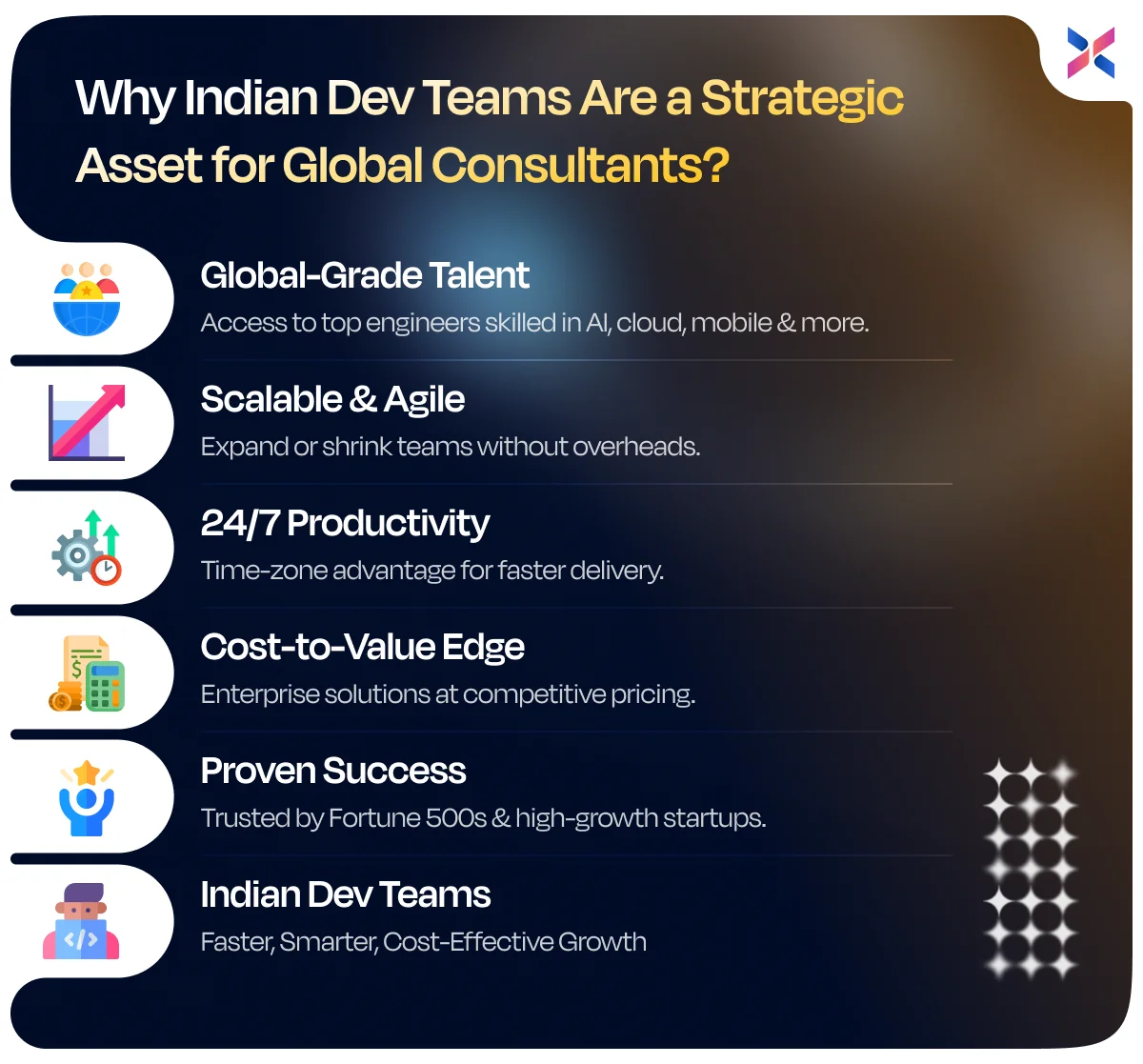
As a global consultant, efficiency, scalability and reliability are non-negotiable. That’s why most of you prefer partnering with India. The region boasts of the largest talent pools as they have more than 5 million skilled developers. This could be attractive when you are working with enterprise-grade projects that require specialists across domains.
Your entire project becomes cost-efficient when you work with an Indian team, making them affordable partners. Their delivery cycles are budget-friendly, available round-the-clock and scalable. No wonder they are suited for multi-region expansion and global rollouts.
According to a recent report, Indian commands over 55% of the global outsourcing market, making its a unique place in IT services outsourcing. This statistic also indicates that India is a reliable and trustworthy partner.
That’s why a lot of you tend to hire offshore developers from India for short-term and long-term requirements, formulating a partnership. With this approach, you get continuous support for multiple engagements and a dependable partner across clients.
Beyond Cost Benefits
While cost benefit definitely tops the chart for reasons to choose India as your strategic offshore partner, it is not the only reason. There are several invaluable advantages that Indian dev teams bring to the fore. For example, their strong proficiency in the English language ensures smooth communication across the different time zones.
Moreover, they have a good experience working with global enterprise tech stacks, helping them deliver solutions at par with International standards. Moreover, they can rapidly scale their resources, allowing them to handle fluctuating demands seamlessly.
When you partner with an outsourcing app development company in India, you unlock efficiency and scalability along with a strategic advantage.
Common Productivity Challenges When Working with Indian Dev Teams
Outsourcing to India poses multiple challenges. Despite that, you may face several productivity challenges. If left unchecked, these challenges can slow down your projects or impact the outcomes.
#1. Time-Zone Differences
The biggest challenge you are likely to face working with Indian development companies would be managing the time zone gaps. This can lead to communication delays and missed overlaps. Eventually, it will slow down your decision-making abilities. To overcome this challenge, you should have defined overlap hours and escalation protocols. This will ensure small blockers don’t turn into delays.
#2. Misunderstood Requirements and Scope Creep
If your requirements are unclear, you may notice subsequent delays in your project. A project that lacks detailed SOWs, milestones and acceptance criteria indicates misaligned expectations. The scope creep that comes in is harder to control. That’s why you should always have boundaries set in after defining the scope. Make sure you talk about the additional costs in case of delays.
#3. Quality and Performance Variations
Even when you hire the most skilled development teams from India, the quality of the project may vary. You might need to enforce the different KPIs, like delivery schedules, and review mechanisms to ensure consistent quality. With continuous monitoring and feedback cycles, you can maintain the standards.
#4. Security, Compliance and IP Protection
Ensure compliance with regulations and protecting the intellectual property is non-negotiable in case of multi-region and enterprise-grade projects. You must have clear policies, NDAs and audits. In case of its absence, you might face security breaches and data mismanagement.
#5. Procurement and Vendor Evaluation
The entire procurement process, from requirement gathering to vendor shortlisting and RFP cycles, are lengthy and resource-intensive. When you manage the evaluations poorly and connect with mismatched partners, it can pose challenges for you.
#6. Operational and Cultural Barriers
Your team’s productivity is impacted when there is a high attrition rate, a hierarchical culture and separate escalation approaches. This means your team works completely differently from theirs, and there is no alignment. You can overcome this issue by building a rapport with the team and adapting the managing styles that works for both of you.
Proven Productivity Hacks Used by Top Global Tech Consultants
It becomes easier to manage your offshore teams when you incorporate the best practices that have worked for several global consultants. Here we have added some of the tried and tested productivity hacks that can help you keep projects on track, communication transparent and delivery consistent.
#1. Define Clear Scope, Milestones, and KPIs from Day 1
Scope creep can be a big productivity killer, especially when you are working with an offshore partner. That’s why you must begin with a clear and defined scope using a statement of work document. You can also implement Gantt charts and use sprint-backed delivery schedules to reduce the scope creep.
For every module, you must define the success criteria along with delivery milestones and timelines. This would help all people involved know what to expect and when. With this clarity, you can minimize rework, reduce ambiguity and help teams measure real progress.
You can have a strong kickoff meeting with the partner company to align the proposal terms and share the expectations. By using scope, milestones and KPIs as your documentation, you will stay accountable from day one. It will also make the entire project predictable for all stakeholders.
#2. Standardize Communication with Collaboration Tools
Misunderstanding between your offshore partners and you can be expensive. You can reduce this risk by standardizing communication using tools like Slack, Jira and Confluence. They will ensure a single source of truth for discussions, tickets and documentation.
Instead of relying on the numerous email threads, you can rely on project boards, sprint dashboards and automated notifications to stay aligned. With weekly updates and review calls, you can add a human touch to the entire process, staying on track and correcting the course immediately.
With this approach, you can also create a culture of continuous delivery and collaboration so that teams are aligned. You can also avoid duplication and ensure transparency along the project lifecycle with continuous collaboration and clear expectations.
#3. Set Up an India-Aligned CI/CD & DevOps Pipeline
Automation is the best way to manage teams that are split across time zones. You must align the CI/CD pipelines of your project with the working hours in India to maximize the team’s productivity. Use tools like Jenkins, Bitbucket, Selenium and AWS to help automate builds along with QA and performance testing. This will ensure that the code is continuously integrated and deployment-ready.
So, when one part of the world sleeps, the other side would be running the tests, fixing bugs and pushing out the updates. When you align the DevOps pipelines with project milestones, you can go live and launch on time without chaos.
With this approach, you can improve speed, minimize errors and give your clients the confidence in trusting you. Whether you are partnering with CI/CD consultants or working in-house, you must align the automation workflows with the offshore team to ensure integration and delivery.
#4. Use Cultural Context to Your Advantage
When there are cultural differences, it can cause friction in the process. A smart consultant knows how to turn them into their strength. For example, by respecting the Indian holidays and their working hours, you build trust and show empathy that can uplift morale and productivity.
Instead of pushing for 24/7 availability, you can call for a balance of documentation and asynchronous check-ins that allow you to keep projects moving even when teams are offline. With this approach, you reduce dependency on real-time calls. It also allows the Indian development team to contribute efficiently. Moreover, it helps treat the team as an extension of your resources. When you encourage knowledge sharing, you provide feedback in a culturally sensitive manner while recognizing their contributions.
With time, you can turn the offshore teams into dedicated resources that offer long-term support.
#5. Appoint a Local Technical Lead or Delivery Manager
You should avoid micromanagement by appointing a single point-of-contact or delivery manager within the Indian team. This person would act as the on-ground bridge to resolve the issues quickly, offer smooth collaboration and ensure the consultants aren’t needed for day-to-day tasks.
The local lead can also provide cultural alignment, help translate the strategic plan into actions and offer complete support. This will reduce the frictions you may experience and allow them to focus on high-value tasks. With time, the structure will strengthen the trust and provide a sense of stability. It will also help turn this relationship into a long-term partnership.
#6. Additional Productivity Hacks
As consultants, you should also use these smaller hacks that can convert into bigger gains. For instance, rotate the key roles to avoid burnout and bring a fresh perspective to the project. You can also use AI-backed tracking tools to detect bottlenecks and provide predictive insights into the workload. It will also help manage deadlines and risks.
You can also create playbooks to manage recurring tasks so that you can onboard new members faster without the slow delivery.
How to Ensure High Performance in Enterprise-Level Projects?
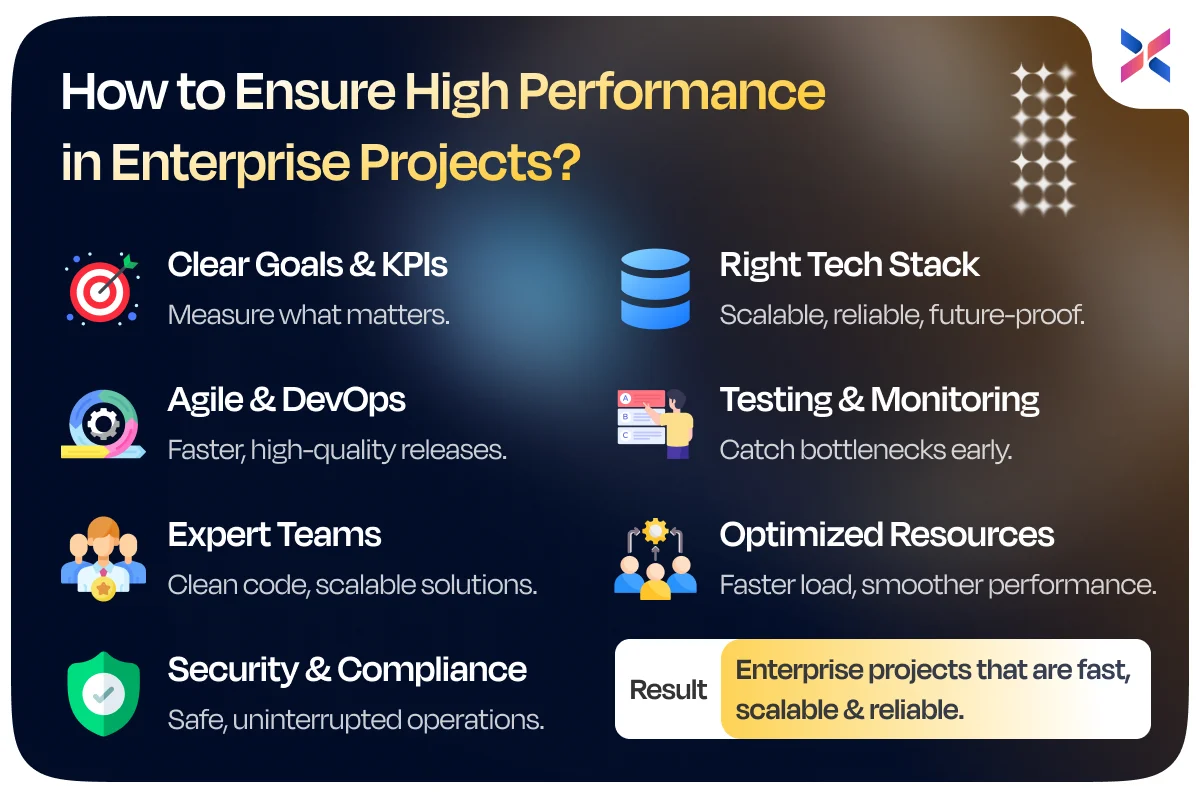
To succeed with an enterprise-grade project, you need to ensure consistency, reliability and measurable outcomes. This happens when you blend the right processes with the tools and include accountability within the workflows.
You must prioritize tracking key performance indicators like delivery velocity, bug count and release frequency. With these metrics, you get real-time visibility into the team’s efficiency and the product’s stability. It will also help identify the bottlenecks you must escalate.
Regular code reviews, security audits and performance testing integrated into the workflow can help you maintain the high standards. You should also use performance testers, QA consultants and automated testing frameworks to ensure the releases are stable, secure and enterprise-ready.
With robust cloud infrastructures, you can support scalability, allowing projects to manage larger user bases and heavy workloads without impacting performance.
Maintain clear accountability by assigning dedicated resources and ownership for each module. It can help ensure all the deliverables have a responsible point of contact. You will reduce delays and streamline decision-making with this culture of ownership.
Lastly, you should plan for talent and capacity to ensure the right specialists are available at the right time. Using these practices, you can deliver enterprise-grade projects that meet the performance benchmarks without compromising on agility and scalability.
Security, Compliance and Data Protection Tips
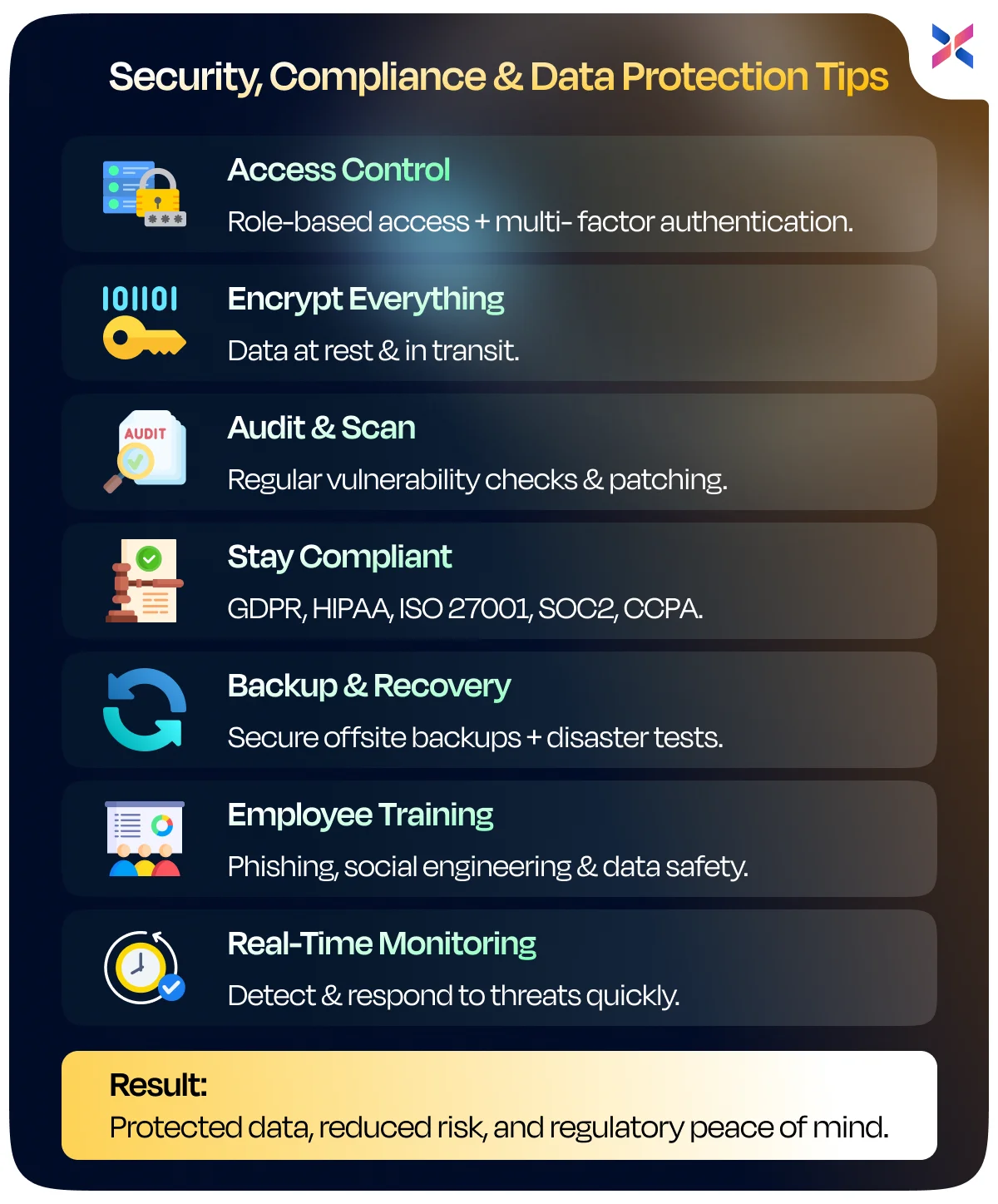
Security and compliance are integral to the enterprise projects, and you must not compromise on them. That’s why you must include international standards like GDPR, SOC2 and HIPAA into your app development process.
Partner with experienced security and compliance consultants to align the policies with client requirements to minimize risks during audits and certifications. It is equally important to ensure intellectual property protection. It should be built into your statement of work and reinforced using legal and technical measures.
Sign NDAs, enforce access control policies and use VPNs with remote connections. You should also implement the code versioning systems like Git and Bitbucket to add an additional layer of protection. It will also help ensure changes are tracked and access is allowed to authorized contributors only.
If preparing to live or launch the project, you must implement a robust backup and rollback system. This will ensure business continuity even when an unexpected issue occurs during deployment. You can embed these processes into your managed service model, where security and compliance monitoring are beyond the initial project delivery.
By combining the clear agreement with strong technical safeguards and continuous oversight, you can scale the project with Indian teams while protecting sensitive data. This will secure the client’s trust and foster long-term relationships.
Scaling Your Indian Dev Team with the Right App Development Partner
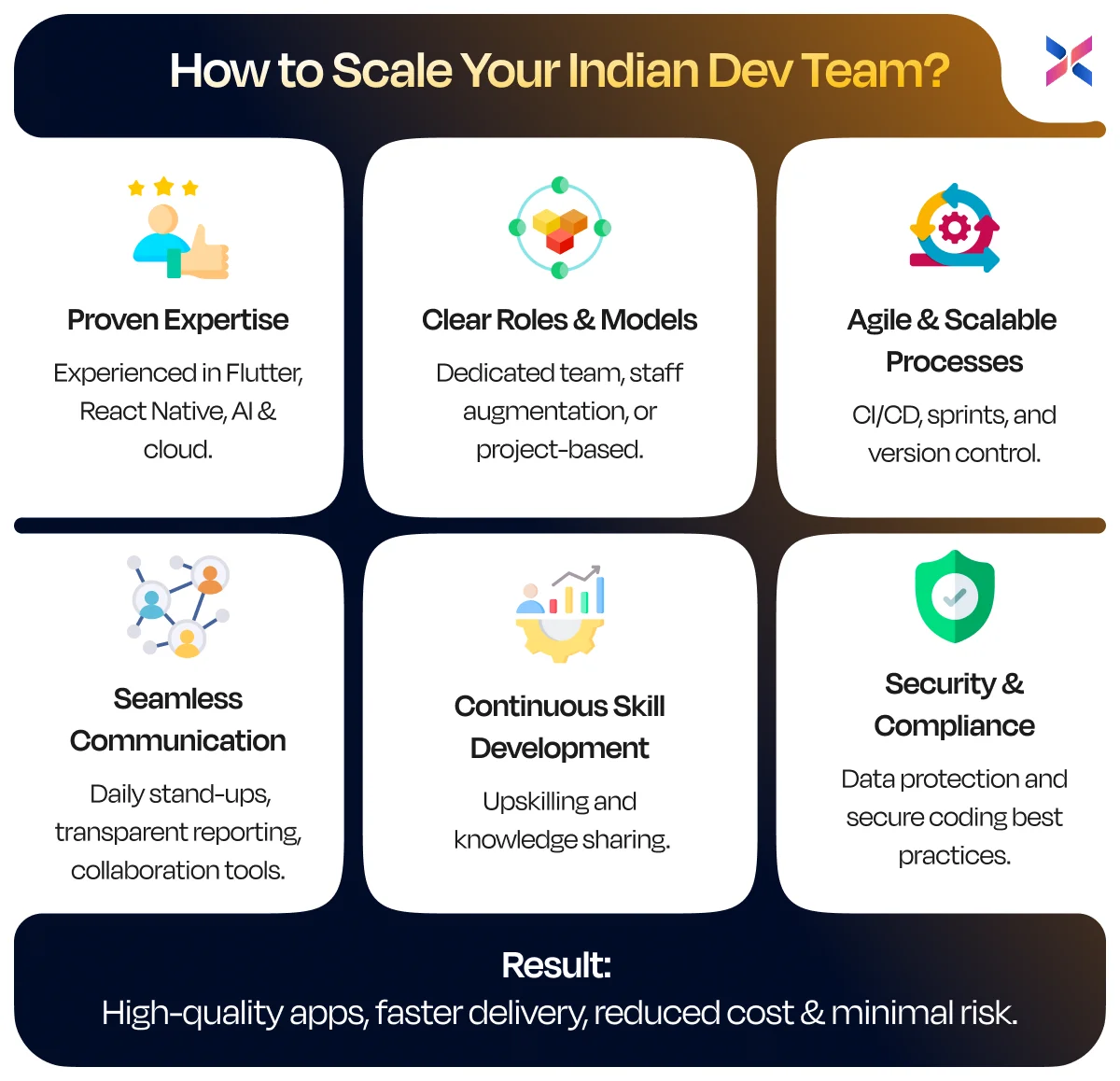
As project complexities are increasing, your offshore strategy’s success depends on the technology partner you choose. Selecting the right app development partner goes beyond access to a talent pool. They should bring to the table structured processes, scalability and long-term reliability.
You should find vendors who have proven their proficiency in multi-project enterprise solutions. Moreover, they should be able to handle diverse requirements and shifting priorities while incorporating the global delivery standards.
Strong onboarding is also another factor to consider when choosing the offshore development partner. Most of the top offshore software development companies offer smooth transitions, complete documentation and defined communication rhythms to integrate the developers into your workflows seamlessly.
In order to evaluate the preferred partner, you should ask them to share their case studies, onboarding details and delivery reports to highlight how they have managed enterprise-level engagements similar to yours.
When you find a partner who positions themselves as your technology ally rather than a vendor, you are laying a scalable foundation to enable innovation, faster delivery and consistent quality.
When to Hire Offshore Developers from India And How?
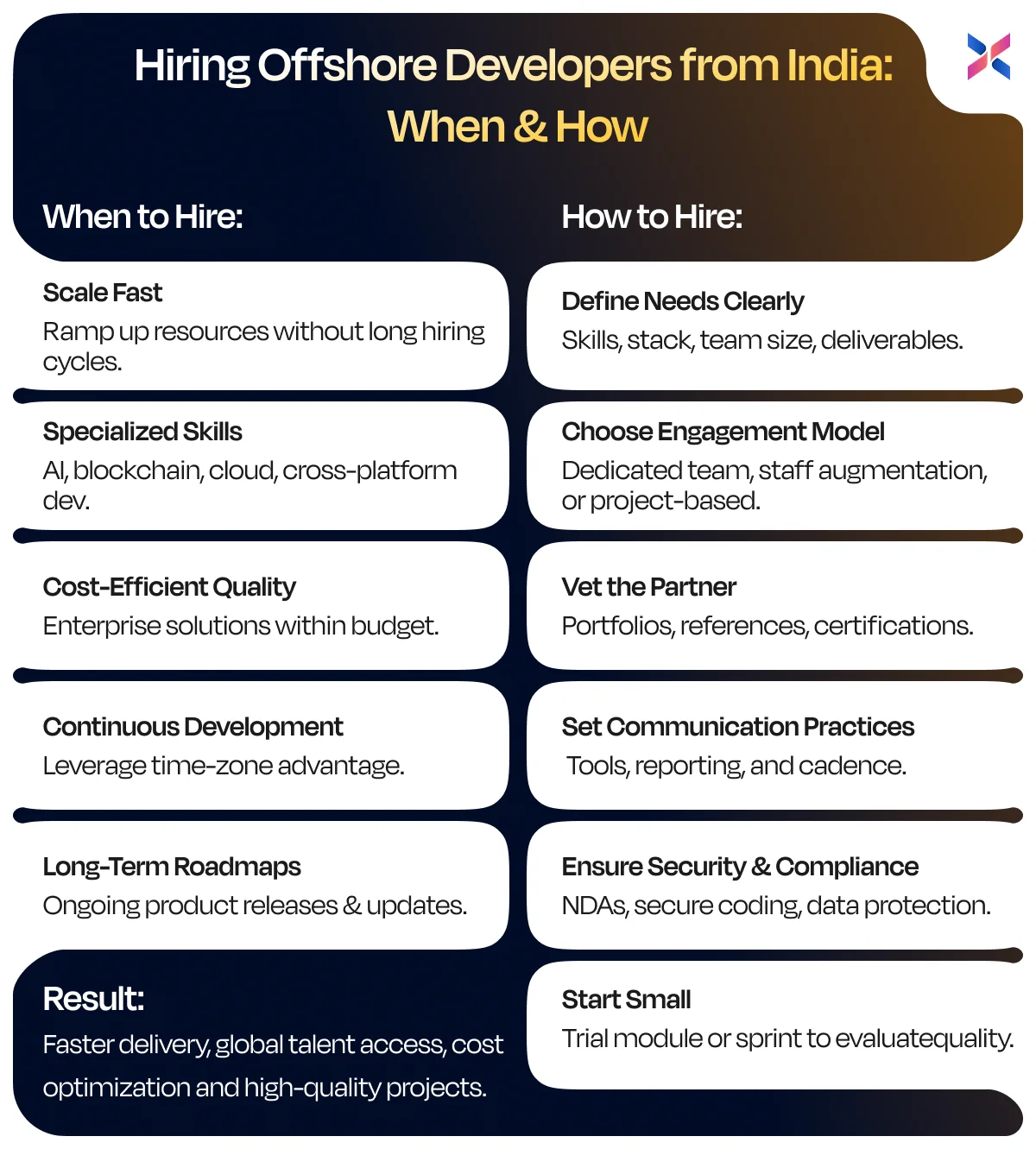
If you know when to hire offshore developers from India, you can succeed. Hiring Indian development teams proves to be valuable for large-scale rollouts, RFP-backed engagements and retainer models where you need long-term support. These development teams are ideal as your team’s extension, allowing you to scale the capacity of your team without hiring in-house talent.
There are diverse roles and responsibilities that you can outsource to the offshore teams in India. Backend and frontend development, along with UI/UX consulting and QA testing, are some of the most popular outsourced roles. The flexibility Indian teams offer provides you with an efficient approach to manage multi-technology environments effortlessly.
You should also consider your budget when planning to hire offshore developers from India. You can hire smartly when delivery timelines and budget are fixed. This way, you can deliver on time without compromising on the quality.
How to hire the offshore developers from India is as important as the when to hire them. You should evaluate the vendors and their case studies, along with the onboarding practices and delivery reports. By partnering with the experienced offshore team, you can gain the perfect mix of capacity, expertise and reliability.
FAQs for Enterprise Tech Consultants
#1. How can I manage time zones with Indian developers effectively?
You can take advantage of staggered stand-ups, async status updates and overlapping shifts to manage the different time zones. This will help with smooth communication, continuous updates and quick decisions across regions. As a result, you can move through projects without productivity loss.
#2. What’s the cost of hiring Indian offshore developers?
The typical cost of hiring an Indian offshore developer from ExpertAppDevs begins at $22 per hour or $2500 per month. The final price of hiring the developer depends on the role type, the seniority of the developers, skillset and engagement model. This will help you gain flexibility while balancing budget efficiency with quality talent delivery.
#3. How do I ensure secure code delivery in outsourced development?
By using VPNs, Git-based repositories, and strict code audits, you can safeguard the intellectual property and maintain compliance. It will also help you protect the sensitive data across enterprise rollouts while ensuring secure delivery.
#4. Can Indian teams support multi-region product launches?
Yes. An experienced technology offshore company like Expert App Devs can offer multi-region and enterprise rollout. They have a proven framework, incorporate global compliance and use scalable resources to manage the development. They can handle regional differences as well, thus helping you manage large-scale launches.
#5. What’s the best way to begin a long-term engagement with Indian teams?
You can start with a 4 to 8-week pilot using a clear SOW. Based on the results attained and the trust you have built, you can transition to a retainer-based partnership that ensures consistency and scalability for enterprise-grade consulting.
#6. What Makes an Offshore Team Proficient for Businesses in North America, Europe, Middle East and Oceania?
A proficient offshore team combines technical expertise, cultural understanding and time-zone flexibility. They use agile processes, clear communication and proven frameworks to deliver enterprise-grade results while aligning with your business standards.
#7. How Do I Ensure Smooth Collaboration with a Globally Distributed Offshore Team?
For Smooth Collaboration with a Globally Distributed Offshore Team Set clear goals, use project management tools like Jira or Asana and schedule regular video check-ins. Transparent KPIs and strong documentation ensure your offshore team stays aligned with local expectations and timelines.
#8. Can Offshore Teams Support Enterprise Compliance in Different Regions?
Yes, Offshore Teams Support Enterprise Compliance in Different Regions. Leading offshore partners follow international standards such as GDPR, HIPAA and SOC 2. Before onboarding, verify their compliance readiness and data-protection policies.
#9. Who Are Offshore Developers and Why Do Companies Hire Them?
Offshore developers are skilled professionals located in another country who build, maintain, or scale your software solutions. Businesses hire them to access specialized talent, accelerate delivery and reduce development costs without compromising quality.
#10. What Are the Benefits of Hiring Offshore Developers?
The main benefits of hiring offshore developers are, you get access to a larger talent pool, faster project turnaround, and flexible engagement models. Offshore teams can also provide 24/7 productivity by working across time zones.
#11. How Can I Choose the Right Offshore Development Partner?
When choose the right offshore development partner looks proven experience, transparent pricing, strong communication and client references. A good partner acts as a long-term technology ally, not just a service vendor.
#12. Why Is India a Preferred Destination for Offshore Development?
India offers one of the world’s largest pools of skilled developers, competitive pricing and strong English proficiency. Its IT ecosystem supports everything from startups to global enterprise projects.
#13. How Do I Overcome Time-Zone Challenges When Working with Indian Teams?
Use overlapping working hours for critical meetings and rely on async tools like Slack, Trello, or Loom for continuous collaboration. Many Indian teams also offer flexible shifts to match your schedule.
#14. What Communication Practices Improve Productivity with Indian Offshore Teams?
Keep feedback loops short, define milestones clearly, and use visual dashboards for progress tracking. Encourage openness and proactive reporting to minimize misunderstandings.
#15. Are Indian Offshore Teams Reliable for Long-Term Enterprise Projects?
Yes. Many Indian firms have global delivery centers, ISO certifications, and experience managing complex projects. Choosing a partner with a strong retention rate and delivery history ensures stability.
#16. What Services Does an Offshore Development Team In India Provide?
They handle end-to-end software projects from app and web development to QA, DevOps and support. You can hire full teams or specific roles like backend engineers, UI/UX designers or QA testers.
#17. How Much Does It Cost to Hire an Offshore Development Team in India?
Rates typically start around $22 to $45 per hour, depending on skill level and tech stack. For dedicated teams, monthly retainers often range between $2,500 to $7,200 per developer.
#18. How Do I Manage Quality and Delivery Timelines with An Offshore Indian Team?
Set up clear SLAs, use agile sprints, and track progress through tools like Jira and GitHub. Regular reviews and code audits help maintain performance and security standards.
#19. What Industries Benefit Most from Indian Offshore Development Teams?
SaaS, fintech, healthcare, retail, logistics, and e-commerce sectors benefit the most. Indian teams have deep experience in custom enterprise solutions and secure, scalable architectures.
Why Choose Expert App Devs as Your Trusted Offshore App Development Company?
When managing enterprise-grade projects across diverse time zones, you need a strategic and technology ally you can count on. That’s where Expert App Devs comes into play. For over 13 years, we have helped clients across the USA, UK, UAE, MENA, Canada and Australia regions launch and scale projects demanding speed, scalability and reliability.
What makes us different is our ability to keep things clear and simple. From the proposal to milestones, delivery and ongoing support, you will be in the loop, always aware of what is happening. With no hidden gaps or confusion, you will get a transparent process that works.
Whether you need to expand your in-house capacity or wish to outsource end-to-end development, our team will become an extension of yours. With us, you gain a long-term partner who is invested in your success.
Final Take: Unlock Growth with the Right Partnership
The secret to a successful collaboration is perspective. Basically, you should treat Indian development teams as your strategic partner and not just another vendor. When you view them as an extension to your team, you will be able to plan, execute and scale projects effectively.
When you implement the right processes and use apt tools, you can improve productivity, scalability and speed to market. With structured workflows, clear milestones and continuous feedback, you can ensure a smooth movement from rollout to implementation.
For enterprise projects, you should use an approach that translates into tangible benefits like faster growth, cost savings and continuous delivery. All of this will help support ongoing business growth.
When you choose the right partner, they can help scale effectively, enable expansion into newer regions and maintain quality throughout development. Ultimately, the right partner will grant you a strategic advantage, unlocking immediate results with long-term expansion.





 203
203

 0
0


 244
0
244
0
 177
0
177
0
 465
0
465
0