


 Blog
How Global Consultants Can Scale App Development with Offshore IT Teams? A Phase-Wise Strategic Guide
Blog
How Global Consultants Can Scale App Development with Offshore IT Teams? A Phase-Wise Strategic Guide
- Why Consultants Are Outsourcing App Development?
- Phase-Wise Outsourcing Strategy
- Risk Management Across Phases
- Consultant Delivery Models at a Glance
- Cost Structures Consultants Must Know
- Regional Insights: GEO-Specific Consultant Needs
- Key Triggers for Outsourcing
- Strategic Decision-Making Framework
- KPIs Consultants Should Track
- Whitepaper Directory: Explore Deep-Dive Phase Playbooks
- Future of Offshore Development
- Frequently Asked Questions
- Conclusion
Ready to transform your vision into reality?
Get Started
How Global Consultants Can Scale App Development with Offshore IT Teams? A Phase-Wise Strategic Guide
 128
128
 0
02 Oct 2025
47 Min Read
0
02 Oct 2025
47 Min Read


 Share
Share

 Download PDF
Deadlines wait for no one, and neither do your clients. As an app development consultant, you understand the pressure to deliver smart and fast while keeping the costs low. It may be a tall order especially when you have a limited in-house capacity and evolving client expectations.
That’s why a lot of you embrace offshore IT teams as outsourcing is easier, and efficient. Moreover, offshore IT teams can scale your business easily, offer access to diverse talent and help with cost savings.
Offshore may seem lucrative but it is not automatically successful. You need a clearly devised strategy, a detailed structure and a complete understanding of when and how to integrate the right partners into your project.
That’s where this guide will help you. It will become your high-level roadmap that provides a phase-wise understanding of offshore collaboration. You will learn to see the bigger picture, identify the common mistakes to avoid and build deliverable partnerships. This strategic lens will make your offshore work easier and aligned with your client’s needs.
Why Consultants Are Outsourcing App Development?
Outsourcing doesn’t just help to cut down the costs; it is a critical lever that helps you stay competitive in the app development ecosystem. Partnering with offshore IT teams can help you scale faster, fill talent gaps and deliver solutions that align with the expectations of the clients across industries.
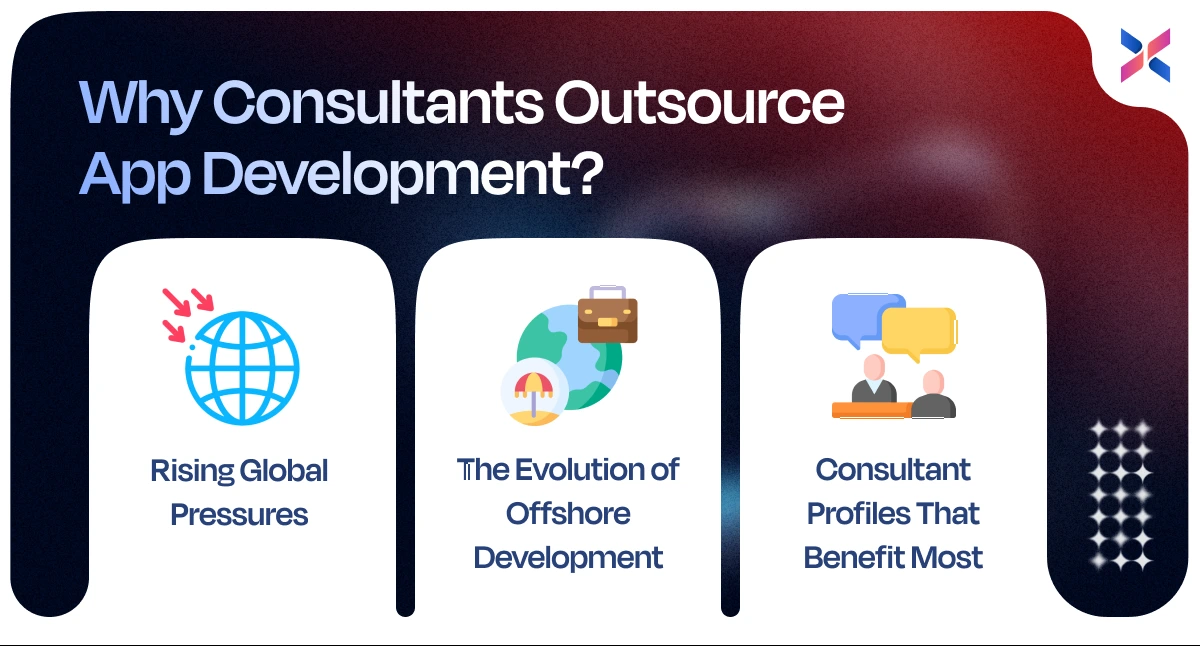
#1. Global Pressures
When it comes to delivery, you are navigating a tough environment. The rising living costs in the EU and the US make it difficult for you to sustain using the local-only teams without letting go of your profits. Even with a good budget, you will face roadblocks when you don’t find the right talent for your needs.
As a result, this has made recruitment difficult and unpredictable. Offshore IT teams can easily help overcome these challenges by providing skilled resources on demand and at scale.
Apart from the shortage of tech talent, the increasing demands have also led more people towards outsourcing. They need mobile-first and audit-ready applications that can pass compliance checks without delays. Localization has become non-negotiable, especially for MENA regions where Arabic interfaces and VAT compliance are important.
If you don’t have the required internal capacity, you may not be able to meet these requirements consistently. That’s why you need offshore partners who offer flexibility and provide the knowledge.
Offshore development can provide a reliable way to balance cost, speed, compliance and talent shortages.
#2. Evolution of Offshore Development
The perception towards offshore development has shifted dramatically in recent times. Earlier, it was mainly used to cut down on development costs. The cheap labour abroad allowed companies to save some money against delayed timelines, uneven quality and communication hurdles. However, it was the best transaction for those operating on a low budget.
Today, the picture is completely different. Offshore partners have become strategic extensions to your in-house team, offering both delivery support. You can access specialized skills, domain expertise and compliance knowledge with this partnership.
As they are proficient with agile practices and cloud-based collaboration tools, you can sync with offshore IT teams to get round-the-clock support and enable seamless communication. It helps you with 24/7 development cycles, which is key in high-pressure projects.
There has also been a mindset shift concerning offshore development, as it has become a growth strategy. With this partnership, you can scale globally and accelerate delivery to drive flexibility and innovation.
#3. Consultant Types Who Benefit Most
Not every consultant requires the same things from their offshore IT teams. As an ERP consultant who is working with SAP, Oracle or NetSuite, you are facing enormous complexities. There is a need for custom modules, integrations and mobile extensions requiring a newer timeline. Offshore IT teams can help you keep moving with these projects without compromising quality or timelines.
System integrators benefit from different aspects. They need mobile app development with API integrations for diverse platforms. Offshore developers can help with technical expertise and sync easily with in-house developers.
As a design and digital consultant, you can build MVPs with your in-house strengths. But you cannot scale them into full-fledged products with offshore IT teams. The in-house team can scale to capacity while protecting the creative abilities.
If you are the project manager who is overseeing large-scale transformations, your offshore partner can help manage deadlines while balancing workloads. Offshore with in-house teams can help run your projects smoothly.
Phase-Wise Outsourcing Strategy
When you align outsourcing mobile app development with the project lifecycle, you can succeed. Not all phases need the same level of external support. You must know what to outsource and why to make a strategic decision. Here is a phase-wise breakdown of how your offshore team can add value.
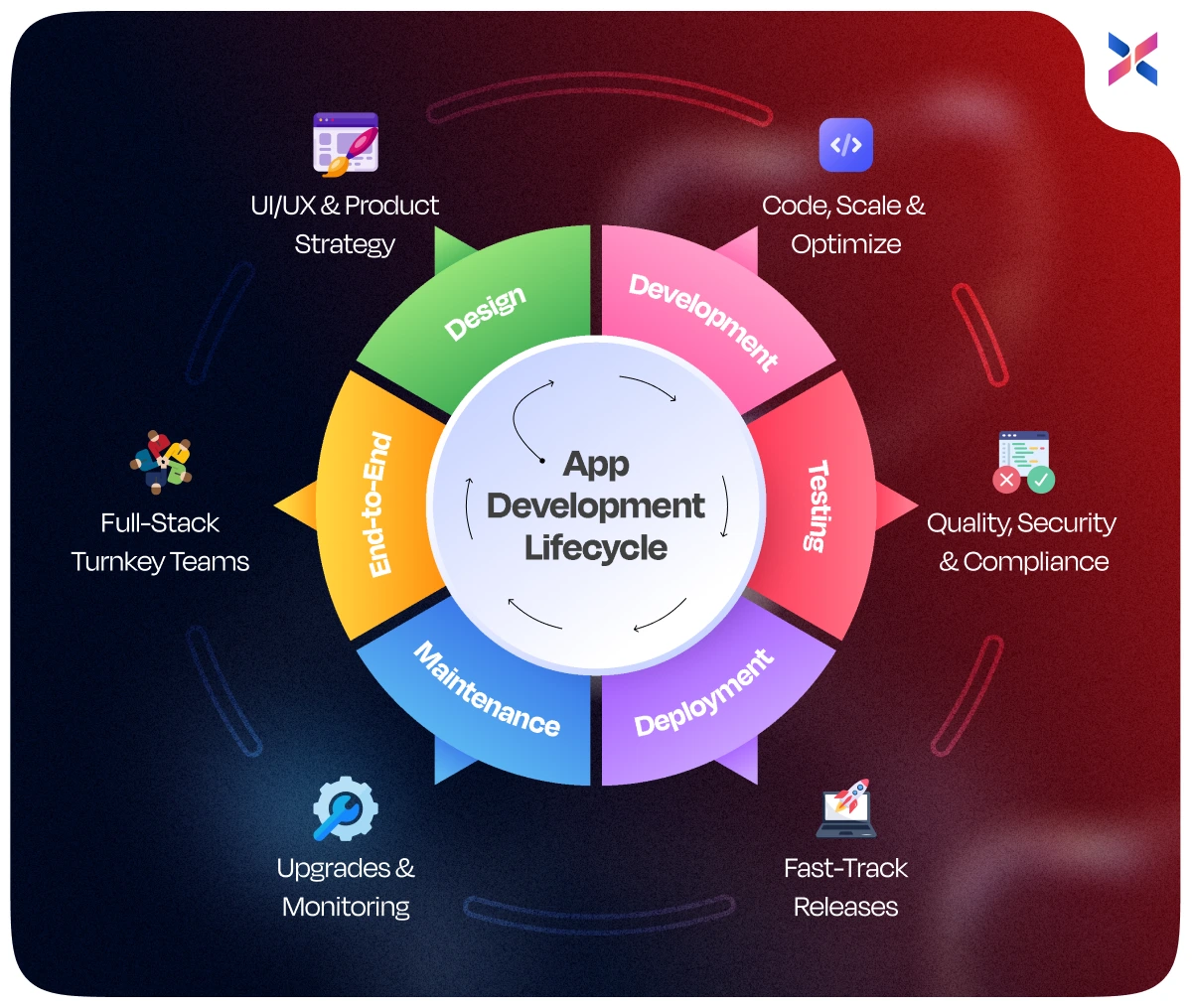
#1. Design
Offshore IT teams can help you manage the UI/UX design, product workflows and business analysis needed at the design stage. At this point, you must make sure that the deliverables like a Figma file are developer-ready.
With this, you can reduce handoff friction and allow your internal/external developers hit the ground running. Outsourcing allows you to validate your concepts quickly and iterate without tying down your core teams.
#2. Development
You can easily outsource frontend development using frameworks like Flutter or React Native, as well as backend coding & DevOps tasks. It is also easy to outsource strategic decisions like stack choices that impact scalability, maintainability and code reuse. Offshore IT teams can help you scale features while maintaining long-term flexibility.
#3. Testing
Outsourcing manual quality assessment with automated testing and security checks is a smart move. You can also use the offshore team to incorporate compliance like GDPR and HIPAA in the early stages to reduce post-launch surprises.
Strategically, you can use this phase to determine the quality benchmarks and build confidence for your product among the clients. It also helps catch issues before you enter the production stage.
#4. Deployment
Offshore IT teams can help manage CI/CD pipelines, app or play store submissions and releases. With milestone-based delivery, you can shorten your release cycles and ensure stakeholders are updated. With outsourcing, your internal teams can focus on innovation instead of operational issues.
#5. Maintenance
Offshore IT teams are given SLAs that help them with bug fixes, feature upgrades and analytics monitoring. This will also help build their trust in end clients and ensure apps evolve after post-launch. It also converts outsourcing into a long-term partnership for consistent growth.
#6. End-to-end Delivery
When you partner with full-stack, white-label and turnkey teams, you can handle large-scale transformations or multi-product portfolios in a scalable format. This model helps your project managers and advisors to handoff apps and modules confidently while freeing up the internal teams on core tasks.
|
Phase |
What to Outsource |
Strategic Insight |
|
Design |
UI/UX, product design, business analysis |
Align Figma files with developer-ready components |
|
Development |
Flutter, React Native, backend, DevOps |
Stack decisions affect scalability and reuse |
|
Testing |
Manual QA, automation, security |
Build GDPR/HIPAA compliance from the start |
|
Deployment |
CI/CD, App Store, Play Store submission |
Milestone-based teams shorten release cycles |
|
Maintenance |
Bug fixing, feature upgrades, analytics |
SLAs and monitoring build trust with end clients |
|
End-to-End |
Full-stack, white-label turnkey teams |
Scalable, NDA-bound delivery for PMs and advisors |
Risk Management Across Phases
While outsourcing app development delivers great benefits, it comes with its set of risks. You must carefully manage them for project success. These include protecting your intellectual property, handling the team turnover and overcoming communication hiccups. By implementing a plan for every stage, you will be able to overcome all issues.
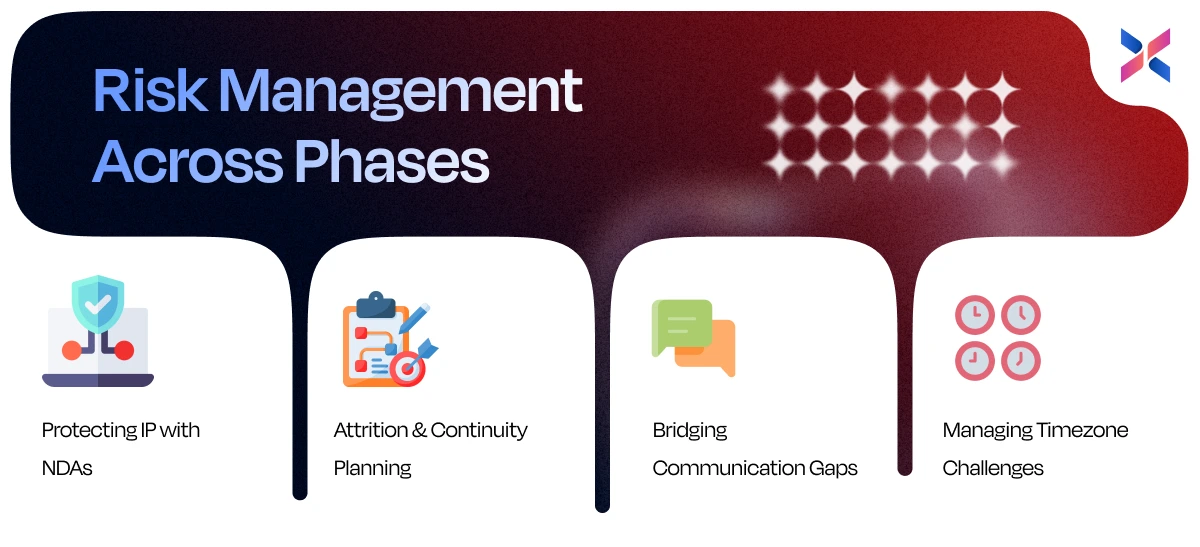
#1. IP Protection with NDAs
You must protect the intellectual property. That’s why you need well-crafted NDAs and contracts that confirm the security of your ideas, designs and proprietary workflows. This is crucial when working with multiple offshore IT teams and freelancers. Clear IP agreements help build trust and give your clients the confidence that their sensitive information is protected.
#2. Attrition With Continuity Plan
Developer turnover occurs even when you have hired the best offshore IT teams. A continuity plan can help you overcome this. It documents the workflows, handover protocols and backup resources so that all your projects are on track.
You can ensure that the project progress remains continuous and the knowledge isn’t lost. Moreover, it helps in protecting timelines and quality without relying on the individual contributors.
#3. Communication Gaps
Working in diverse locations can lead to misunderstandings and delays. You must establish clear communication channels, have structured and scheduled updates and regular check-ins with the team. This will help all stay aligned throughout the project. Shared project boards and weekly touchpoints can also help reduce the friction and improve sync.
#4. Timezone Differences
Timezone differences can be a challenge and an advantage. If you plan for overlapping working hours, asynchronous updates and early milestone deliveries, you can convert this challenge into an opportunity.
You must invest in the right strategy to enable the timezone differences to speed up progress and offer 24/7 development cycles.
Consultant Delivery Models at a Glance
Choosing the appropriate delivery model plays a pivotal role in scaling up the app efficiently. Each model has its own strengths, trade-offs and ideal use cases. When you understand these differences, it helps you match client needs with the right approach to manage costs and reduce risks.
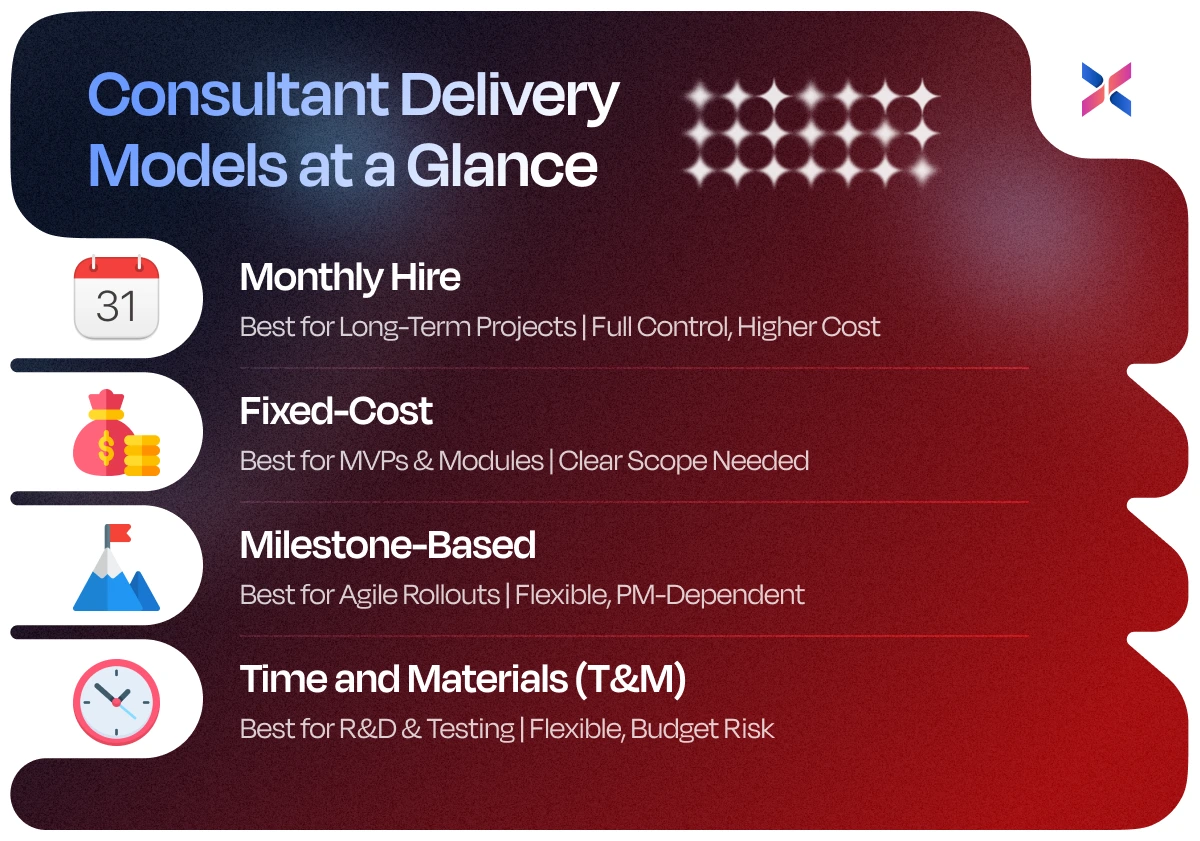
#1. Monthly Hire
It is best suited for long-term and evolving projects where you need complete control over the team working on the project. It allows you to direct the priorities, adjust the tasks and build the institutional knowledge. The cost involved is higher as your are directly managing a dedicated team. However, it gives you complete visibility and control into the project delivery.
#2. Fixed Cost
It is ideal for the MVPs and SAP module development & deployment. There is a clear scope in this case, which makes it easier for you and the team to budget. In this model, your clients get cost predictability and fewer surprises. However, for this model to be a success, you need a clear SOW right from the start. It doesn’t make way for scope changes or evolving scopes.
#3. Milestone Based
The is perfect if you are planning agile rollouts and phased ERP development, as they offer flexibility with structure. The payments in this case are tied to the milestones achieved, which makes it easier for you to track the progress. Its success depends on the project manager’s oversight and the defined milestones.
#4. T&M
It is best for R&D, compliance testing and exploratory work. This model suits all projects where the scope is uncertain. You get complete flexibility with the scope and can manage evolving requirements. However, the budget can pose a risk in this case as the cost is tied to the hours’ resources spent on the project. You might need to hire someone to carefully monitor the hours spent to avoid overruns.
|
Model |
Best For |
Tradeoff |
|
Monthly Hire |
Long-term, evolving projects |
Higher cost, full control |
|
Fixed-Cost |
MVPs, SAP modules |
Requires clear scope/SOW |
|
Milestone-Based |
Agile rollouts, phased ERP dev |
Better flexibility, PM-dependent |
|
T&M (Optional) |
R&D, compliance testing |
Scope flexibility, budget risk |
Cost Structures Consultants Must Know
Understanding cost structures is important when outsourcing app development. There are hidden and ongoing management costs that can impact the overall budget, timelines and client’s profitability. It helps to know what you should watch out for to plan smartly and avoid surprises.
#1. Hidden Expenses
When you are outsourcing, the sticker price may not tell you the entire story. You must also look at the hidden expenses like onboarding, knowledge transfer, integration with existing systems, communication protocols and training.
If you face delays or longer feedback loops in the projects, it can also add to the costs that are not calculated in the ballpark. You should also account for the licensing fees, compliance expenses and the testing tool costs you may incur.
By considering all aspects strategically, you will be able to build realistic timelines and a budget. It also helps you set clear expectations with the clients to minimize surprises. When you are proactive about the hidden costs, you can create a more predictable and manageable process.
#2. How To Manage Costs?
It is critical to manage the costs so that you don’t increase the overhead for the project. You can begin this by creating transparent agreements with clear scope definitions. Adding regular tracking for diverse milestones and combining them with frequent budget reviews and contingency planning can help.
You can also optimize the costs by using blended teams. For this, you should bring together senior offshore talents with junior resources who can handle two facets of the project development.
You should also plan for efficient communication, automated reporting and pre-planned sprints that can prevent overheads and overruns. Treating cost management as an ongoing process instead of a single-time setup can help you stay profitable and improve client satisfaction.
By anticipating potential challenges and actively monitoring spend, you can maximize the value from these partnerships.
Regional Insights: GEO-Specific Consultant Needs
As a global consultant, you may face region-wise challenges in your projects. Offshore IT teams can easily bridge these skill gaps and address the compliance issues to accelerate delivery. However, the fit depends on the geography and the needs thereof.
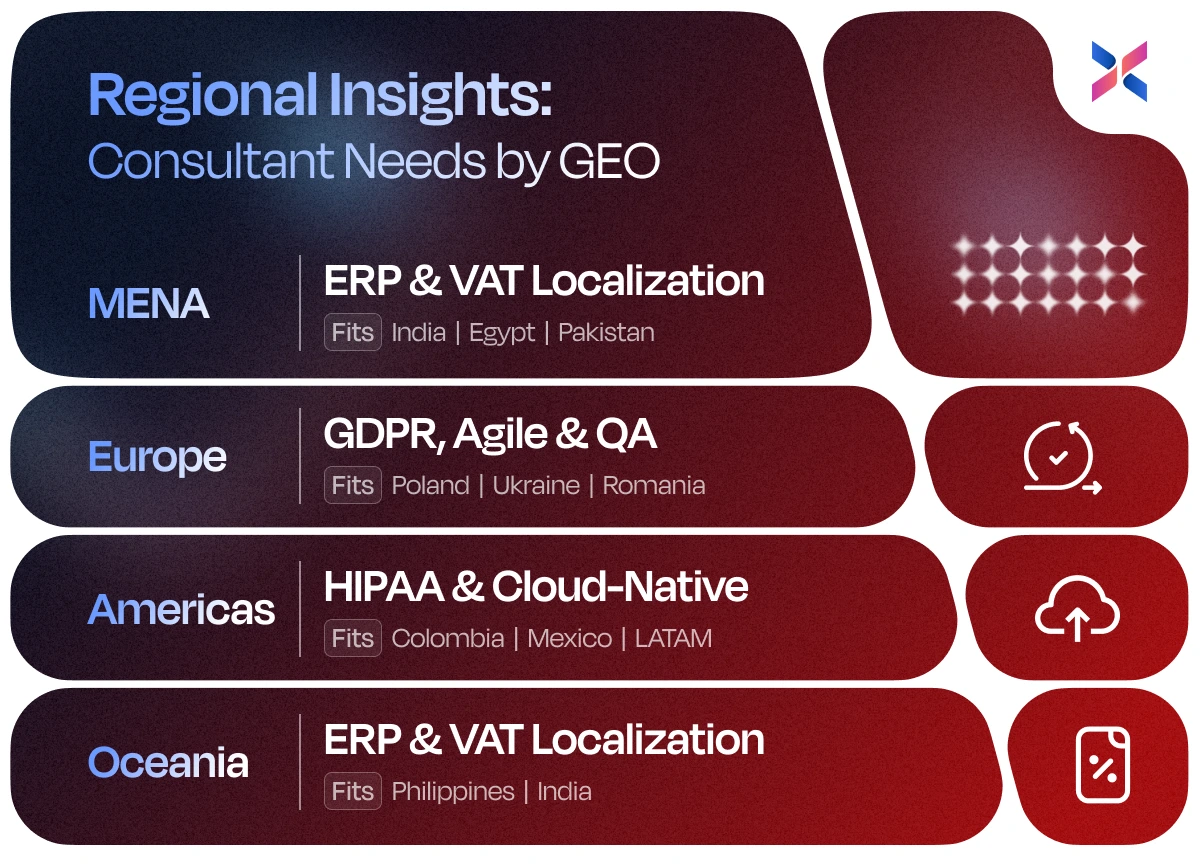
MENA
Most of you who work in the Middle East and North Africa regions focus on ERP rollouts using SAP and Oracle. You may also be working on Arabic UI localization and VAT compliance. Offshore IT teams from regions like India, Egypt and others can handle these requirements easily.
They have the language expertise, ERP experience and understanding of regional tax systems. They can also ensure culturally and legally compliant applications. As a result, you can scale your projects efficiently.
Europe
GDPR compliance, agile delivery, swift QA processes and localization are priorities for the European projects. Partnering with teams from countries like Poland, Ukraine and Romania helps gain access to strong technical skills and familiarity with European standards. These teams become an extension of the consultant’s core team, allowing them to work on projects with strict compliance.
America
North and South America need HIPAA-compliant, cloud-native, and well-integrated app solutions. That’s why they should work with regions like Colombia, Mexico and LATAM to gain cost-effective support, real-time collaboration and coordinated teams. It can help you manage compliance-sensitive projects efficiently.
Ocenia
The Australia and New Zealand regions focus on mobile modernization with secure DevOps for both enterprise and consumer applications. Consultants in this region can work with the Philippines and India for timezone alignment and secure outcomes. These partner companies accelerate delivery cycles without compromising security and quality.
|
Region |
Focus Areas |
Offshore Fit |
|
MENA |
ERP (SAP/Oracle), Arabic UI, VAT localization |
India, Egypt, Pakistan |
|
Europe |
GDPR, Agile, QA, localization |
Poland, Ukraine, Romania |
|
Americas |
HIPAA, cloud-native, integration/API |
Colombia, Mexico, LATAM |
|
Oceania |
Secure DevOps, mobile modernization |
Philippines, India (timezone match) |
Key Triggers for Outsourcing
Certain challenges you face can trigger outsourcing your next app project. By understanding these triggers, you can anticipate engaging offshore IT teams as your next move to enhance impact and efficiency.
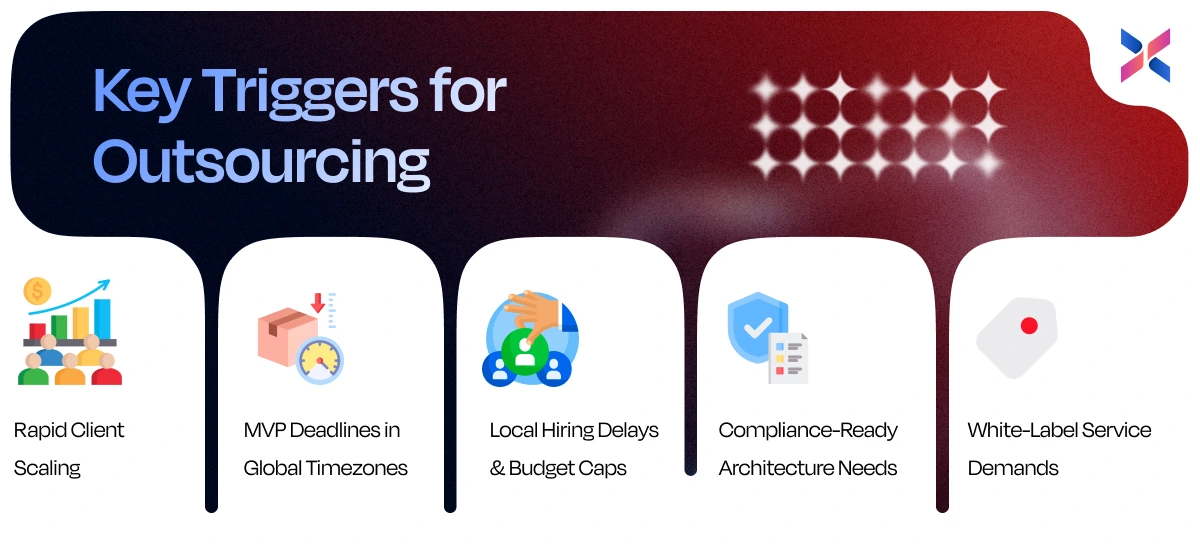
#1. Consultant Facing Rapid Client Scaling
When your client demand evolves quickly, your in-house team may not be able to maintain the pace. With offshore development, you can meet these spikes using their flexible and scalable capacity.
This partnership allows you to tap into the skilled resources from their teams to deliver high-quality and consistent solutions. It can help you manage deadlines, avoid increased costs and reduce the time taken to recruit resources. Subsequently, it helps you improve your client’s satisfaction.
When you rapidly scale your team and projects with outsourcing, it helps you expand your service offerings without overstretching your internal teams.
#2. MVP Deadlines Across Multiple Time Zones
Tight MVPs are a nightmare, especially when you are coordinating across diverse geographies. With offshore IT teams in different time zones, you can establish a 24/7 development cycle that eventually accelerates delivery without impacting the quality.
You can hand off the tasks at the end of your workday and expect the results at the start of your next workday. This will reduce bottlenecks and reduce the timelines effectively. It will also help you achieve your timelines with ease.
#3. Local Hiring Delays Or Budget Caps
When you hire local talent for your project, you may incur more costs and may not get the niche skills. Outsourcing to an offshore team can help you gain ready-to-deploy expertise, too at lower costs. You can avoid the long recruitment cycles and access highly talented resources with this approach. This makes way for strategic budget allocation to ensure your projects are on track financially and operationally.
#4. Need For Compliance-Ready Architecture
More clients need apps that meet the GDPR, HIPAA and other region-specific regulations. Offshore IT teams understand the compliance and can build audit-ready architectures from the beginning. When you outsource expertise, you reduce risks, improve regulatory adherence and reduce costs.
With compliance-ready offshore IT teams, you can gain peace of mind that accelerates your project’s delivery.
#5. End-Client Wants White-Label Service Execution
A lot of your clients may require turnkey or branded solutions. Offshore IT teams can offer white-label development that allows you to maintain ownership of the product and manage the client’s relationship. In this approach, you will not only get scalable resources but also protect intellectual property, and offer consistent quality.
With white-label execution, you can strengthen clients’ trust and gain access to additional capabilities with faster timelines.
Strategic Decision-Making Framework
Outsourcing app development works effectively when you take a structured approach. By having a framework, you can identify gaps, match the delivery models and validate the quality. In this section, we are taking you through a phase-wise strategic playbook to make confident decisions.
This below 5-step playbook is your roadmap to use offshore IT teams to your advantage as a global consultant. Using these five steps, you can identify the resource gaps, determine the right model, validate quality and scale your delivery to maintain your client’s trust.
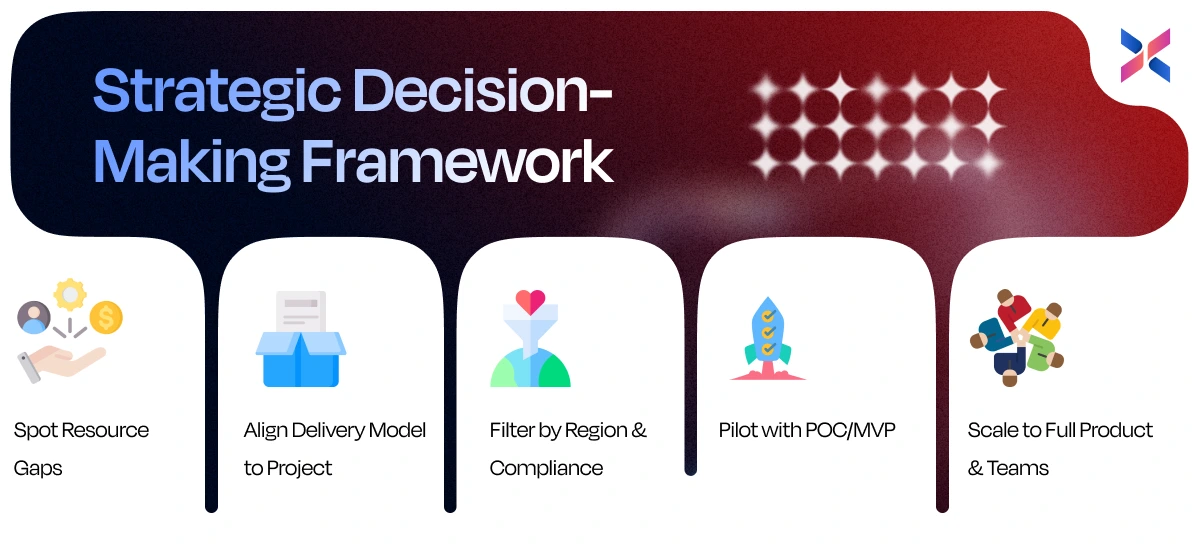
#1. Identify the Phases Where You Lack Resources
Pinpoint all the phases where your internal team might be stretched. It could be design, UX, development, testing or deployment.
Understanding the lack of resources for the phase can help you allocate them efficiently and avoid overloading your existing team. For example, if you have a strong design team but not a great backend pool, your timelines may be compromised.
With this approach, you can prevent unnecessary outsourcing while keeping the costs in check and maintaining quality consistency. When you identify the precise phase, it can help maximize the value attained from offshore engagement while reducing risks and accelerating delivery.
This will also help you align resources to particular phases so that you can scale selectively while enhancing your team’s efficiency.
#2. Match the Delivery Model to Project Type
When you have identified the phases where you need resources, it is important to align your delivery models to project needs. Fixed-cost models are perfect for MVPs that need a clear scope while milestone-based work for agile ERP rollouts.
Time & Material models are useful for exploratory work and compliance testing; basically, everywhere that the scope changes are normal. With monthly hires, you can ensure long-term control, especially in evolving projects.
Matching the right model with your project can ensure budget predictability, optimized timelines and reduce risk of misalignment that occurs between your expectations and offshore delivery. This can also maximize efficiency while balancing cost, control and flexibility.
#3. Filter By Region and Compliance Fit
Once you have chosen the delivery model, you need to ensure that the region fits your technical and regulatory needs. For example, they should have an understanding of the GDPR, HIPAA, Arabic localization and VAT compliance to choose the right fit.
For example, when you are working with EU-adjacent teams, you need them to have an understanding of GDPR compliance while for US regions, you need teams versed with HIPAA.
Timezone overlap, language, and cultural compatibility impacts the communication and delivery efficiency. When you filter by the regions, you get offshore IT teams that connect on technical and legal as well as operational levels. This will help you reduce risks while building client’s trust and ensuring smooth collaboration.
#4. Start With A POC/MVP For Quality Validation
Begin with a proof-of-concept or MVP before entering the full-fledged development stage. It allows you to validate the quality, reliability and communication of the offshore IT teams before you proceed with a high-risk engagement.
This small scale engagement allows you to test their adherence to design standards, coding quality and integration abilities. You can also identify the gaps early through proof-of-concept while reducing the rework at a later stage.
Additionally, it gives your client complete clarity and confidence in the delivery model. If the MVP succeeds, you can use the same team to build the full product.
#5. Scale Up To Full Product Or Support Teams As Demand Grows
Once you have validated the offshore team’s ability to manage development and reliability, you can scale the team for full-scale development with ongoing support. This will include all aspects such as QA coverage, feature development and maintenance while ensuring structured oversight of the project.
With milestone-based scaling, you can align the project with client’s priorities while retaining flexibility. You can also scale after validation to reduce risks while enabling consistent quality and optimized resource allocation. You can increase engagement with the rising complexities and increasing demands.
KPIs Consultants Should Track
Here are all the KPIs you should track to handle the offshore IT teams.
#1. Cost Per Feature
This measures the investment you need to make to provide your clients with individual app functionalities. When you track this, you can determine which phases or tasks require you to partner with offshore IT teams to stay cost-efficient.
You can also gain insights into budget allocation, thus making adjustments in resourcing and delivery model selection. When you compare the cost per feature across projects, you can predict the costs and optimize your offshore engagement.
#2. Defect Leakage Rate
This metric helps you track the total bugs or issues that have escaped during the development and production stages. If there is a high leakage rate, it indicates there are gaps between QA, communication and process alignment.
Offshore IT teams, when evaluated against this metric, can help manage rigorous testing and development quality. With strategic monitoring, you can reduce quality risks, refine your testing processes and retain clients’ trust. It can also help improve the offshore processes, reduce paperwork and maintain the client’s trust.
A lower leakage rate indicates better technical proficiency and effective collaboration between consultants and teams.
#3. Client Satisfaction And NPS
These two metrics combine to measure the perceived value and trust for the offshore team you plan to partner with. When you regularly track this KPI, you can ensure that the offshore delivery aligns with your client’s expectations.
Use surveys and even structured feedback loops to identify areas of improvement. It could be aspects like the team’s responsiveness, communication abilities or the quality they deliver.
You can validate if the offshore team meets your technical and communication requirements with this metric. If the scores are high for this metric, you can stay assured that the partnerships are effective and scalable.
Whitepaper Directory: Explore Deep-Dive Phase Playbooks
This curated phase-wise playbook gives you actionable insights with step-by-step guidance into scaling your app development with an offshore team. Each of these clusters focuses on a specific aspect of the project lifecycle, from strategy to compliance and delivery models.
|
Topic Name |
What It Covers |
|
Overview of outsourcing models, pricing and case studies |
|
|
Design to Deployment: App Development Phases Consultants Can Outsource |
Full SDLC outsourcing for app delivery |
|
GDPR, HIPAA & Security-First App Development for Consultants |
Compliance-focused delivery models |
|
MVP growth strategies and CI/CD pipelines |
|
|
Real-Time Integration in App Projects: Tools & Team Models for Consultants |
API-first, cloud-native integration for apps |
|
ERP-Integrated Mobile Apps: Unlocking Value for GCC and EU Clients |
SAP/Oracle app extensions, regional compliance |
|
Choosing the Right Delivery Model for Consultant-Led App Projects |
Fixed-cost, T&M, milestone, and monthly hire insights |
|
Offshoring vs Nearshoring App Development: Best Routes for Consultants |
Strategy for consultants evaluating Nearshore Vs Offshore |
Future of Offshore Development
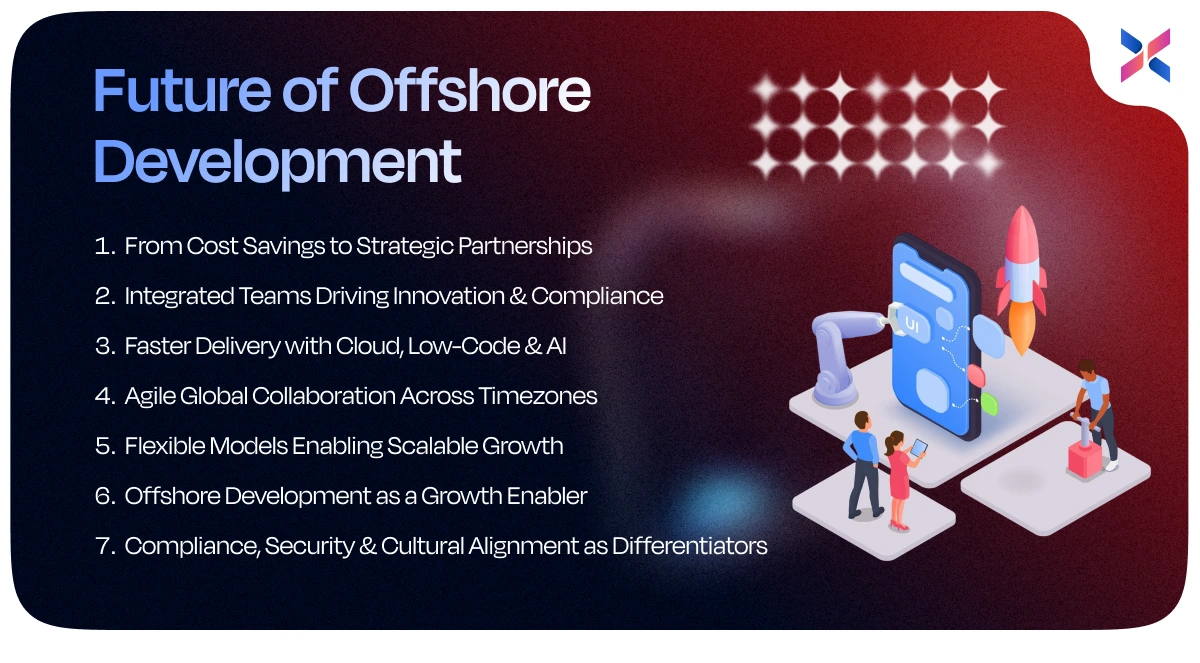
The offshore development landscape is fast-evolving and you must stay ahead of the curve to get competitive outcomes. While traditional outsourcing focused on cost savings, the future is about strategic partnerships, niche skills and scalability.
Offshore IT teams act as an integrated extension of your in-house team, contributing towards the domain knowledge, innovation requirements and compliance needs.
With technological advancements like cloud-native architecture, low-code platforms and AI-backed development, offshore IT teams are able to deliver faster outputs with reduced risks and better alignment with end goals. Global collaboration tools with agile frameworks are helping them break through the barriers like time zones to provide 24/7 development.
Their ability to deliver compliance, security and cultural alignment have become the key differentiator to choose the right partners. You will rely on the flexible delivery models, one that quickly adapts to your evolving needs.
Consequently, offshore development will shift from a pure operational aspect to a growth enabler, helping you scale efficiently and deliver client-centric products. By embracing it, you will be leading the app development ecosystem.
Frequently Asked Questions
Here are some clear answers to popular questions that will guide your decisions and optimize partnerships.
#1. Which delivery model is best for consultants managing multiple clients?
You can either use milestone-based or monthly-hire models to handle multiple clients. Both these models offer flexibility, help with clear progress tracking and efficiently scale resources. You can manage diverse clients without overloading the teams or compromising on quality.
#2. How can offshore teams ensure compliance with GDPR or HIPAA?
When you integrate compliance into development from the start, you use secure coding, adhering to regulatory frameworks and detailed documentation. It can help you stay audit-ready and release an app that meets the legal standards consistently.
#3. What’s the first step to testing an offshore partnership?
You can start small with a proof-of-concept or MVP to test your offshore partnership. It will help you validate the quality of their solutions, communication protocols, responsiveness and reliability before you scale the team for full-scale development.
#4. How do white-label services work in consultant-offshore relationships?
Offshore teams offer branded solutions under the consultant’s name, which allows the consultant to maintain the client relationships. The offshore team will be helping them with design, development and deployment.
#5. What’s the ROI of using offshore MVP development teams?
By using offshore MVP development teams, you can reduce costs, limit the risks, accelerate time-to-market and validate ideas quickly. Faster iteration means lower overheads which directly translates to better ROI.
Conclusion
Scaling app development with an offshore team isn’t just about cutting the costs; it is about unlocking the ability to stay on speed, access talent and gain strategic flexibility. When you embrace this development model, you can deliver a model and grow sustainably. You must align the right delivery models with the regions and compliance practices to ensure offshore partnerships are growth accelerators.
Expert App Devs offers professional mobile app development services across Android, iOS, Flutter, React Native, and other cross-platform technologies. We deliver high-performance native and hybrid mobile solutions tailored for startups and enterprises. In addition to end-to-end development, we provide a full range of application services, including maintenance, support, and ready-made solutions to clients in North America, Europe, the Middle East, and Oceania through strategic outsourcing from India. We also welcome new consultants from these regions to partner with us and explore collaborative opportunities.
If you want a free consultation to determine if the offshore model meets your project needs, you can connect with our team. Get in touch to schedule a free consultation.





 163
163

 0
0


 209
0
209
0
 205
0
205
0
 153
0
153
0