



Ready to transform your vision into reality?
Get Started
AI Features That Elevate Engagement and Retention in E-Learning Mobile Apps
 285
285
 11
04 Aug 2025
Min Read
11
04 Aug 2025
Min Read


 Share
Share

 Download PDF
After COVID, online learning has become the new form of education. It has become one of the growing businesses after 2000, i.e., by 900%. In 2024, the global e-learning market was a $299.67 billion industry, and by 2030, it's expected to reach nearly $842.64 billion. 70% of students believe online learning is better than classroom-based methods, and 63% of U.S. students are already studying through online platforms on their daily basis.
Today’s learning apps give users a lot of flexibility, i.e, you can skip modules, jump ahead, or binge-watch an entire course at once. This might seem convenient, but it actually creates a problem. Without real-time feedback or a personalized learning path, most learners don’t absorb the content properly. Everyone learns differently at different speeds. AI in education apps can fulfill the unique needs of every student by providing personalized attention.
If you're thinking about using AI in your learning app, then you must explore this blog to know the helpful features to boost learning and keep users engaged.
The Problem: Why Traditional E-Learning Approaches Are Failing?
There are vast amounts of reasons why traditional e-learning isn’t working. It may be real-time feedback, interaction, absence of personalized content, adaptive learning, and so on. There’s no denying that Web-based education has made getting educated more flexible and convenient, as anyone can study from any corner of the earth.
However, online learning still doesn't have that personal touch that students get in a physical classroom.
So this clearly shows, the main gap is “real-time interactions and personalized attention,”.
Here are some of the reasons why traditional e-learning apps fail.
- Users may create an account but never use it or return back. Because there’s no strong onboarding or reason to stay.
- Learners binge-watch videos but don’t really understand or remember the content.
- No real-time feedback means students don’t know if they’re doing well or not.
- No personalized learning paths. Everyone sees the same content.
- Mid-course drop-offs happen when learners feel lost or unmotivated.
- Progress bars and badges show completion, not real understanding or progress.
- Apps don’t adapt to different learning styles (visual, hands-on, etc.).
- Too much irrelevant content. Learners often see content that doesn't match their goals.
- Admins and instructors can’t see who’s struggling.
The Role of AI in Transforming Learning
The world is achieving progress with the help of AI. Today, if you see, each and every industry uses AI in some or another. AI in education apps can help learners learn like a personal tutor from the comfort of their home.
It helps to learn how different users learns and understand the concept to recommend a personalized learning module based on their mood, learning capabilities, strengths, and other weaknesses. Other than this, it can track progress, find struggles of learners to know what works for them and what does not.
Many popular education apps already use AI as their Intelligent Tutoring System and have seen good results in terms of delivery, engagement and outcomes.
Top 10 AI Features Every E-Learning App Needs to Succeed
If you are building an edtech app or improving an existing one, you must implement these AI features in your e-learning app.
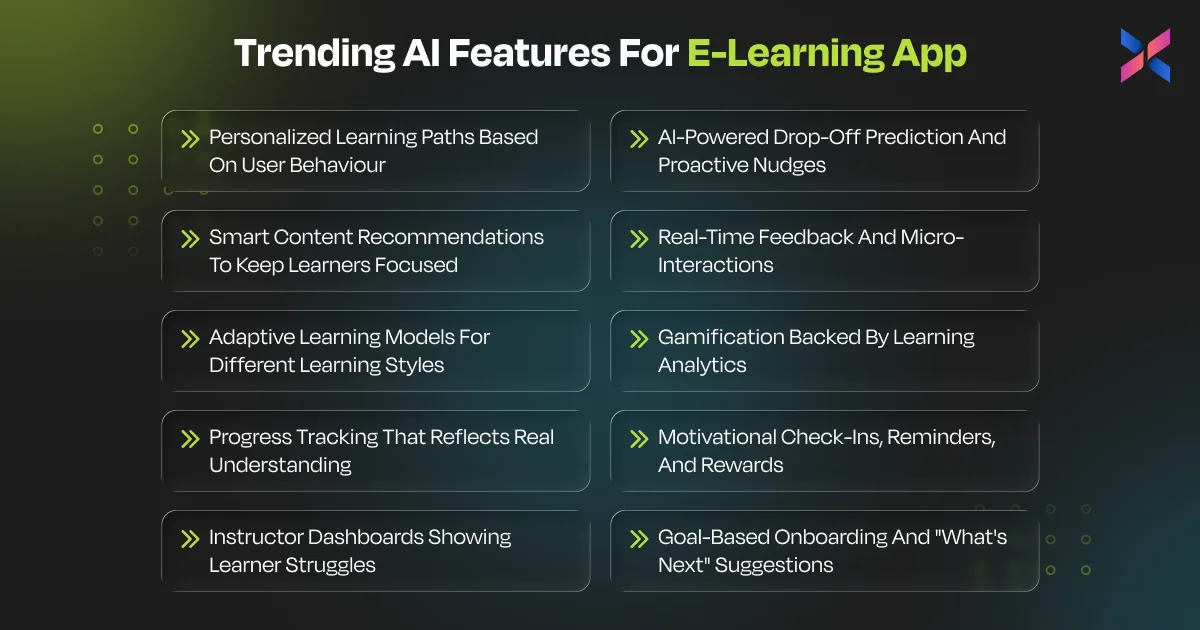
#1. Personalized Learning Paths Based On User Behaviour
Users will only keep using the app if the app feels familiar to them. AI can be a helpful tool to analyze how a student is utilizing the app. This enables you to see what they are good at, where they are struggling, and which concepts they are having difficulty. You can train AI models to create a learning environment that understands students' learning issues and solves problems like a teacher.
#2. AI-Powered Drop-Off Prediction and Proactive Nudges
The most common cause of user drop-off is that your app is not engaging. Educational apps should be less comprehensive and interactive enough to keep students attracted till the end of the courses. The learner's behavior can be tracked by the AI, and the user is notified if the learner has logged in or missed taking a lesson.
When it notices the slightest hint, the app will send out a reminder or a cheering message, something like "Life gets busy, we get it! Ready to get back on track? Your next lesson is waiting for you." Such small efforts and reminders can help pull students back and get them to keep trying to learn.
#3. Smart Content Recommendations To Keep Learners Focused
With data curated from user profiles, AI can recommend videos, quizzes, or segments based on what a student may have already learned or had trouble with. You could also list topics or courses that students could take to advance in a field that interests them.
Thanks to the smart content recommendation, you will not waste time reading useless information. and not waste time on unnecessary things.
#4. Real-Time Feedback And Micro-Interactions
AI can quickly give a review about individual learners by looking at the profile, subjects, or topics completed. It will analyze every minor detail like Time taken to complete a specific subject, method of working, writing style and much more to polish the learning.
Hence, with real-time interactions, students can easily fix mistakes and understand concepts better.
#5. Adaptive Learning Models For Different Learning Styles
Every student learns differently. Some like reading, others prefer videos or practice exercises. AI can recognize how a student learns best and adjust the content accordingly. If someone learns better visually, the app might show more videos and diagrams. If any students learn better with quizzes or reading material, it can recommend that.
This means learners can flexibly learn by their favorite technique rather than being forced to follow one boring approach.
#6. Gamification Backed By Learning Analytics
We all like to play games, but isn’t it great if learning comes with exciting games? You can turn the complex courses into a game by dividing them into levels. AI can analyze the users' data by offering random points and badges based on performance and learning.
#7. Progress Tracking That Reflects Real Understanding
Classic progress bars simply display how much content a student has completed, not whether they were successful in mastering the material. Real progress can be monitored by AI-powered apps and an accurate picture provided about the learner by analyzing quiz scores, engagement levels, and learning behaviour.
This makes it easier to see what students know and what work is left. It helps students and teachers know how much the learner has really accomplished, not just how much they’ve watched or clicked.
#8. Motivational Check-ins, Reminders, And Rewards
Sometimes, students need a little push to keep going. AI can schedule check-ins, send reminders when a student misses a session, or offer rewards for completing milestones. These thoughtful touches make learners feel supported. Whether it’s a motivational quote, a congratulatory message, or a small badge, these AI-driven interactions keep students coming back and help build consistent learning habits.
#9. Instructor Dashboards Showing Learner Struggles
It's impossible for teachers to give attention to each and every student. But with AI, it is no longer a headache. AI can be used to collect students' data and show it to the teachers' dashboard to understand how many students are able to learn and how many face difficulties.
Based on these insights, teachers can adapt different teaching styles by looking at the personalized student dashboard.
#10. Goal-Based Onboarding and “What’s Next” Suggestions
Goal-based onboarding is one of the most useful ways to onboard new users without confusing them. Here, AI is used to ask useful questions to users like what's the purpose of their learning, their interest in subjects, topics, weak subjects, etc, to personalize the learning better and focus more on weak points.
As users get used to using the app, AI can be used to suggest the next step using the tool tip to what’s next, so the users never feel stuck using the app.
How To Implement AI Features In The Learning App?
Here is the step-by-step guide to implement the AI Features in any Education App. Read each step one by one.
#1. Where to Start: Priorities for New vs. Existing Apps
If you're building a new app, start with AI features that add the most value, like personalized learning paths or smart content recommendations. For existing apps, begin by analyzing user behavior, and see where users drop off or get stuck. Then add AI tools gradually, like chatbots for FAQs or performance tracking features.
Focus on areas that improve learner engagement first. Always test new AI features with a small group of users before a full rollout. This helps you adjust and improve the app experience.
#2. Integrating AI with Your Current Tech Stack
AI can be easily integrated with your current app or website. You just need to have an experienced app developer who knows how to develop custom AI models and knows how to integrate it.
Most AI tools and services can be connected to your existing backend through APIs. Platforms like Google Cloud, AWS, and OpenAI offer AI services for language processing, personalization, and analytics.
Make sure the AI works well with your database, content system, and mobile app code. Start with one or two features, like a recommendation engine, before scaling up to more complex functions.
#3. Balancing AI Automation with Human-Led Instruction
AI can do some amazing stuff, but it works best when you use it in concert with actual human labor. You can use AI to automate some of the work that feels repetitive, such as grading, tracking student progress or answering FAQs.
For example, AI can suggest assignments or identify struggling students, and then notify teachers to offer help.
This kind of mix between automation and human touch is how you build trust and make learning more effective. And always offer a real person that learners can talk to if they want.
#4. Example Use Case or Step-by-Step Flow
For instance, suppose you would like to introduce a custom learning path. First, monitor how each student is using the site, what lessons they finish, where they get stuck, and how often they log on. Then employ AI to interpret that data and recommend the next best module, practice quiz, or video. Clearly present these recommendations in the app with a “Next Step” label.
You can also use a chatbot tutor to explain the suggestions. Over time, the AI will keep adjusting the path based on progress. This helps users stay focused and feel like the app understands their needs.
Real-World Examples of AI in E-Learning
Previously, we saw examples of Coursera and Khan Academy and how they use AI for enhanced learning. Let's take a look at some more real-world examples to understand how AI is making learning easier day by day.
#1. Coursera
One of the popular online platforms that is currently using AI in several ways is Coursera. They include personalized learning paths, as well as AI-driven coaching and AI-translation services. They employ AI to see what students have studied and how they did. Then, it provides clever course recommendations from that information. This enables the user to find the most appropriate content and can learn without feeling distracted.
They use machine learning to launch courses in multiple languages with AI-powered translation and subtitles. Their AI coaching is effective in answering learners’ questions and doubts.
#2. Khan Academy
Khan Academy is among the top online learning platforms founded by Sal Khan. It is a non-profit organization that offers free education worldwide. It has Khanmigo, which is an AI-powered teaching assistant that helps students one-on-one to feel like personalized teaching, similar to traditional classrooms. It gives instant feedback on student work, offers helpful suggestions, and even helps teachers plan the syllabus according to the students’ progress.
Here's how Khan Academy uses AI for an enhanced learning experience:
- Personalized Learning: It uses AI to check how students are doing and change the difficulty of exercises in real time.
- Smart Content Recommendations: If a student struggles with a specific topic, the AI will suggest videos or exercises to practice on that topic.
- Instant Feedback: Based on how students are performing, AI will give grades, tasks by explaining mistakes like a coach.
- Writing Help: They also have an AI writing coach to help students improve their writing with useful suggestions.
- Teacher Support: Not only for students, Khan Academy also uses AI for teachers to plan their schedule, create student groups, theories, etc.
- Customized Learning Paths: They use AI to create personalized learning for every student.
- Ethical and Safe AI: Khan Academy is also careful about how AI is used. They follow clear rules and listen to feedback from teachers and students to keep things safe and fair.
READ MORE: AI-Based Language Learning App Development: Personalized EdTech Solutions
Conclusion: AI-Powered E-Learning
We hope you found this blog helpful in understanding how AI plays an irreplaceable role in improving students' learning. As AI is growing, it is becoming a powerful tool in the online education industry to offer personalized learning.
A recent survey has found that students' test scores improved by 62% with an AI-based adaptive learning program. In the upcoming years, AI will make learning more personal and effective. As education keeps changing, you must adapt to an intelligent teaching method to stay unique from others in the learning industry.
Consider the above AI features if you are planning to integrate AI-based learning in your existing app or are thinking of developing from scratch. This investment will surely pay you off with attractive business growth and ROI.
Schedule free consultations today for your Project. At Expert App Devs, we are happy to help you and provide all types of application services, including maintenance, support, and ready-made solutions, to clients in North America, Europe, the Middle East, and Oceania through outsourcing from India. We also welcome new consultants from these regions to collaborate with us.






 271
271

 0
0


 260
0
260
0
 317
1
317
1
 239
0
239
0