



- Introduction: The Real Offshore Problem Enterprises Don’t Talk About
- TL;DR
- Offshore Talent vs Execution Design (Why Most Teams Fail)
- Enterprise Offshore Operating Models That Actually Work
- Role Clarity & Decision Rights (The #1 Success Factor)
- Communication Across Time Zones Without Slowing Delivery
- Governance, Reporting & Accountability Frameworks
- Communication Rhythms That Actually Work Across Time Zones
- Governance Metrics Enterprise Leaders Should Track
- Offshore Partnership Maturity Model
- Enterprise Offshore Success Checklist
- How to Evaluate Offshore Development Partners (Enterprise Vetting Framework)
- Costing & Budget Planning for Offshore Teams
- How Enterprise Offshore Delivery Is Evolving
- How to Turn Offshore Teams into Long-Term Product Partners?
- What Enterprise Leaders Should Look for in Offshore Delivery Partners?
- Enterprise Offshore Success Checklist
- FAQs
- Conclusion
Ready to transform your vision into reality?
Get Started
How Enterprises Manage Offshore Development Teams Successfully?
 320
320
 1
09 Mar 2026
43 Min Read
1
09 Mar 2026
43 Min Read


 Share
Share

 Download PDF
Introduction: The Real Offshore Problem Enterprises Don’t Talk About
Nearly 70% of the offshore initiatives underperform and nobody talks about them. The real reason behind the failure isn’t cost or geography; it fails because enterprises treat them as basic outsourcing contracts.
Most of you implement the wrong operating model, start with unclear ownership and lay the foundation of offshore development on weak governance. This occurs because you are partnering with a vendor mindset instead of a partner mindset.
If you are a team lead or key decision maker, you are aware that offshore development isn’t about sending tasks to another company. It is about designing a distributed team that works as one.
The offshore development companies team should be an extension of your in-house capability that work remotely but share the vision. Strategically, an offshore development team can become more than staff augmentation for your business.
In this article, we will take you through how enterprises can manage a successful offshore development partnership.
TL;DR
- Structured offshore development team management improves delivery predictability, product ownership and enterprise scalability.
- Enterprises achieve 40 to 60% cost efficiency while maintaining strong engineering depth and faster scaling.
- Use dedicated pods, clear ownership, async communication and governance metrics to run distributed engineering teams.
- Avoid vendor-style outsourcing, unclear decision rights and weak governance frameworks that cause delays and rework.
- Build long-term offshore partnerships with defined KPIs, delivery governance and outcome-based engagement models.
Offshore Talent vs Execution Design (Why Most Teams Fail)
Most of you assume that offshore success starts with hiring strong dedicated developers. However, talent alone doesn’t guarantee successful execution. Talent-backed hiring model will focus on adding engineers, assigning them tasks and tracking the metrics.
It is the execution-based model that lets you build a structured delivery approach. It ensures clear outcome ownerships, release accountability, architectural supervision and defined governance layers. In this model, you will design how work flows from inspiration to deployment.
|
Talent Based |
Execution Based |
|
Hire the team |
Build a delivery system |
|
Assign tasks |
Offer outcome ownership |
|
Reactive reporting |
Aligned with governance |
|
Vendor mindset |
Takes product ownership |
Reporting is reactive and ownership is fragmented between offshore and onsite teams in a talent-based setup. However, in an execution-driven model, the offshore app development teams are part of sprint planning, quality benchmarks, roadmap discussions and release cycles.
The two teams will share the product ownership and are equally accountable for the outcomes. The right structure will ensure that offshore offers scalable and strategic advantage.
Common Enterprise Problems
- In the absence of clear roles and responsibilities, issues occur between the teams. As no single person offers a resolution, the decision-making slows down.
- Requirements are passed as tickets without context. Eventually, offshore teams will execute the tasks without a proper understanding of user impact, causing misalignment and rework.
- There are no structured overlap windows or escalation protocols that result in multi-day delays for small issues.
- If the requirement is not clear and architectural guidance is limited, it can increase corrections and draining velocity.
- If there is no integrated release governance, it can increase missed deadlines and last-minute issues.
- When you don’t have shared standards or review frameworks, output will vary according to the developer working on it.
In short, offshore doesn’t fail because of a lack of talent; it fails because you scale talent without designing the execution.
Enterprise Offshore Operating Models That Actually Work
Once you have hired the talent and started designing execution, you should understand which structure will work. Enterprises have identified and refined a few operating models that have delivered consistent results with proper implementation. We will be discussing these models in detail here.
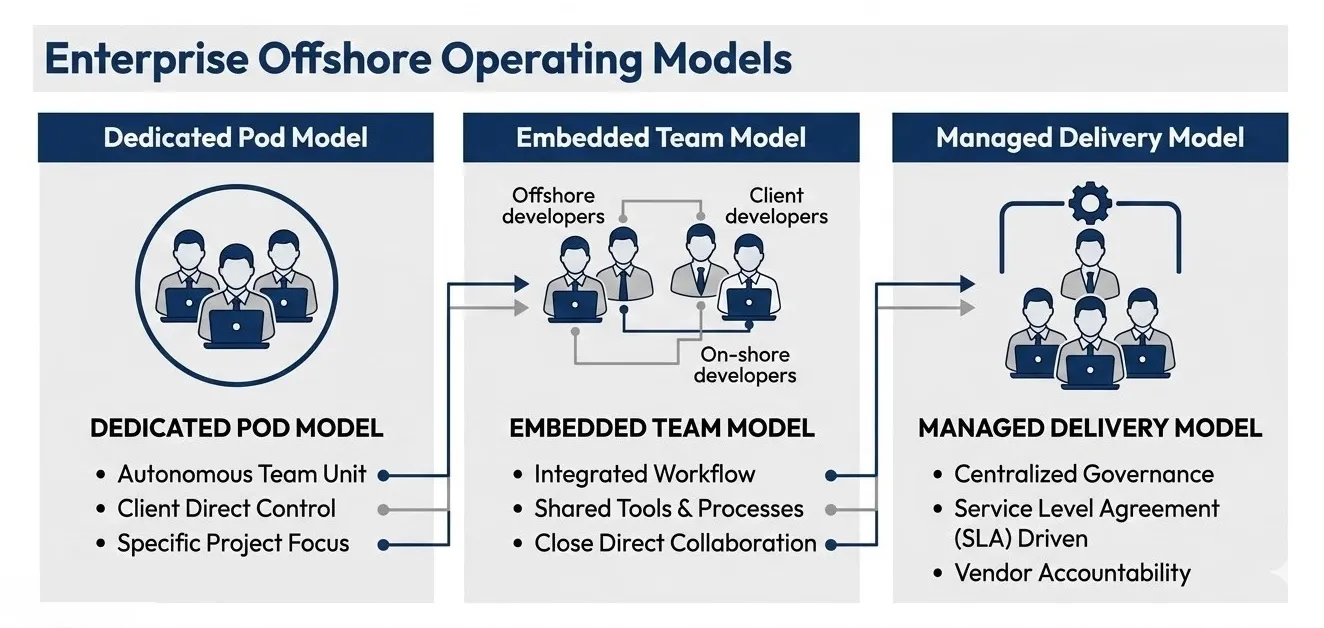
1. Dedicated POD Model (Most effective)
This is the gold standard for scaling your offshore team sustainably. You build a cross-functional squad comprising developers, QA, DevOps and even product owners aligned with a particular product aspect. They will own the entire feature, from refinement to release. As the team is built for the long term, the knowledge compounds, velocity enhances and accountability is stronger. It is best for enterprises building long-term products or platforms, requiring stability and in-depth understanding.
2. Embedded Team Model
In this model, your offshore engineers are embedded into the existing teams. They will part of the daily standups, sprint planning and roadmap discussions, contributing equally to these aspects. Instead of operating as a separate unit, they would function as a distributed team member within the core structure. Best suited for mature agile teams that need to expand rapidly without restructuring delivery governance.
3. Managed Delivery Model
This is where the offshore development partner owns the delivery roadmap. You will be driving outcomes instead of managing teams of engineers. Moreover, the governance, execution planning and even QA will be part of your partner’s deliverables while internal teams will work on strategy and alignment. Suited for enterprises that want execution accountability with minimal overhead. Works best for defined scopes.
Role Clarity & Decision Rights (The #1 Success Factor)
Role clarity is crucial if you want a successful offshore execution. It’s not tools or talent but clear decision rights that brings forth success at the end of this partnership.
Define ownership clearly before you scale your team
|
Role |
Owner |
|
Architecture |
Enterprise |
|
Sprint Delivery |
Offshore Team |
|
Product Decisions |
Product Owner |
|
DevOps |
Shared |
|
Quality |
Offshore +Internal QA |
Using this structure, you can remove ambiguity. Moreover, architectures will be aligned with enterprise standards, ensuring offshore teams own sprint commitments not just task execution.
While the product decisions are centralized to avoid roadmap shifts, DevOps is shared for aligned deployment. Quality is also a joint accountability.
You can use the RACI (Responsible, Accountable, Consulted, Informed) model to operationalize this. This means you must have a clear, accountable owner for each major activity like feature design, release approval or incident resolution. While multiple teams can be responsible, only one will have the authority.
Clear decision rights can help accelerate execution. That’s why you must formalize the ownership in the early stages to build offshore systems that scale effectively.
Communication Across Time Zones Without Slowing Delivery
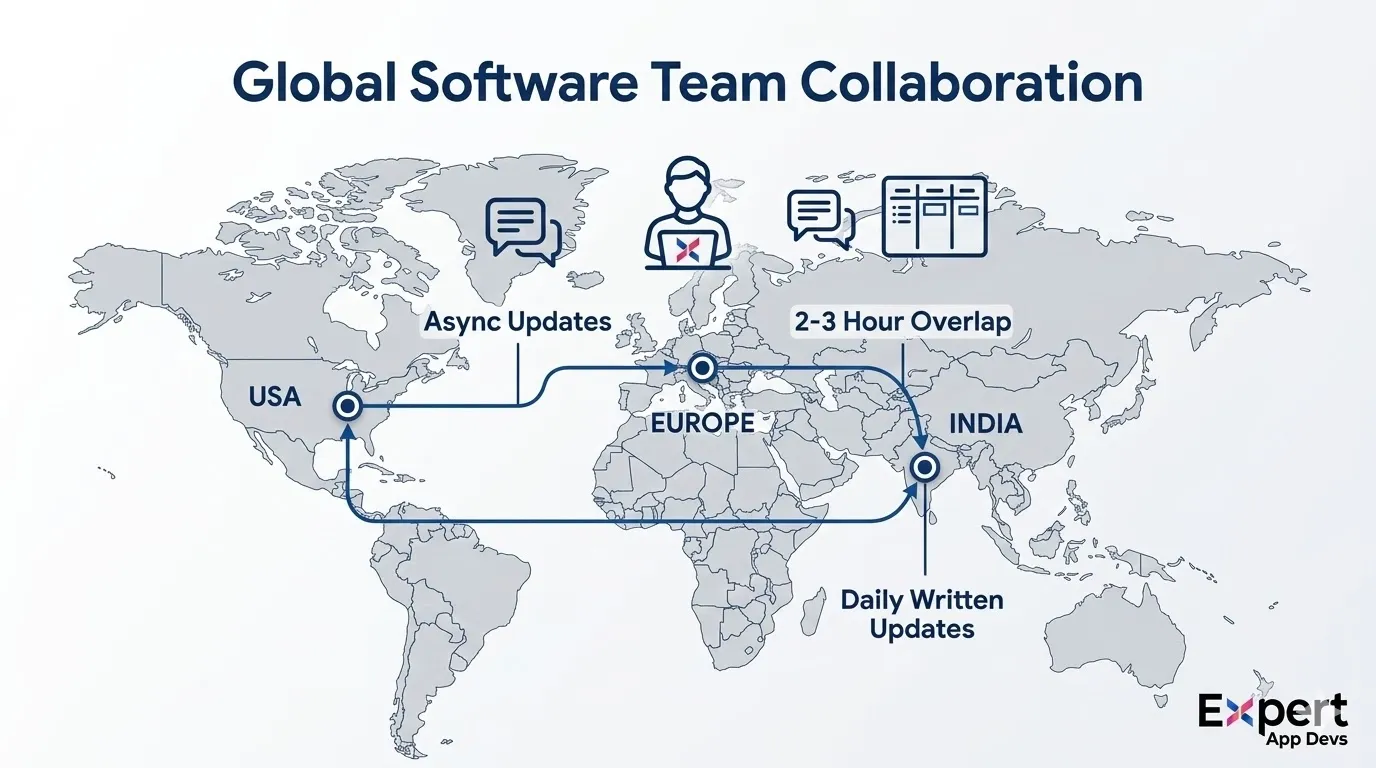
Different time zones don’t slow deliveries; it is poor communication design that does. Modern offshore enterprises are gradually shifting towards async-first workflows that prioritizes clarity over continuous communication.
It’s simple, less calls equal to more clarity.
Instead of relying on overlapping calendars, your teams should document detailed specs before execution. You should specify the product requirements clearly, mention the acceptance criteria and log the architectural decisions in shared systems.
Replace long calls with short loom videos, and allow your teams to absorb the context at their availability. Summarize blockers, progress and even next steps using written updates to reduce ambiguity.
Have intention and limited overlap time for sprint planning or decision making while letting most things run asynchronously.
You can even have tools to do the heavy lifting. For example, Jira workflows can track status and Slack channels can be structured by feature or releases. You should use reporting dashboards intead of status meetings.
With these few tweaks, you can enjoy less interruptions and deeper focus on work. By mastering distributed communication, you create systems that allows information flow seamlessly.
Governance, Reporting & Accountability Frameworks
This is the point where offshore models should be different from the vendor-managed solutions. Governance should not be thought of as micromanagement. Instead, it should be considered as a structured system that builds visibility, control and predictability without slowing execution.
Here’s a concrete three-layer framework you can use to define governance.
Layer 1- Delivery Metrics (Operational Health)
This layer measures if the sprints are running efficiently. You can also use it to monitor the workload balance, spillover trends and dependency patterns. Consistency indicates signal stability while volatility indicates structural issues. Operational health metrics let you intervene early before the minor execution gaps become systemic failures.
Layer 2- Quality and Risk Controls (Stability Guardrails)
This layer ensures that scaling doesn’t compromise standards. You can use the layer to determine defects and security vulnerabilities along with technical debt accumulation and regression frequency. Governance becomes proactive with this layer.
Layer 3- Executive Visibility (Strategic Confidence)
This layer will connect offshore delivery with business outcomes, establishing leadership can forecast with confidence. The layer will offer milestone forecasting, risk heatmaps and roadmap predictability scoring.
By combining these layers, you can ensure offshore delivery is measurable, predictable and aligned with enterprise strategy.
Delivery Governance Stack
You should think of it as a layered visibility, from sprint health to enterprise risk.
Sprint Velocity Tracking: Track committed vs completed work across sprints. The goal here is to measure speed along with predictability and stability with time.
Lead Time: Measure how long it takes to move the feature from backlog to production. Shorter and consistent lead times indicate maturity
Defect Density: Monitor defects for each release or story point. In case the defect rates are increasing, it indicates architectural or requirement clarity gaps.
Deployment Frequency: Frequent and smaller releases reduce risk while improving responsiveness. Infrequent deployments signal increasing bottlenecks.
SLA Adherence: Track if the delivery timelines and support commitments are honored to build contractual and operational trust.
Security Audits: Review periodically to ensure your offshore code aligns with enterprise compliance and data protection standards.
Code Review Standards: Institutionalize peer reviews with architectural approvals to ensure proper quality irrespective of who develops it.
Reporting that Builds Confidence
Executives don’t need daily status updates; they need foresight.
Weekly Executive Summary: With this concise narrative, you can check what has moved forward, what’s blocked and what leadership needs to know
Monthly Roadmap Health Review: This aligns offshore delivery with quarterly objectives to ensure strategic initiatives are on track.
Active Risk Log: Document the known risks with mitigation owners to offer transparency that reduces escalation issues.
Budget vs Burn Rate Tracking: Financial discipline matters which is why you should monitor forecast against actual spend.
Structuring governance in this way can ensure delivery is measurable, controlled and scalable.
Communication Rhythms That Actually Work Across Time Zones
With async-first workflows, you can reduce timezone friction while increasing productivity. More meetings will not improve delivery; only better systems can. Distributed enterprises will succeed only when communication flows a clear rhythm.
Daily → async updates: Your team members should post structured written updates that showcase progress, blockers and next steps to ensure visibility without forced overlap.
Weekly → sprint review: Focused session to demonstrate completed work, review metrics and bottlenecks, reinforcing accountability and delivery quality.
Biweekly → roadmap planning: Align the upcoming priorities, clarify requirements and confirm capacity allocation across teams.
Monthly → executive summary: Leadership gets concise performance review with delivery health, risks and milestone progress.
Quarterly → strategy review: You can reassess the goals, architectural direction and scaling plans to create offshore strategy that supports business growth.
You can reduce timezone friction while protecting deep work time and enhancing productivity with async workflows.
Governance Metrics Enterprise Leaders Should Track
You must track outcomes instead of activity. The total hours logged and ticket counts may not reflect delivery health; only execution will.
- sprint velocity: Is delivery consistent across cycles?
- lead time: Know how fast ideas reach production stage
- deployment frequency: Know if releases are steady and controlled
- defect density: Check if quality improves with time
- SLA adherence: Learn if commitments are reliably met
- budget vs burn: Check if financial tracking is aligned with forecasts
- attrition rate: Know if offshore development team stability is strong
- roadmap predictability: Determine if the strategic milestones are delivered as per plan
With these metrics, you gain confidence in both offshore scalability and control.
Offshore Partnership Maturity Model
Offshore relationships evolve via predictable stages.
- Vendor: Offer task-based execution with limited ownership
- Managed Delivery: Outcome-backed engagement with complete SLA accountability
- Dedicated Team: Stable and embedded squads are aligned with product goals
- Product Partner: Strategic collaboration using shared roadmap ownership with innovation input
The last two stages define sustainable and long-term value for your business. When your offshore team goes beyond transactional delivery to become an integrated contributor in architecture, planning and product direction, the performance enhances. Enterprises that embrace offshore teams as their strategic extension see 2X better delivery outcomes.
Enterprise Offshore Success Checklist
Before you scale offshore delivery, you must pause and pressure-test the foundation. Most often, you struggle with offshore not because of weak development teams, but because you expand without structure. Scaling talent in the absence of governance is operational risk veiled as growth.
- Ownership Defined: You must document decision rights across architecture, sprint delivery, quality control and product direction as every workflow needs an accountable owner.
- KPIs aligned: You should use metrics that reflect outcomes like velocity stability, defect trends and lead times instead of activity metrics.
- Governance Model Set: Formalize the escalation paths, review layers and risk controls before complexity rises
- Reporting Cadence Fixed: Define weekly operational updates, monthly roadmap reviews and quarterly strategic evaluations in advance
- Security Compliance Ready: Audit standards, access controls, data governance and even regulatory requirements should be validated proactively
- Dedicated Pods Formed: Create long-term cross-functional teams with roadmap continuity to outperform rotating and transactional staffing models
If you haven’t ensured proper foundations, offshore will struggle irrespective of your teams
These are the results you get by laying a proper foundation:
- Clear performance metrics
- Scalable execution frameworks
- Stronger executive credibility
- Enterprise-grade authority
- Better stakeholder confidence
- Improved conversion impact
How to Evaluate Offshore Development Partners (Enterprise Vetting Framework)
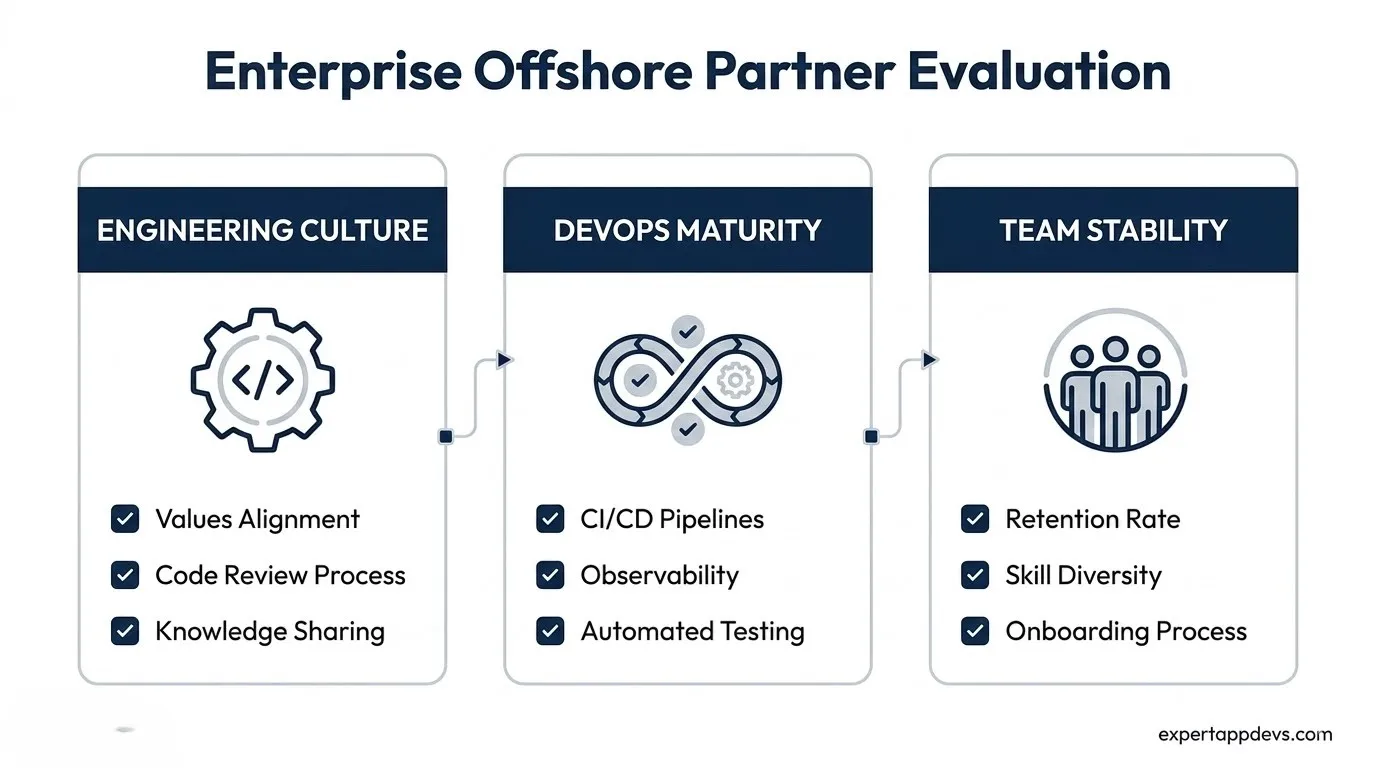
Choosing the right offshore development partner isn’t just about comparing hourly rates; it is about evaluating whether they can support enterprise-grade delivery under complexity and scrutiny. Here is a detailed enterprise vetting framework, comprising three layers- enterprise assessment criteria, red flags to avoid and questions to ask.
Enterprise Assessment Criteria
Here is the three-step structure for assessing enterprise acceptance.
- Engineering Culture: Strong partners will invest in technical depth. You should ask them if they contribute to open-source projects or run internal communities of practice. If they have a mature engineering culture, they will prioritize standards, architectural discipline and peer learning.
- DevOps Maturity: Ask them to walk you through their CI/CD pipeline. The enterprise-ready team would automate builds, testing and deployments. If they have a manual deployment process, it signals operational fragility.
- Attrition Data: Check with them if they have a 12-month developer retention rate. High churn can disrupt knowledge continuity and slow velocity while increasing long-term delivery risk.
Read Flags to Avoid
- The “Yes” Men: Partners who agree with every feature, scope change and unrealistic deadline might lack strategic depth
- Lack of Architecture Leadership: If they provide developers without senior architects, it will increase technical debt
- Opaque Security Practices: An enterprise-ready partner should offer documented IP protection policies along with SOC2 and ISO compliance proof without hesitation.
Questions to Ask During Evaluation
- What is the knowledge transfer process in case key developer exits mid-way?
- How would you resolve conflicts between offshore leads and product owner?
- Can you demonstrate automated testing coverage from a recent enterprise requirement?
Evaluation is the most critical phase of the offshore journey. With the right partner, you can ensure transparency and demonstrate governance maturity.
Costing & Budget Planning for Offshore Teams
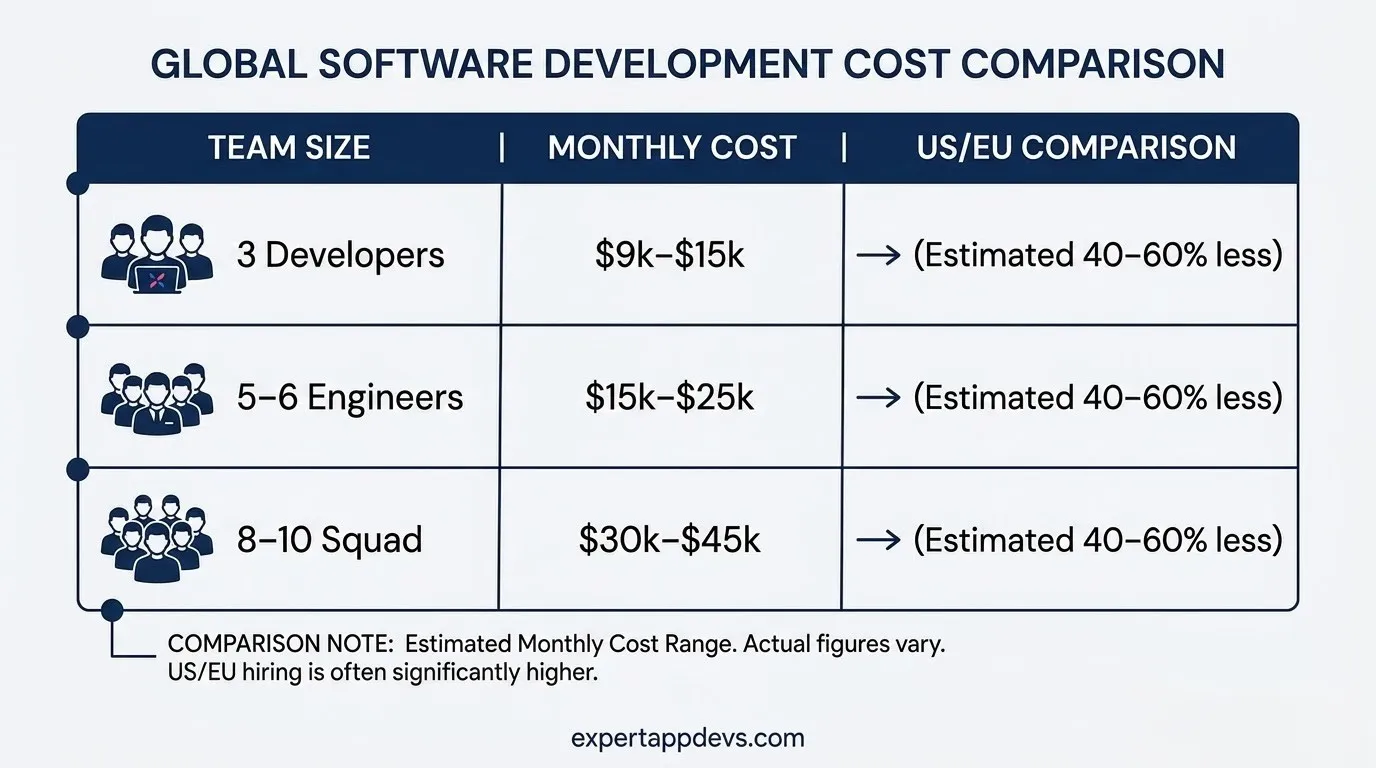
Budget clarity is crucial before you scale your offshore delivery team. While pricing may vary by expertise and engagement depth, Indian dedicated teams follow these ballpark ranges. This will give you an insight into the approximate charges.
Ballpark Costs for India Dedicated Teams
|
Team Size |
Monthly Cost |
|
3 Dev Pod |
$9k to $15k |
|
5-6 Engineers |
$15k to $25k |
|
Full Squad with 8-10 members including QA, PM and DevOps |
$30k to $45k |
These ranges reflect a structured and long-term engagement model instead of ad-hoc freelancers. If you hire integrated and cross-functional teams, you gain higher strategic value with delivery ownership.
The offshore teams cost 40-60% less when compared with the hiring equivalent of US and EU. Additionally, they offer strong engineering depth. But, cost-savings cannot be the sole driver; you must consider operational efficiency as well.
You can eliminate heavy recruitment costs, agency fees and long hiring cycles with offshore hiring. Moreover, it lets you scale your teams in weeks instead of months. Capacity being flexible lets you scale pods up or down as per your roadmap requirements.
Combining budget planning with cost efficiency helps you manage governance and delivery design, creating a strategically scalable offshore partnership.
How Enterprise Offshore Delivery Is Evolving
Offshore delivery isn’t just about accessing global talent; it is also about designing technology-enabled, AI-accelerated and outcome-driven ecosystem. Here are some of the trends that help offshore models evolve beyond traditional execution.
1. AI-Assisted Coding & Reviews
Using AI-powered code generation, intelligent testing and automated reviews allows you to accelerate development cycles. Offshore teams integrate AI copilots to improve documentation and standardize output, letting engineers focus on architecture, optimization and problem-solving.
2. Async-First Global Teams
Enterprises are designing async workflows that minimize overlap dependency. This also helps use structured documentation, automation and recorded collaboration tools instead of constant meetings to ensure smooth operations across continents.
3. 24/7 Delivery Cycles
Using follow-the-sun models, you can track progress across time zones. Add to the mix structured handoffs and documented workflows, you can get faster turnaround times while reducing bottlenecks caused by geographic constraints.
4. DevSecOps Automation
Security is embedded into the CI/CD pipeline. Features like automated vulnerability, compliance checks and policy enforcement offers enterprise-grade protection without slowing down releases or increasing manual oversight.
5. Platform Engineering
Enterprises are creating internal platforms to standardize infrastructure, tooling and workflows to avoid isolated teams. Offshore teams are contributing towards shared engineering platforms to improve scalability.
6. Product Pods vs Staff Augmentation
Dedicated product pods with outcome ownership can outperform staff augmentation models. Enterprises prefer implementing stable squads aligned with their business domains instead of rotating developers as per the needs.
7. Outcome-Based Contracts
More enterprises are entering into milestone or SLA-based contracts with their offshore partners. This ensures the partnership is structured around measurable business outcomes rather than efforts.
8. Nearshore + Offshore Hybrid
Enterprises can combine nearshore leadership with offshore execution to blend collaboration with proximity and cost-efficiency. These hybrid models can optimize responsiveness while ensuring scalability.
9. AI/IoT/AR Specialization
Offshore teams are going beyond general development to embrace advanced technologies like AI systems, IoT infrastructure and AR platforms. This enables you to innovate at speed without expanding your R&D teams.
How to Turn Offshore Teams into Long-Term Product Partners?
The biggest transformation in offshore success happens when your relationship with the team goes from vendor to ownership. Vendors will execute tasks while partners align with the outcomes. However, it is the product partner that shares accountability for long-term success. This shift needs to be engineered. Here’s how you can get started.
- Start with a 12+ month engagement with the company. If you begin with a long-term contract, it will ensure stability, reduce attrition and compound knowledge. Short-term scopes can reinforce transactional behavior.
- Implement shared OKRs like release goals, performance benchmarks and product adoption so that you can measure the in-house and offshore teams against same goals. This will make them think beyond tickets.
- Don’t just give the teams sprint-level tasks. Instead, share quarterly and annual strategies with them to fuel ownership.
- Introduce innovation sprints by allocating time for architectural improvements and automation ideas. This will make them think beyond execution
- Lastly, invest in retention strategy. You must recognize the performance and create leadership pathways to reduce team rotations.
If your offshore team is embedded into the product journey, they will no longer be service providers; instead, they will become product stakeholders.
What Enterprise Leaders Should Look for in Offshore Delivery Partners?
Partnering with the right offshore delivery requires detailed evaluation. You should assess the structural strength along with pricing and team size.
Must-have Criteria
Here is a detailed checklist that must ensure all ticks before making the choice.
Proven Enterprise Experience: The partner company should be able to demonstrate delivery in high-pressure and complex environments while managing multi-team coordination, compliance standards and large scale architecture. Their case studies should indicate their ability and showcase measurable outcomes.
Dedicated Pods (Not Freelancers): You should look for stable and cross-functional pods that are aligned to product domains, instead of rotating freelancers. This continuity will improve their product understanding, accountability and long-term velocity improvements that transactional staffing can’t offer.
Architecture Capability: Senior architects are crucial for enterprise delivery as they define system design, scalability standards and technical debt controls. In the absence of this leadership, development will focus on features alone, leading to structural instability.
DevOps Maturity: A reliable partner will have automated CI/CD pipelines, monitoring dashboards, infrastructure-as-a-code environments and structured release governance. Manual deployments or inconsistent automation may indicate limited enterprise readiness and delivery bottlenecks.
Security Compliance: You should get documented IP protection policies, audit mechanisms and even secure access controls from the partner companies. This will help protect enterprise data and intellectual property.
Transparent Reporting: Expect a structured executive summary with measurable KPIs and roadmap health visibility from the company. Confidence on the team depends on predictable reporting system instead of reactive updates.
Stable Retention: When there is low attrition within the team, it ensures continuity, protects the inside knowledge and prevents the need for continuous onboarding. This will improve velocity while reducing delays.
References: Talk to the clients of the partner company to validate delivery maturity and governance strength along with communication discipline.
Enterprise Offshore Success Checklist
Enterprise offshore success isn’t the result of hiring alone; it happens when you process structured onboarding, disciplined execution and long-term optimization. Here is how you should think through each phase.
1. Before Onboarding
Establish clarity at the structural level before proceeding with the sprints. Define ownership for the entire architecture, product, sprint delivery, quality and DevOps to eliminate chaos from the start. Align KPIs to business outcomes to ensure success is measured beyond the number of tickets closed.
At this point, choose the right operating model from dedicated pod, embedded team and managed delivery the one that suits your complexity and scale goals. Simultaneously set up collaboration tools, CI/CD systems and reporting dashboards. Lastly, document architecture standards and technical principles to avoid inconsistent implementation and expensive rework.
2. During Execution
Once the delivery begins, your team’s discipline matters. You must track the sprint metrics like velocity, lead time and deployment frequency to maintain predictability. Enforce the code quality through automated testing, peer reviews and security checks.
You must also maintain a risk log to escalate issues early. Make sure to conduct regular demos, helping you validate progress and confirm alignment with product expectations. This transparency bolsters trust and reduces friction.
3. Long-Term
Evolution enables sustainable long-term offshore success. Integrate offshore teams into your quarterly roadmap planning to improve ownership. Also, conduct periodic cost optimization reviews that help with efficiency. Finally, add innovation cycles focused on automation and refactoring to maintain competitive edge and deliver future ready solutions.
FAQs
1. How much does offshore development cost monthly?
On an average, a small dedicated pod costs you anywhere between $9k and $15k while full cross-functional squads cost between $30k to $45k. The actual cost depends on scope, team size and expertise.
2. What to select: Dedicated vs project outsourcing?
Dedicated teams provide long-term alignment and product continuity while project outsourcing is scope-based and short-term.
3. How many engineers do we need?
You can start the project with a 3-5 member cross-functional pod aligned to a particular product area. Next, you must scale based on the roadmap, release frequency and performance metrics.
4. When to move offshore?
You can move to offshore development if your roadmap demand exceeds the in-house developers or hiring is slowing the growth. You can easily maintain cost structures without compromising delivery standards.
5. How to ensure quality?
You must implement code review standards, automated testing, defect tracking and CI/CD pipelines to ensure system-driven quality.
6. What security standards should partners follow?
You should always check if the partners follow security standards like ISO or SOC compliance, documented IP protection policies and secure access controls.
7. How fast can teams scale?
Well-structured partners can easily scale the pods in weeks, depending on the skill requirements and onboarding readiness.
8. How to transition from in-house to offshore?
You must start with defined ownership, document the architecture and transfer the knowledge systematically. At the same time run parallel sprints and measure performance before expanding scope.
9. What are risks?
The key risks include weak governance, AI misuse, security compliance gaps and high attrition along with vendor relationships lacking architectural leadership.
11. How to measure ROI?
To measure ROI, you must check velocity stability, lead time reduction and defect trends along with overall business impact delivered for each dollar spent.
Conclusion
Offshore success isn’t just about geography, cost-savings or access to talent; it is also about designing the right structure for execution. Implementing the right operating model, offering clear ownership, defining measurable governance and having structured communication sets apart most high-performing enterprise offshore teams from struggling ones.
By treating your offshore company as a strategic extension of engineering instead of a transactional vendor relationship, it will become your growth lever.
If you evaluate or scale offshore delivery, you must start with structure instead of headcount; define execution before proceeding with expansion.
At ExpertAppDevs, we help enterprises design offshore systems built for scale and stability. If you want to move beyond staff augmentation, connect with our team now.






 532
532

 0
0


 342
0
342
0
 275
0
275
0
 241
0
241
0