



- TL;DR
- Key Statistics: React Native Development & Hiring Indian Developers
- Why Hire Dedicated Indian React Native Teams?
- What to Look for in React Native Developers (Skillset Checklist)
- Interview & Screening Strategies for Hire React Native Developers from India
- Engagement Models: Full-Time vs Contract vs Dedicated Team
- Onboarding and Management of Offshore React Native Teams
- Common Pitfalls & How to Avoid when Remote React Native Hiring
- Hire React Native Developers: Alternatives, MVP Strategy and Team Models
- How to Assess Offshore React Native Developers Using Visual and Outreach Resources?
- Conclusion
Ready to transform your vision into reality?
Get Started
How to Choose Dedicated React Native Developers
 248
248
 2
27 Feb 2026
36 Min Read
2
27 Feb 2026
36 Min Read


 Share
Share

 Download PDF
Your app idea is great, the market is ready and funding is fully planned. With Vision 2030, you have the perfect tailwind to translate your idea into a solid mobile app. Yet, you are unable to move forward as you are unable to assemble a mobile development team that moves at the pace needed.
With React Native, you can solve half the problem, by enabling cross-platform development that limits the need for duplicating your efforts. However, unless you are able to pair your framework with the right talent, you won’t be able to meet the timelines or vision.
That’s why you must not limit your hiring to local companies; instead, you should create distributed teams that can blend strategic ownership in Saudi Arabia with the execution strength. India’s React Native ecosystem will give you the depth, delivery experience and maturity across multiple industries at a fraction of your local and Western team hiring costs.
This article is like a practical playbook for you, as the key decision-maker, to hire dedicated React Native developers India while avoiding common offshoring traps.
TL;DR
- Deliver apps faster and cheaper using dedicated Indian React Native developers with cross-platform execution
- Reduce costs 50–70% while accessing a large, proven engineering talent pool
- Use structured vetting, real coding tests, and dedicated team or staff augmentation models
- Avoid unclear scope, weak onboarding, and poor communication that slow offshore delivery
- Hire pre-vetted dedicated Indian React Native developers and start with an MVP to validate quickly
Key Statistics: React Native Development & Hiring Indian Developers
#1. React Native Market Shows Steady and Reliable Growth
React Native is no longer a promising technology; it is a proven one. The global React Native app development market, valued at $325 Mn in 2024 is a clear indication of how developers are embracing this technology. According to the market indicators, React Native will reach $499 Mn by 2031 at a 6.6% CAGR, signifying steady growth. This shows how businesses are choosing it for long-term and production-ready apps as well.
#2. Most-popular Cross-platform Frameworks
React Native is one of the top choices for cross-platform app development. According to a recent Statista survey, 35% developers globally prefer React Native, making it the most popular platform. It also signifies a strong support system with better tools and a larger developer pool.
#3. Fast Adoption of the Platform
The React Native ecosystem is stable and growing rapidly. It was recently revealed that React Native has reached 4 Mn weekly downloads, doubling the downloads from the previous year. This indicates that businesses are seeing real results and faster development using this framework.
#4. Indian IT Industry is Fast Scaling
The growth story of React Native is perfectly aligned with India’s evolving tech industry. The country’s IT sector is set to reach $350 Bn by 2026, and it contributes towards 10% of the National GDP. For global companies, this signifies an access to a mature and rapidly growing ecosystem.
#5. Rapidly Growing Tech Talent Pool
India’s talent pool is very impressive. The country is expected to have about 9.5 Mn tech professionals by FY 2026, with the industry aiming to generate $500 Bn by 2030. This means the country can offer deep and scalable tech talent pool to support all project sizes.
Why Hire Dedicated Indian React Native Teams?
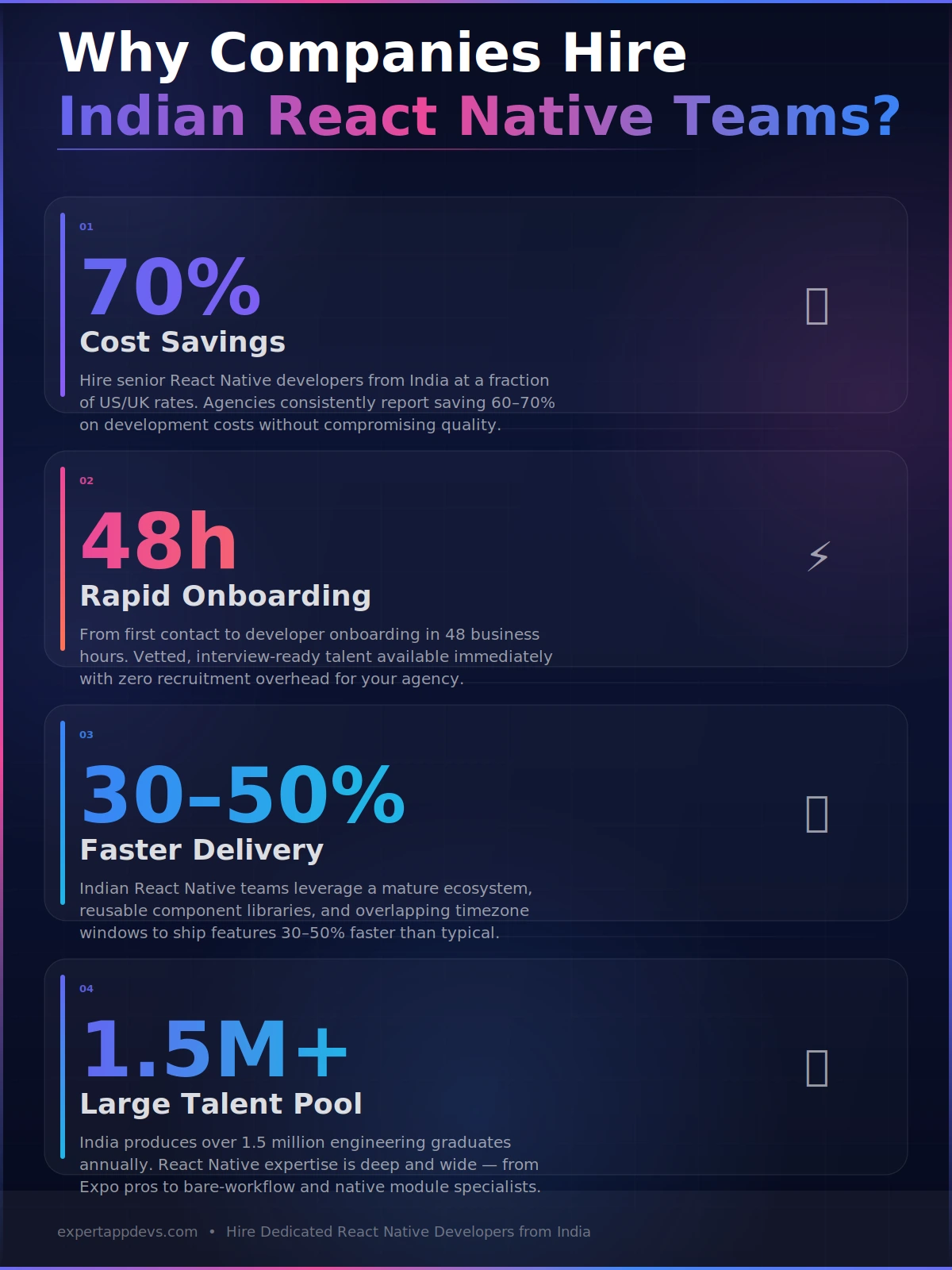
When companies begin exploring offshore React Native development, Indian markets usually come up first. The reasons to choose Indian teams goes beyond cost alone. Businesses can access scale, speed and mature delivery practices to support startups and enterprises.
Cost Advantage
One of the biggest reasons most companies choose Indian markets is straightforward economics. The Indian React Native developers usually charge anywhere between $15 and $30 per hour.
Compared to India, developers in US or Western Europe charge $60 to $120+ per hour while developers in Eastern European markets range from $35 to $60 per hour.
This gap lets companies build high-quality mobile apps at a low budget. Companies can reinvest the savings in marketing, product improvements and even new features.
Deep Talent Pool
India offers a scale that only a few markets can match. With millions of engineers and strong hold over JavaScript ecosystem, you are likely to find exceptional React Native specialists in India. You will find senior developers who handle complex architectures and integrations as well as mid-level teams who maintain development speed without inflating costs.
Faster Delivery with Distributed Teams
With React Native, you can reduce development time with a single shared codebase. When it is paired with an offshore Indian development team, you benefit from faster iterations and near continuous development cycles that’s available across time zones.
Mature Processes and Industry Expertise
With mature Indian development partners for Saudi Arabia, you get structured workflow, project managers coordinating the process and QA specialists. These teams have proven experience across eCommerce, healthcare, SaaS and fintech, that helps reduce risks and improve predictability.
What to Look for in React Native Developers (Skillset Checklist)
Hiring React Native developers can seem tricky. A strong resume doesn’t mean they can deliver a scalable and production-ready application. In fact, a resume is never an assurance that you have found a developer.
This checklist can help you focus on skills that matter, so that you go from a superficial view into the experience to real engineering capability.
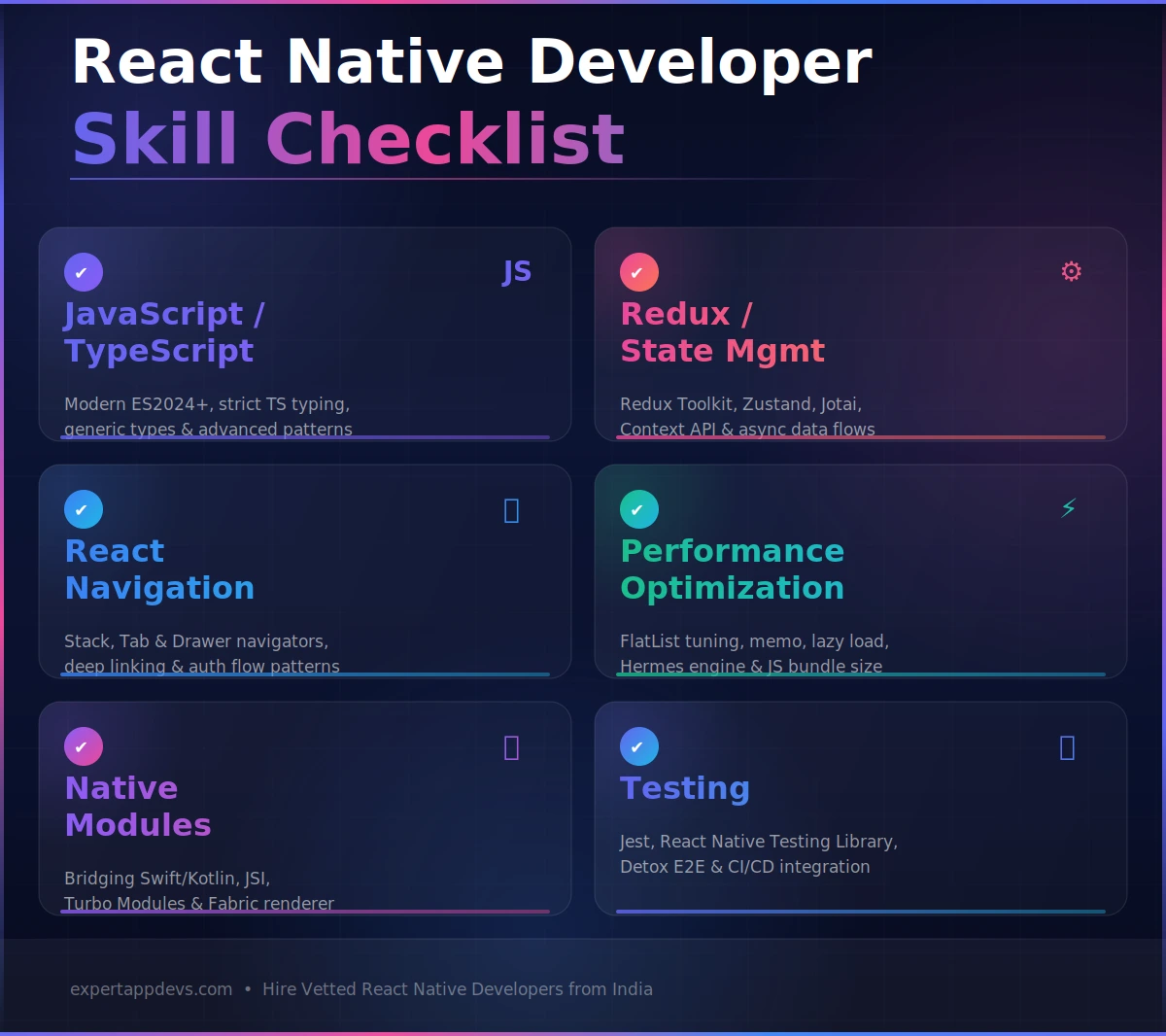
#1. Core JavaScript and TypeScript Foundations
React Native is built on JavaScript, which is why the language is crucial to this framework. A strong command over modern ES6+ features, TypeScript typing and async patterns is a must. The developer should be comfortable writing predictable and maintainable code. Hiring a React Native developer with proper foundation can impact the app’s stability, long-term scalability and performance.
#2. React Fundamentals that Matter
When you hire an experienced React Native developer, they would have in-depth knowledge and understanding. State, props, hooks, component lifestyle and clean separation of concerns would come easily to them. You should always look for experience and certified React Native app developers who write reusable components, and think from an architectural perspective.
#3. Knowledge of Native Mobile Concepts
Mobile fundamentals matter even when you are dealing with a cross-platform setup. The dedicated React Native app developer should have a clear understanding of iOS and Android navigation patterns, and performance constraints. They should know how React Native bridges with the native modules. This knowledge is useful when they are handling device APIs, custom animations and platform-specific issues.
#4. State Management and Data Flow
A real-world app relies on predictable state management. That’s why you should hire developers experienced with Redux, Toolkit, MobX and Context API. This will help them manage complex data flows. A strong developer would know when global state is necessary and when to keep the app in local state.
#5. Navigation, UI and Performance Awareness
You should also look at the way they execute the user interfaces to understand more about them. Your developers should be fluent with React Navigation, responsive layouts and animations. It is equally important for them to be well-versed with performance optimization as it reduces unnecessary rendering that uses memorization. It can also help with profiling apps to deliver smooth experiences.
#6. Communication, UX and Team Fit
The dedicated developers from India will work as an extension of your team. That’s why clear communication along with strong English skills and a collaborative mindset are important. Their UX sensibility is important so that they can include cultural design preferences and offer RTL support.
A Quick Vetting Checklist for your Reference
- Strong JavaScript, TypeScript and React fundamentals
- Experience working with Redux, MobX and ContextAPI
- Understanding native modules and platform-level behaviour
- Live React Native apps available on app store or GitHub
- UI and UX awareness along with understanding of responsive layouts and RTL support
- Proactive communication with an ability to collaborate remotely
- Experience with testing, maintaining long-term code and handling CI pipelines
Interview & Screening Strategies for Hire React Native Developers from India
Interviewing React Native developers from India will yield results when you stop treating it as a single conversation and look at it as a system. This structure can prevent you from making gut-based decisions and comparing candidates objectively.
#1. Define Technical Requirements
Start by understanding what your app needs. Is performance crucial for the app? Do you need heavy integrations, a complex UI or even offline usage? Define the must-have technical skills, expected experience level and soft skills for the developers before you begin the process. Clear requirements can help you drive focused conversations and prevent under/over hiring.
#2. Use Practical Coding Tests
Don’t go with abstract puzzles that may not solve any purpose. You should use take-home or live coding tasks that provide an insight into their React Native abilities. Ask your candidate to build a small feature or manage async storage. This will give you an upfront view into the code quality, structure and problem-solving habits they possess.
#3. Running a Deep Technical Interview
Ask them how React Native is different from React, when native modules are used and how the framework bridge works. Discuss their state management choices, navigation architecture and performance strategies in case of large lists and complex screens.
#4. Check Frameworks and Tooling Knowledge
The candidate you are planning to hire should be comfortable with React Navigation, Redux, TypeScript, and other common libraries. You should ask them how they integrate payments, analytics and biometrics. This would give you an insight into their real-world experience.
#5. Evaluate Communication and Portfolio
Review their GitHub repos and the published apps. Ask them to walk through the app they have built. Probe them on remote collaboration habits, timezone overlaps and their fluency in English language. You can also include a senior reviewer along with a standardized checklist to ensure a consistent and confident hiring.
Using this approach, you can build trust internally, document the risks involved and make leaders see why a particular candidate was chosen. You can ensure that expectations are aligned from the beginning.
With a clear process, you can reduce hiring mistakes and shorten the ramp up time.
Engagement Models: Full-Time vs Contract vs Dedicated Team
Choosing the right engagement model for the hire app developers from India is as important as choosing the framework. The model you pick will help determine cost control, flexibility and speed along with how closely the developers will align with your business vision.
Engagement Models At-a-Glance
|
Model |
Pros |
Considerations |
|
Full Time Hire |
Deep ownership with cultural alignment and long-term continuity |
High fixed cost, increased hiring overhead and difficult to scale down |
|
Part-Time Contract |
Flexible with pay-per-hour models. It is fast for short-term needs |
Limited availability with weak ownership. Delivers inconsistent quality |
|
Dedicated Team/Staff Augmentation |
Stable teams that are scalable. Fast onboarding and the provider will manage hiring |
Monthly commitment and needs more coordination |
|
Agency/Outsourcing |
End-to-end delivery. Comes with a PM and QA |
Less control, higher total cost and best for fixed scope. |
Hire Full Time React Native App Developers
If mobile app is core to the long-term development roadmap, then you must hire full-time React Native developers. They can grow with the product, understand domain context and integrate with your internal teams. However, you might need to budget more for salaries, benefits, and recruitment. The increased competition in local markets makes this model expensive and inflexible if your priorities shift.
Hire Part Time React Native on Contracts
Contractual developers offer flexibility. With this model, you will pay for what you use, making it a sensible choice for short-term sprints, audits and even when considering filling gaps. However, contractors tend to juggle multiple clients. That can impact their availability, project continuity and accountability. This is especially true when you are building a complex product.
Hire Dedicated React Native Team/Staff Augmentation
In this engagement model, you can blend stability with flexibility. The dedicated offshore team will work on your product while being on the provider’s payroll. As a result, you can control the priorities and deliveries while avoiding recruitment overhead. This engagement model scales easily and works well in case you are developing multi-feature apps or adding to your product roadmap.
Partnering React Native Agency or Outsourcing React Native Development
An agency will take complete ownership of the project and features, including planning, management and testing. This works best when you have a fixed scope and limited bandwidth internally. However, you might have less visibility and control over individual contributors. It also limits flexibility as scope is locked.
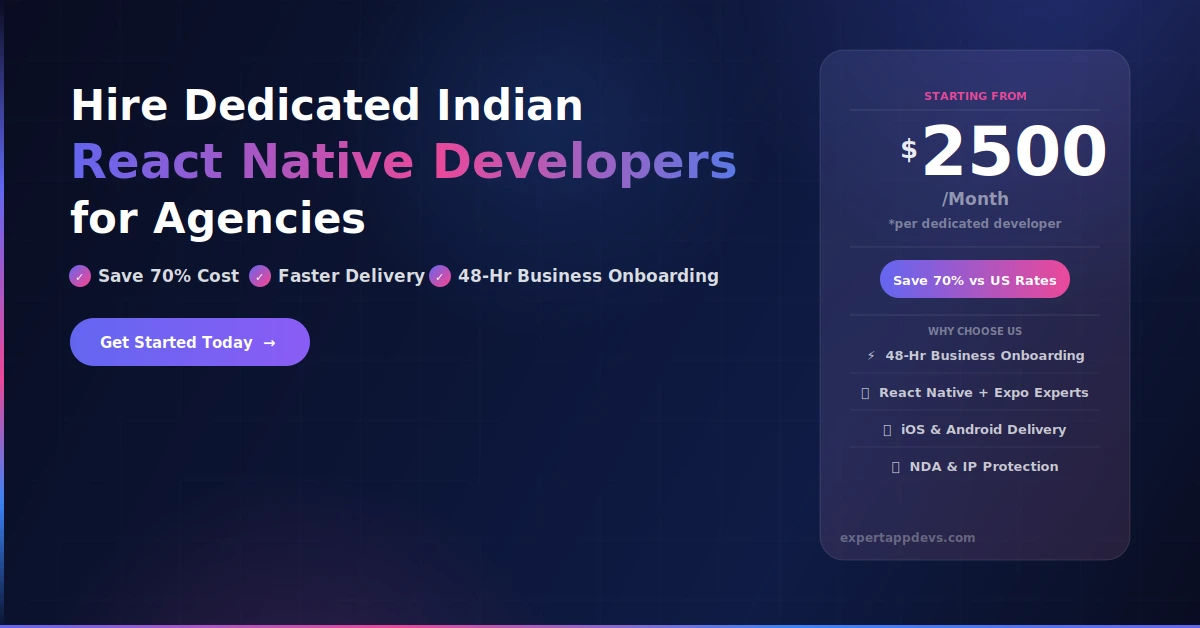
Expert App Devs follows a dedicated team model that is especially designed for speed and control. You can onboard pre-vetted React Native developers within 48 business hours at a predictable cost ($22 per hour) with a 40-hour free trial. With us, you get a committed team member and the flexibility to scale your resources while reducing hiring friction.
Onboarding and Management of Offshore React Native Teams
Onboarding your offshore React Native developers teams is where your best hiring decisions will either succeed or fail. According to a report by FullScale, 68% of the companies struggle with inadequate remote onboarding, which reflects in their productivity. With a clear and structured onboarding plan, you can make your offshore developers feel confident, aligned and productive.
#1. Pre-start Setup
Onboarding starts even before the first day starts. You must set up their email accounts, repository access, and the project management tools like Jira and Trello. Share with them a concise written brief that covers the product development goals, target users, architecture and tech stack, helping them stay prepared instead of guessing.
#2. Week One: Access, Context, Communication
In the first week, you must focus on offering access and clarity. Use tools like Git, IDEs, emulators and VPNs along with Slack and Figma to ensure smooth collaboration. You should also run a video walkthrough of the coding and architecture along with a welcome call to introduce the team members and the expectations.
You should also consider daily check-ins, a good 15-30 minutes, during the first week. Also include 4 to 6 hours of overlapping hours to ensure proper onboarding. By setting clear communication norms along with defining where decisions live, you would have specified everything from access to context.
#3. Weeks Two to Four: Momentum and Ownership
As the confidence in your team builds, you should move from guidance to ownership. Pair your offshore developers with a local engineer or PM for the early tasks. You can then assign them independent tickets after some time. Make sure to break down the work into smaller milestones so that progress is visible. By reviewing code in the early commits, you can ensure high quality standards.
#4. Ongoing Sync and Team Integration
You should manage weekly reviews, covering delivery, blockers and priorities. Invite offshore developers for planning, design reviews and brainstorming sessions. You should also share the market context and encourage questions that can build trust and reduce rework. By tracking progress susing Jira and Asana, you can also get onboarding feedback.
Pitfalls to Avoid:
- Skipping daily check-ins that can cause confusions and wasted days
- Overloading developers with excessive documentation from the start
- Forcing your offshore team to mirror your working hours, which can increase burnout
- Failing to document the decisions
- Assuming silence means progress
Common Pitfalls & How to Avoid when Remote React Native Hiring
Even with a strong React Native development team, your offshore projects can slow down if you ignore these common pitfalls. Most of these issues are predictable and can be avoided by incorporating the right habits.
#1. Unclear or Shifting Requirements
Offering vague specifications is a quick way to derail your offshore execution. When scope keeps changing, it can lower the confidence and momentum of your developer. You must define a clear MVP, prioritize the features and document acceptance criteria. Make sure changes are intentional, logged and communicated clearly.
#2. Communication Gaps and Silos
Remote work may break down when you don’t follow a structure. By missing scheduled syncs or updates, you can cause confusion and wasted efforts. Add mandatory standups, written status updates and shared documentation to make sure progress is visible.
#3. Cultural Misalignment
While Indian developers are committed, the work style is completely different. Some developers may wait for explicit direction while others hesitate to challenge the assumptions. You should always clarify decision-making authority, encourage questions and offer feedback respectfully.
#4. Poor Task Scoping
By assigning large and complex features in the early stages, you can overwhelm the new developers. That’s why you must break down your work into small and testable tickets. When they have early wins, it builds their confidence, improves the work velocity and reduces misunderstandings that cost you.
#5. Skipping Code Reviews and Overlap Planning
Quality can deteriorate if you don’t include regular code reviews. Add pull requests and shared Git workflows consistently. You can even use daily time zone overlap to reduce delays.
Assigning project owners from both sides along with document norms can help you stay ahead of your timelines.
Hire React Native Developers: Alternatives, MVP Strategy and Team Models
When you are planning your mobile app, it always helps to look at the bigger ecosystem surrounding your React Native framework along with the available options. React Native covers most modern mobile app use cases. The newer React Native architecture has also ensured that the performance gaps with native apps is minimal.
However, there are alternatives that you can consider like Flutter, pure native development and PWA, depending on your needs. React Native wins because of its mature ecosystem and strong code sharing.
You must always start building a new solution with a focus on MVP development. Prioritize core features, validate the demand and iterate quickly. Offshore development works best for MVPs as they cost less, allows fast experimentation and reduces upfront investment. Most teams use this phase to refine the product and development processes.
You can also go with local agencies in Riyadh and Jeddah for close collaboration and better market insight. However, the tradeoff in this case is cost. The local React Native salaries are higher than offshore development rates. That’s why the best approach is to go hybrid. Have a local leadership with offshore partners for execution.
As modern apps depend on cloud integration, your team should understand backend APIs, push notifications and services like AWS/Firebase. With a clear process, defined phases and milestones, you can ensure everyone is aligned.
How to Assess Offshore React Native Developers Using Visual and Outreach Resources?
In this section, we will talk about how you can make your hiring and evaluation process tangible. Going beyond interviews and resumes, you should use visual and outreach resources that help validate assumptions and spot gaps faster.
Ask the right outreach questions, whether you are hiring senior react native developers or agency leaders. This would give you a real-world insight into their skills, communication standards and onboarding maturity. These conversations can also happen during expert interviews or in LinkedIn conversations.
Visual assets are also important. For example, infographics that compare React Native with native development can help you align the non-technical stakeholders with the project. Adding hiring and onboarding flowcharts can help bring structure to your ad-hoc process.
Using rate comparison charts can help you back cost discussions in data. At the same time, a simple UI framework with the React Native components can help you define the skill requirements.
Structured research tables can turn subjective evaluations into actual comparisons. These side-by-side tables offering insights into skills, tools and engagement models make it easier for you to assess candidates and make confident decisions.
An Example Table for your Reference
|
Skill/Tool |
Description |
Example Criteria |
|
JavaScript/TypeScript |
Core language knowledge |
Can write clean JS/TS, async handling, strong typing |
|
React Framework |
Familiar with RN components and relevant APIs |
Uses ScrollView, Linking and StyleSheet |
|
State Management |
Manages global app state |
Implements Redux Toolkit, Understands middleware |
|
Navigation |
Handles screen flow with deep lines |
Uses React Native stacks, back behaviour |
|
Performance |
Optimizes rendering and memory |
FlatList optimization and lazy loading |
|
Native Modules |
Integrates with iOS and Android SDKs |
Uses camera and notifications as well as device APIs |
|
Testing |
Ensures code reliability |
Jest setup, Detox and E2E testing |
|
Communication |
Clear and responsive collaboration |
Timely updates, clear English and proactive questions. |
Conclusion
Hire React Native developers isn’t just a staffing decision anymore; it should be a strategic move that helps decide how fast your product moves into the market and how nicely it scales. Combining React Native and offshore Indian talent in the wake of Vision 2030 can help you gain an incredible combination of speed, quality and cost control.
By hiring thoughtfully, screening thoroughly and onboarding with structure, you can make offshore teams feel like a natural extension of your core team. Whether you are scaling your app or building an MVP, the right engagement model does all the trick. ExpertAppDevs can help you onboard highly qualified and responsive React Native developers within 48 hours, allowing you to focus on building and growing with confidence. Connect with our team and schedule your call now.
Must Ask Critical Interview Questions for Evaluating React Native Developers from India
- How Do You Optimize React Native Performance Across iOS and Android?
- What's Your Experience Integrating Third-Party Libraries and Native Code?
- Describe Your State Management Strategy: Redux, Context API, or Alternatives?
- How Do You Ensure App Quality Through Testing and Code Reviews?
- Can You Walk Us Through a Challenging React Native Project You've Completed?




 273
273

 0
0


 253
0
253
0
 273
0
273
0
 259
0
259
0