



- TL; DR
- Why Project Mindset Breaks Offshore Teams?
- Which Offshore Model Drives Better Outcomes: Product Squads or Delivery Pods?
- Is Documentation a Deliverable or Team Discipline?
- Velocity Is the Wrong North Star: Here's What to Measure Instead
- From Outsourced Team to Core Engineering Capability; The Transition Roadmap
- How ExpertAppDevs Structures Engagements for Long-Term Product Ownership?
- The Offshore Team You Need Already Exists: It Just Needs the Right Structure
- Frequently Asked Questions
Ready to transform your vision into reality?
Get Started
How Enterprises Structure Offshore Teams for Long-Term Product Ownership?
 515
515
 14
20 Apr 2026
Min Read
14
20 Apr 2026
Min Read


 Share
Share

 Download PDF
Enterprises that build a strong offshore outcome owners structure consistently outperform project-based contractor rotations on roadmap delivery speed, feature and codebase quality over a 24-month window. The gap compounds, and it is significant. The difference isn’t talent. It is the structure. Team composition, contract design and even documentation practices designed for product ownership, not sprint delivery is what separates teams that accelerate from the ones that reset.
TL; DR
- Project mindset, not the offshore talent, is the root cause for dedicated offshore development team management failures.
- Product squads outperform delivery pods on long-term metrics, such as stability, onboarding, architecture and codebase continuity.
- Document three crucial knowledge layers: architectural, contextual and operational.
- Velocity is a lagging indicator. The metrics that actually matter in the long-term include stability rate, MTTR and codebase coverage.
- With the right structure, teams can reach autonomous status by month 15 or 18. Without it, they rarely do.
- The transition from delivery pod to core product team requires changes on the client side, too.
Let's start with simple What is an Offshore Product Team Structure? A structured offshore team model where developers, product owners, QA, and DevOps operate as a unified product squad with clear ownership of outcomes, roadmap alignment, and long-term accountability instead of task-based delivery.
It’s quarter three of your product development. Your offshore team hasn't missed a single sprint. Yet, your product has never felt more fragile. Despite the speed, your engineering team isn’t able to explain half the decisions made in year one.
This is one of the most common failure patterns in offshore engagements. The velocity is real but the stability isn’t.
The problem isn’t that you went with an offshore team to build your product. It is in how your offshore team product ownership is defined from day one. Teams built around project delivery as the outcome will deliver projects. But teams designed around product ownership own the products and stay accountable.
Most offshore arrangements are structured around deliverables but expected to function with product ownership. That gap doesn’t stay invisible for long. It shows up in the product.
This article is about understanding that gap, what it costs and how to close it deliberately and not accidentally.
Why Project Mindset Breaks Offshore Teams?
The project mindset is the root cause. Not the offshore model or how you manage offshore developers long-term.
When an offshore engagement underperforms, product leaders rush to blame the offshore model.
- The team was far away.
- The time zones didn’t work.
- Communication was always the problem.
These are noticeable symptoms. But the root cause is structural. It happened because the engagement was designed around project delivery. The team in this case will execute the tasks.
You cannot fault your offshore team for optimizing around the metrics that you use to measure their performance.
What Project Mindset Looks Like in Practice?
Project mindset isn’t obvious. A task executors that’s high-performing according to sprint metrics could be operating in project mode. The signals are structural, not behavioural.
The team is assessed on the sprints completed instead of product health. Their knowledge lives in tickets, not documentation or team memory.
Developers are interchangeable. The goal is not expertise but throughput in this case. The offshore team has no visibility into product strategy or user feedback. The engagement is renewed by quarter. So, the team optimizes for renewal, not outcomes.
The Diagnostic Question: Ask your offshore team lead, “if our product had to pause development for 60 days and resume, what would be the first three things you would need to re-establish?” If they hesitate or offer a generic answer instead of an architectural one, your offshore team is in project mode.
What Project Mindset Costs Over 24 Months?
You don’t incur the project mindset cost in the first quarter. It accumulates and becomes visible all at once.
- Months 1-3: The velocity and confidence are high. The sprint board looks healthy. Delivery feels on track.
- Month 6: Signs of product fragility first appear. “Why did you choose this architecture?” becomes a recurring question. You don’t get a clear answer.
- Month 12: The technical debt slows down feature delivery by 20-30%.
- Month 18: A key developer churns. Two sprints are spent re-establishing context that wasn’t documented by the previous team or member.
- Month 24: The team is capable. The codebase has outgrown their collective understanding.
This pattern isn’t theoretical. It describes most offshore engagements we have inherited after enterprises switched to ExpertAppDevs after their first failed engagement. The talent rarely is the problem. The structure always was.
Why the Project-vs-Product Gap Is a Structural Problem, not a People Problem?
Developers hired on project terms have no incentive to invest in architectural decisions that outlast their sprint. Product Squad rewarded for velocity have no incentive to slow down and document.
Offshore teams that are excluded from product strategy cannot make the judgement calls that product ownership requires. The fix is structural, not cultural. It starts with contract design, governance and team composition.
Identifying individual developers or Product Squad as the problem delays the only intervention that works.
Which Offshore Model Drives Better Outcomes: Product Squads or Delivery Pods?
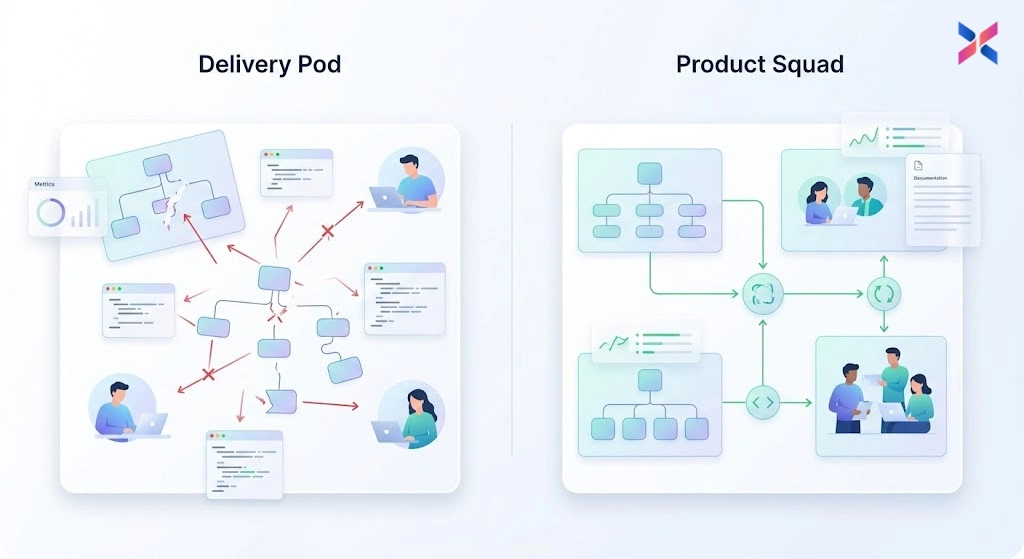
Two Models, Two Outcomes: Product Squads vs. Delivery Pods
You need a simple taxonomy to think clearly about offshore product team structure. Two dominant models exist in enterprise outsourcing.
Product squads are long-term and cross-functional teams that own outcomes. Delivery pods are short-term teams focused on executing pre-defined outputs.
Understanding this difference isn’t academic. It determines how you optimize your offshore team, what gets documented and what walks out when a developer leaves.
Delivery Pod: Definition and Design
A delivery pod is an offshore team structured around task completion. The team receives work, executes it and reports back to the client. The north star metric for this framework is sprint velocity.
It is a dominant model in outsourcing. This structure also causes enterprise plateau after the first year.
This isn’t a broken model. It is built for specific task that has a clear end date. You face issues when you apply it to products that don’t have an end date. This gap will make it harder for you to navigate the codebase quarter-after-quarter.
|
Characteristic |
What it means in practice? |
|
Task-driven |
Work arrives as ticket, leaves as completed features. Nothing more is expected |
|
Shallow ownership |
Developers know their module. They don’t know the product |
|
Thin documentation |
Done means merged and not documented. The next developer will start from scratch |
|
Split accountability |
Product Squad manages headcount. Client handles the roadmap. Gaps occur and decisions are lost in them |
|
Success metric |
Sprint goals are met, on-time delivery rate. |
Product Squad: Definition and Design
A product squad is another engagement model for offshore team. It is organized around a specific product area or user outcome.
The team participates in discovery, contributes towards architecture decisions, documents reasoning and owns a section of the codebase. It operates within a strong offshore team product ownership framework. The north star metric is product health, not sprint velocity.
Knowing this distinction is important as ownership changes team behaviour. A developer responsible for maintaining code will plan for durability. However, a developer whose contract ends after feature is shipped will optimize for speed.
|
Characteristic |
What it means in practice? |
|
Outcome-driven |
Work is defined by user outcomes, not backlog tickets. Team understands why behind every task |
|
Deep ownership |
Team members can answer why questions for architecture, design and other decisions |
|
Living documentation |
Architecture decision records, runbooks and onboarding documents are maintained along with codebase. |
|
Engineering authority |
The team lead can push back on architecture decisions. They aren’t just executing them. |
|
Success metric |
Feature stability rate, onboarding time for new developers, time-to-recovery, codebase coverage. |
Head-to-Head: Delivery Pod vs. Product Squad
This distinction isn’t just about judging team quality. It is also about understanding whether the engagement is designed to deliver real product outcomes or just complete assigned work.
|
Dimension |
Delivery Pod |
Product Squad |
|
Organized Around |
Sprint backlog and task completion |
Product area and user outcome |
|
Where Knowledge Lives |
In ticket history |
In code, documentation and team memory |
|
Architecture Involvement |
Executes decisions made by others |
Participates in and owns decisions |
|
New Developer Onboarding |
2-4 weeks, high disruption |
1-2 weeks with documented runbooks |
|
Impact When Developer Leaves |
High- context leaves with the team |
Low- context lives in codebase |
|
Roadmap Visibility |
Next sprint only |
Quarterly alignment |
|
What the Product Squad Is Accountable For |
Output delivery |
Product health over time |
|
12-month Technical Debt Trajectory |
Accumulates |
Actively managed |
Hybrid Configurations: When You Need Both
Large enterprise product development cannot be carried out using only one model. The core platform architecture design needs a product squad. Delivery pods can manage the peripheral feature streams, time-bound integrations and isolated module builds.
You may put product development to risk by applying delivery pod model to everything, including aspects that need long-term ownership. If a codebase will exist for three years, it needs product squad. That’s a structural requirement.
At ExpertAppDevs, the first month of any inherited engagement includes a configuration audit. It involves a structured review of which parts require product squad and which can be handled by Agile delivery pods. Most enterprises discover they have been running delivery pods on systems that need product squads. This audit helps determine fastest way forward.
Is Documentation a Deliverable or Team Discipline?
Documentation Is Not a Deliverable; It Is a Team Discipline.
Most offshore engagements don’t fail because of talent gaps. They fail due to continuity breaks over time. These breakdowns can be traced back to documentation. Not its absence but the way it is treated.
Documentation is positioned as the final step in most cases. It is worked on after development is done. That moment doesn’t come and critical context is lost along the way.
High-performing teams approach this differently. They don’t treat documentation as an output. It becomes a system that supports how work is done. It shapes your team’s consistent, preserves the project’s context and ensures knowledge isn’t locked with individuals.
Embedding documentation into daily workflows makes it structured, accessible and built to last.
The Three Layers of Knowledge an Offshore Product Team Must Protect
Documentation is effective only when it is structured around what your team needs to protect. Not all knowledge serves the same purpose. Some enables safe change. Others enable fast recovery or prevent repeated mistakes. Mature teams recognize differences and document them.
Here are the three layers of knowledge every offshore team must protect.
|
Layer |
Focus Area |
What it Protects |
Where it Lives |
|
System Design |
Architecture decisions and trade-offs |
Safe evolution of codebase |
ADRs, design notes |
|
System Operation |
Deployment, monitoring and recovery |
Speed during incidents |
Runbooks and playbooks |
|
Product Context |
Feature rationale and insights |
Decision quality with time |
Wikis and retros |
If anyone of these layers is missing, the impact is immediate. Missing design context slows down architectural decisions. No operational clarity can increase incident resolution timeline. Teams tend to repeat work that’s done without the product context.
Teams that scale don’t document more. They document with intent.
Embedding Documentation in the Definition of Done
Documentation works when it is embedded in your workflow. It will be skipped immediately when it becomes an extra effort. The most effective teams solve this issue by redefining completion. They consider work is complete only when both code and context are captured.
With this, documentation becomes a standard instead of another task. A typical definition of work done includes:
- Code is merged and reviewed.
- Key decisions are recorded in a structured format.
- Deployment and recovery steps are updated when it becomes relevant.
- Pull request includes context, rationale and validation.
Pull requests are critical here. A well-written document isn’t just code review artifact. It captures the intent. It shows why any change was made and what alternatives were considered during the change. Over time, this creates a searchable history within the codebase.
This same principle also applies to system diagrams. If it is stored outside the codebase, it will become outdated. If you version control the architectural designs, it will evolve with the system. The documentation will reflect the reality instead of a past state.
The Knowledge Continuity Plan: What Enterprise Teams Must Require
Documentation cannot rely on goodwill if continuity is your priority. It should be enforced structurally. You must set clear expectations before engagement begins, reinforcing them through governance.
Here’s a table showing the elements included within a strong continuity plan.
|
Requirement |
Expected Outcome |
Why it Matters? |
|
Onboarding guide |
Setup and deploy within 2 days |
Reduces dependency on individuals |
|
Ownership audits |
Identify single points of failures |
Prevents knowledge silos |
|
Documentation sprint |
Periodic gap closure |
Knowledge stays current |
|
Exit handover |
Structured knowledge transfer |
Protects from churn-backed loss |
|
Architecture map |
Continuously updates system view |
Aligns team on system design |
Each element solves a particular failure point. Onboarding reduces ramp up time while ownership audits can reduce risk. Handover protocols prevent last-minute knowledge loss. Combining these elements create a system where continuity is present by design.
Most teams feel this is operational and skip it. However, it is important for long-term product stability.
Continuity Planning: The Scenario Every Enterprise Should Rehearse
Documentation quality is hard to assess in a steady state. Everything feels manageable when the same people are handling it. You get to know the real situation when something breaks or someone leaves the team. That’s why experienced teams simulate failure
Here are two scenarios that reveal a lot of things:
- 72-hour incident test: Imagine your lead offshore developer is unavailable when you face a production issue. The rest of the team must diagnose, fix and communicate the problem. If they do it confidently, the documentation is working. If they struggle, the knowledge is concentrated.
- 30-day handover test: Assume the offshore team is replaced in a month. Check how quickly the offshore team can regain momentum with the new team.
|
Outcome Time |
What it indicates? |
|
~ 2 weeks |
Strong documentation and clarity |
|
~ 6 weeks |
Acceptable yet inconsistent |
|
3+ months |
Critical knowledge gaps exist |
These scenarios seem extreme. But they aren’t. They are inevitable at scale. Running these as structured reviews helps you identify gaps early. Eventually, they don’t turn into delivery risks.
Teams that scale don’t rely on documentation during handovers. They build it into their daily scope. Every decision is captured and every change explained. The system is easier to understand for the next person joining the team.
That’s the shift you must make. Documentation shouldn’t be something you deliver. It should be an everyday practice.
Key Insight: ExpertAppDevs runs a structured continuity audit at 6-month intervals on all long-tenure engagements. The output is a gap report shared with the client’s engineering lead; not filed internally.
Velocity Is the Wrong North Star: Here's What to Measure Instead
Velocity is easy to track. That’s why most teams default to it. It shows how fast work is moving through the system. But it doesn’t tell you whether the work is creating long-term value or friction.
High velocity in early months can exist in systems that are healthy or quietly accumulating debt. The difference becomes visible later when teams slow down under the weight of earlier decisions.
Velocity answers how fast you are moving. It doesn’t tell whether the product is stable and the system resilient.
Why Velocity Is a Lagging Indicator of Team Health?
Velocity reflects output, not system health. It indicates what has already happened. It doesn’t show you the hidden issues or technical debt slowly accumulating within the system. That’s why it is considered a lagging indicator. By the time velocity drops, underlying issues have already compounded.
Velocity increases in the first few months of engagement. The scope is clear, backlog negligible and system manageable. At this stage, a well-structured product squad and delivery pod appear equally productive. The divergence begins later.
|
Timeframe |
What velocity shows? |
What it hides? |
|
Months 1-3 |
High and increasing |
Early design is compromised |
|
Months 6-9 |
Stable output |
Growing dependency complexity |
|
Months 12-18 |
Gradual slowdown |
Accumulated technical debt |
|
Months 18+ |
Volatile and declining |
System fragility, rework load |
That’s why velocity shouldn’t be your north star. It doesn’t capture stability or resilience. It doesn’t even capture how much current effort is spent fixing the earlier work.
The Measurement Reframe: Velocity answers “how fast we are going?” The more important questions are: “how stable is the product we have already build?”, “how much of what we have built in month 3 are we modifying in month 18?” and “how long does it take to recover when something breaks?”
The Product Health Scorecard: Four Metrics That Matter
You must shift from output metrics to system metrics to understand team performance. These metrics will measure how your product holds up over time and how quickly it is delivered.
Here is a detailed product health scorecard to know your offshore team’s performance.
|
Metric |
What It Measures |
Healthy Range |
Warning Sign |
|
Feature Stability Rate |
% of features that work without modification 90 days post-release |
> 85% |
< 70%: architecture or QA gaps |
|
Mean Time to Recovery (MTTR) |
Avg. time from incident detection to full recovery |
< 2 hours |
> 4 hours: runbooks missing or outdated |
|
Codebase Coverage |
% of codebase understood by 2+ team members |
> 80% |
< 60%: bus factor risk is high |
|
Onboarding Time to Productivity |
Days for new developer to deliver independently |
< 10 days |
> 20 days: documentation gaps or complexity debt |
|
Unplanned Work Ratio |
% of sprint capacity consumed by unplanned fixes |
< 15% |
> 25%: hidden technical debt surfacing |
|
Architecture Drift |
Frequency of decisions that contradict existing ADRs |
0–1 per quarter |
> 3 per quarter: no ownership of standards |
These metrics redefine how teams behave. Teams invest in quality when stability is measured. If recovery time is tracked, it improves their operational clarity. Teams reduce dependency risks when knowledge transfer is visible.
With this shift, you move from measuring activity to gauging stability.
Team Autonomy as a Success Metric
System health indicates how your product behaves over time. Autonomy signifies how your team behaves. Both are connected.
A stable system built by a dependent team doesn’t stay stable for long. Dependency becomes a bottleneck as complexity increases.
A delivery pod needs constant validation and direction. A mature product squad identifies problems before you ask and proposes architectural options before tickets are written.
Autonomy isn’t a switch. It evolves with product stages. The problem in this case isn’t progression. It is that most enterprises don’t measure it. When you don’t measure it, things don’t improve. This results in plateau across offshore teams that never reach ownership.
|
Autonomy Stage |
How Teams Operates |
Decision Behaviour |
Typical Timeline |
|
Directed |
Executes defined tasks with strict guidance |
Escalates all decisions |
Months 1-3 |
|
Guided |
Suggests approaches, raises blockers early |
Makes limited implementation decisions |
Months 3-6 |
|
Aligned |
Contributes to planning, highlights technical risks |
Shares ownership of decisions |
Months 6-12 |
|
Autonomous |
Owns product areas and execution independently |
Makes decisions with accountability and full context |
Month 12+ |
The way your offshore team contributes to the work changes with each stage. A directed team completes their tasks while aligned teams improve work. The autonomous team shapes the work. This is the difference between execution and ownership.
Each team will interact with uncertainty differently. Early-stage teams wait for clarity while mature teams create it. The mature teams reduce need for oversight as they operate with context.
|
Stage |
Planning Involvement |
Risk Handling |
Client Dependency |
|
Directed |
None. Work on assigned tasks |
Reactive. Responds after issues appear |
High. Requires constant input |
|
Guided |
Limited. Contributes during execution |
Identifies immediate blockers |
Moderate. Requires validation |
|
Aligned |
Active. Participates in sprint and roadmap discussions |
Flags risks ahead of time |
Reduced. Operates using shared context |
|
Autonomous |
Drives planning for owned areas |
Anticipates the risk and mitigates them early |
Low. Operates independently within scope. |
Most teams don’t reach autonomy. That’s because it is never treated as a goal. These teams are measured on velocity, not ownership. So, they optimize for speed, not judgment.
Key Insight: At ExpertAppDevs, autonomy is treated as a measurable outcome, not a byproduct of time. It is tracked explicitly in quarterly reviews with enterprise clients. The expectations on progression across stages is also clear. The goal is to build teams that can own, sustain and evolve without constant intervention.
From Outsourced Team to Core Engineering Capability; The Transition Roadmap
Most companies treat offshore teams as an extension of their internal capacity. They become extra hands that help move faster. But you don’t have to stop there. Using the right structure, your offshore team can evolve into a core engineering capacity. They can own, build and sustain parts of your product.
Most product leaders hesitate to ask if this transition is realistic. It is but it won’t happen by default. You need to make deliberate changes in how your team is structured, performance is measured and ownership is shared.
What 'Core Product Team' Status Actually Mean
A core outcome owners isn’t defined by their location. It is defined by ownership, context and decision-making authority. The shift is subtle but the impact significant.
After attaining core team status, the offshore team doesn’t execute against instructions. They participate in shaping them. Product discussions begin including them early. The team understands what’s being built and why it matters.
Ownership also changes form at this point. Team members take responsibility for specific product areas instead of just working on assigned modules. They will be part of architecture, stability and long-term evaluation aspects. The tech lead will contribute to architectural decisions.
The distinction between an onshore and offshore team will start fading with time. What will matter is accountability and capability. The team’s performance is measured on outcomes, not billed hours.
|
Shift Area |
Delivery Team/Task Executors Model |
Core Product Team Model |
|
Involvement |
Executes after decisions are made |
Participates in strategy and planning |
|
Ownership |
Task or module based |
Product area ownership |
|
Decision Role |
Follows direction |
Contributes to architecture and trade-offs |
|
Team Identity |
Onshore vs offshore split |
Unified product team |
|
Accountability |
Output and timelines |
Product outcomes and stability |
At this point, the offshore team stops being external. It becomes a part of your engineering function.
The Three-Phase Transition Model
A transition from an external, dependent offshore team to an integral part of your team doesn’t happen in a single step. It follows a progression where structure, expectations and behaviour evolve together. Each phase builds on the previous one. Skipping steps leads to failure.
|
Phase |
Timeline |
Focus Area |
What Changes |
Success Signal |
|
Foundation |
Months 1-6 |
Stability and clarity |
Documentation practices, ownership mapping, communication norms are established |
New developers onboarded quickly. Team handles incidents without escalations |
|
Alignment |
Months 6-18 |
Shared context and contribution |
The team participates in planning and decisions. Documentation done for their area |
Proactive improvements are suggested. Reduction in unplanned work |
|
Ownership |
Months 18+ |
Autonomy and accountability |
Team leads discovery, operates independently within the scope |
Product stability improves. Team becomes an extension |
The starting phase prioritizes building the base. Nothing scales without documentation and clarity. Shared responsibility is introduced in the middle phase. The team starts thinking beyond execution. In the final phase, ownership is visible. The team starts operating with confidence and accountability.
Most transitions fail when teams are expected to behave as a product squad without being structured as one. Structure must precede expectations. For the replacement policy details, see our guide Hire Dedicated Developers: Pricing, Risk, and Replacement Explained!
What Has to Change on the Client Side?
Offshore teams don’t fail to evolve. Clients fail to create conditions where evolution is possible. Four shifts from your side can enable this.
- Give teams access to product context: A team that works on tickets cannot own outcomes. Include them in discovery sessions, post-release reviews and sprint planning. They will understand why features are built, not just what needs to be built.
- Define decision rights clearly: Write down what the team can decide without escalation. Mention what requires your inputs. Unclear authority doesn’t create caution. It causes team paralysis. Teams that know boundaries move faster and take ownership.
- Change what you measure: Teams optimize what they are evaluated on. If sprint delivery is your metric, that is what they will protect. Add feature stability and codebase health to your scorecard, and notice behaviour shifts. Teams start investing in quality, not just completion.
- Extend the contract horizon: Quarterly renewals produce quarterly thinking. A team that doesn’t know if it exists in four months won’t invest in systems that will start paying off after twelve. You must move to a 12-month commitment with structured reviews. That will let the team build stability.
|
Client Lever |
What Stays the Same |
What Needs to Change |
|
Product Access |
Teams will see tickets and backlogs only |
Team can join discovery, planning and post-release reviews |
|
Decision Rights |
All decisions are escalated to the client |
Clearly written what team can decide vs what to escalate |
|
Performance Metrics |
Velocity and sprint completion only |
Feature stability, codebase health and autonomy stages are added |
|
Contract Structure |
Quarterly renewals with no long-term commitment |
12-month minimum with defined 6-month review |
Your offshore team cannot move beyond execution without these four shifts. Capability isn’t the constraint. The engagement model you have chosen is.
Markers That the Transition Is Working
The transition into a core product team is visible in behaviour even before it shows in the metrics. You will notice changes in how the team thinks, communicates and makes decisions.
The team begins to act ahead of instructions when the transition works. Risks are flagged before they impact delivery. Alternatives are also proposed instead of executing the specifications. Documentation is updated as part of the work, not as a follow-up. Incidents are resolved with minimal escalation as team has clarity and context.
On the contrary, teams that operate in project mode show a different pattern. Decision-making is centralized. Work moves forward but understanding doesn’t deepen. Systems are harder to navigate and dependency on certain individuals increases.
|
Signs The Team is Moving Towards Ownership |
Signs Team is in Project Mode |
|
Team lead flags a roadmap decision as architecturally risky before the sprint starts |
Every decision is escalated, however small |
|
Developers propose alternatives to specified implementations, not just execute them |
Ticket completion is high; codebase confidence is low |
|
Documentation is updated as a matter of course, not when requested |
Key developer leaves and velocity drops more than 20% |
|
Incidents are diagnosed and resolved with minimal client involvement |
Team cannot explain why a core architectural decision was made |
|
Sprint retros surface product quality insights, not just process issues |
Documentation is always 'on the backlog' |
These signals matter more than short-term delivery metrics. They show if your team is an asset that compounds in value or a dependency that needs continuous management.
How ExpertAppDevs Structures Engagements for Long-Term Product Ownership?
You know now what breaks an offshore team and what makes them work. The difference isn’t intent. It is structure.
The focus should be simple. Build teams that can own products over time, not just deliver features in short-term.
Engagement Structure: How ExpertAppDevs Builds Product Squads, Not Delivery Pods
Every engagement begins with an ownership mapping exercise. We break down the product into logical areas and align the team to them. Team composition is defined by what needs to be owned, not by developers required. This is documented and shared with the client before starting sprint planning.
Our team leads become engineering decision-makers. They are responsible for architecture discussions and trade-off evaluation. They also own long-term system stability. The team lead participates in the technical reviews and planning sessions at the client side.
In the first 30 days, we establish three working systems. This is attained before velocity gains focus.
- Architecture Decision Record practice: At least one ADR is created for every major design choice.
- Documentation Standards: This is maintained across architectural, operational and contextual layers.
- Continuity Plan: This includes onboarding runbooks, offboarding protocols and ownership mapping.
They are not deferred activities. They are completed and reviewed with the client before scaling the engagement.
Performance is assessed quarterly using product health scorecard. The scorecard includes feature stability, onboarding time, codebase coverage and mean time to recovery. Sprint velocity is tracked; it is not the primary metric. Each quarterly review also includes written report that’s shared with the client’s engineering lead.
If you want to understand how we structure teams for ownership from the start, connect with us to hire mobile app developers from India.
The Long-Term Partnership Model
We structure engagements to support continuity, not short-term delivery. Most enterprise engagements are setup for minimum 12-month commitment. We define formal 6-month review gates to check team’s performance, system health and autonomy progression.
We also assign a bench candidate for every active role. The individual is introduced to codebase, documentation and architecture decisions during engagement. Replacement becomes a structed handover not a new hire with zero context in case of transitions.
We define technical escalation paths. The client engineering lead has direct access to our tech leadership. They can discuss architectural aspects and escalate scenarios. It avoids delays that occurs when communication moves through account management.
Our team conducts transition reviews annually. This structured assessment helps understand where the offshore team is in the autonomy progression. Output is fully documented, outlining what needs to change in the structure, access and decision rights.
|
Engagement Area |
How we Structure It? |
Why It Matters? |
|
Contract Cycle |
12-month minimum with review gates |
Enables long-term thinkin |
|
Team Continuity |
Named bench with active context exposure |
Reduces transition risk |
|
Escalation |
Direct to technical leadership |
Faster and informed decisions |
|
Progress Tracking |
Product health with autonomy reviews |
Aligns behaviour with ownership |
What Enterprise Clients Say
The impact of this structure becomes visible over time. Not in the first sprint. But in how team behaves in year one and two.
- “By the second year, we were no longer managing day-to-day activities of the offshore team. They were flagging risks before they became blockers and proposed solutions we handn’t even considered.” ~ VP of engineering, SaaS Platform
- “One architectural decision they pushed back in the early stages saved us from scaling issues we would have discovered much later. That kind of input comes when team understands systems deeply.” ~ CTO, Fintech Company
- “We began with a delivery mindset. Over time, the team took ownership of an entire product area. That shift was gradual but visible.” ~ Head of Digital Transformation, Enterprise Retail.
You will find more examples of long-term engagements and outcomes here.
Starting the Right Conversation
We don’t start engagements by asking how quickly your team needs to be scaled. We begin by asking how teams should be structured for the product you are planning. That alone determines everything that follows.
To make this practical for you, we offer a 40-hour risk-free trial. This isn’t positioned as a hiring test. It is used to setup the initial engagement structure.
In that period, we complete:
- Ownership mapping across product areas
- First architecture decision record
- Draft of knowledge continuity plan
- Communication and decision-making protocols
With this, we ensure that trial phase aligns with long-term product ownership.
Initiate your 40-hour-risk-free-trial to try before you hire.
Key Insight: ExpertAppDevs doesn’t rely on process claims or delivery metrics to demonstrate capability. The engagement is structured to evolve from execution to ownership naturally.
The Offshore Team You Need Already Exists: It Just Needs the Right Structure
The problem with offshore engagement is rarely talent. It is always the model. Teams structure around project delivery will deliver them. Teams structured around product ownership will own the product. The difference isn’t cultural. It is structural and most often decided before the first sprint starts.
If you want a different outcome, the change must occur before engagement begins. Here are three things to shift:
- How you define success for the team?
- How much authority to give team lead?
- What you require the contract to protect?
Velocity as north star, a team lead with no engineering authority and documentation treated as optional aren’t Product Squad problems. They are structural choices from the client side.
Rewrite your success metric from velocity to product health. Give your team lead engineering authority along with task ownership.
Offshore success isn’t about finding better people. It is about designing a system where good people do their best work consistently. If you are looking to structure your offshore team for long-term product ownership, start the conversation with ExpertAppDevs. We can help you build it right from day one. We are ready for your white label mobile app development partner!
Frequently Asked Questions
#1. What is the difference between a product squad and a delivery pod in offshore development?
A delivery pod focuses on executing tasks and meeting sprint goals. The product squad is aligned to a specific product area. It contributes to architecture decisions, maintains documentation and is accountable for long-term product health. The difference is ownership, not team’s capability.
#2. Why do offshore development teams fail at long-term product ownership?
Failures in offshore development teams are usually structure. A team contracted for delivery are incentivized to complete tasks. They aren’t assessed on architectural or documentation aspects. When success is measured, these teams optimize for success. It results in long-term debt and instability, causing failures.
#3. How should enterprises measure offshore team performance beyond sprint velocity?
Prioritize product health metrics like feature stability, mean time to recovery and codebase coverage. These metrics reveal system stability, knowledge distribution and technical debt. These areas cannot be captured by velocity alone.
#4. How long does it take an offshore team to reach product ownership maturity?
Teams reach alignment by 9-12 months with the right structure. They begin contributing towards planning and decisions. Full autonomy takes 15-18 months. At this point, teams operate with minimal oversight. Teams can never reach this stage without structured practices.
#5. What documentation should an offshore product team maintain?
Teams should maintain three layers of documentation: architectural decisions, product context and operational processes. These include ADRs, runbooks and product rationale. The documentation should be version-controlled and kept alongside codebase. This ensures it is current and usable.
#6. How do enterprises transition offshore teams from delivery to product ownership?
Transition follows three phases. Foundation to establish documentation and continuity. Alignment brings team into planning and decision-making. Ownership offers autonomy allowing teams to manage product areas independently. The team structure and client engagement should change for this transition.




 349
349

 0
0


 218
0
218
0
 202
0
202
0
 301
0
301
0