



- Key Takeaways
- What Does an IT Staff Augmentation Company Do?
- When Should You Use Staff Augmentation and When Should You Not?
- How Do the Main Hiring Routes Compare?
- How Much Does IT Staff Augmentation Really Cost Compared With Hiring?
- How Should You Evaluate an IT Staff Augmentation Company? Use This Scorecard
- Top IT Staff Augmentation Companies in India to Shortlist
- What Questions Should You Ask Before You Sign?
- Which Contract Terms Protect You the Most?
- How Do You Onboard Augmented Engineers in the First 90 Days?
- What Are the Biggest Risks, and How Do You Reduce Them?
- How Is IT Staff Augmentation Changing?
- How Does Expert App Devs Approach IT Staff Augmentation?
- Frequently Asked Questions
- Conclusion: Choose on Evidence, Not on Rate
Ready to transform your vision into reality?
Get Started
How to Choose an IT Staff Augmentation Company: A Buyer's Guide
 28
 3
28 Oct 2026
40 Min Read


 Share

 Download PDF
Choosing an IT staff augmentation company is a hiring decision and a vendor decision at the same time. The right partner gives you skilled engineers who work inside your team, under your direction, without the cost and delay of permanent hiring. The wrong one gives you a resume pipeline, weak contracts and engineers who leave halfway through a release. This guide shows you how to tell the difference before you sign.
It is written for CTOs, VPs of Engineering, founders and procurement teams in the United States who are comparing IT staff augmentation companies. You will get a clear definition, a cost model built on public US data, a weighted vendor scorecard, the contract clauses that matter most and a 90 day onboarding plan.
Key Takeaways
- Staff augmentation works only when you have someone internal to direct the work.
- Compare vendors on vetting depth, security, contracts and continuity, not hourly rate alone.
- A median US software developer costs roughly $198,500 a year before recruiting costs.
- Get IP assignment, replacement terms and exit support in writing before work starts.
- Run a paid or free trial on real tasks before you commit to a full team.
What Does an IT Staff Augmentation Company Do?
Quick answer: An IT staff augmentation company supplies screened engineers, testers, designers or DevOps specialists who join your existing team for a set period. You assign their tasks, set priorities and own technical decisions. The vendor handles sourcing, employment, payroll, equipment and replacement. You pay a monthly or hourly rate instead of hiring permanent staff.
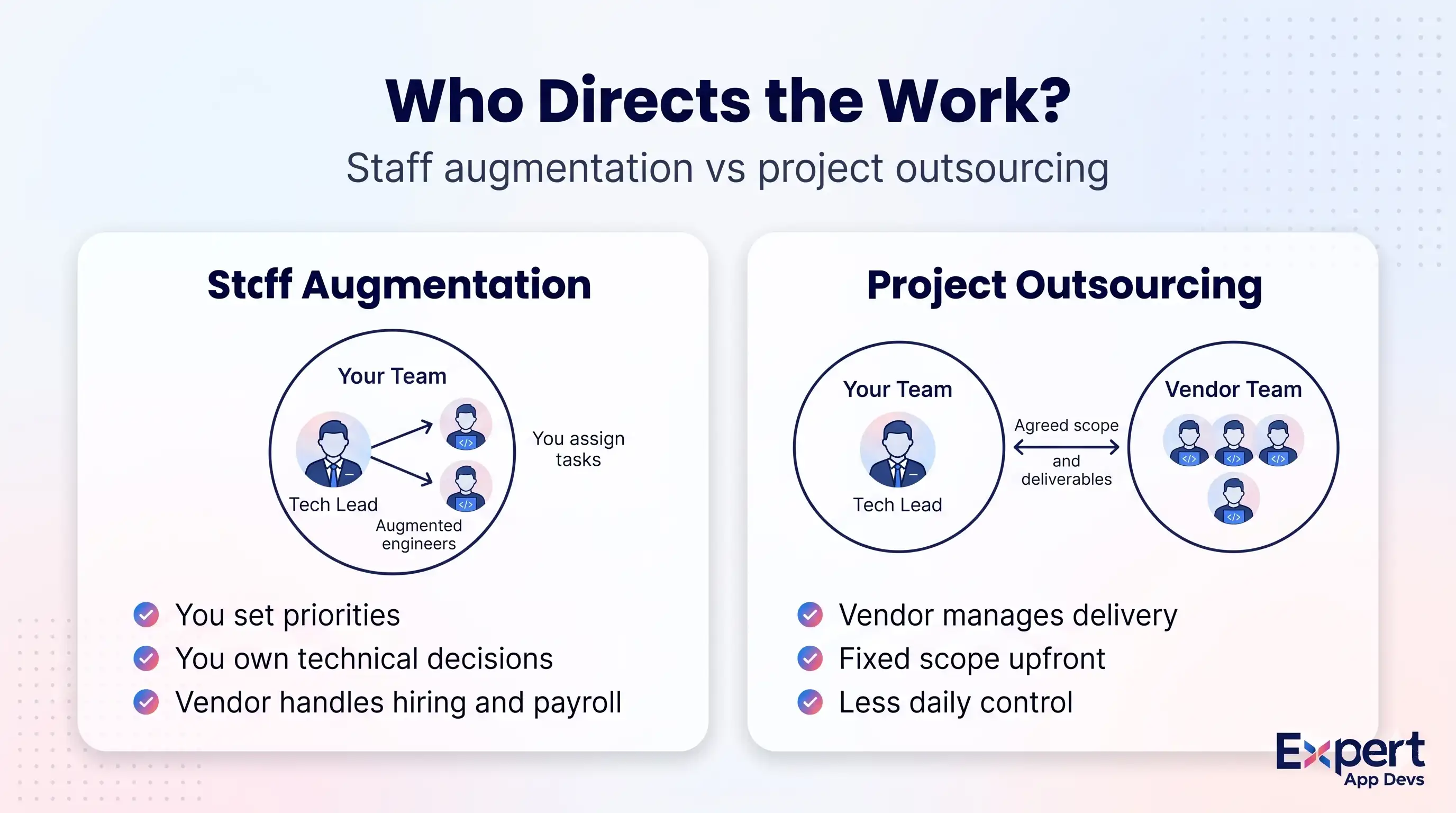
This model is also called technology staff augmentation or IT resource augmentation. The key idea is control. In staff augmentation, your team leads the work. In project outsourcing, the vendor leads the work and delivers an agreed outcome.
Typical roles include frontend, backend and full stack developers, mobile developers, QA engineers, DevOps and cloud engineers, data and AI engineers, UI and UX designers and project managers. Most buyers start with one or two roles to close a specific skill gap, then grow the team once the working model is proven.
When Should You Use Staff Augmentation and When Should You Not?
Staff augmentation fits when you have a clear roadmap, an internal technical lead and a gap in capacity or skills. It does not fit when nobody on your side can review code, assign work and make decisions. In that case, a managed team or project outsourcing is usually the safer choice.
Use staff augmentation when:
- Your backlog is growing faster than your team can ship.
- You need a skill you lack today, such as test automation, cloud cost work or LLM integration.
- A release, migration or modernization project needs extra hands for months, not years.
- You want to test a new role before you open a permanent position.
Avoid it, or pair it with a delivery lead, when:
- You have no engineering manager or tech lead with time to direct new people.
- Requirements are fixed and you only want a finished product handed over.
- You expect the vendor to own architecture and delivery risk.
If you are weighing these options for a long running product, our guide on the dedicated development team model explains how it differs from adding individual engineers.
How Do the Main Hiring Routes Compare?
Most US tech leaders compare five routes: direct hiring, freelancers, onshore staffing agencies, offshore IT staff augmentation companies and managed outsourcing. Each one trades off speed, cost, control and risk differently. The table below compares them on the same criteria so you can see which fits your situation.
| Criteria | Direct hire | Freelancer | Onshore staffing agency | Offshore IT staff augmentation company | Managed outsourcing |
|---|---|---|---|---|---|
| Who directs daily work | You | You | You | You | The vendor |
| Who employs the worker | You | Self employed | The agency | The vendor | The vendor |
| Speed to start | Slowest | Fast | Moderate | Moderate to fast | Moderate |
| Relative cost | Highest fixed cost | Varies widely | High | Lower rate, plus management time | Priced per scope or team |
| Replacement if someone leaves | You rehire | You rehire | Agency replaces | Vendor replaces | Vendor replaces |
| Time zone overlap with US teams | Full | Varies | Full | Partial, must be agreed | Partial, must be agreed |
| Best fit | Core, permanent roles | Small, isolated tasks | Onsite or regulated roles | Skill gaps and extra capacity under your lead | Clearly scoped projects |
This comparison is directional, not a price list. Real costs depend on seniority, stack, contract length and location, so always request written quotes for the exact roles you need.
How Much Does IT Staff Augmentation Really Cost Compared With Hiring?
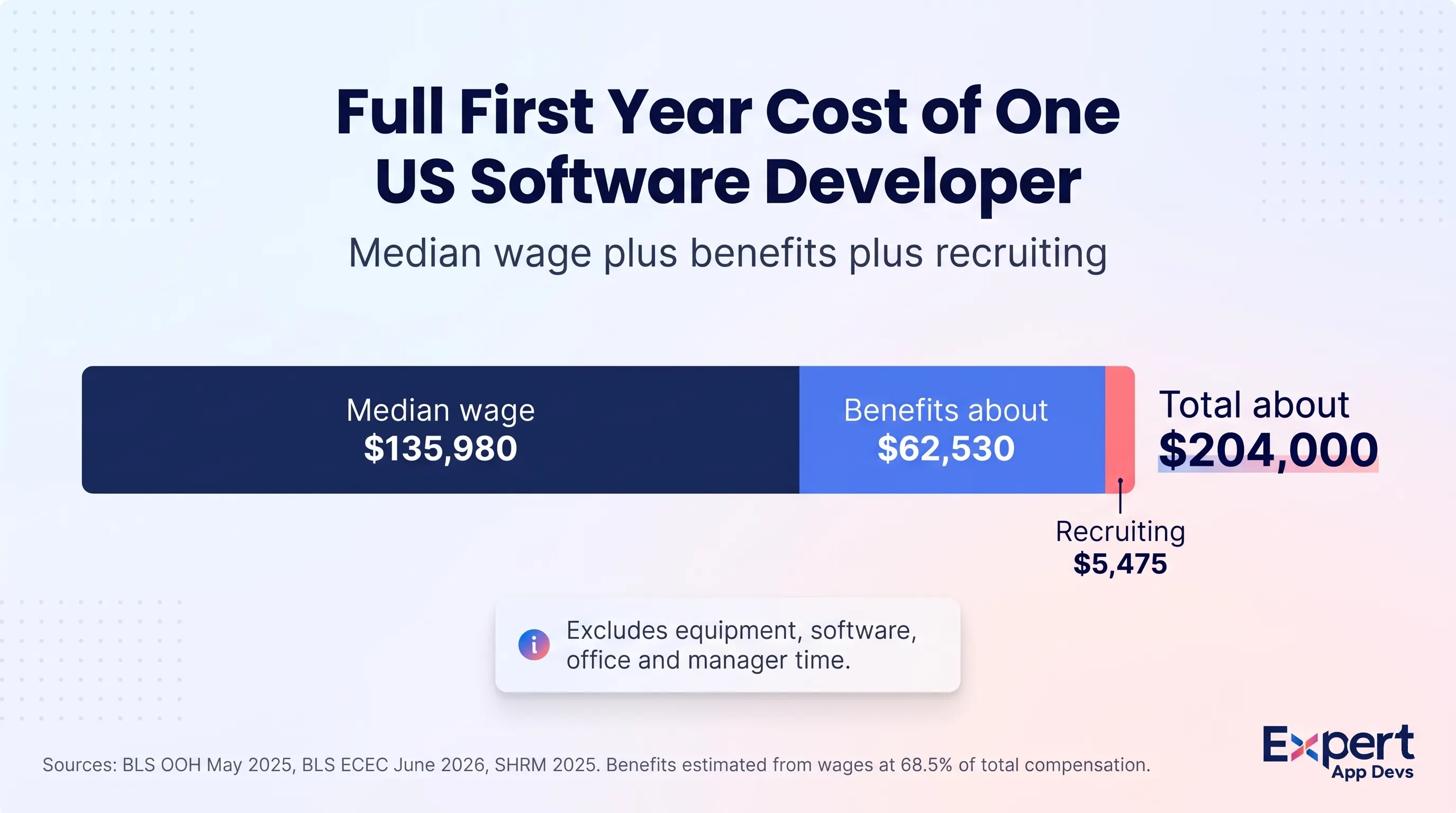
To compare fairly, start with the full cost of an internal hire, not just salary. Using public US data, a median software developer costs roughly $198,500 a year in wages and benefits, plus about $5,475 in average recruiting cost. Then compare that with the vendor rate plus your own management time.
Step 1: Build your internal baseline
The calculation below uses three public sources. It is an estimate for planning, not a quote.
| Cost item | Figure | Source and note |
|---|---|---|
| Median annual wage, US software developer | $135,980 | BLS Occupational Outlook Handbook, May 2025 data |
| Wages as a share of total compensation | 68.5% | BLS Employer Costs for Employee Compensation, full time private industry workers, June 2026 |
| Estimated wages plus benefits | About $198,500 | Our calculation: $135,980 ÷ 0.685 |
| Average cost per hire, nonexecutive roles | $5,475 | SHRM 2025 Benchmarking |
| Estimated first year cost before equipment, software and office | About $204,000 | Our calculation |
Three limits matter here. First, the BLS benefits share covers all full time private industry workers, not developers only, so treat it as an approximation. Second, the SHRM figure is an average across many roles, and technical hiring often costs more. Third, a median hides a wide range. Senior engineers in high cost cities can cost far more.
Step 2: Build the vendor side honestly
The vendor rate is the visible number, but it is not the whole cost. Add the items below for each augmented engineer.
- Monthly or hourly rate for the exact seniority and stack you need.
- Internal management time, such as a tech lead's hours for code review, planning and calls.
- Ramp time, the weeks before the engineer works at full speed in your codebase.
- Tools and access, such as extra seats for your repository, CI, issue tracker and cloud accounts.
- Transition costs if someone leaves, including knowledge transfer and lost time.
A simple formula keeps the comparison clear:
Annual vendor cost = (rate × 12 months) + (internal management hours × your lead's hourly cost) + tools + an allowance for ramp and transitions
For reference, Expert App Devs publishes starting prices of 20 USD per hour and 1,800 USD per month for a full time developer on its 40 hour trial and pricing page. These are starting prices. Senior, specialist and AI roles cost more, so do not compare a starting rate with a US median wage as if both described the same engineer. For a deeper look at rate structures, see our guide on dedicated developer pricing, risk and replacement.
How Should You Evaluate an IT Staff Augmentation Company? Use This Scorecard
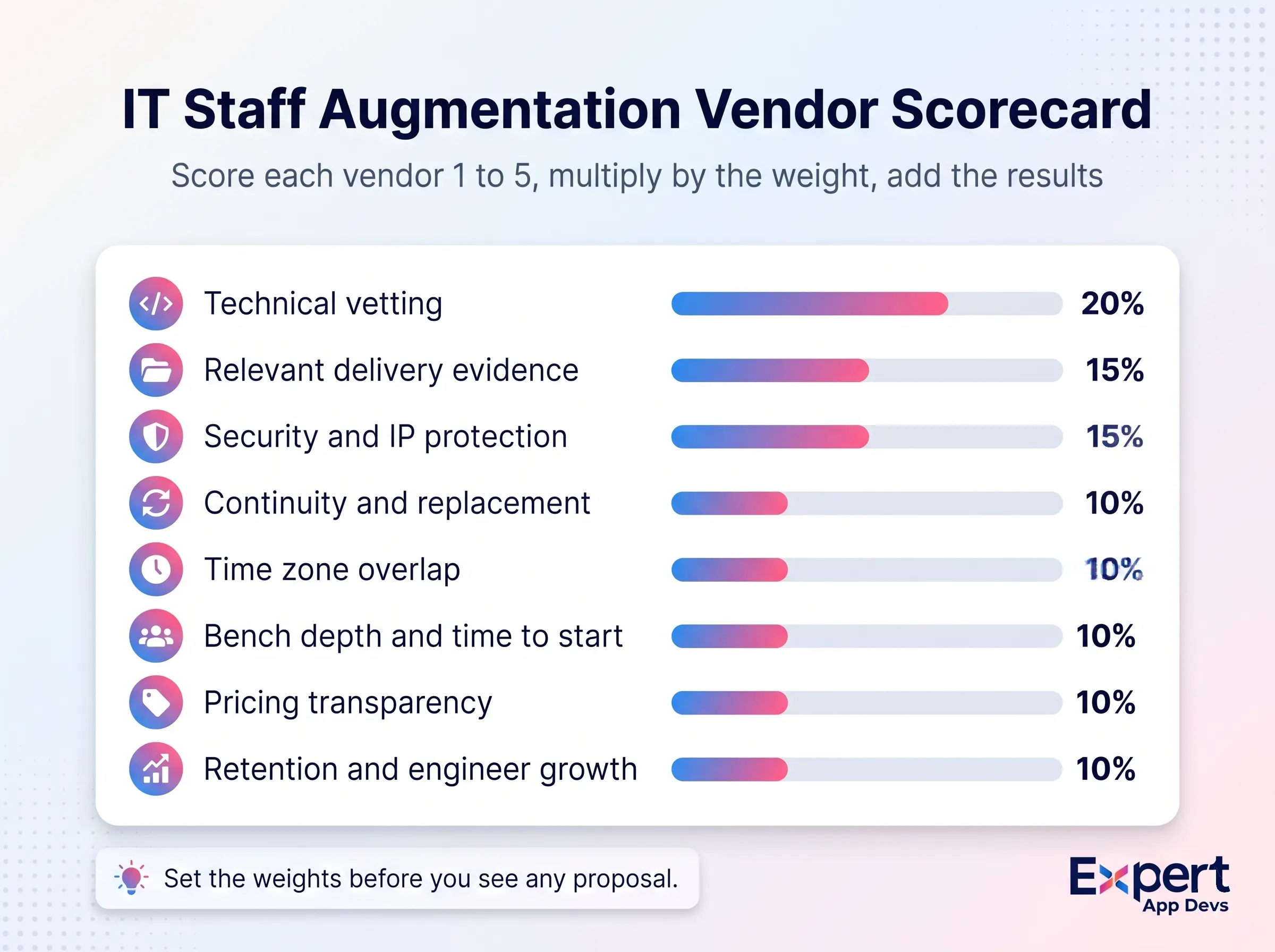
Score every shortlisted vendor on the same eight criteria, using evidence rather than sales claims. Give each criterion a score from 1 to 5, multiply by its weight and add the results. A vendor that scores well on rate but poorly on vetting, security or continuity will usually cost you more over a year.
| Criteria | Suggested weight | Evidence to request | Red flag |
|---|---|---|---|
| Technical vetting | 20% | Their screening steps, a sample assessment, the right to interview and test candidates yourself | Profiles only, no live technical interview allowed |
| Relevant delivery evidence | 15% | Case studies in your stack or industry, client references you can call | Logos with no project detail and no references |
| Security and IP protection | 15% | NDA, IP assignment clause, access control policy, device and data handling rules | Vague answers on who owns the code |
| Continuity and replacement | 10% | Written replacement terms, notice periods, knowledge transfer process | No written commitment on replacement time |
| Communication and time zone overlap | 10% | Agreed overlap hours, English proficiency, meeting and reporting plan | Refusal to commit to overlap hours |
| Bench depth and time to start | 10% | How many matching engineers they employ today, typical time to first shortlist | Every role requires fresh recruiting |
| Pricing transparency | 10% | Full rate card, what is included, notice and scaling terms | Hidden fees for onboarding, tools or replacements |
| Retention and engineer growth | 10% | Average tenure of engineers on client accounts, training practices | High churn they cannot explain |
How to use it: Adjust the weights before you see any proposals, so the scoring is not shaped by a favorite vendor. A healthcare or fintech buyer may raise security to 25%. A startup racing to a launch may raise time to start. Keep notes on the evidence behind every score, so procurement and leadership can review the decision later.
Top IT Staff Augmentation Companies in India to Shortlist
India has a deep pool of IT staff augmentation companies, so a good shortlist saves weeks. The five companies below each run a dedicated staff augmentation service from India and publish facts you can check. They are listed in alphabetical order, not ranked. Use the scorecard above to decide which one fits your needs.
How we built this list: We included only companies that have their main delivery base in India, publish a dedicated IT staff augmentation page, and state their team size, experience and engagement models on their own website. All facts below are taken from each company's website as checked on 28 October 2026. They are company stated claims, not independent audits. Please note that this article is published by Expert App Devs, which is one of the five companies listed.
| Company | India base | Experience and team (company stated) | Engagement models | Published starting price | Trial and replacement | Certifications stated |
|---|---|---|---|---|---|---|
| Bacancy Technology | Ahmedabad | In business since 2011, 1,050+ developers | Hourly (80 hour minimum), monthly dedicated, fixed cost | $22 per hour; $2,880 per month for a senior developer | 15 day trial; replacement terms not stated | ISO 27001 |
| Capital Numbers | West Bengal (listed on BSE) | 14+ years, 600+ engineers | Staff augmentation, agile pod, fixed price | Not published | No trial stated; aims to share replacement profiles within 10 business days | ISO 9001, ISO 27001, SOC 2 Type II |
| Expert App Devs | Ahmedabad | 16+ years, 400+ team | Hourly, monthly, yearly | $20 per hour; $1,800 per month | 40 hour free trial for new monthly clients; replacement offered | Not listed on its staff augmentation page |
| Radixweb | Ahmedabad | Since 2000, 650+ experts | Remote team extension, managed dedicated teams, project delivery | Not published | No trial stated; replacement guarantee with no timeframe given | ISO 27001, ISO 9001, SOC 2 Type II |
| ValueCoders | Noida | 20+ years, 675+ full time staff | Team extension, dedicated pods, development centers | $25 to $40 per hour; $3,500 to $6,400 per month full time | 2 week trial; replacement at no extra cost | ISO 27001, CMMI Level 3 |
Prices are not like for like. Each company defines seniority, included hours and extras differently. For example, Bacancy's monthly price includes a senior developer and a project manager, while other prices are starting rates. Always ask for a written quote for the same role, seniority and hours before you compare.
#1. Bacancy Technology
Bacancy is an Ahmedabad based company that has been in business since 2011 and states a team of over 1,050 developers, with offices in the USA, Canada, Australia, the UAE and Sweden. Its staff augmentation page publishes hourly and monthly prices and a 15 day trial.
Check before signing: the replacement policy, which is not stated on that page.
May suit: buyers who want published pricing and a senior developer with project management included.
#2. Capital Numbers
Capital Numbers is a company listed on BSE, with 14+ years of delivery and 600+ engineers, according to its staff augmentation page. It states ISO 9001, ISO 27001 and SOC 2 Type II, and targets shortlists within 5 to 10 business days for many standard roles.
Check before signing: pricing, which is not published.
May suit: buyers who put security certification and a listed company's governance high on their scorecard.
#3. Expert App Devs
Expert App Devs is an Ahmedabad based company with 16+ years in business and a team of 400+, with offices in the USA, UAE and Germany. Its IT staff augmentation service covers developers, QA, DevOps, cloud, data and AI engineers, and new monthly clients can test one developer with a 40 hour free trial.
Check before signing: security certifications, which are not listed on its staff augmentation page, so ask for its current security practices in writing.
May suit: buyers who want to test a developer on real tasks before committing, at a low published starting price.
#4. Radixweb
Radixweb has operated since 2000 and states a team of 650+ experts, with delivery from Ahmedabad and offices in the USA, Canada, Australia and Morocco. Its IT staff augmentation page lists ISO 27001, ISO 9001 and SOC 2 Type II.
Check before signing: pricing and the replacement timeframe, which are not published.
May suit: buyers with strict compliance needs who value a long operating history.
#5. ValueCoders
ValueCoders is based in Noida, states 20+ years of experience and 675+ full time staff, and has offices in the USA, UK and UAE. Its IT staff augmentation page publishes price ranges, a 2 week trial, replacement at no extra cost and a 30 day notice period to scale.
Check before signing: some figures on the page do not match each other, such as its years of experience, so confirm the details in your contract.
May suit: buyers who want clear price ranges and a path from one engineer to a full development center.
What Questions Should You Ask Before You Sign?
The best questions force a vendor to show evidence. Ask them in writing, compare the answers side by side and treat vague replies as a risk. The list below covers vetting, delivery, security, contracts and exit, which is where most staff augmentation problems start.
- Are the engineers your full time employees, or contractors you source per request?
- Can we run our own technical interview and a short paid or free trial on real tasks?
- How many engineers with our exact stack are available now?
- What overlap hours with our time zone will you commit to in writing?
- Who owns code, designs and documents created during the engagement, including during any trial?
- How do you control access to our repositories, cloud accounts and customer data?
- Which AI coding tools may your engineers use on our code, and can we restrict them?
- If an engineer leaves or is not a fit, how fast do you provide a replacement, and who pays for the overlap?
- What is the notice period to scale the team up or down?
- What happens at the end of the contract? How will knowledge and access be handed back?
If you are replacing an existing partner, our checklist on what enterprises ask before replacing an offshore development partner covers transition risks in more detail.
Which Contract Terms Protect You the Most?
Four clauses carry most of the risk: intellectual property assignment, confidentiality and security, replacement and continuity, and exit support. Get each one in your master service agreement or statement of work before any engineer touches your code. Have your own legal counsel review the final wording.
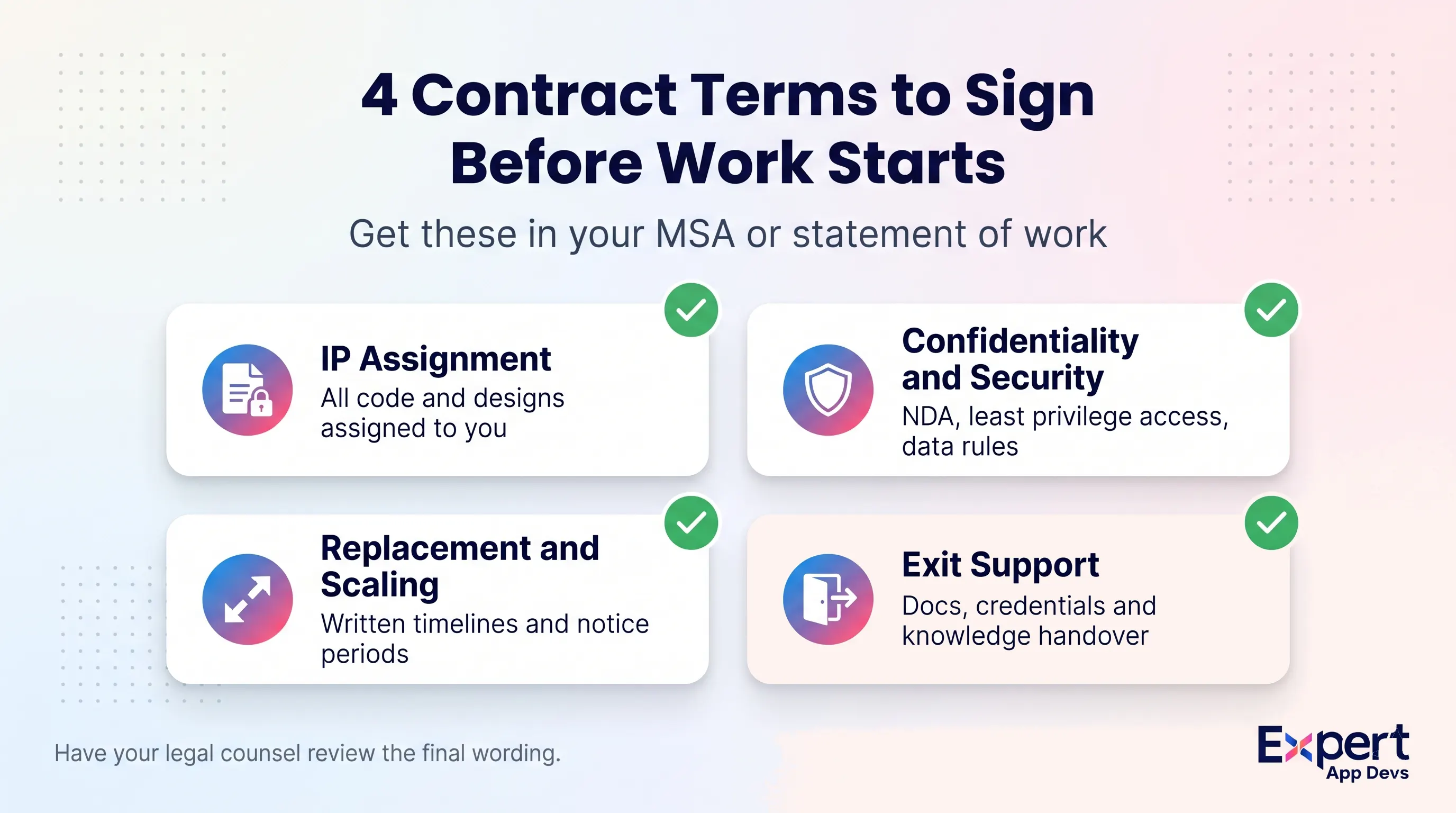
Intellectual property assignment
Do not assume you own code just because you paid for it. Under US copyright law, work by an independent contractor is a "work made for hire" only in limited categories and only with a signed written agreement, as the US Copyright Office explains in Circular 30. Software often does not fit those categories neatly. That is why your contract should include a clear assignment of all rights to your company. Also ask the vendor to confirm that its own employment agreements give it the rights it is assigning to you.
Confidentiality, access and security
Your contract should cover an NDA, least privilege access, use of company managed accounts, rules for customer data and how access is removed at exit. For secure coding expectations, many US buyers reference the NIST Secure Software Development Framework (SP 800-218). You can ask vendors how their practices map to it. If you handle regulated data, add the specific requirements, such as HIPAA, before the engagement begins.
Worker classification
Staff augmentation is often chosen because the vendor, not you, employs the engineer. Still, the more you control how, when and where someone works, the more a relationship can look like employment. The IRS describes three categories it reviews: behavioral control, financial control and the relationship of the parties. If you plan to engage individuals directly rather than through a vendor that employs them, get legal and tax advice first.
Replacement, scaling and exit
Write down the replacement timeline, how overlap time is billed, the notice period to scale up or down, and what the vendor must hand back at exit. That includes documentation, credentials and a knowledge transfer session. These terms cost nothing to agree at the start and are hard to negotiate later.
How Do You Onboard Augmented Engineers in the First 90 Days?
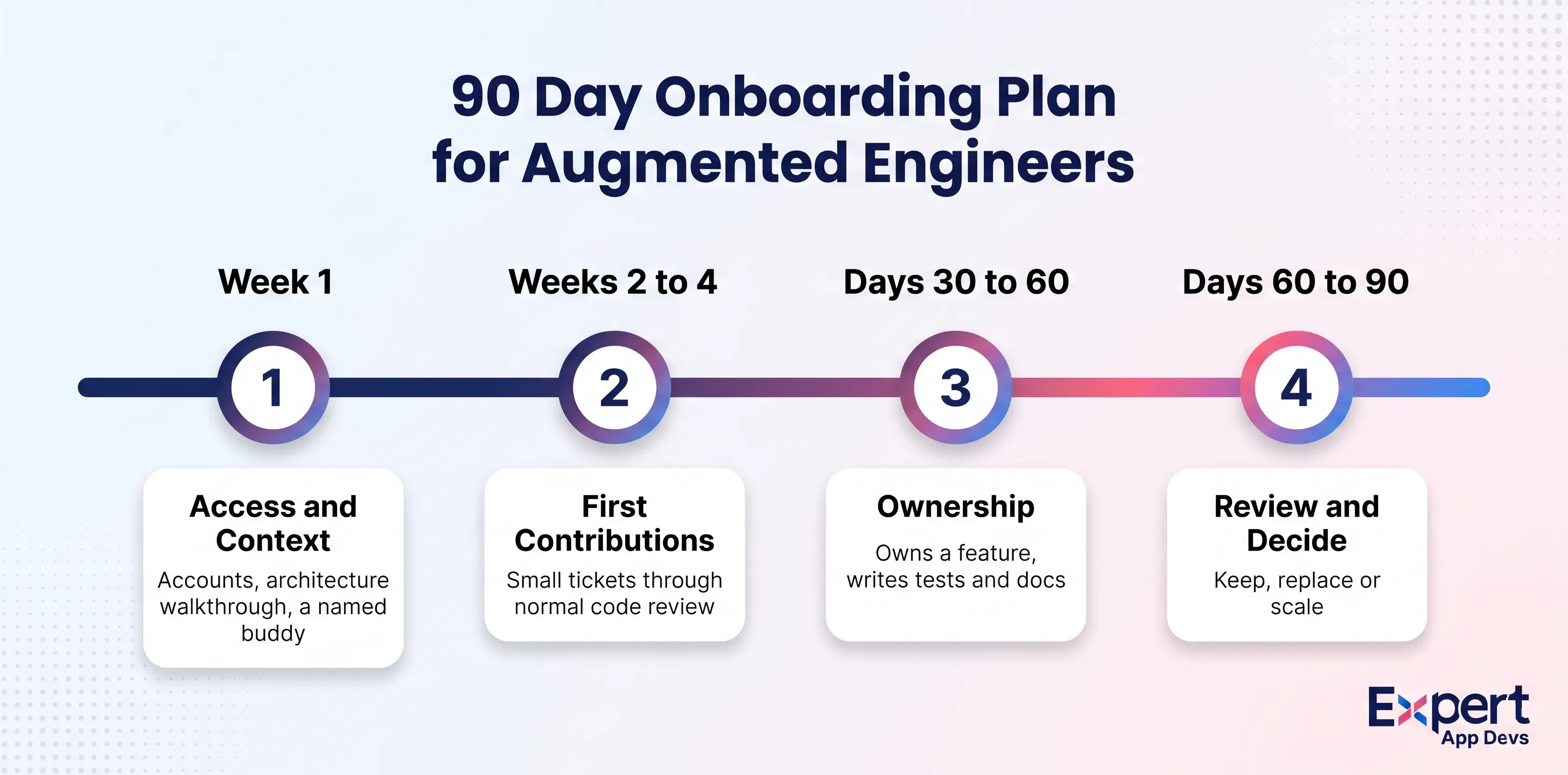
Treat augmented engineers like new team members, not outside tickets. A structured first 90 days sets expectations, shortens ramp time and gives you clear points to decide whether to keep, replace or scale. Most failed engagements skip this step and rely on the vendor to fill the gap.
| Period | Focus | What good looks like |
|---|---|---|
| Week 1 | Access and context | Accounts set up with least privilege, architecture walkthrough, coding standards shared, a named internal buddy |
| Weeks 2 to 4 | First contributions | Small tickets merged through normal code review, attendance at standups and sprint planning |
| Days 30 to 60 | Ownership | Owns a feature or component, writes tests and documentation, needs less review over time |
| Days 60 to 90 | Review and decide | Joint review with the vendor on quality, speed and communication; decide to keep, replace or scale |
Track a few simple signals: review comments per pull request, cycle time for small tickets, defects found after release and how often the engineer is blocked. These tell you more than hours logged. For more on running distributed teams, read how enterprises manage offshore development teams successfully.
What Are the Biggest Risks, and How Do You Reduce Them?
The main risks are weak vetting, knowledge loss when people leave, security gaps, poor communication and unclear ownership of code. Each one can be reduced with a specific control agreed before work starts. The table below matches each risk with a practical safeguard.
| Risk | What it looks like | Safeguard |
|---|---|---|
| Weak vetting | Strong resume, poor code | Your own technical interview plus a trial on real tasks |
| Knowledge loss | Progress stalls when one engineer leaves | Documentation in the definition of done, written replacement and handover terms |
| Security gaps | Shared passwords, personal devices, broad access | Company managed accounts, least privilege, access reviews, offboarding checklist |
| Communication friction | Questions wait a full day for answers | Agreed overlap hours, async updates, clear escalation path |
| Unclear IP ownership | Disputes over who owns code or designs | Signed IP assignment before work begins |
| Management overload | Your tech lead spends all day reviewing | Start small, add a vendor side lead as the team grows |
How Is IT Staff Augmentation Changing?
Buyers are asking for more than extra hands. Staffing Industry Analysts links the recent decline in US IT staffing to offshoring, AI assisted coding, a correction after the pandemic hiring boom and a shift from IT staffing toward IT solutions. It forecasts only about 1% growth in IT staffing in both 2026 and 2027, according to its 2026 coverage of the largest US IT staffing firms. This is a forecast, not a guarantee.
For buyers, three practical shifts follow from this:
- AI fluency with guardrails. Ask how augmented engineers use AI coding tools, how generated code is reviewed and how your code stays confidential.
- Accountability beyond attendance. More buyers want engineers who own outcomes, with clear quality and delivery signals, rather than billed hours alone.
- Flexible models. Teams often start with one augmented engineer, then move to a dedicated team or a pod as the roadmap grows. Our article on the evolution of offshore engineering beyond staff augmentation explains this path.
Demand for core engineering skills remains strong over the long term. BLS projects employment of software developers, QA analysts and testers to grow 10% from 2025 to 2035, much faster than the average for all occupations, according to the Occupational Outlook Handbook.
How Does Expert App Devs Approach IT Staff Augmentation?
Expert App Devs is an IT staff augmentation company with engineers based in India and offices in the USA, UAE and Germany. Its engineers join your sprints, code reviews and CI/CD pipelines while your team keeps control of priorities and technical decisions. You can interview candidates and test one developer on real tasks before you commit.
Here is what you can verify on our site today:
- Roles: frontend, backend and mobile developers, dedicated QA engineers, DevOps and cloud engineers, AI and machine learning developers, UI and UX designers and project managers.
- Trial: new clients on a monthly plan can use a 40 hour free trial with one developer. Code from the trial is handed to you.
- Contracts: NDA, MSA and SLA terms are discussed and agreed before work begins.
- Time zones: engineers align with agreed working hours across North America, Europe, the Middle East and Oceania.
- Track record: 16+ years in business and a team of 400+, with case studies covering fintech, telecom, banking and enterprise modernization.
See the full scope of roles, engagement models and process on our IT staff augmentation services page. If you need a fully offshore setup instead, explore our offshore development services.
Frequently Asked Questions
#1. What is the difference between an IT staff augmentation company and a staffing agency?
A traditional staffing agency mainly finds and places people, often onshore and often for general IT roles. An IT staff augmentation company usually employs a bench of engineers, screens them technically and supports them during the engagement. Many also replace engineers, manage equipment and offer delivery support as your team grows.
#2. How fast can an IT staff augmentation company provide developers?
It depends on the role and on whether the vendor already employs matching engineers. Vendors with an existing bench can often share profiles within days. Rare skills or senior roles take longer. Ask each vendor for its typical time to first shortlist and time to start for your exact stack, in writing.
#3. Who owns the code written by augmented developers?
You should, but only if your contract says so. Include a clear assignment of all intellectual property to your company, signed before work starts. Ask the vendor to confirm its own employee agreements give it those rights to assign. Have legal counsel review the wording for your jurisdiction.
#4. Is offshore IT staff augmentation cheaper than hiring in the US?
The rate is usually lower, but the real comparison is total cost. Add your internal management time, ramp time, tools and transition risk to the vendor rate. Then compare it with the full cost of a US hire, which includes benefits and recruiting. Our cost section above shows how to do this.
#5. How many hours of time zone overlap do we need?
There is no single rule. Many teams agree on a daily overlap window for standups, reviews and questions, then work asynchronously for the rest of the day. Agree the exact hours in writing, and choose roles that can work well with partial overlap, such as QA, backend or feature work with clear tickets.
#6. Can we start with one developer and scale later?
Yes. Starting with one or two engineers is a low risk way to test the vendor's vetting, communication and code quality. Once the working model is proven, you can add roles or move to a dedicated team. Confirm notice periods and scaling terms in your contract first.
Conclusion: Choose on Evidence, Not on Rate
The best IT staff augmentation company for you is the one that proves its engineers can work inside your team, protects your code and data, and stays accountable when people change. Build your internal cost baseline, score vendors on the same weighted criteria, lock down IP and exit terms, and run a trial on real work before you scale.
If you are planning to add developers, QA, DevOps or AI engineers to your team, we can help you map the right roles and engagement model. Talk to our experts.






 294

 0


 555
5
 273
0
 309
0