


- Why Do Businesses Consider Replacing An Offshore Development Partner?
- Why is the Vendor Replacement Happening Frequently?
- What Questions Leadership Teams should Ask Before Leaving Their Vendor?
- Which Checklist to follow before Vendor Replacement?
- What Is an Enterprise Vendor Transition Framework?
- What Are the Biggest Risks During a Vendor Transition?
- How Enterprises Plan a Safe Vendor Transition?
- What Enterprises Look for in Their Next Offshore Partner?
- What are the Red Flags to watch out for When Changing Vendors?
- Why Do Companies Work With ExpertAppDevs in Cases of Vendor Transition and Recovery?
- What is the importance of Requesting a Confidential Transition Assessment?
- Frequently Asked Questions
- Conclusion
Ready to transform your vision into reality?
Get Started
What Enterprises Ask Before Replacing an Offshore Development Partner?
 324
324
 4
03 Jul 2026
25 Min Read
4
03 Jul 2026
25 Min Read


 Share
Share

 Download PDF
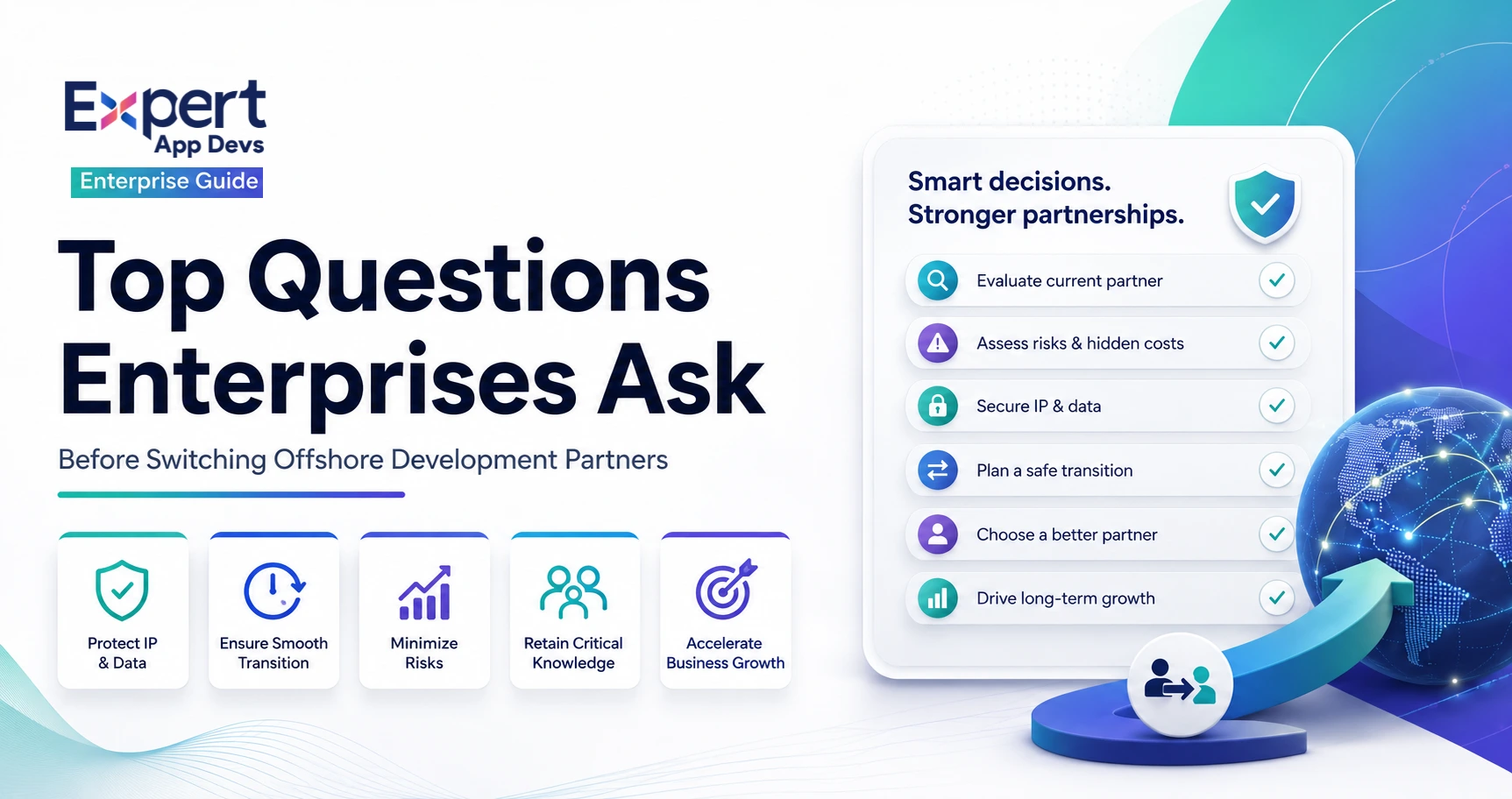
Replacing an offshore development partner requires evaluating project risks, intellectual property ownership, knowledge transfer, governance, technical capabilities and business continuity. A structured vendor transition framework helps enterprises minimize disruption, recover delivery performance and select a partner that supports long-term modernization and scalable software development.
Outsourcing your software development is important for businesses that want the global pool of talent, save time and save money by cutting out unnecessary costs. As time goes by, the problems start creeping in: missed deadlines, code quality, communication gets all tangled up and you start to wonder if your current overseas partner is still a good fit for your business.
Replacing an offshore development partner is a big decision that has an effect on your ongoing projects, your internal teams, your customers and in the end your business goals. Yet even if you're 100% convinced that the relationship has gone wrong, it's not just moving on to the next one.
Businesses have to carefully think through the risks and potential benefits before making the switch. They start asking some deeper questions about keeping your intellectual property safe, transferring knowledge, managing risks, and how you can still drive growth in the future.
Why Do Businesses Consider Replacing An Offshore Development Partner?
The only goal for companies in the beginning is to reduce costs through outsourcing the development process to other Countries. Nowadays, however, the stakes have become significantly higher. It becomes essential to provide some innovative solutions in order to support the process of digital transformation and stay ahead of competitors.
In case of failure to meet these demands, companies will be searching for alternatives.
Consistent Project Delays
Another reason why businesses switch to different vendors is consistent delays in project completion.
Delays can cause numerous issues such as the delay in product launch and loss of both clients and income. While an occasional delay may not be a problem, recurring delays definitely show that there is something wrong, and this needs to be addressed promptly.
The following are examples of signs of a vendor's poor performance:
- Recurring failure to meet milestone deadlines
- The tendency to avoid sprint commitments
- Delays in release of new products
- Inability to predict project timelines
- Vendor's lack of responsibility
With the introduction of delays, there is an indication that the offshore company you have hired cannot give you what you want in order for your business to succeed.
Low-Quality Code and Technical Debt
The quality of the software being created by the offshore firm has a lot of influence on the usability, security, scalability and obviously the profitability of the firm.
It is quite common for organizations to realize that the offshore firm they hired was not only failing to provide value but was actually working against them due to such things as:
- Increasing bug backlog
- Constant production issues
- Security flaws
- Performance problems
- Codebase becoming unmaintainable
Bad coding practices make the already heavy burden of technical debt even worse.
Communication Breakdown
For offshore partnerships to work well, communication is absolutely crucial.
However, where you find that the offshore firm does not communicate regularly or in detail about projects, it becomes clear that there is a breakdown in communication and that you may have picked a bad partner.
The common communication challenges to look out for include:
- Slow responses
- Lack of consistent reporting
- Lack of ownership on assignments
- Low visibility on project progress among stakeholders
- Issue escalation problems
Overall, this makes for a partnership that is clearly not working for you.
Technical Skills Deficiency
With technology evolving so rapidly, the skills necessary for the job only a few years back can already seem totally outdated.
This is one of the reasons why organizations have no choice but to search for partners who are able to support them in their efforts towards staying competitive through:
- Cloud-native software development
- Artificial Intelligence
- DevOps automation
- Enterprise architecture
- Mobile application development
- Data engineering
- Cybersecurity
Should the existing vendors fail to deliver on your future technology strategies, change will be inevitable.
Lack of Strategic Value
Modern businesses want more than vendors who just follow the directions.
They expect partners who can:
- Recommend new improvements and identify potential risks early on
- Contribute to architecture decisions and come up with innovative solutions
- Help drive business growth
When vendors fail to deliver any real strategic value, organisations start to look for better partners.
Why is the Vendor Replacement Happening Frequently?
The way we do outsourcing is changing. Research says that organisations now put quality, speed, expertise and innovation ahead of cost savings.
|
Enterprise Priority |
Percentage of Organizations |
|
Improving software quality |
62% |
|
Faster time-to-market |
58% |
|
Access to specialized talent |
56% |
|
Better security and compliance |
52% |
|
Cost optimization |
47% |
This shows a pretty big shift in how businesses think. They're no longer putting up with poor performance just because a vendor is cheap.
Now they look for offshore development partners who can actually deliver some real results.
What Questions Leadership Teams should Ask Before Leaving Their Vendor?
Before switching to a new development partner, leadership teams go through a pretty thorough evaluation process.
Can We Fix This?
First of all, is there anything we can do to fix things with our current partner?
Orgs assess:
- What's going wrong on our project?
- If our vendor is listening to us and making an effort to improve things
- What we've already tried to fix things
- Whether there's a simple fix we're missing
If the problems are just temporary or we can easily fix them, maybe we don't need to replace the vendor.
What's the Cost of Sticking with Things as They Are?
Lots of businesses focus on the cost of switching to a new vendor, but experienced leaders also think about the cost of sticking with an underperforming vendor.
These hidden costs can include:
- Lost revenue opportunities
- Delayed product launches
- Customer dissatisfaction
- Technical debt
- Reduced team productivity
In many cases, the cost of sticking with things is actually higher than the cost of switching.
What Are the Risks of Making the Switch?
Replacing a vendor can be a bit of a risk. Decision-makers need to weigh up:
- How much disruption it'll cause to our operations
- If it'll delay our project
- Any security concerns
- How it'll affect our customers
- If we have the resources to manage the transition
We want to make sure the benefits outweigh the risks.
How Much of Our Project Secrets Does Our Current Vendor Know?
Often, lots of our Project’'s secrets are locked up inside our vendor's team.
Leadership needs to think about:
- How good is our documentation?
- How well do our vendors understand our system's architecture?
- How much do our vendors know about our business processes?
- What kind of dependencies do we have on our vendor?
The more we rely on them, the more careful we need to be with the transition.
Can Our New Partner Do a Better Job for Us?
Switching to a new vendor only makes sense if they can actually do a better job.
Orgs assess:
- Does the new partner have the right experience?
- Do they have the tech capabilities we need?
- Do they have industry expertise?
- Have they got some client success stories we can learn from?
- Can they scale up to meet our needs?
The new partner needs to be able to show us a clear path to improvement.
Which Checklist to follow before Vendor Replacement?
Before we start the transition process, we should check if our org is ready.
Business Readiness
- Does our leadership team agree on what we're doing?
- Has our budget been approved?
- Do we have some clear goals for the transition?
- Are all our stakeholders on the same page about what's going to happen?
Technical Readiness
- Do we own the source code?
- Is our documentation in order?
- Can we get access to our infrastructure?
- Do we understand all the technical dependencies?
Security Readiness
- Are our intellectual property rights safe?
- Have we documented all our compliance requirements?
- Do we have some clear security procedures in place?
- Are we prepared to off board the old vendor?
Operational Readiness
- Have we got a plan for transferring knowledge to our new partner?
- Have we worked out how we're going to communicate with everyone?
- Have we got a plan for managing any risks that come up?
- Do we have a clear governance structure in place?
If we run through this checklist, it'll make the transition a lot smoother.
What Is an Enterprise Vendor Transition Framework?
Vendor transitions that have been successful follow a certain structure of focus areas such as governance, risk mitigation, business continuity and knowledge retention.
|
Transition Area |
Key Objective |
Enterprise Focus |
|
Governance Assessment |
Establish accountability |
Governance maturity, reporting structure, executive oversight |
|
Technical Discovery |
Understand current systems |
Architecture review, technical debt assessment |
|
Access Governance |
Secure organizational assets |
Repository access, infrastructure ownership, credentials management |
|
Knowledge Transfer |
Preserve critical expertise |
Documentation, stakeholder interviews, system walkthroughs |
|
Parallel Operations |
Reduce operational risk |
Controlled overlap between outgoing and incoming teams |
|
Stabilization & Recovery |
Restore delivery confidence |
SLA recovery, issue remediation, performance optimization |
|
Modernization Planning |
Accelerate business value |
Cloud adoption, automation, scalability improvements |
Businesses which formalize vendor handover through a formal process generally enjoy less operational risk, better stakeholder visibility, and quicker stability post handover.
What Are the Biggest Risks During a Vendor Transition?
The primary risks that exist are knowledge loss, failure in access management, disruption to operations, IP leakage, and reduced delivery speed when onboarding. These risks, however, can be greatly mitigated through proper transition planning.
Transition Risks vs Mitigation Strategies
|
Risk |
Potential Impact |
Mitigation Strategy |
|
Knowledge Loss |
Reduced productivity and delayed releases |
Structured knowledge transfer workshops and documentation audits |
|
IP Exposure |
Legal and security risks |
Ownership validation, contractual review, access audits |
|
Infrastructure Access Issues |
Operational disruption |
Early access governance review and credential inventory |
|
SLA Failures |
Customer dissatisfaction |
Parallel support operations and phased transition |
|
Stakeholder Misalignment |
Project delays |
Executive governance committee and communication plan |
|
Business Continuity Risks |
Service interruptions |
Parallel operations and contingency planning |
|
Technical Debt Discovery |
Increased remediation costs |
Comprehensive technical assessment during onboarding |
How Enterprises Plan a Safe Vendor Transition?
You won't find many companies that just up and switch vendors overnight.
They plan ahead and go through a structured transition process.
Phase 1: Getting to Know You
The vendor you're replacing gets a good look at your operation to build a transition plan.
They're looking at:
- How's the code quality?
- What kind of infrastructure are you running?
- What's going on with security?
- How are you doing development?
- What's the state of your technical debt?
This gives them a good foundation to work from.
Phase 2: Transfer of Knowledge
The new team gets all the critical information they need to keep things running smoothly.
They do this through:
- Looking over architecture
- Running some technical workshops
- Auditing the documentation
- Talking to stakeholders
The idea is to get all the knowledge out of the old vendor's hands and into the new team.
Phase 3: Doing it in Parallel
At this point, both teams are running in tandem.
This helps with:
- Reducing the risk of downtime
- Getting to the bottom of issues faster
- Making sure knowledge is validated
- Having more confidence in the whole operation
Phase 4: Taking Control
The new team takes over more and more responsibilities.
You're talking about:
- Development
- Testing
- Infrastructure management
- Deployment processes
- Support operations
Phase 5: Getting the Most Out of Your New Partner
Once you're all stable, it's time to get some real value out of your new vendor.
You want them to focus on:
- Performance
- Process optimization
- Technical modernization
- Product acceleration
That way you can really start to grow and improve.
What Enterprises Look for in Their Next Offshore Partner?
After a bad outsourcing experience, companies get a lot more selective.
Proven Transition Experience - You Don't Want to Be an Experiment
You want vendors who've done this before - and who can show off their skills.
So look for things like:
- Transition case studies
- Recovery project experience
- Legacy modernization expertise
- Structured onboarding processes
Strong Technical Capabilities - Don't Forget About the Details
You need a vendor who can handle a lot of different domains.
So think about things like:
- Mobile app development
- Cloud engineering
- DevOps
- AI integration
- Enterprise software development
Transparent Communication - You Need to Know What's Going On
Your leadership team wants to see what's going on with your project - so you need a vendor who will keep them in the loop.
That means things like:
- Regular reporting
- Executive updates
- Clear ways to escalate issues
- Dedicated project management
Security and Compliance
Companies now are placing a lot more emphasis on security.
When choosing a vendor, they should demonstrate some key things to you:
- How do they build security into their development processes?
- How do they manage access to your systems and data?
- That they actually know what's required to meet your compliance needs
- That they have procedures in place to test and evaluate security
Scalability
A good partner should be able to help you scale up as much as you need to - and right now.
You want to know if a vendor can:
- Get their team up and running quickly when you need them
- Bring in special talent when you need it
- Keep up with the latest technologies
- Handle global growth when that's what you need
What are the Red Flags to watch out for When Changing Vendors?
Not every new vendor is going to be an improvement - in fact they often just turn into another set of headaches.
Watch out for the warning signs:
Unrealistic Promises
Be wary of vendors who promise:
- Your old project will magically get back on track overnight
- They can slash costs so deep you'll wonder how they do it
- There's zero risk in transitioning to them
- They can get your project done super-fast - like way faster than anyone else can
Experienced partners will tell you exactly what risks exist and how they plan to handle them.
Bad Documentation Practices
If a vendor can't even tell you how they operate, what their governance looks like, or what kind of reporting they do - then you're probably in for trouble down the line.
Lack of Experience with Big Companies
Working with large organisations is complicated - and requires a lot of experience to get right.
Choose a vendor who has actually worked with big companies before.
No Transition Plan
A good offshore partner needs to have a plan for how they are going to make a smooth transition happen.
Without one, you're basically just taking a big risk.
Why Do Companies Work With ExpertAppDevs in Cases of Vendor Transition and Recovery?
ExpertAppDevs is an enterprise-grade partner in outsourcing transitions, recoveries, stabilization and modernization efforts.
ExpertAppDevs differs from other development providers by focusing on transition and recovery with a goal to reduce impact on business and restore trust in delivery.
ExpertAppDevs' areas of focus include:
- Vendor transition strategy for enterprises
- Project recovery and stabilization efforts
- Technical debt assessment and elimination
- Knowledge transfer strategy
- Infrastructure ownership validation
- Access governance and security audit
- Legacy modernization programs
- Cloud migration and optimization
- Engineering teams augmentation and scaling
If companies experience recurring SLA violations, governance issues, ineffective communication channels, or stalled digital transformation efforts, then ExpertAppDevs can help them move forward.
What is the importance of Requesting a Confidential Transition Assessment?
In case your existing offshore development partner is failing to deliver against business expectations, a transition assessment will reveal areas of risk, recovery options, and modernization needs prior to an outsourcing decision.
A confidential assessment can assist your company to:
- Evaluate vendor performance and governance maturity
- Reveal areas of delivery, security, and business continuity risks
- Determine transition complexity and timeline
- Create a phased approach to recovery
- Define modernization priorities
- Minimize disruption during transition
Arrange a confidential transition assessment with ExpertAppDevs for your technology company.
Frequently Asked Questions
Question #1. What are the ways for protecting intellectual property when changing vendors?
Answer: It is necessary to perform an IP audit prior to the transition process that will include validation of the code ownership, assessment of contractual obligations, security of repositories, auditing of infrastructure access, and implementation of access governance.
Question #2. How can downtime be prevented when transitioning from one development partner to another?
Answer: Usually, the most effective transition strategy involves a parallel operation, when the new team and the existing vendor operate in the same environment for some time.
Question #3. What would happen in case the outgoing vendor doesn't cooperate?
Answer: The organization could use contractual provisions, repository ownership, infrastructure access, internal documentation, and interviewing of stakeholders. There is a chance to get system knowledge reconstructed by the experienced transition team even without the vendor's assistance.
Question #4. What does a parallel operations strategy mean?
Answer: The parallel operations strategy involves simultaneous work of both teams in the same environment during the transition process.
Conclusion
Replacing an offshore development partner is a move that never comes easy to big companies. However if they stay with a vendor that’s underperforming, things can get a whole lot worse - delayed projects, security worries and business opportunities slipping through their fingers.
Companies that do this right think this one through. They weigh up the risks, sort out who owns what intellectual property, make sure the new team learns from the old one, and then choose a new partner who has actually done this before and can do it smoothly.
When done properly, switching over to a new supplier is a lot more than just finding someone else to do the same old job. It’s an actual chance to make your software better, accelerate innovation, build a more robust operation and put your company in a much stronger position for years to come.
If you are stuck deciding whether to swap out your current offshore development partner, the right transition plan can turn this into a game-changer giving you a real edge over your competition.






 175
175

 0
0


 234
1
234
1
 166
0
166
0
 1.1K
0
1.1K
0