



- TL;DR
- 1. Why Cheaper Proposals Cost More: The Setup
- 2. What Dedicated Developers Actually Cost
- 3. Four Risk Areas Enterprise Buyers Must Address Before Signing
- 4. What Your Vendor's Replacement Policy Should Look Like
- 5. Why Dedicated Developer Teams Outperform Freelancers and Staff Augmentation
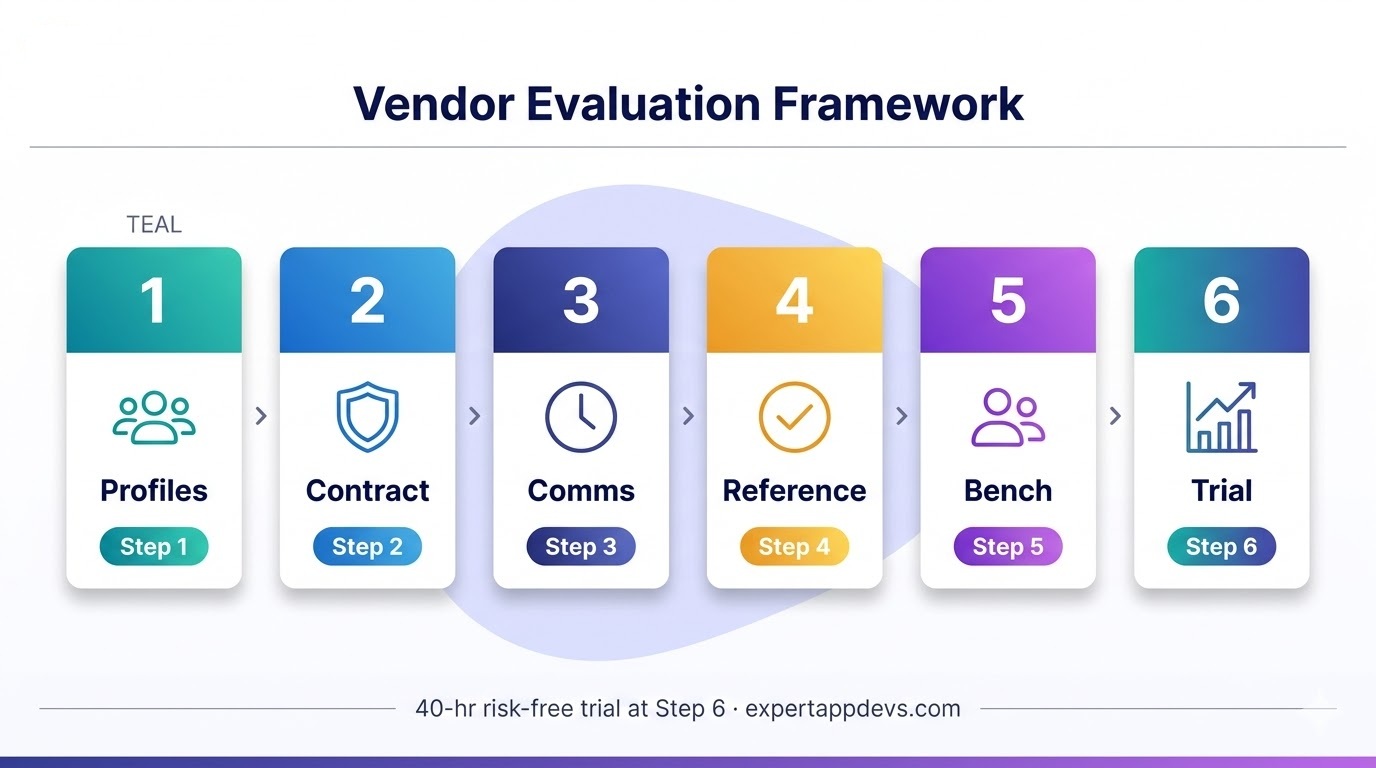
- 6. The 6-Point Vendor Evaluation Framework for Enterprise Buyers
- 7. Future Outlook: Next 12 to 24 Months
- 8. Making a Decision That Does Not Cost You at Month Six
- 9. Frequently Asked Questions
- Executive Conclusion
Ready to transform your vision into reality?
Get Started
Hire Dedicated Developers: Pricing, Risk, and Replacement Explained
 457
457
 0
23 Mar 2026
62 Min Read
0
23 Mar 2026
62 Min Read


 Share
Share

 Download PDF
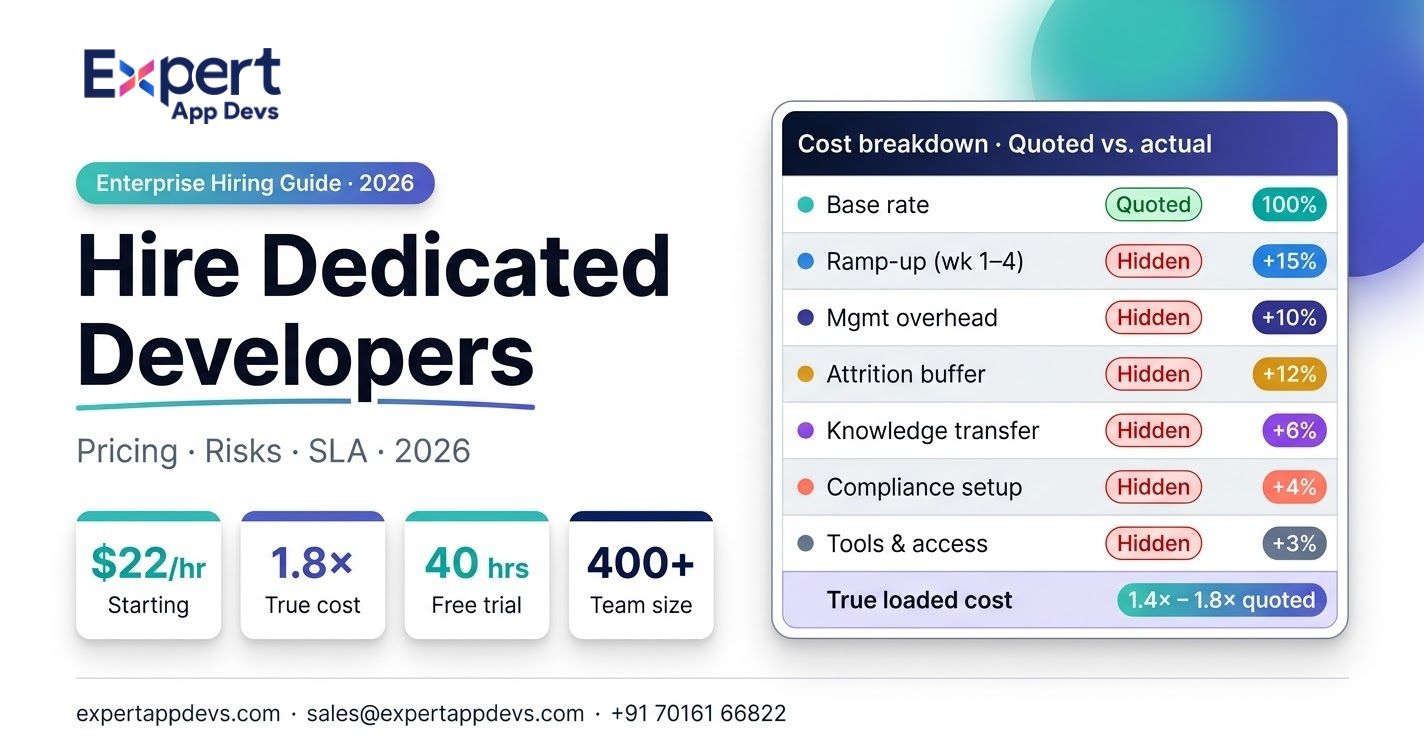
Hiring a dedicated developer team India at $22 to $75 per hour looks straightforward until the contract starts. The true loaded cost is 1.4x to 1.8x the quoted rate after ramp-up, attrition, compliance, and management overhead are counted. This guide gives enterprise buyers a complete picture of real costs, contract risks, replacement policies, and a six-step vendor evaluation framework before a single dollar is committed.
TL;DR
- The software development outsourcing market reached $618 billion in 2026 at a 9.6% CAGR, per Mordor Intelligence. Dedicated developer demand is accelerating as internal hiring costs rise.
- Hidden cost components including ramp-up, attrition, compliance, and knowledge transfer add 40% to 80% to the quoted hourly rate across all regions and vendor types.
- IP disputes in offshore engagements cost $200,000 to over $1 million to resolve before settlement. Contract structure before onboarding is the only effective mitigation.
- India's DPDP Rules 2025, notified by MeitY on November 14, 2025, introduced enforceable data obligations for all offshore processing arrangements. Penalties reach INR 250 crore per violation, equivalent to approximately $30 million.
- The dedicated model delivers the lowest 12-month total cost of ownership at $80,500 for two developers, compared to $114,800 for staff augmentation and $105,600 for freelancers.
1. Why Cheaper Proposals Cost More: The Setup
The mobile development outsourcing market reached $618.38 billion in 2026. It is projected to reach $977 billion by 2031, growing at a 9.6% CAGR. One mistake that causes more failed projects in this market is picking a developer based on hourly rates alone.
The pattern is consistent. A founder evaluating two vendor proposals selects the lower bid. Within 3 months, you experience budget overruns, delays and lack of accountability. The rate card was accurate. The estimate wasn’t.
That’s because the real cost includes more than hourly rates. Add ramp-up time, attrition, management overhead and compliance, and the actual cost goes up by 40-63%. A proposal citing $22 to $75 per hour represents the starting point for comparison, not the basis for a budget.
This guide shows you the full cost picture before you hire dedicated developers. ExpertAppDevs has observed this pattern across industries and engagement sizes since 2011. Every component in this guide is preventable with the right contract and evaluation process. That’s what we will share with you.
2. What Dedicated Developers Actually Cost
The hourly rate starts a conversation. It doesn’t end it. What actually matters is what you spend by month three or six. The number is always higher than the proposed cost. It is at this point in the engagement that the gap between quoted and actual spend becomes visible. This sections breaks down the complete cost structure, provides verified rate benchmarks across roles and regions.
2.1 The Published Rate vs. The Real Cost
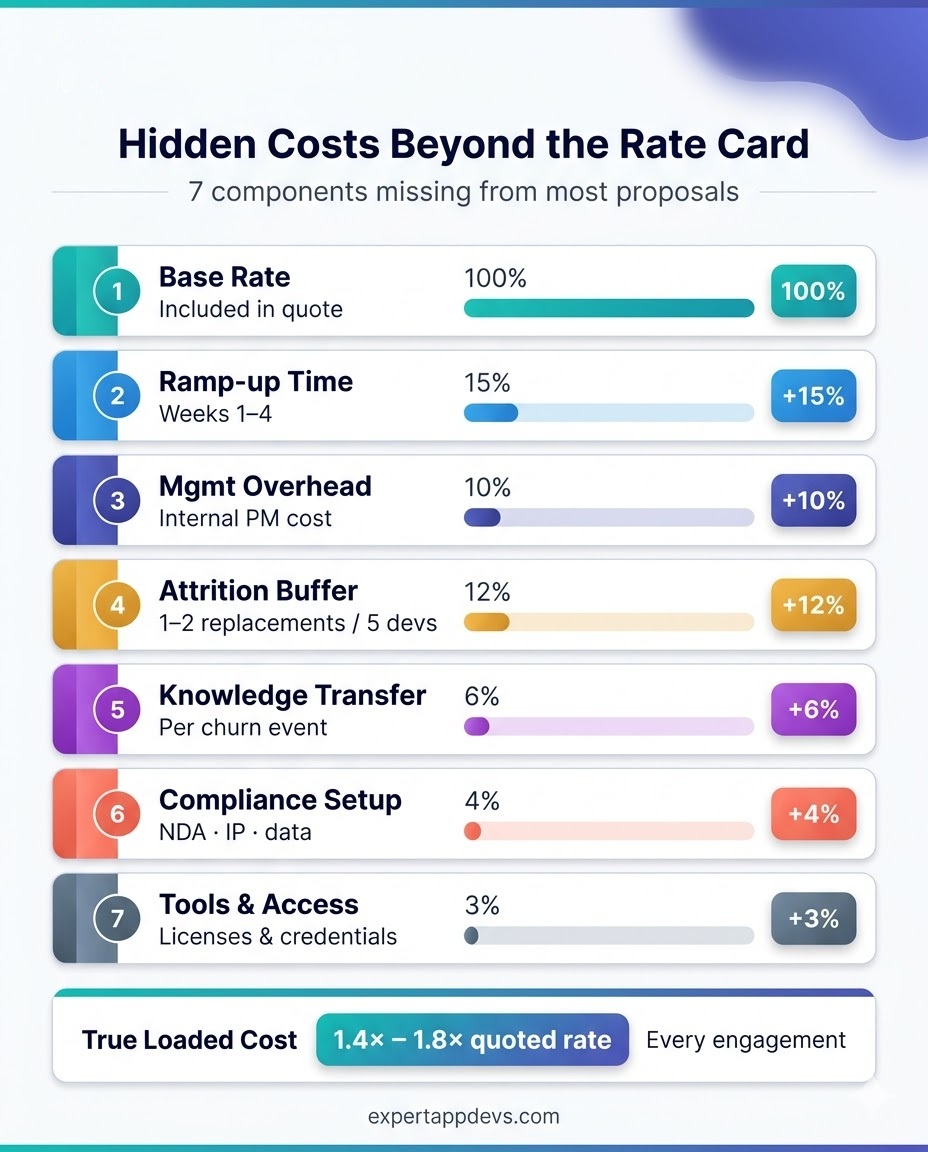
A developer billing $30 per hour for 160 hours sends you a $4,800 invoice. By month three, your actual cost is between $6,500 and $8,500. The rate was never wrong. The proposal didn’t include the remaining components.
The components in the table appear in every dedicated engagement, across geographies and vendors. Most proposals don’t include them.
|
Cost Component |
In Proposal? |
Real Impact |
Typical Add |
|
Base hourly rate × hours |
Yes |
Baseline cost |
100% |
|
Ramp-up / onboarding time |
Rarely |
Weeks 1–4 at 40–60% productivity. Zero deliverables during this period. |
+12–18% |
|
Management and coordination overhead |
Never |
Internal PM cost continues regardless of vendor. Meeting time, approval cycles, review rounds. |
+8–12% |
|
Attrition buffer |
Never |
1–2 replacements per 5 developers per year. Industry-standard churn, never included in proposals. |
+10–15% |
|
Knowledge transfer on replacement |
Never |
2–4 weeks of reduced output while the replacement developer learns the codebase. |
+5–8% |
|
Compliance and security setup |
Rarely |
NDA execution, IP audit, data handling protocol definition, device management. |
+3–6% |
|
Tools and access provisioning |
Never |
License acquisition, credential management, repository access setup. |
+2–4% |
|
TRUE LOADED COST |
- |
Combined impact of all hidden components across a standard engagement |
1.4× – 1.8× quoted rate |
Add all the hidden components and you get 40-63% on top of your base cost. That is how a $4,800 bill becomes $6,500 to $8,500.
Key insight: Every line item marked 'Never' in the proposal column represents a standard component of a dedicated engagement model. They are not omitted because they are rare. They are omitted because including them would make the quote appear more expensive at comparison stage.
Ask your vendor to explain each of these line items before you sign a contract. If they cannot share, that’s your answer on whether to hire them or not.
2.2 Rate Benchmarks by Role and Region
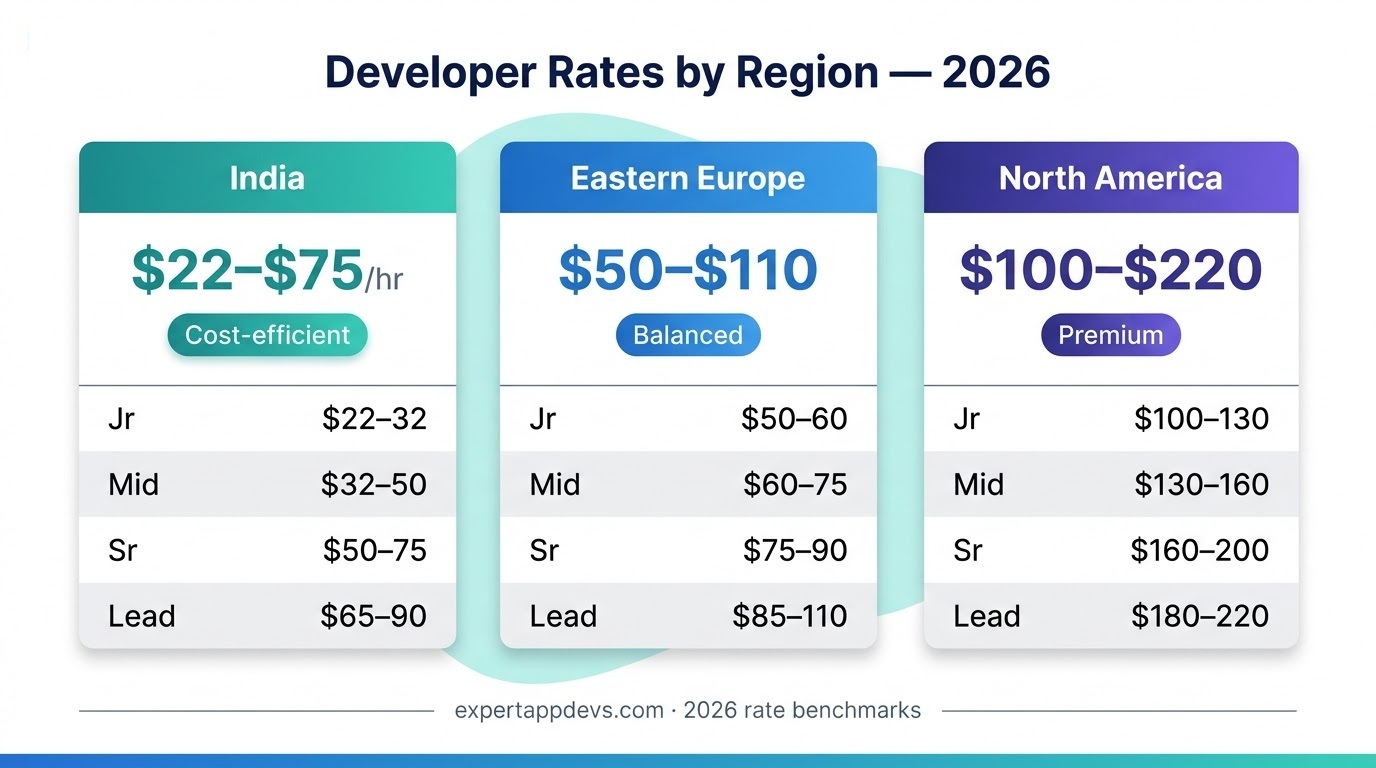
Where your dedicated developer team sits determines what you pay. India offers the lowest hourly rates. Eastern Europe costs more but they have better overlaps with European time zones. North America is the most expensive, reflecting their local hiring costs. Pick based on your timezone needs and budget, and not just their hourly rates.
|
Role |
India (per hour) |
Eastern Europe (per hour) |
USA / Canada (per hour) |
|
Junior Developer |
$22–$32 |
$50–$60 |
$100–$130 |
|
Mid-level Developer |
$32–$50 |
$60–$75 |
$130–$160 |
|
Senior Developer |
$50–$75 |
$75–$90 |
$160–$200 |
|
Tech Lead / Architect |
$65–$90 |
$85–$110 |
$180–$220 |
|
QA Engineer |
$20–$38 |
$40–$60 |
$90–$130 |
|
DevOps / Cloud Engineer |
$35–$65 |
$55–$80 |
$140–$190 |
The gap within India alone is significant. A junior developer costs $22 and senior costs $75 per hour. The $53 difference reflects the experience, specialization, and supervision needs. A junior developer at $22 needs oversight that causes the cost gap. Factor this in before deciding.
Eastern Europe is a strong middle ground. The rates are 60-80% higher than India. But, the time zone overlap with Europe reduces coordination time. For time-sensitive projects, the tradeoff is worth it.
No rate table tells you the entire story. A senior developer in India at $65 per hour inside a structured team with defined SLAs delivers more per dollar than the mid-level contractor in North America working at $140 per hour. The rate is where you start. Output per dollar is what you need to measure.
Rate data benchmarked against Toptal, Arc.dev, and Glassdoor published ranges for 2026.
2.3 Dedicated Model vs. Staff Augmentation vs. Freelancers
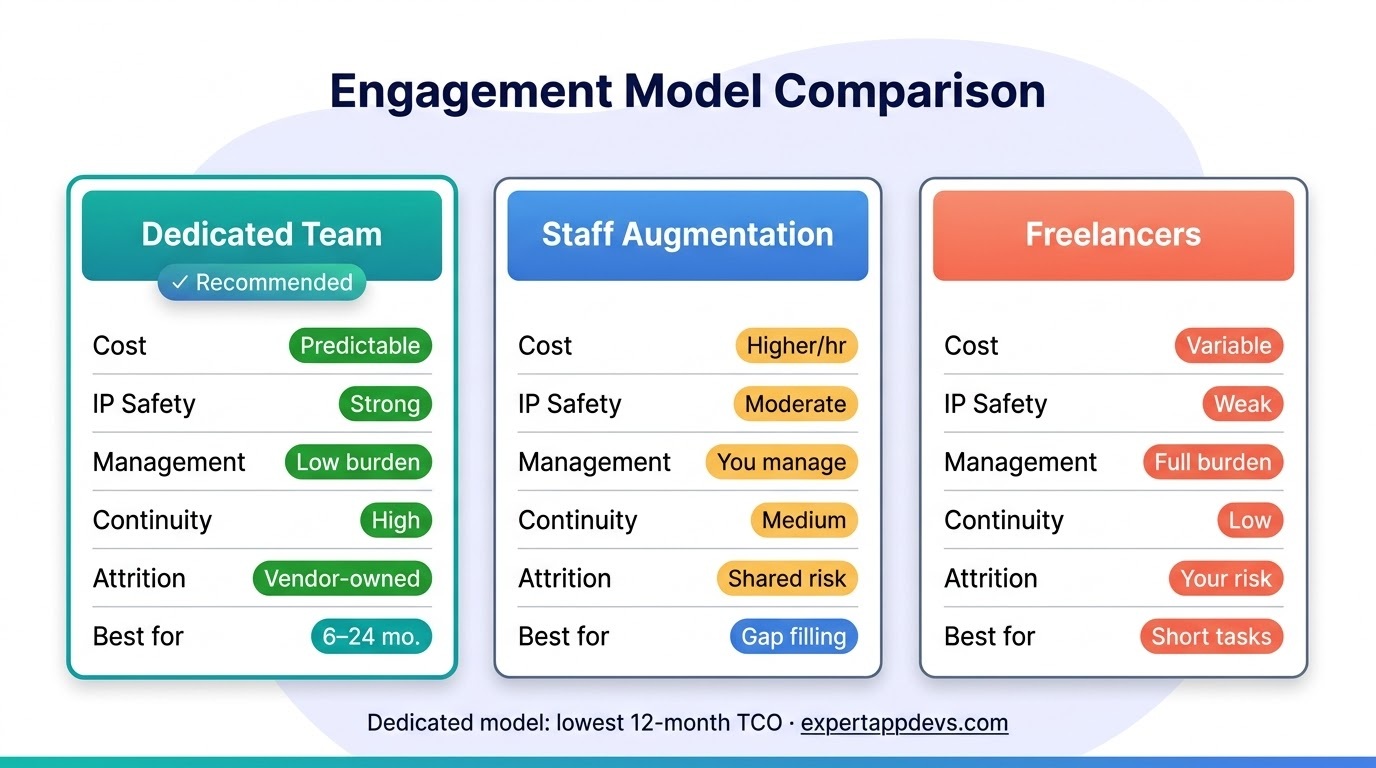
Three models exist, dedicated teams, staff augmentation and freelancers. Each one serves a different purpose. Picking the wrong one is the fastest ways to spend more money. Here is how they compare.
|
Factor |
Dedicated Team |
Staff Augmentation |
Freelancers |
|
Cost structure |
Predictable, moderate long-term cost |
Higher hourly, variable total |
Low upfront, high total over time |
|
Onboarding speed |
1–2 weeks, structured ramp-up |
1–3 weeks, role-dependent |
Days, immediate start |
|
Team continuity |
High, stable long-term |
Medium, contract-dependent |
Low, highest churn rate |
|
IP protection |
Strong, defined in contracts |
Moderate, vendor-dependent |
Weak, inconsistent |
|
Management effort |
Low, vendor owns delivery |
Medium, you manage resources |
High, full client ownership |
|
Scalability |
High, team-level scaling |
Medium, role-based |
Low, individual hiring |
|
Attrition risk |
Low, vendor-managed |
Medium, shared responsibility |
High, client responsibility |
|
Exit and replacement |
Smooth, SLA-based |
Variable, vendor-dependent |
None. Restart hiring from zero. |
|
Best use case |
6–24 month product builds |
Filling specific skill gaps |
Short-term, single-task projects |
IP protection is a critical differentiator that first-time buyers consistently underweight. Freelancer contracts are vague on who owns the code. Dedicated team contracts define it clearly from day one. The distinction matters most when raising funds or going through an acquisition.
ExpertAppDevs data across multi-year engagements shows that the dedicated model delivers the lowest total cost of ownership when measured at the six-to-twelve-month mark, even for engagements that begin at a higher monthly rate than the freelancer alternative.
For full 12-month cost-breakdown across all three models, see section 5.4
3. Four Risk Areas Enterprise Buyers Must Address Before Signing
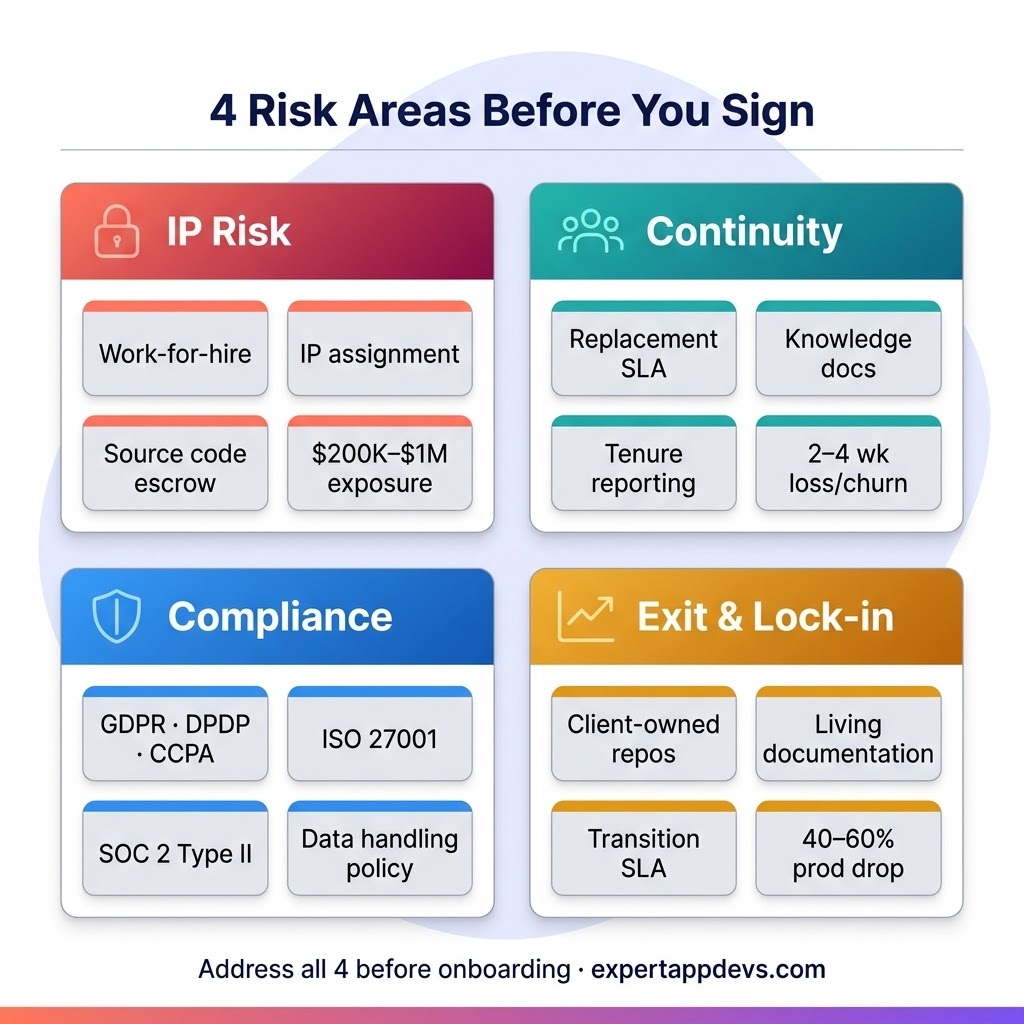
Pricing transparency is the entry requirement for any vendor conversation. Risk exposure is where procurement decisions are finalized and where engagements fail. The four areas below account for the majority of dedicated engagement failures. They appear consistently when contracts are vague and vendors are onboarded without structured evaluation.
3.1 Intellectual Property Risk
IP disputes surface at the worst possible time: during a funding round, an acquisition process, or a product launch. Three common scenarios cause most of them.
A developer uses your codebase to build something for a competitor. The vendor claims ownership of frameworks built during your engagement. The developer from the team leaves and takes the technical knowledge with them. An NDA slows this down. It doesn’t stop it.
Resolving an IP dispute costs between $200,000 and $1 million before settlement. This number is based on observed technology litigation cases. If the dispute occurs during a funding round, it can damage investor confidence and delay your launch. This is not hypothetical. It happens.
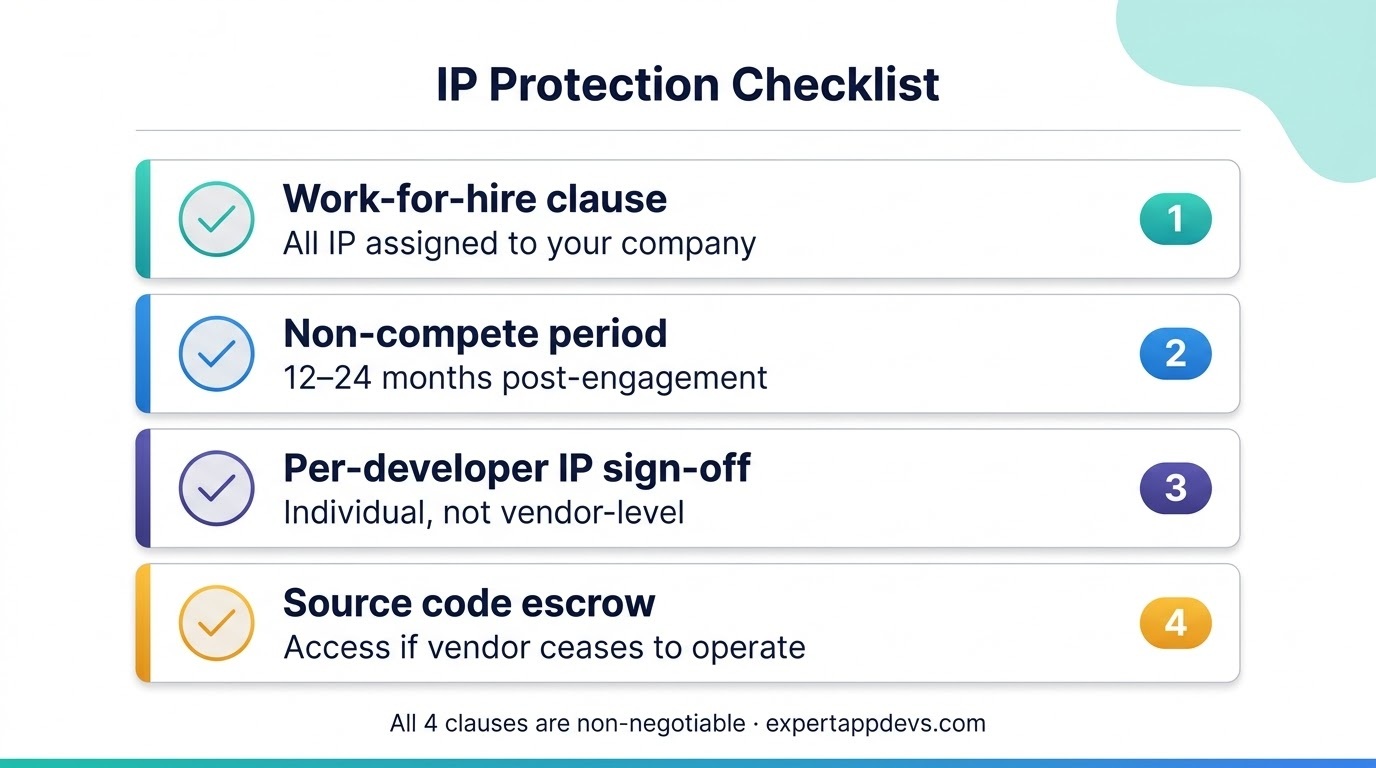
Four Contract Clauses that Eliminate Intellectual Property Risk
- Work-for-hire Clause: Every line of code, design file and document belongs to your business and not the vendor.
- Non-compete Clause: No team member can work for your competitor for 12-24 months after engagement ends.
- Individual IP Assignment: It will be signed by each developer on the dedicated developer team.
- Source Code Escrow: You will have full access to your code even when the vendor company shuts down.
At ExpertAppDevs, IP assignment is a standard contract term. Not an add-on. Every developer signs it individually before they start. This is non-negotiable for us.
3.2 Team Continuity Risk
This is the most often ignored risk when you hire dedicated mobile app developers. One developer leaving mid-project costs you about 2-4 weeks of productivity. In teams of 5 or more developers, expect one or two departures per year. That is 20-40% of your team churning. If knowledge lives with one or two people, a single departure can stall everything.
Before you hire anyone, ask the vendor one question. What is your average developer tenure on accounts that run longer than 12 months?
Their answer will tell you everything about how they manage team stability. It will also tell if attrition patterns align with the quote shared.
Four Contract Terms that Protect You from Continuity Risk
- Mandatory knowledge documentation contains architecture decisions, code comments, and onboarding materials. Updated continuously throughout the engagement.
- Transition overlap clause lets the replacement developer start before the departing developer leaves. There’s no gap in handover.
- Replacement SLA defines how many days the vendor has to present a candidate and make them productive. If it is not written, it doesn’t exist.
- Quarterly team tenure reporting is mandatory for engagements running 12 months or longer. The vendor reports team stability with these reports.
3.3 Compliance and Data Protection Risk
The compliance rules for offshore development changed in late 2025. If you hire dedicated developers from India, you are operating under multiple frameworks at the same time. GDPR for EU user data, and DPDP rules for India. Ignoring any of them is expensive.
India’s DPDP Rules 2025 were officially notified by MeitY on 14th November 2025. Full enforcement begins in May 2027. The penalty for non-compliance is INR 250 crore per violation found. That’s approximately $30 million per violation.
These rules apply to you even if you are not an India-based company. If your Indian developers process or access data governed by these frameworks, you must follow the compliance. This includes most offshore development arrangements.
|
Regulation |
Region |
Penalty |
What to Check? |
|
GDPR |
European Union |
~€20M or 4% global revenue |
Vendor’s data processing agreement |
|
CCPA |
California, USA |
~$7,500 per violation |
How they manage California user data? |
|
DPDP Rules 2025 |
India |
~ $30 million per violation |
Vendor’s MeitY compliance |
|
ISO 27001/SOC 2 |
Global Standard |
Audit failure risk |
Current certifications and audit dates |
Ask Your IT Vendor or Agency These Five Compliance Questions Before You Hire Dedicated Developers
- Who owns and controls the devices your developers use to work? What security controls are on those devices?
- How do you classify and protect client data on developer machines and shared systems?
- Show us your current ISO 27001 or SOC Type II certificate? What is the audit date?
- If there is a security incident affecting our code or credentials, what happens in the first 24 hours?
- How are you managing DPDP rules 2025 compliance for international client data right now?
A vendor who cannot answer these questions with documented evidence rather than verbal assurance represents a compliance liability before the engagement begins. The cost of a data breach or regulatory action exceeds the cost of selecting a compliant vendor at the outset.
3.4 Exit Planning and Vendor Lock-In Risk
Most outsourcing contracts say nothing about how an engagement ends. That silence is expensive. Vendor lock-ins will show in three ways.
- An undocumented codebase that only the vendor understands.
- Key knowledge that stays with two or three people who aren’t always available.
- Deployment tools that cannot be transferred to a new vendor.
Switching vendors mid-project reduces productivity by 40-60%, based on observed engagement transitions at ExpertAppDevs. It gets worse when exit planning wasn’t a part of the original contract.
Five Exit Protection Clauses that Prevent Vendor Lock-In
- Client-owned repositories: Your code lives in your environment and not the vendor’s from the first commit
- Living Documentation: README files, architecture diagrams, and deployment runbooks updated throughout engagement. They aren’t written when someone is about to leave
- Transition assistance clause: The vendor is contractually required to extend support during handover for a defined period. In the absence of this clause, they are not obligated to support you
- Credential and Access Inventory: A complete list of every account, system and license the vendor manages. Updated regularly and handed over cleanly
- Off-boarding Sprint: The final phase of engagement dedicated to documentation and transition. It should be planned from the start.
Exit planning is not a pessimistic clause. It is the single most reliable signal that a vendor manages their engagements with institutional process rather than individual dependency. Raise it in the first conversation before you hire dedicated developers.
4. What Your Vendor's Replacement Policy Should Look Like
Developer churn happens. It is a normal part of any dedicated development engagement. A clear developer replacement policy is one of the most overlooked elements of enterprise outsourcing risk management.
Most buyers only think about it after someone leaves. The real question isn’t whether your vendor offers free replacements. It is whether they can replace a developer fast, and without derailing your projects.
Most developers can’t do it. Here is how to find the ones that can.
4.1 What a Replacement Scenario Actually Costs
Free replacement isn’t free. It means the vendor waives their fee. It doesn’t mean you lose nothing. For a $35 per hour engagement, a poorly managed replacement costs 3-5 weeks of lost output. That is $4,200 to $7,000 in unbilled value gone.
This is one of the most consistent hidden costs in enterprise outsourcing risk management. It almost never occurs in the proposal.
Here’s Where the Cost Accumulates During a Replacement Cycle
- 2-4 weeks of reduced output. The new developer is still learning your codebase, processes and team. You are paying full rate for partial productivity.
- A knowledge gap that no document can cover. Some context stayed with the departing developer. The context leaves the moment they exit.
- 3-8 hours of your own leadership time. Someone from your team reviews candidates, runs calls and approves the hire. That time has a cost too.
- 1-2 sprint delays, depending on where you are in the project. These disruptions push your delivery cycle by one or more full cycles.
A well-managed replacement barely disrupts your sprint. It sets you back by a few weeks and thousands of dollars. The difference comes down to one thing. Does your developer replacement policy in the outsourcing contract define how it works? If it doesn’t, you are leaving your entire replacement to chance.
4.2 The Replacement SLA: Minimum Standard vs. Best in Class
|
SLA Term |
Minimum Acceptable Standard |
Best-in-Class Standard |
|
Replacement notice to client |
5 business days advance notice |
10 business days with named candidate presented |
|
Candidate presented within |
5 business days of departure |
3 business days with full CV and portfolio |
|
Onboarding to working productivity |
3 weeks from start date |
2 weeks with parallel handover period |
|
Client veto right |
Right to reject one candidate |
Right to reject up to two candidates without delay |
|
Overlap period |
Not guaranteed |
5 business days of parallel working |
|
Cost to client |
No fee for standard replacement |
No fee and no reduction in billed hours during transition |
|
Performance replacement trigger |
30-day notice period for underperformance |
7-day notice following documented underperformance |
Every dedicated developer engagement needs a replacement SLA in writing. This is the foundation of a serious developer replacement policy in outsourcing. The table here shows you what acceptable and great looks like. If your vendor cannot commit to the minimum standard, disqualify them and move on.
ExpertAppDevs includes a named bench candidate in every dedicated team contract for warm handover. The named candidate is identified before the engagement begins, not after a departure occurs.
4.3 Questions That Reveal a Vendor's Replacement Maturity
Every vendor will tell you their replacement process is smooth. Don’t accept that. A mature developer replacement policy in outsourcing documents answers to every question. Ask these directly. Their answers will tell you whether they have a real process or just another sales pitch.
- What was your average replacement time on dedicated accounts in the last 12 months? Give us a number, not an estimate.
- Do you have pre-vetted developers in our specific tech stack right now, before anyone leaves?
- Show us an onboarding document your replacement receives on day-one. It should be an actual document.
- If replacement joins mid-sprint, what happens to the sprint? Walk us through it step-by-step.
- How do we formally request performance-based replacement? How many times are we allowed to replace per engagement?
A vendor having a mature developer replacement policy answers all five without hesitation. They pull up documents. They quote numbers as part of their answers. In enterprise outsourcing risk management, vendors who cannot answer these basic questions aren’t ready to hold accountability for your project.
4.4 Attrition-Based vs. Performance-Based Replacement
There are two types of replacement in any developer replacement policy for outsourcing. Most buyers discover the second type only when they need it. It is never part of the contract. Know the difference before you sign anything.
Attrition-based replacement is when a developer chooses to leave. The vendor is expected to manage this. Most contracts cover it in principle. Whether they execute it cleanly is a different story.
Performance-based replacement is when you remove a developer who isn’t delivering. This sits at the intersection of offshore developer IP protection and contract design. An underperforming developer isn’t just a productivity problem. They are also potential security and IP risk. Most contracts stay silent here, offering you no right to act here.
In practice, you need to terminate the entire engagement to deal with a single underperformer. Adding only four contract lines can solve this problem.
Here’s Exactly What Your Contract Needs to Say About Both Types of Replacement.
- Performance replacement starts after a documented 14-day underperformance period. Specific failure criteria must be recorded in writing. No documentation equals no claim.
- The vendor presents a replacement within 5 business days of the written request. It must be available in writing.
- A performance replacement doesn’t restart your contract. You don’t need a new commitment period just because you asked for a better developer
The contract must define the grounds for requesting a performance replacement. Mention how many times you can request one. If it isn’t written, assume the answer is zero.
If a vendor's contract contains no performance replacement clause, treat this as a binding signal. You are entering a long-term engagement with no contractual mechanism to address a team member who is not performing. This is a structural risk, not a hypothetical one.
5. Why Dedicated Developer Teams Outperform Freelancers and Staff Augmentation
If you are building a product that will run 6 months or longer, one model consistently outperforms the rest. The dedicated team model benefits are measurable.
- Lowers total cost at 12 months
- High sprint velocity with time
- Clear accountability when something goes wrong
These are patterns observed across multiple engagements. This section takes you through the numbers behind each engagement model
5.1 When Dedicated Teams Win and When They Do Not
Not every project needs a dedicated team. Picking the wrong model is the fastest way to overspend. Here is a straight answer on when the dedicated model wins and when it doesn’t. Use this table to match your project with the right engagement model.
|
Project Scenario |
Dedicated Team |
Staff Augmentation |
Freelancer |
|
6–24 month product build |
Best fit |
Possible, but expensive |
Not recommended |
|
Single feature / short task |
Not suited |
Possible |
Best fit |
|
Mission-critical / IP-sensitive project |
Best fit |
Risky without IP contract |
High risk |
|
Senior specialist for one sprint |
Not suited |
Best fit |
Possible |
|
Post-launch maintenance and iteration |
Best fit |
Possible |
Fragmented |
|
First product, undefined requirements |
Best fit with discovery stage |
Not ideal |
High risk |
5.2 The Productivity Compounding Effect
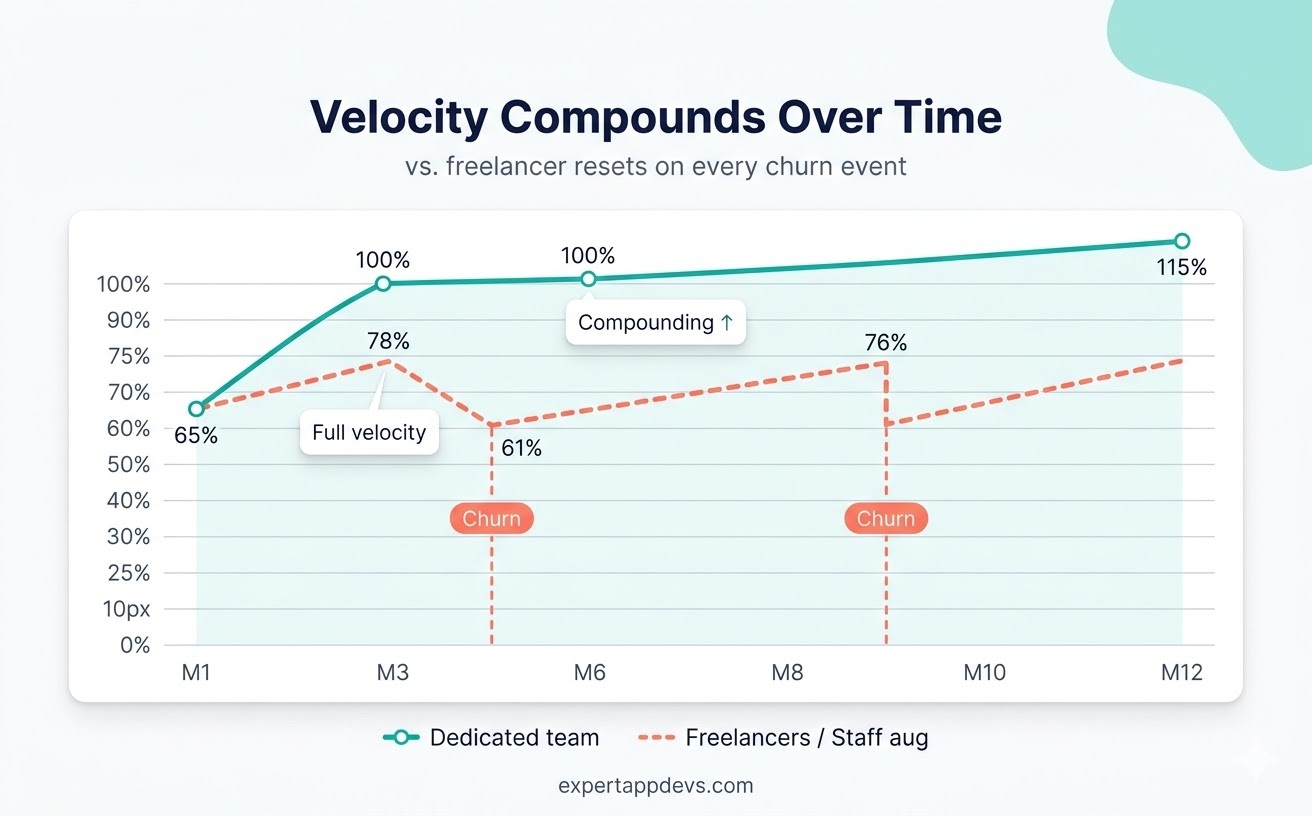
No staff augmentation or freelancer proposal models what happens to sprint velocity when a team stays together over time. It is one of the significant dedicated team model benefits. It is also easy to overlook it on a monthly invoice. The dedicated team gets faster over time. Freelancers and staff augmentation reset the clock with every rotation.
Here’s what it looks like across six months.
- Month 1: Ramp-up phase. The team is learning the codebase, processes, and communication patterns. Productivity is at 60–70% of the eventual baseline.
- Month 3: The team is fully embedded. Sprint velocity reaches 90–100% of the initial estimate. The investment in ramp-up begins to return.
- Month 6 onwards: The team knows your codebase better than the original estimate assumed. Velocity exceeds the baseline. Output per sprint compounds. This is the moment when dedicated team becomes your most cost-efficient option. It is also when freelancers and staff augmentation fall behind.
Every time a freelancer cycles out, the curve resets to 60%. Every staff augmentation rotation does the same. You pay ramp-up costs over and over.
With a dedicated team, you pay it once. That single difference makes dedicated team model a low-cost engagement approach. This is true even when hourly rates look high on paper.
One documented example: A Series B fintech team that transitioned from staff augmentation to a dedicated team model saw a 40% increase in sprint velocity and an 18% reduction in total engagement cost by month eight following the transition. The productivity improvement outweighed the higher dedicated team rate within six months.
5.3 The Accountability Structure
The accountability model is the clearest practical difference between the three engagement types and the one that most directly affects delivery outcomes.
Dedicated team: The vendor is responsible for delivery quality, team continuity, and replacement. When something goes wrong, both parties address it. The vendor holds delivery accountability alongside the client.
Staff augmentation: The vendor provides the resource. You are responsible for delivery, productivity outcomes, and quality. Underperformance is your problem to manage.
Freelancer: You own everything from recruitment through replacement. Attrition and underperformance cost falls entirely on your team. The offshore IP protection risk is also highest here. Freelancer contracts are weak on code ownership and confidentiality.
The dedicated model is the only engagement type where the vendor shares delivery accountability. That is the difference between a vendor who provides developer and a partner who owns outcomes.
If your project involves sensitive IP, compliance requirements or timelines you cannot afford to miss, this accountability structure isn’t an option. It is minimum standard.
5.4 Total Cost of Ownership: 12-Month Comparison
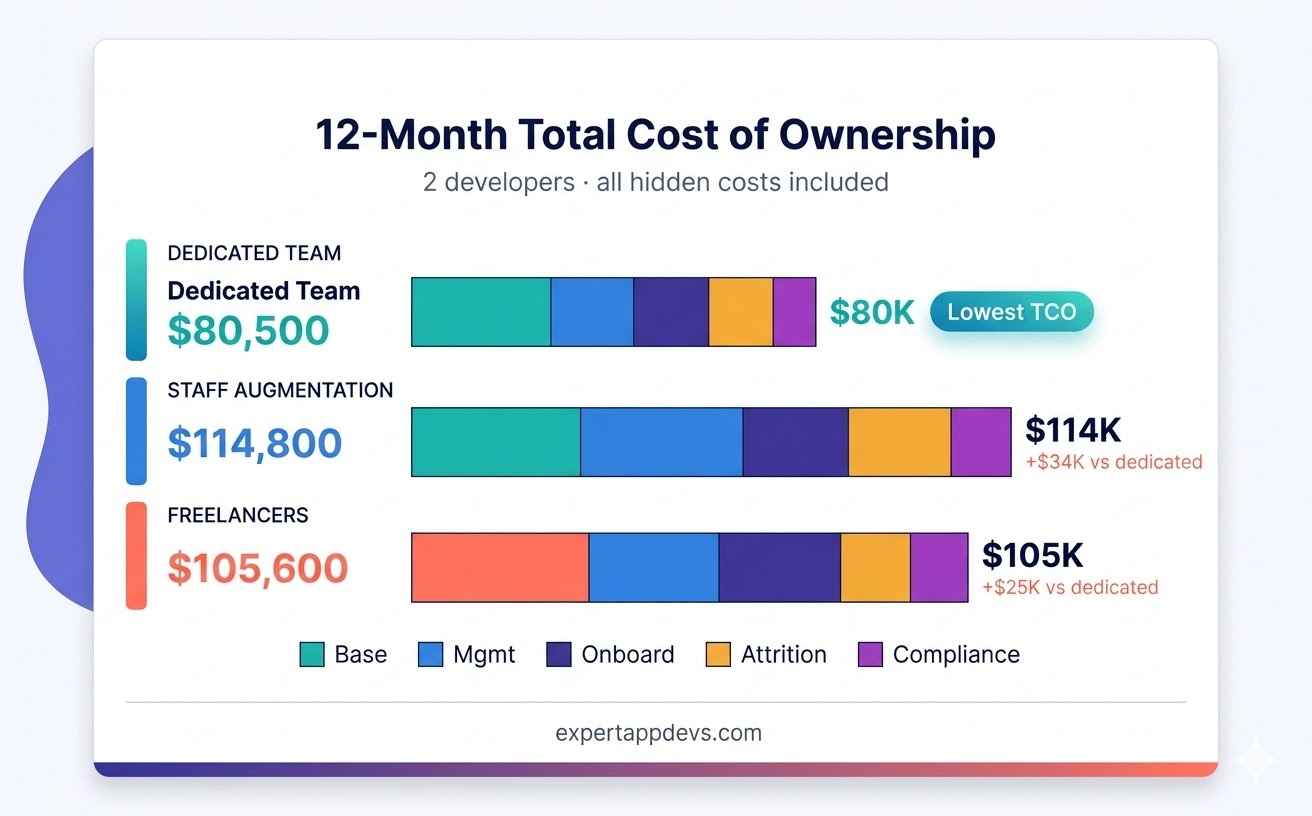
Monthly invoices are a misleading basis for engagement decisions. The following comparison covers the full 12-month picture for two developers at mid-range rates across each engagement type.
|
Cost Component |
Dedicated Team |
Staff Augmentation |
Freelancers |
|
Base development cost |
$67,200 |
$86,400 |
$52,800 |
|
Management overhead |
$3,600 |
$12,000 |
$18,000 |
|
Onboarding / ramp-up cost |
$5,000 |
$8,000 |
$14,000 |
|
Attrition / replacement cost |
$3,500 |
$6,000 |
$16,000 |
|
Compliance and IP setup |
$1,200 |
$2,400 |
$4,800 |
|
ESTIMATED 12-MONTH TCO |
$80,500 |
$114,800 |
$105,600 |
The freelancer looks cheapest at $52,800 base development cost. By month 12, it is $105,600. This $53,000 gap is caused by management overhead, attrition and reboarding. Costs that the vendor never absorbs.
The dedicated model costs $80,500 total. That is the lowest 12-month number across the three models.
When evaluating the cost to hire dedicated developers, compare at 12 months. Not just a monthly invoice.
These figures are based on two mid-level developers at $35/hour dedicated, $55/hour staff augmentation, and $33/hour freelancer, each billing 160 hours per month. Assumptions are disclosed because procurement decisions require verifiable inputs, not directional estimates.
Note: If your team includes mobile specialists, the numbers will shift slightly. When you hire dedicated mobile app developers, the base rate runs $5-$15 higher than mid-level developers at equivalent seniority.
6. The 6-Point Vendor Evaluation Framework for Enterprise Buyers
Most vendor evaluations focus on proposal quality and price. The factors that determine whether a dedicated engagement succeeds or fails are contract terms, replacement maturity, communication structure, and exit provisions. This framework provides the evaluation sequence that addresses each.
Step 1: Verify Developer Profiles Before the Contract, Not After
Request LinkedIn profiles and GitHub portfolios for the specific developers proposed for your engagement before signing. A professional vendor will agree to this without hesitation. Ask for a two-hour paid technical assessment conducted against your actual tech stack requirements.
Look beyond job titles and years of experience. A React developer with five years of general experience is not equivalent to a React developer with three years of fintech-specific implementation. Domain context is a material productivity variable.
Step 2: Audit the Contract for Five Non-Negotiables
Confirm all five clauses are present in the contract before signing:
- Work-for-hire IP clause signed by each individual developer, not only the vendor entity.
- Replacement SLA with defined timelines for candidate presentation and productivity achievement.
- Transition assistance obligation specifying the vendor's active role during any handover.
- Data protection and NDA signed at both company level and individual developer level.
- Client-owned repository and access control active from the first day of the engagement.
If any of these clauses is missing, request it explicitly. A vendor who declines to include these terms is communicating how they will operate when a problem arises.
Step 3: Stress-Test the Communication Model
Communication failures are the leading operational cause of dedicated engagement underperformance. They become visible within two weeks. Before committing to a long-term arrangement, establish the daily overlap hours, the escalation path, and who on the vendor's side holds delivery accountability.
The escalation owner should be from the delivery or technical leadership team, not from sales. Run a short trial sprint before full engagement. Evaluate how the vendor communicates when a problem arises, not only when things are running smoothly.
Step 4: Ask for a Reference from a Client Who Exited
Every vendor maintains a reference list of satisfied current clients. What distinguishes a confident vendor is their willingness to connect you with a client who completed or exited an engagement. Ask for this reference directly.
The answer and the clarity of the response tells you how the vendor manages the end of relationships, which is precisely the information you need when evaluating an engagement model that may run two years.
Step 5: Evaluate Bench Depth
Bench depth measures how well the vendor can absorb attrition without passing the disruption to your project. Ask two direct questions:
- If your proposed developer leaves tomorrow, how many days until you can name a replacement?
- Do you currently have pre-vetted developers available for our tech stack who can begin within two weeks?
Vendors with a deep active bench absorb attrition internally. Vendors without one ask for three to four weeks after departure before they begin searching.
Step 6: Validate Through a Structured Trial
A structured two-to-four-week paid trial sprint provides direct evidence of code quality, communication discipline, process maturity, and the team's ability to handle ambiguity. Four metrics to track during the trial:
- Code review pass rate on initial submissions before revision requests.
- Average response time to technical queries and escalations.
- Ratio of clarifying questions asked to assumptions made independently.
- Sprint completion percentage against the agreed trial deliverables.
ExpertAppDevs offers a 40-hour risk-free trial that allows enterprise buyers to evaluate code quality, communication patterns, and team capability before committing to a long-term engagement. This trial is structured against your actual tech stack and product requirements, not a generic assessment.
7. Future Outlook: Next 12 to 24 Months
The mobile development outsourcing market hits $977 billion by 2031. That growth isn’t evenly distributed. Three structural shifts are already reshaping how enterprise buyers evaluate, contract and manage dedicated developer teams right now.
If you are planning a dedicated engagement model in 2027, these shifts affect vendor selection, contract terms and cost to hire dedicated developers.
Here is what’s changing and what it means for your decisions.
What Changed and Why It Matters
Three things changed. AI has raised productivity expectations across dedicated teams. New compliance laws made offshore developer IP protection and data handling a vendor qualification requirement. Buyers demand outcome-based contracts instead of hourly billing.
Together these shifts mean one thing. Evaluating vendors on hourly rate alone is a liability.
#1. AI-Augmented Team Performance Expectations
AI is changing what a dedicated team is expected to deliver. McKinsey documents a 20-45% productivity gain in software engineering from generative AI adoption. GitHub Copilot users code 55.8% faster as observed from controlled studies. These are current benchmarks.
What does this mean for you? If vendors aren't operating with AI-augmented workflows, they are already behind. Your vendor must operate with AI-augmented workflows. Absence of these tools will be treated as a productivity gap in vendor evaluation. Rate card comparisons will shift toward output-per-sprint metrics rather than hourly billing.
#2. India DPDP Rules 2025 Compliance Becoming a Vendor Qualification Criterion
The DPDP Rules 2025, notified by MeitY on November 14, 2025, establish an 18-month phased compliance timeline with full obligations active by May 2027. Enterprise buyers sourcing from India will increasingly require vendors to demonstrate DPDP compliance as a qualification criterion rather than a discovery item during engagement. Vendors without documented compliance posture will face disqualification from procurement shortlists in regulated industries by late 2026.
#3. Outcome-Based Pricing Gaining Share Against Hourly Rate Models
ISG data from Q2 2025 shows managed services contracts up 20% year-over-year in the Americas. The shift from resource provision to outcome-based delivery is accelerating. Dedicated team models that guarantee sprint velocity, code quality metrics, and replacement response times within the contract will command a pricing premium over standard hourly arrangements. Buyers who structure contracts around outcomes rather than hours will demonstrate lower total cost of ownership at 12 months.
#4. Near-Shore Expansion Alongside India
Mordor Intelligence projects near-shore outsourcing will grow at a 13.95% CAGR through 2031, the fastest segment within the outsourcing market. North American buyers are increasingly evaluating Latin American teams for timezone-aligned product builds. European buyers are expanding into Southeastern Europe. India retains cost leadership for senior technical talent. Multi-region delivery models will become standard for enterprise engagements above $500,000 per year.
These four shifts aren’t distant trends. They are active procurement decisions. Buyers who adjust vendor evaluation criteria for AI capability, compliance posture and outcome-based contracts will lower total cost.
8. Making a Decision That Does Not Cost You at Month Six
Hiring a dedicated developer team is not operationally complex. It becomes costly when the decision is made on the rate card rather than on contract terms, replacement policies, compliance posture and exit provisions.
This guide has established three things. First, the true loaded cost of a dedicated engagement is 1.4x to 1.8x the quoted rate after all hidden components are included. Second, the four risk areas of IP, continuity, compliance, and exit lock-in are preventable through contract design before onboarding. Third, the dedicated model delivers the lowest 12-month total cost of ownership across all three engagement types when measured at the engagement level rather than the invoice level.
The vendor evaluation framework in Section 6 provides the questions that separate vendors with institutional process from those operating on testimonials. Run the framework before you sign, not after a problem appears.
ExpertAppDevs operates against each of the standards outlined in this guide: IP assignment included in every engagement, a 40-hour risk-free trial before any long-term commitment, named bench candidates for warm handover, and client-owned repositories from day one. If you are currently planning a dedicated development engagement or evaluating vendors for an RFP, we recommend using this framework as your evaluation baseline regardless of which vendor you select.
9. Frequently Asked Questions
#1. How Should Enterprise Buyers Make the Final Decision?
Enterprise buyers should evaluate dedicated developers using a weighted model across cost, risk, vendor maturity, compliance readiness, and scalability. Decisions should not be based on hourly rates but on total cost of ownership, SLA strength, and long-term delivery accountability.
#2. Should You Build In-House, Outsource, or Use Dedicated Teams?
Dedicated teams outperform in-house hiring and freelancers when speed, scalability, and cost predictability are required. In-house is suitable for core IP control, while freelancers are only viable for short-term tasks.
#3. How much does it cost to hire a dedicated developer in India?
The published rate for dedicated developers in India ranges from $18 to $75 per hour depending on seniority and specialization. The true loaded cost including ramp-up, management overhead, attrition buffer, compliance setup, and tools provisioning is 1.4x to 1.8x the quoted rate. A developer billing $30 per hour produces an effective monthly cost of $42 to $54 per hour when all components are counted.
#4. What is the difference between dedicated developers and staff augmentation?
In staff augmentation, the vendor supplies the resource and you manage delivery, productivity, and quality outcomes. In a dedicated engagement model, the vendor manages delivery, continuity, and replacement and shares accountability for outputs. The management burden is the primary operational difference. The IP protection and exit clause structure are the primary contractual differences.
#5. What should a developer replacement policy include?
A replacement policy should specify: the advance notice period before departure, the number of business days to present a named candidate with a CV and portfolio, the overlap period for parallel working, the client's right to reject candidates, the cost responsibility during transition, and the grounds and process for performance-based replacement distinct from attrition-based replacement.
#6. How do I protect intellectual property when hiring offshore developers?
Include a work-for-hire clause signed by each individual developer assigning all code, design, and documentation to your business. Require a non-compete and non-solicitation period of 12 to 24 months post-engagement. Maintain all code in client-owned repositories from the first commit. Use source code escrow to preserve access if the vendor ceases to operate.
#7. Is a dedicated developer model cheaper than hiring full-time employees?
Yes, in most scenarios. The total cost of a dedicated engagement including all loaded components is typically 40% to 60% lower than a full-time hire when recruitment cost, equity, benefits, payroll overhead, and termination risk are included. The comparison is most favorable for engagements of six months or longer at senior to mid-level seniority.
#8. How do I evaluate a dedicated developer vendor before committing?
Use the six-step framework: verify specific developer profiles with a paid technical assessment before signing, audit the contract for IP, replacement SLA, transition, NDA, and repository terms, stress-test the communication model through a trial sprint, request a reference from a client who completed or exited an engagement, evaluate bench depth with direct questions about replacement timelines, and run a structured two-to-four-week paid trial before full commitment.
#9. What compliance obligations apply to offshore development teams?
Enterprise buyers sourcing from India face obligations under India's DPDP Rules 2025, notified by MeitY on November 14, 2025, with full enforcement expected by May 2027. Penalties reach INR 250 crore per violation. EU user data requires GDPR compliance from the vendor regardless of geography. California-based users require CCPA compliance. Vendors should hold current ISO 27001 or SOC 2 Type II certification and be able to provide documentation of their DPDP compliance posture.
#10. What does attrition-based vs. performance-based replacement mean in a contract?
Attrition-based replacement occurs when a developer voluntarily leaves the project. The vendor is responsible for resolving this. Performance-based replacement occurs when the client initiates a change due to underperformance. Most contracts address only the attrition scenario. Ensure your contract explicitly defines the grounds for performance replacement, the request process, the response timeline, and whether a performance replacement triggers a new minimum commitment period.
#11. How does the productivity compounding effect work in dedicated teams?
A dedicated team begins at 60% to 70% productivity during the ramp-up period in month one. By month three, the team reaches 90% to 100% of the sprint velocity baseline. After month six, the team's familiarity with the codebase produces velocity that exceeds the original baseline. Freelancer and staff augmentation models restart this curve with each rotation. The compounding effect becomes the primary cost advantage of the dedicated model at the 12-month mark.
#12. When should I not use a dedicated developer team?
The dedicated model is not suited for single-feature tasks, one-sprint engagements, or situations where you need a senior specialist for a specific technical problem that your internal team cannot address. In these scenarios, staff augmentation is the appropriate model. Freelancers are appropriate for isolated short-duration tasks where IP risk and continuity are not material concerns.
Executive Conclusion
Choosing a dedicated developer is not a pricing decision. It is a contract, continuity, and accountability decision. Organizations that evaluate vendors based on SLAs, IP protection, and long-term cost outperform those that optimize for hourly rates alone.
A structured evaluation combined with a short trial engagement is the most reliable way to shortlist a long-term technology partner.
If you are evaluating vendors this quarter, use the 6-point framework in this guide as your baseline.
Shortlist partners who can commit to SLA-backed delivery, not just hourly rates.
You can validate this in practice through a structured 40-hour free trial before entering a long-term engagement.






 274
274

 0
0


 201
0
201
0
 193
0
193
0
 203
0
203
0