



 Blog
Management System Compliance For App Teams: ISO Aligned Steps To Make Your Mobile and Web Apps Audit Ready
Blog
Management System Compliance For App Teams: ISO Aligned Steps To Make Your Mobile and Web Apps Audit Ready
- Why Management System Compliance Matters For Technology Companies
- Why App Builders Must Take Compliance Seriously?
- What Is A Compliance Management System (CMS)?
- How does a Compliance Management System look inside a Software Team?
- Why Aligning Your CMS to ISO 37301 Matters?
- Building Compliance Into The Software Development Lifecycle
- Practical Steps To Build An ISO Aligned CMS
- Automation and Tooling For Audit-Ready Apps
- Mobile-Specific Compliance Controls
- Choosing Between Outsourcing and In-House Compliance Services
- Technology Patterns and The Final Compliance Checklist
- Common Pitfalls and How To Avoid Them
- Conclusion
Ready to transform your vision into reality?
Get Started
Management System Compliance For App Teams: ISO Aligned Steps To Make Your Mobile and Web Apps Audit Ready
 194
194
 0
12 Oct 2025
35 Min Read
0
12 Oct 2025
35 Min Read


 Share
Share

 Download PDF
This blog explains how app teams can align with ISO 37301 and ISO 27001 to make their mobile and web apps audit-ready. You will also read how compliance management reduces risks, builds trust, and creates new revenue opportunities. It covers costs, outsourcing models, white-label options and the importance of automation tools with practical SDLC-first checklists. Whether you’re a CTO, product lead, or founder, this guide covers all the actionable steps to transform compliance from a burden into a growth advantage.
Building mobile and web applications today is no longer just about speed, features and user experience. It’s also about trust and compliance because today they deal with all types of personal and sensitive details. Nowadays, cyber attacks are getting more disruptive than before as cyber criminals keep finding new ways for data breaches and exploitation. Do you know that 81% of mobile apps are easily at risk of cyberattacks? According to the CIO insight study, 58% of web applications fail the initial security audit. IBM reports say that Data breaches can cost about $220K more per incident due to non-compliance.
This is why compliance management systems (CMS) and aligning them with ISO 37301 are becoming an important part of modern software teams. CMS compliance can be the backbone of your growth driver. It helps reduce legal and security risks, enhances the processes, and achieves enterprise-level contracts that demand proof of compliance before onboarding a vendor.
In this blog, you’ll learn the importance of management system compliance for app teams, how ISO 37301-aligned compliance helps app teams reduce risks, build trust and prepare for audits. We will also cover cost factors, outsourcing models, automation tools and practical checklists and SDLC-focused strategies to make your mobile and web apps enterprise-ready.
Why Management System Compliance Matters For Technology Companies
Management system compliance is an undeniable factor in today's extraordinary cyber-threat world. As your company grows, the risks of errors, breaches and inefficiencies also grow with it. Let's go through the points below to understand why management system compliance is a must.
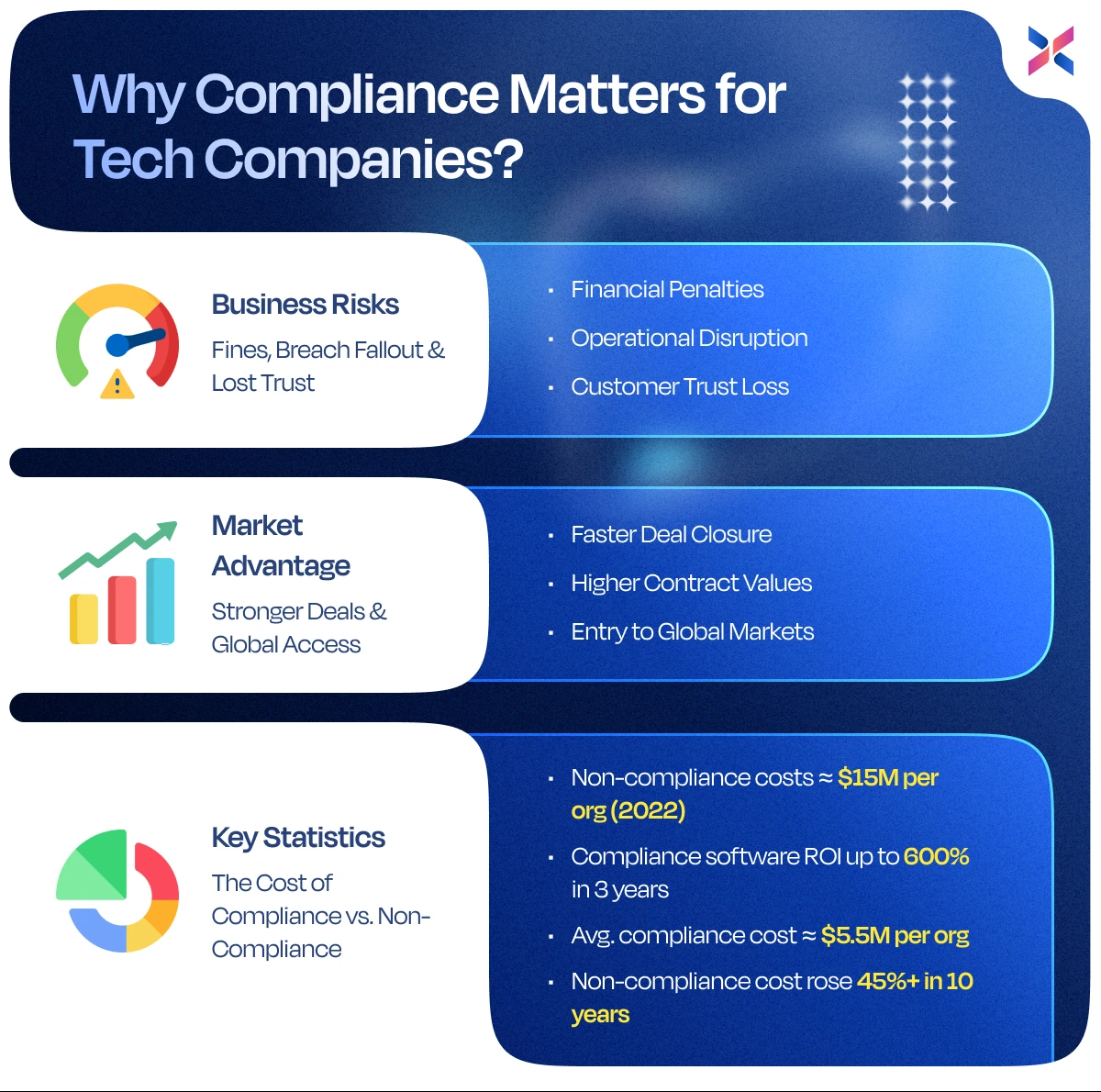
#1. Business Risks: Fines, Breach Fallout and Lost Trust
If you ignore compliance, it can disrupt your daily workflow and lead to heavy financial losses. Hence, understanding risks is important to take action before it gets worse.
Financial Fines
If you run a non-compliant business, you will have to pay heavy fines, penalties or legal costs. This financial pressure eventually drains resources, slows growth and affects your company’s ability. This can also cause a delay if you think about investing in other innovations.
Operational Disruption
This also interferes with your daily operations. In case of any security breaches or system failures, it can also pause the ongoing projects, delay product launches and create chaos within teams.
Loss Of Customer Trust
Customers trust companies to keep their data safe and services reliable. If your company has any record of data breaches or system failures, this will always leave a doubtful impression and users will think before trusting your business.
Do you know that in May 2023, Meta was fined $1.3 billion by Ireland for failing to follow data protection rules? 85% of people think of a company’s privacy policies before making any purchase. (IBM)
#2. Market Advantage
Following a compliance management system can actually grow your business and help access bigger markets.
Faster Deal Closure
The majority of clients only prefer to deal with businesses that are compliant with standards. It removes risk concerns, eases legal checks and proves credibility, so clients feel confident signing agreements quickly.
Higher Contract Values
Being compliant shows professionalism and represents that you care for clients and users. This increases the chances of securing bigger contracts or premium deals, as clients are willing to pay more for trusted, risk-free partners.
Global Market Access
Many international markets require strict compliance with regulations. Hence, if you already follow the compliance standards, you can easily access global markets without barriers.
Overall, this will act as a revenue accelerator for your business and serve as a strong feature in the competitive market.
#3. Key Statistics
The statistics below show that compliance is not just a legal requirement, but it's an important financial factor.
- In 2022, the price of not staying compliant per organization was approximately $15 million. (Finrep AI)
- Investing in compliance software can deliver up to 600% ROI and recover your cost within three years. (Prove)
- The average cost of maintaining compliance is about $5.5 million per organization. (IndusFace)
- In the last 10 years, the cost of non-compliance has increased by over 45%. (CornerstoneOnDemand)
Why App Builders Must Take Compliance Seriously?
Today, compliance is your ultimate deal-maker because clients don’t just look at features; they search for trust, security and reliability. When you already follow all legal compliance standards, you secure your business from all sides and attract better opportunities.
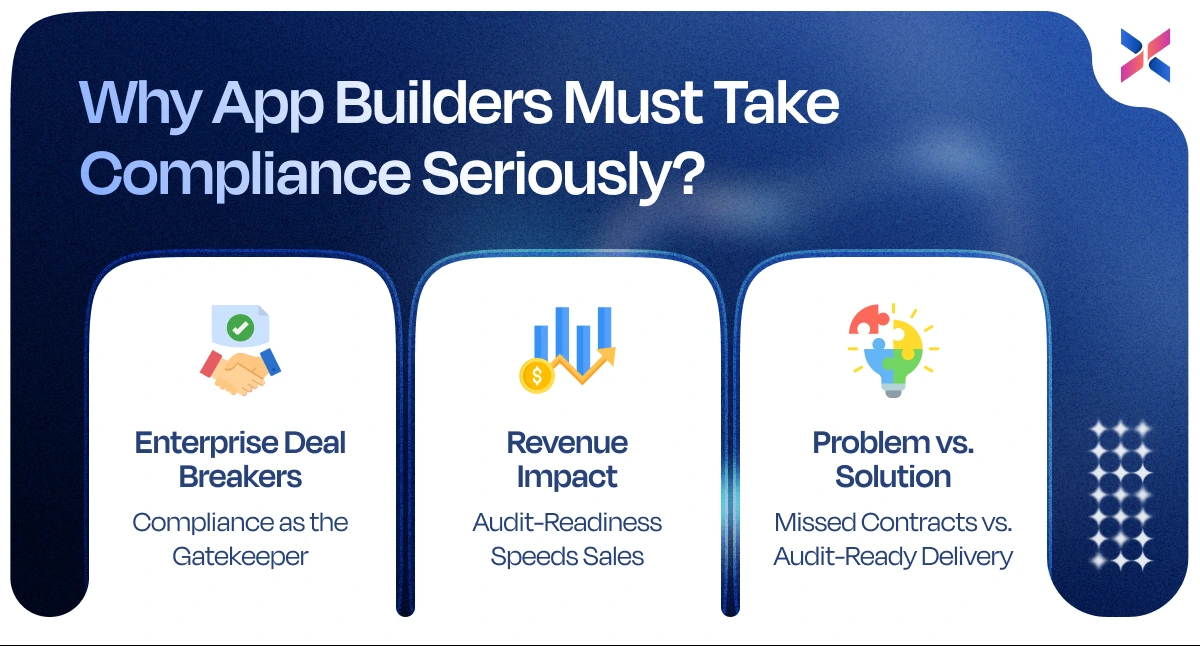
#1. Enterprise Deal Breakers: Compliance As Gatekeeper
Enterprise business will prioritize compliance first. Without meeting legal and security standards, most business deals will not move forward. Being compliant fulfills your credibility and shows that you are reputable. Overall, this is a win-win situation for both clients and the business.
#2. Revenue Impact: Audit Readiness Equals Faster Sales Cycles
When you make an app by following compliance standards, it directly speeds up how quickly you close deals. Here is how.
- Shorter Procurement Cycles: When compliance documents are ready, procurement teams will easily approve vendors. This also removes delays, takes less review time, and gets your proposal signed smoothly.
- Higher Win Rates: Clients will see your compliant business as a trustworthy and reliable opportunity, hence there are more chances of getting long-term contracts.
- Premium Positioning: a compliant business gets more high-paying clients rather than normal ones.
#3. Problem and Solution: Missed Contracts Versus Audit-Ready Delivery
Think practically, no compliance means no contracts. As an app builder, when you can’t prove you meet standards, you lose the contract at that moment. Always be ready with an audit report and clear the client’s doubts to secure the great deal.
What Is A Compliance Management System (CMS)?
A Compliance Management System (CMS) is a set of rules, processes and tools that help a company follow laws, regulations and industry standards. It makes sure the business stays legal, secure and trustworthy, while preventing mistakes, fines or risks.
To get more clarity, let's break down its core concepts.
#1. Compliance Management System Compared To Compliance Management
Compliance management system and compliance management sound a little bit similar, but both are for different purposes.
Compliance management is an overall process of making sure a business follows rules, laws and industry standards, while a compliance management system is a whole structured framework that includes policies, tools and processes for managing compliance.
#2.The Three Pillars: Governance, Compliance Program, and Monitoring
A strong CMS includes three main components. Here they are:
- Governance means it is a responsibility of oversight and decision-making.
- Compliance programs are the rules, processes, and training. It is created by the compliance team based on the current situation and is applicable throughout the organization.
- The next part is monitoring, which is usually done by an internal team or via automated tools. It involves checking and auditing, and making sure that everything is working as planned.
Together, these three parts help to improve the business over time and meet compliance standards.
#3. Best Practices: Connecting CMS With Product Governance In App Teams
In simple words, connecting a CMS with product governance just means making compliance part of the app development process. This will apply compliance rules to planning, coding, testing and launching. Hence, the problems in app development will be caught earlier and prevent fines and penalties.
It also makes approvals faster because everything is already checked and documented.
How does a Compliance Management System look inside a Software Team?
A compliance management system is not just a rule or workflow. You set a tone for your organization by following certain criteria that enhance your overall reputation. Here is how CMS works.
#1. Governance Structure For Development Organizations
Governance defines who is responsible for compliance in a software team. A compliance officer, or lead developer, mentions clear roles and responsibilities to ensure everyone understands the rules and their part in following them. This step involves decision-making, so all the issues are covered in development, and everything is properly aligned.
#2. Controls Mapped Into SDLC Pipelines
Compliance controls are integrated directly into the Software Development Life Cycle (SDLC). This means every phase of app development will follow the decided compliance rules, go through security checks and quality standards.
This approach makes apps safer, more reliable, and audit-ready from the very beginning.
#3. Collecting Evidence With Automation and Dashboards
If you are using a modern CMS which uses automation and dashboards to track compliance activities and generate proof. Managers and Auditors can easily review compliance status, issues and progress from the dashboards.
#4. Trending Features: CI/CD Integrations and AI-Powered Compliance Tools
Add the latest features like CI/CD pipelines, so compliance checks happen automatically with every code update. AI-powered tools can detect risks, suggest fixes and monitor security in real time. This makes compliance faster, smarter and more efficient for software teams.
Why Aligning Your CMS to ISO 37301 Matters?
ISO 37301 helps your business to stay compliant with laws and ethical standards. It creates a culture of integrity and motivates employees to follow ethical practices in the company to protect the business and build a reliable reputation.
#1. Scope and Who Benefits From Adopting Iso 37301
When your CMS is connected to ISO 37301, the rules are applied to the entire organization, from leadership to operational teams. This improved the whole process and keeps the organization compliant with laws, regulations, and ethical standards.
It helps all the employees and managers to work in alignment and with proper understanding.
By adopting ISO 37301, you will reduce errors, avoid penalties, and create a culture of accountability.
#2. Key Benefits: Governance, Trust and Reduced Risk
Aligning your CMS with ISO 37301 has multiple benefits for business because it clarifies roles, responsibilities, and reduces operational and legal risks. By promoting ethical practices and transparency, ISO 37301 can help you operate more efficiently, avoid costly mistakes, and maintain a solid reputation.
#3. Comparing ISO 37301 With Iso 27001 SOC 2 and GDPR
ISO 37301 focuses on compliance management and ethical operations, whereas ISO 27001 is about information security. SOC 2 checks if a system is secure, always available, processes data properly, and keeps information confidential. While GDPR focuses mainly on protecting personal data and privacy.
ISO 37301 works well mostly with other standards by giving a clear framework to manage compliance risks across the company. By aligning a CMS with ISO 37301 along with ISO 27001, SOC 2, or GDPR, you can stay compliant, protect data, and build trust with clients and stakeholders.
Building Compliance Into The Software Development Lifecycle
If you want to have security, privacy, and meet regulatory demands, then compliance should be included in your software development life cycle from the very start.
#1. The SDLC First Roadmap
The very important thing is you must include a compliance check at every stage of the SDLC, i.e, design, build, test, release and monitor. Users today are smart and know their digital and privacy rights. When your app is built using compliance rules, it means it already follows data protection and privacy standards and keeps users’ sensitive information safe.
This also smoothens the entire development process, such as QA and testing, and avoids all kinds of major risks, threats and penalties.
#2. Proven Strategies
Adding automatic compliance checks directly into your software build and release process is one of the best tricks to use in SDLC. As you know, CI/CD is the process where code is continuously integrated, tested and deployed. With compliance, every module will be automatically checked for quality before moving to the next step to ensure your software stays compliant and safe.
#3. Ideas and Examples
Tools like SAST (Static Application Security Testing) and DAST (Dynamic Application Security Testing) help monitor code continuously. They automatically detect vulnerabilities and generate evidence that compliance standards are met. This makes audits easier, builds trust with stakeholders and ensures apps are secure throughout development and after release.
Practical Steps To Build An ISO Aligned CMS
Below are the practical steps showing how to build a CMS that aligns with ISO standards and keeps your organization protected.
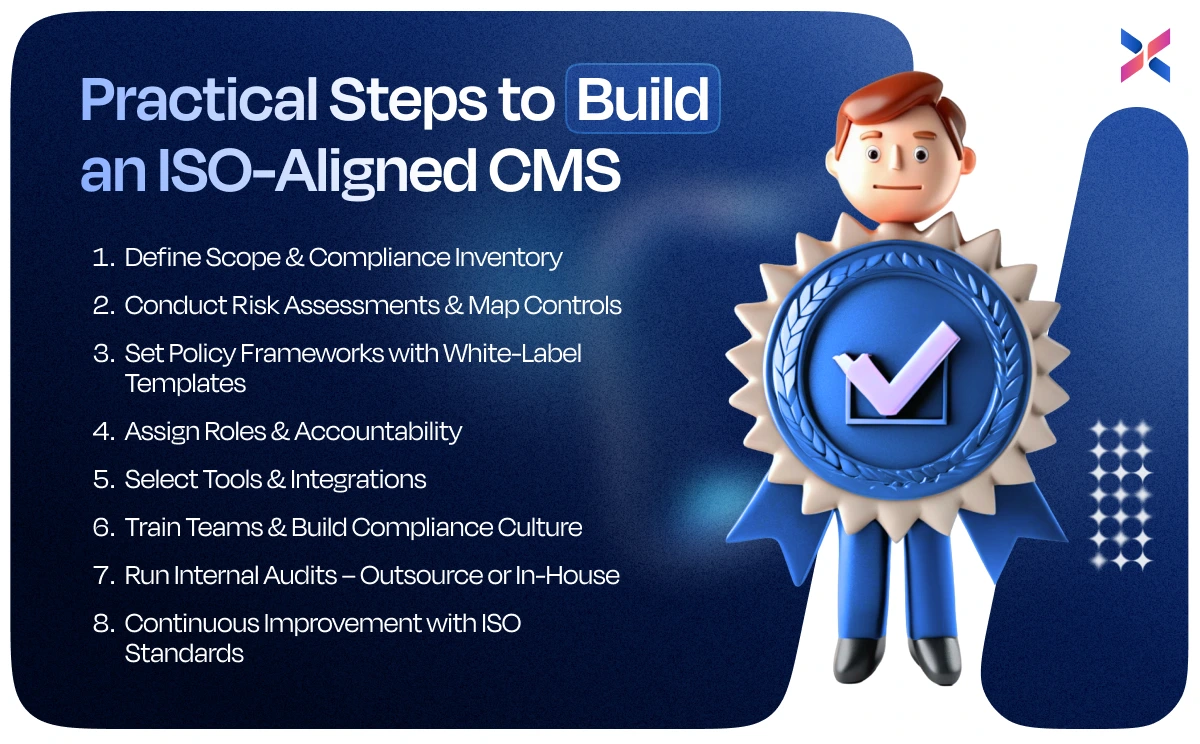
Step 1: Define The Compliance Inventory and Scope With Cost Awareness
Start by listing all laws, regulations, and standards that apply to your organization. Define the scope of your CMS and understand the costs involved. This will help you prioritize resources, avoid unnecessary spending, and focus on areas that matter most for compliance and risk.
Step 2: Conduct Risk Assessments and Mapping Controls
Check who has the controls for processes and what the risks are associated with it if the compliance is compromised. Study the compliance risks and the severity of the effect. This will give you more clarity and focus on high-priority areas to prevent violations or operational issues.
Step 3: Establish Policy and Process Frameworks With White Label Templates
Create standardized policies and processes for compliance using ready-made templates where possible. This gives your employees clear guidance and ensures consistency across the organization.
Step 4: Set Roles and Accountability Across The Team
Define who is responsible for each compliance task, from management to operational teams. Clear roles ensure accountability, prevent gaps and make it easier to monitor performance.
Step 5: Choose The Right Tools and Integrations
Select compliance tools that fit your organization’s needs. Tools like Sprinto, Drata and Auditboard are best for automating monitoring, evidence collection, and reporting. Do research accordingly and pick the best tools that fit your security and financial needs.
Step 6: Train and Build Culture To Reduce Human Error
According to Drata, 74% of breaches happen due to human error. Hence, teach your employees about compliance policies, risks and best practices. Build a culture of compliance where employees are aware of risks and take mistakes seriously, and understand the importance of ethical practices.
Step 7: Run Internal Audits and Decide Between Outsourcing and In-House Approaches
Regularly audit your CMS to check compliance effectiveness. Decide whether to conduct audits internally or hire external experts. Audits help identify gaps, validate controls, and ensure your CMS is working as intended before regulators review it.
Step 8: Continuous Improvement Loop Guided By ISO Standards
Compliance rules keep updating, hence it's crucial to continuously update according to ISO standards. Review and update your CMS using ISO guidelines to address new regulations, risks, or operational changes.
Automation and Tooling For Audit-Ready Apps
Modern software teams today depend on automation to maintain compliance. Tools and features like monitoring, logs and AI make audit readiness much easier.
#1. Automated Evidence Pipelines and Monitoring
To keep your apps audit-ready, set up automated evidence pipelines that track every compliance activity continuously and store proof in real time. Plus, also use monitoring tools to get instant alerts if something goes wrong or deviates from standards.
This will reduce manual work, prevent errors, and ensure you can quickly show regulators or stakeholders.
#2. Top Vendor Picks For Compliance Automation Software
Choosing the right tools makes audit preparation much simpler. Platforms like Sprinto, Drata, and Auditboard automate monitoring, evidence collection, and reporting across systems. They help your team stay organized, reduce human errors and ensure apps are ready for audits or regulatory checks at any time.
#3. Trending Features
Modern compliance tools already come with modern features. Telemetry tracks app activity continuously, immutable logs securely store records so they can’t be altered, and AI tools detect risks and prepare audit evidence automatically. Together, these features help you catch issues early, simplify audits to a great extent.
Mobile-Specific Compliance Controls
Every mobile app needs some details to allow users to use the app or personalize the experience. Below are the mobile-specific compliance controls you must keep in mind.
#1. Permission and Privacy Requirements For Mobile Users
When building mobile apps, always ask users for permissions transparently and only request what’s necessary. Explain why you need each permission and how data will be used. Follow privacy regulations like GDPR or CCPA to protect personal data.
#2. Encryption Standards and Secure Data Handling
Follow all important encryption standards and secure data handling. Always use HTTPS/TLS protocols when data moves between the app and servers. This prevents hackers from intercepting sensitive information like passwords or payment details. Store data on the device or server using strong algorithms like AES-256. Only collect data you really need.
Delete old or unused data regularly to reduce risks. Secure your backend APIs with authentication, rate limiting, and token-based access (like OAuth 2.0).
#3. Vetting SDKs and Third-Party Libraries For Risk
Third-party SDKs and libraries can speed up development, but they also come with hidden compliance or security risks. So, carefully review each one for privacy, security and licensing issues before integration. Make sure they meet your organization’s compliance standards and don’t expose sensitive data.
#4. App Store Submission Requirements With Problem-To-Solution Checklists
There are different rules and compliance standards for the Apple App Store and Google Play Store. Create a problem-to-solution checklist to ensure privacy policies, security measures and user permissions are proper. This will help you to reduce rejections and prevent delays.
Choosing Between Outsourcing and In-House Compliance Services
Deciding whether to build compliance capabilities in-house or outsource them is a big business decision, as it affects costs, timelines, expertise and everything in the app.
#1. Cost Analysis: What the Internal CMS Building Really Costs
When you build a compliance system in-house, you will need to invest in skilled staff, training, tools and ongoing updates. But this is great if you prioritize security seriously because it offers full control. Consider the long-term expenses of internal teams and compare the outsourcing cost to choose relevantly.
#2. Outsourcing Advantages With Indian Development Partners
There are a lot of Indian outsourcing companies following global standards like ISO and GDPR, and they have deep expertise at reliable costs. If you want to avoid training staff, buying tools and other unnecessary expenses, then outsourcing is the best option.
#3. White Label Compliance Solutions For Agencies and Consultancies
You can use white label compliance platforms to serve clients without creating their own systems. Instead of building everything from scratch, you can rebrand ready-made systems and sell them under your own name.
#4. Revenue Impact: Audit Ready Apps As An Upsell Opportunity
Compliance becomes a premium feature. When your apps are already compliant, you can upsell these solutions to enterprise clients who value security and reliability.
Technology Patterns and The Final Compliance Checklist
Here’s how technology and a clear checklist can keep your team audit-ready and confident.
#1. Automated Evidence Collection Must-Haves
Collecting manual evidence takes time and always comes with some errors. Use automation to continuously collect data like user permissions, encryption checks and activity logs.
#2. Mapping Controls To Global Frameworks
Different regions and industries follow standards like ISO 27001, GDPR or SOC 2. Adapt your app’s security and privacy controls so you can expand global markets.
#3. Real-Time Dashboards and Immutable Audit Logs
Integrate real-time dashboards and immutable audit logs to see the areas where risks are higher and lower.
Lastly, your compliance checklist must cover must-haves like data encryption, access control, vendor risk checks, and app store compliance. By running through this list, you avoid last-minute surprises and cut audit stress.
Common Pitfalls and How To Avoid Them
Mistake 1: Treating Compliance As A Project Instead Of A Continuous Program
Many entrepreneurs consider compliance as a one-time role and then forget about it later, but it's actually an important ongoing task that needs to be monitored and updated.
Mistake 2: Underinvesting in Automation and Evidence Collection
You might think investing in automation is expensive, but actually, the work without automation is more expensive and painful in the long term. Adopt tools that auto-capture logs, permissions, and security checks.
Mistake 3: Ignoring Governance Structures and Accountability
You can't fulfill compliance fully if the rules are not clear. Everyone in the team must know transparently who is responsible for what work and follow the responsibility accordingly. Despite responsibility, everyone must keep an eye on risks.
Conclusion
In the above blog, we have learned how management system compliance can be a real growth driver for app teams. Also, how ISO 37301 for compliance and ISO 27001 for security play an equally crucial role in business. If you are an app development company, take app compliance very seriously. You can use great tools like Sprinto to automate heavy lifting jobs and find risks faster than manually. Hence, making audits faster and simpler.
Compliance today is not a requirement that can be ignored; it's the backbone behind your business revenue. Research for the latest automation trends and compliance costs to choose the vendor accordingly, whether you outsource or build in-house compliance to ensure your apps stay audit-ready, cost-efficient, and aligned with ISO standards.
Book A Compliance-Ready App Consultation Today
At Expert App Devs, we don’t just develop apps. We make sure they’re compliance-ready, too. Connect with us to know how we can help you.






 203
203

 0
0


 211
0
211
0
 321
1
321
1
 344
0
344
0