



- What is Enterprise App Modernization and Why Does It Matter in 2027?
- The Cost of Inaction: Risks of Skipping Enterprise App Modernization in 2027
- 2027 Key Features Driving Enterprise App Modernization
- Technologies Powering Enterprise App Modernization in 2027
- ROI Analysis: Justifying Enterprise App Modernization Investments
- Implementation Roadmap for Enterprise App Modernization
- Challenges and Solutions in Legacy App Modernization
- ExpertAppDevs' Approach to 2027 Enterprise App Modernization
- Industry-Specific Modernization Examples of Expert App Devs
- ENTERPRISE EXPERT’S ADVICE ON 2027 APP UPGRADATION (Modernization Advice)
- Frequently Asked Questions
- Partner with ExpertAppDevs for Strategic Enterprise App Modernization
- Conclusion: Future-Proofing Your Digital Assets
Ready to transform your vision into reality?
Get Started
Enterprise App Modernization Guide 2027: Revitalize Legacy Systems with AI and Cloud

 277
277
 0
16 Sep 2025
43 Min Read
0
16 Sep 2025
43 Min Read


 Share
Share

 Download PDF
Do you know that using legacy applications can cause a loss of $4.88 million in breach costs per incident? (source: IBM Report) Legacy systems might seem good enough, but they are silently draining your business.
And the longer you continue to use it, the higher the financial and reputational risks are. Intelligent CIO Europe Studies have found that over 40% of businesses faced revenue losses due to downtime, legacy system constraints, and complicated infrastructure.
More than 90% of apps lose users within the first 30 days after install due to performance and usability issues. (source: Business of Apps)
Looking at the above numbers, you might realize why it's important to modernize the app. If you are a C-level executive still using legacy systems, then you must read our guide till the end.
In this blog, you’ll learn why modernizing your old apps in 2027 is crucial for security, performance and growth. You’ll also discover the latest features, technologies and strategies that can turn outdated systems into a competitive advantage.
What is Enterprise App Modernization and Why Does It Matter in 2027?
App modernization is simply updating your old software to work better with today's technology. In simple words, here you update old software applications with new technologies, designs and features so they stay useful, secure, and efficient.
Instead of building everything from scratch, you simply improve what existing features and functionalities are compatible with today’s platforms and devices.
In 2027, this matters more than ever because outdated apps can't keep up with new security threats, user expectations or modern devices.
By modernizing, businesses save money, improve user experience and stay competitive. It's not just about looking newer; it's about performing better and being ready for the future.
The Cost of Inaction: Risks of Skipping Enterprise App Modernization in 2027
Choosing not to update your app may save time now, but it will be risky in the future. If you don’t take action to update or modernize your old apps (legacy apps), below are some of the risks and hidden costs you may face in 2027.
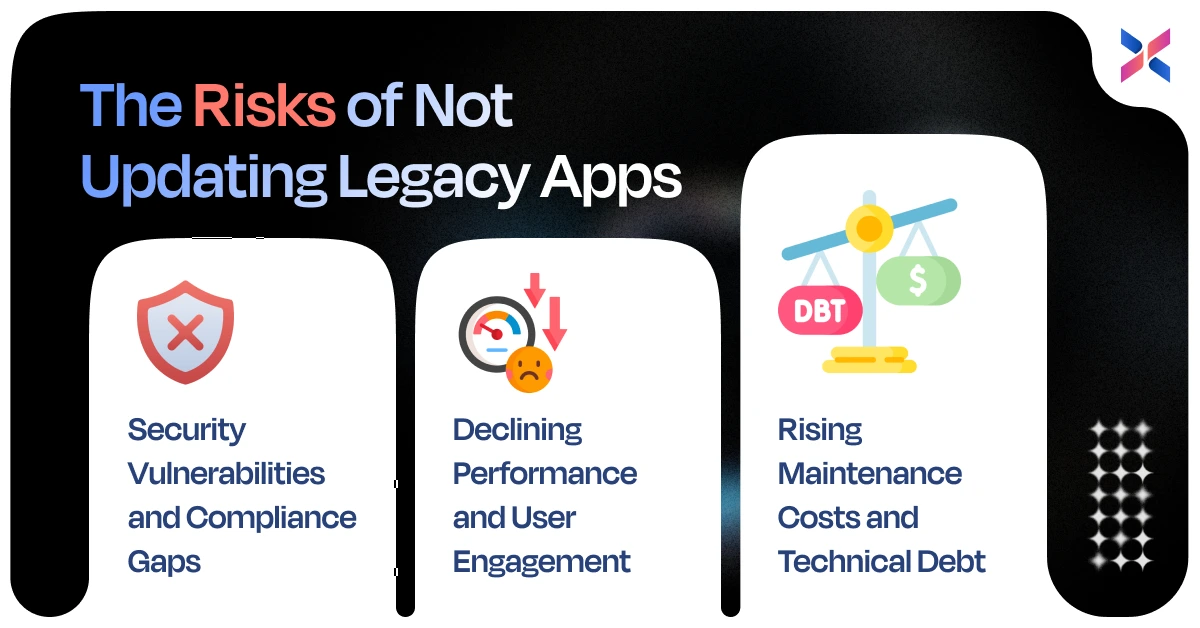
#1. Security Vulnerabilities and Compliance Gaps
Today, most enterprise apps use third-party libraries to save cost instead of building a custom one. But do you know DEVCLASS says 70% of third-party libraries contain unpatched vulnerabilities? Old apps can be easy targets for hackers if its not updated according to the latest security updates. Plus, they also fail to meet modern data protection laws or industry standards, which leads to penalties and loss of customer trust.
#2. Declining Performance and User Engagement
Forrester predictions say that over 50% of employees are unhappy at their job because of inefficient software. 25% consider changing jobs because of it. As technology evolves, legacy apps are not sufficient to fulfill the advanced needs, and they might get slow, crash or miss features that users expect. This overall affects user experience and lowers engagement.
#3. Rising Maintenance Costs and Technical Debt
If you don't modernize your app with the times, you're only adding extra maintenance and technical debt. Because to sustain in the app world, it's important to update the app according to trends and users’ needs.
The average legacy system maintenance cost is about $30 million annually, with enterprises while $1.14 trillion for ongoing legacy system operations and maintenance. (source: RecordPoint)
These can also keep adding other hidden costs like specialized personnel requirements, infrastructure ownership expenses and limited scalability for business growth initiatives.
2027 Key Features Driving Enterprise App Modernization
In 2027, it's important to build apps that adapt, learn, and deliver more value. If you are an app development company, then here are the must-have features that you must consider for app modernization.
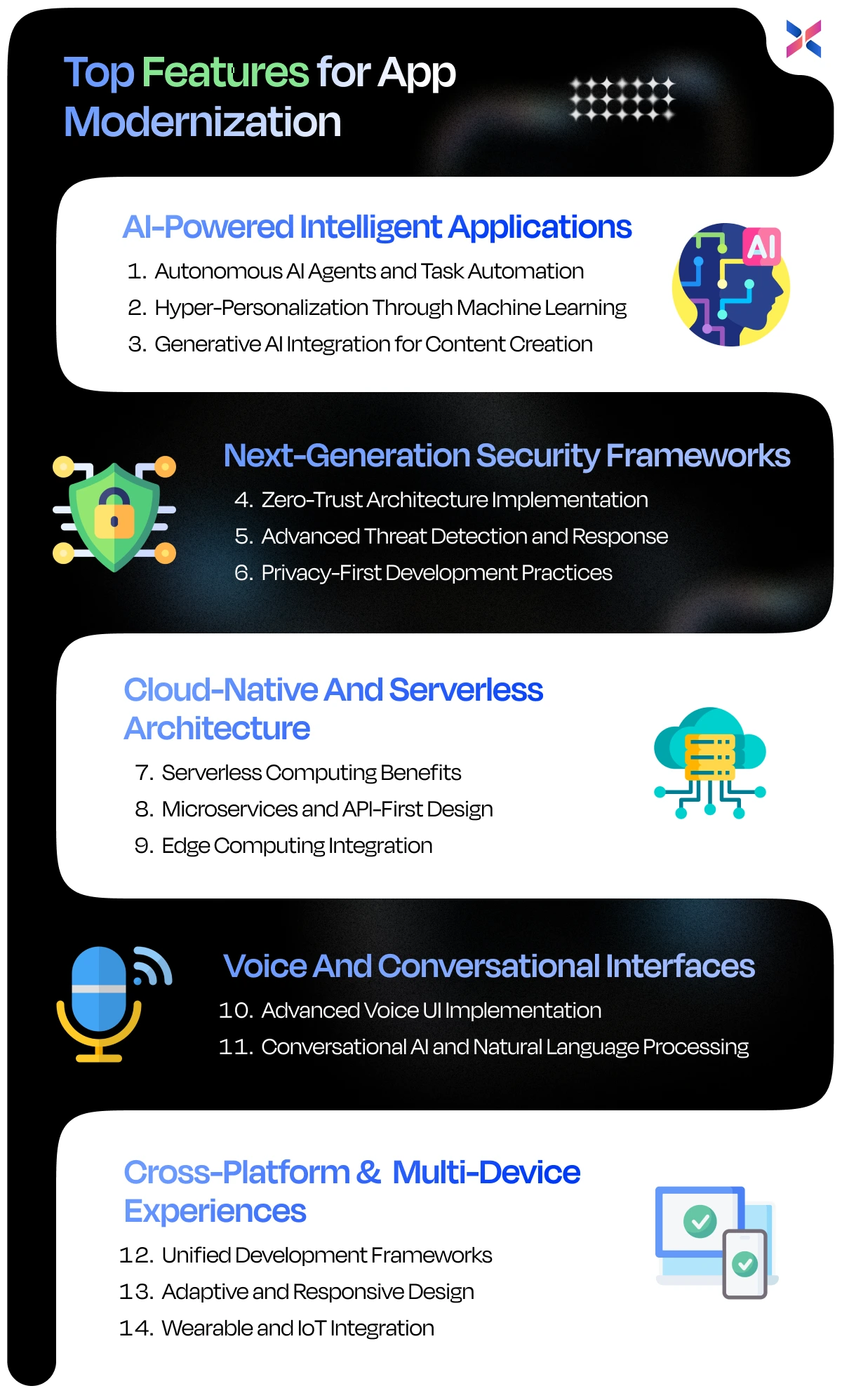
✅ AI-POWERED INTELLIGENT APPLICATIONS
#1. Autonomous AI Agents and Task Automation
According to Gartner's predictions, 40% of tasks will be done by AI by 2027. Many routine tasks can be done by autonomous AI agents without human input, which saves a lot of time and reduces the chances of errors.
They can also handle everything from customer support chats to backend operations and work 24/7 for your enterprise. So your teams can work on other stuff in the business.
#2. Hyper-Personalization Through Machine Learning
Every user is different and wants different things. Your app is only useful when you provide what the user wants. Machine learning in an app can help study user behavior, preferences and past actions to provide personalized recommendations, custom notifications and unique content that feels designed for them.
It is the best way to build loyalty and boost engagement without compromising users’ privacy.
#3. Generative AI Integration for Content Creation
AI is very intelligent and can help to create content far better than a human if it's trained by giving it the proper information and data. You can also create text and images for product descriptions, even marketing materials and much more for your business.
With the fast-moving world, every user wants a quick response, and that can be fulfilled by generative AI integration. Overall, it reduces manual workload upto a great extent while maintaining quality consistency across user interactions.
✅ NEXT-GENERATION SECURITY FRAMEWORKS
#4. Zero-Trust Architecture Implementation
Zero-trust means “never trust, always verify.” Instead of assuming everything inside a network is safe, it's important to check every user and device before granting access.
This helps stop data breaches, insider threats, and unauthorized access. According to Gartner, by 2027, 10% of large organizations will implement comprehensive zero-trust programs.
#5. Advanced Threat Detection and Response
Cyber criminals are getting smarter and more alert day by day. Hence, you need an intelligent threat detection system that blocks unusual activity and responds to it accordingly.
Advanced threat detection uses AI and real-time monitoring to spot risks before they cause damage to your business.
When a threat is found, it sends an automated response system and takes immediate action to minimize downtime and losses.
#6. Privacy-First Development Practices
Users today are very serious about how their data is handled. Privacy-first development means designing apps with data protection built in from the start.
This includes using encryption, anonymization, and transparent data policies. In 2027, it will be the basic standard for businesses to prioritize privacy and stay compliant with global regulations.
✅ CLOUD-NATIVE AND SERVERLESS ARCHITECTURE
#7. Serverless Computing Benefits
It provides the three main benefits to any business, i.e, automation, scalability and productivity.
Managing servers and scaling infrastructure is one of the big headaches for entrepreneurs and serverless computing makes it hassle-free.
You can quickly update new features, deploy apps faster, and do so at an affordable rate. Hence, in the upcoming years, every business should consider serverless computing as it helps to create flexible, cost-efficient apps and grow apps according to demand.
#8. Microservices and API-First Design
Today, modern apps work on independent modules. With the microservices and API-first approach, you can easily customize and expand your app with the continuously changing needs without heavy coding.
As microservices are divided into small modules, every module works independently without affecting other things in the app. Hence, this reduces development risks and ensures a consistently better experience.
#9. Edge Computing Integration
Edge computing is a must-have for app modernization in 2027 because it processes data closer to the user, reduces delays, and boosts overall speed. This means users can experience smoother performance even in areas with poor connectivity.
For businesses, it reduces bandwidth costs, strengthens data security and supports real-time insights.
It’s especially best for fast-growing areas like IoT, AR, and automation, where quick responses and scalability are undeniable factors.
✅ VOICE AND CONVERSATIONAL INTERFACES
#10. Advanced Voice UI Implementation
Do you know that around 20.5% of internet users worldwide use voice search in 2025? Over 48% are already interacting with a voice assistant in their day-to-day lives.
Voice interfaces have evolved a lot from just yes and no to solving personalized queries of users. In enterprise apps, voice UI can be a beneficial addition because it can handle complex inquiries, guide users through workflows and provide intelligent recommendations based on user intent and behavior patterns.
✅ CROSS-PLATFORM AND MULTI-DEVICE EXPERIENCES
#11. Unified Development Frameworks
Your business can't grow to a wide audience if you make an app for only one specific platform. Cross-platform is one of the smartest options to modernize your app and reach a broader audience just with a single codebase.
When you use unified platforms like React Native or Flutter, you can save app development costs up to 40 to 60% and launch the app faster than competitors.
The best thing is that no matter what the device is, users will always have a good experience.
#12. Adaptive and Responsive Design
In 2027, users interact with apps on all kinds of screens, from smartphones and tablets to foldables, desktops and even smart TVs. That’s why adaptive and responsive design is no longer optional.
A responsive app can easily adjust to different screen sizes, with the same design fine-tuning layouts and elements for specific devices.
Hence, users will experience the same look and feel on any device. This also helps to have consistent branding and functionality across all platforms.
#13. Wearable and IoT Integration
You might wonder that there are over 20.1 billion connected IOT devices globally. (source: demandsage)
Wearables and IoT devices are now part of everyday life, from smartwatches tracking fitness to connected cars and smart home systems.
By integrating your modern apps with these devices, you can provide personalized, real-time experiences to the users.
Technologies Powering Enterprise App Modernization in 2027
Behind every great app like Instagram, Microsoft, and Google, there is a advanced technologies working behind them. If you also want to modernize your app, then have a look at these top technologies important for app upgrades.
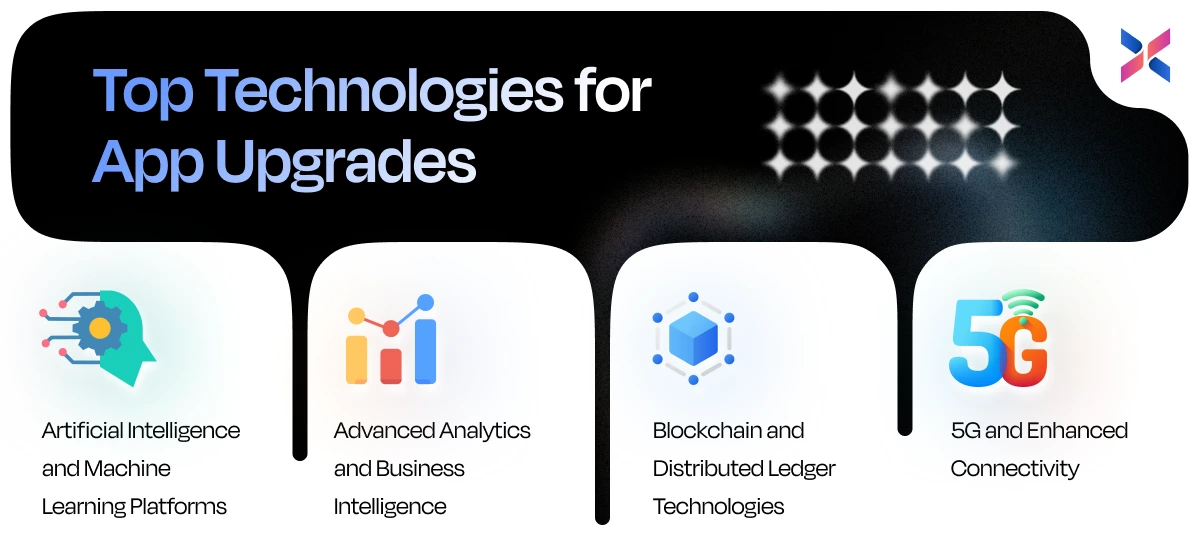
#1. Artificial Intelligence and Machine Learning Platforms
Today's users want the apps that understand them and provide the service that they seek without searching or putting effort.
AI and ML fulfill this by understanding the users' preferences, behaviour, and other actions they take to recommend things they want.
Use cloud-based services like Microsoft Azure, Amazon SageMaker, and Google Cloud to add smart features in your app if you don't want to spend on expensive app development services.
These platforms offer pre-built models and automated training pipelines; hence, with quick AI/ML capabilities, you can quickly implement AI functionality.
#2. Advanced Analytics and Business Intelligence
Modern business is moving constantly. Every day, there is a new thing introduced to the market. If you want to keep your business ahead of others, you need to implement unique and trendy features in your app.
This can be done with advanced analytics and business intelligence by integrating real-time dashboards to get predictive reporting and the latest insights related to business.
#3. Blockchain and Distributed Ledger Technologies
Blockchain is not only for cryptocurrencies; today, it's also a crucial part of enterprise apps to have secure transaction processing, immutable audit trails and decentralized identity management.
Especially if you operate a high-scale business like retail or supply chain, it's useful to automate contracts through smart contracts and share sensitive data securely between multiple parties.
This decentralized nature reduces fraud, boosts transparency and builds trust among users and partners.
#4. 5G and Enhanced Connectivity
Modernized apps heavily depend on real-time collaboration, high-definition streaming and instant data synchronization.
Hence, 5G connectivity is an essential point for app modernization. It helps businesses to have quick, real-time collaboration, have clear HD virtual meetings, and provide a satisfactory experience. In sectors like healthcare, fintech and banks, 5G connection is undeniable as they need to update data quickly in real-time.
ROI Analysis: Justifying Enterprise App Modernization Investments
Hiring an app modernization company may feel like a big investment, but legacy system transformation is totally worth it in today's evolving world because it is a financial and strategic 2-in-1 investment.
#1. Quantifiable Financial Benefits
No doubt, application modernization has countless financial benefits. EsparkInfo research found that companies that modernized their apps noticed a 14% increase in yearly revenue. It also helped to reduce maintenance expenses by 50% and infrastructure costs by 35%. At the same time, apps generate more revenue because of efficiency, scalability and better customer experiences.
#2. Productivity and Efficiency Improvements
Employees work more productively by 15% when using a modernized app, as it makes workflows much easier by automating processes and improving UI. It also helps to save training costs because users can easily learn by themselves and businesses can also check productivity across the organization when everything is connected.
#3. Competitive Advantage and Market Position
Organizations with modern applications respond faster to market changes and implement new features more quickly than legacy apps. This way, you can strengthen your market presence, attract and retain more customers, and enhance brand trust.
When you release the latest and unique features different for others, there are higher chances of increasing market share and brand reputation.
Implementation Roadmap for Enterprise App Modernization
You must follow the right strategy and execute the app modernization in phases to make sure every step delivers value properly. Let's read each phase one by one to get more clarity.
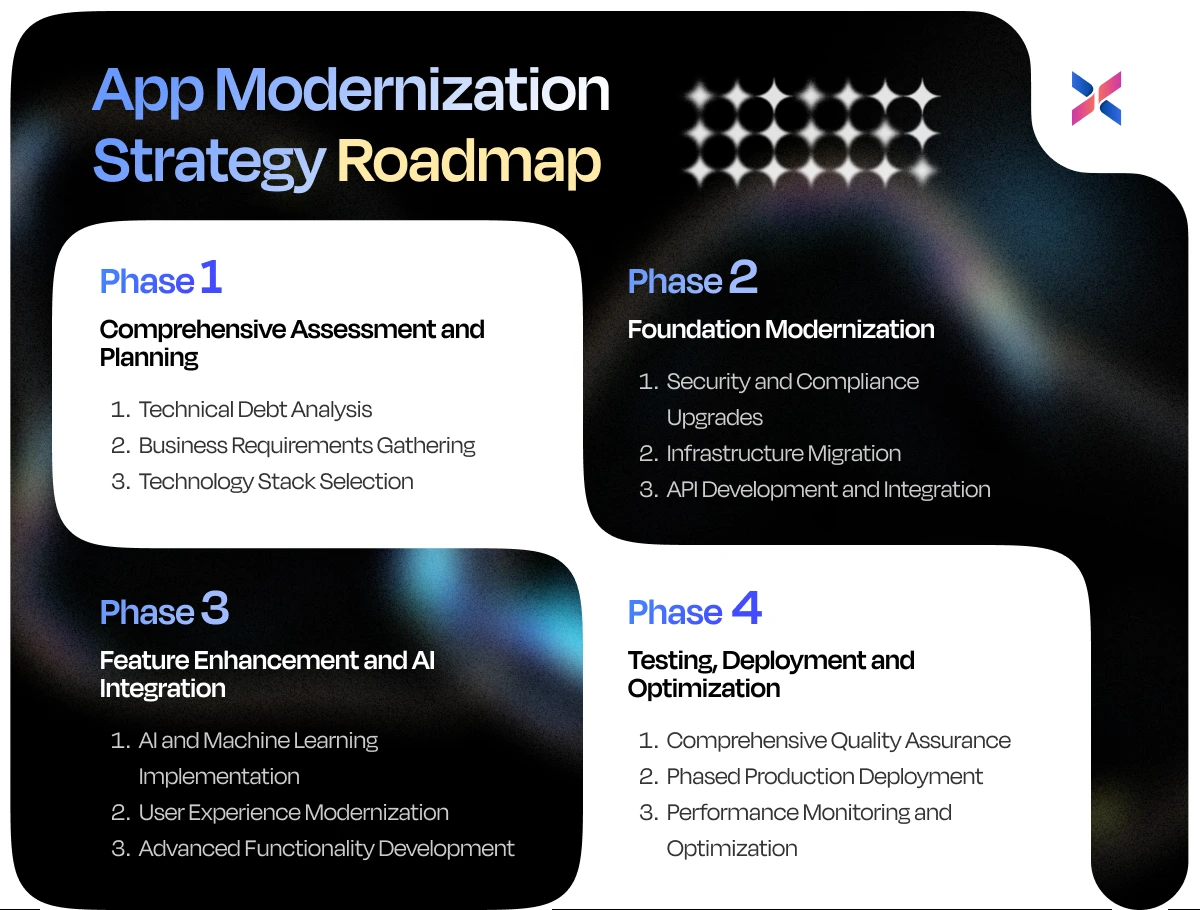
Phase 1: Comprehensive Assessment and Planning
Before starting app modernization, first know what is the current situation of your app. You will need to analyze current systems to know the business goals.
#1. Technical Debt Analysis
Technical debt means outdated code, slow performance and hidden security issues. To find technical issues, do a detailed evaluation of the existing application architecture, security vulnerabilities, and performance bottlenecks.
#2. Business Requirements Gathering
Modernization should always serve business goals, not just technology goals. This step focuses on identifying what success looks like, whether it’s faster performance, stronger security or better user experience. Define your KPIs, like system speed, reliability, customer satisfaction and other factors, where you really want to improve.
#3. Technology Stack Selection
Select the best cloud platforms, development frameworks and technologies that match business needs. It should balance technical constraints with future scalability so your app can grow with the business.
Phase 2: Foundation Modernization
Once your analysis, research and planning are done, it's time to build a proper foundation of the app, which comes from security, infrastructure, development and integrations.
#1. Security and Compliance Upgrades
Follow zero-trust frameworks, advanced threat detection and automated compliance checks to safeguard against cyberattacks. Fix vulnerabilities early to prevent data breaches and costly mistakes.
#2. Infrastructure Migration
This step involves moving to a cloud-native architecture. You can move your old apps to a modernized infrastructure through serverless computing, microservices and automated deployment.
#3. API Development and Integration
APIs are the medium to connect old systems with new, upgraded functionality. Create modern API layers for your existing functionality and prepare it for integration. Make sure you follow all required security protocols, API governance and prepare clear documentation.
Phase 3: Feature Enhancement and AI Integration
Now it's time to finalize features and integrations that add intelligence and usability upgrades to your app. Below are some things where you should focus for a refreshed user experience.
#1. AI and Machine Learning Implementation
Focus on high-impact use areas to add this AI/ML functionality. See how it adds business value. Consider predictive analytics to forecast trends, chatbots to handle customer queries or recommendation engines to boost engagement.
#2. User Experience Modernization
Match modern standards and prioritize accessibility. Redesign the user interface based on modern design principles, accessibility standards, and research user insights to know what type of design they love. Implement a responsive design for multi-device compatibility.
#3. Advanced Functionality Development
Add advanced functionalities like voice interfaces, conversational AI and cross-platform capabilities based on user requirements and business priorities. So apps feel futuristic and practical.
Phase 4: Testing, Deployment and Optimization
Once you have implemented the advanced features in your app, it's time to test them if they are working as expected, are secure and stable to go live.
#1. Comprehensive Quality Assurance
Perform security testing, performance optimization, and user acceptance testing to identify issues from all sides. Implement automated testing pipelines for continuous quality assurance.
#2. Phased Production Deployment
Launch modernized applications using blue-green deployment strategies, feature flags and progressive rollouts. This helps you to test new features with small groups before a full release.
#3. Performance Monitoring and Optimization
Keep tracking performances, user behavior and business metrics to make sure it align with users and your business goals. Keep optimizing by regularly checking real-time user data.
Challenges and Solutions in Legacy App Modernization
Every app modernization journey is different and comes with its own challenges, but knowing the problems early makes a lot of difference.
#1. Integration Complexity with Existing Systems
Legacy system integration requires careful planning to maintain data consistency and proper operation. At Expert App Devs, we always prefer API-first architecture and gradually migrate one by one to ensure data flow between old and new systems.
#2. Skill Gaps and Team Development
Modernizing applications requires experts in cloud technologies, AI/ML platforms and other contemporary development frameworks. You can hire experienced app development companies that have a great record of app modernization.
#3. Change Management and User Adoption
Successful modernization requires effective change management strategies. Have clear communication, hands-on training and roll out the modern features gradually. Introduce updates step by step, and allow enough time to settle down comfortably.
ExpertAppDevs' Approach to 2027 Enterprise App Modernization
At Expert App Devs, our app modernization approach is focused on business value as well as user satisfaction. This is why we prefer a future-oriented business approach.
#1. Discovery and Assessment Services
Our team reviews the app’s technical setup, checks for security gaps and analyzes overall requirements. Based on this, we create a clear roadmap with prioritized steps and timelines.
#2. Security-First Development Methodology
Every project we do follows zero-trust security, compliance monitoring and threat detection to ensure enterprise-grade protection.
#3. Dedicated Development Teams and Ongoing Support
We have flexible engagement models that include dedicated development teams, managed services and long-term partnership arrangements. When you partner with us, we provide continuous support backed by SLAs to keep apps reliable and high-performing.
Industry-Specific Modernization Examples of Expert App Devs
We’ve helped a lot of businesses across industries to upgrade from outdated apps to powerful, modern solutions. Have a look at some of the real-world examples to know how our modernization approach solved their challenges and delivered measurable results.
#1. Healthcare Application Transformation
Problem: One of our healthcare provider clients was struggling with outdated patient management systems, manual reporting and delays in diagnosis. This was impacting both staff efficiency and patient care.
Solution: We used AI-powered diagnosis tools to speed up patient assessments, IoT integration for real-time health monitoring, and automated HIPAA compliance reporting to ensure data security and reduce manual effort.
Results: This modern health care solution gave amazing results. Their admin workload reduced by 30%, while patient satisfaction scores improved by 25%. Now they can deliver more fast and efficient patient care during peak time.
#2. Financial Services Digital Transformation
Problems: The regional bank's old mobile banking app had frequent crashes and security issues. Client received frequent complained from users about slow transactions and fraud. Their app was feeling outdated and facing problems in handling growing user numbers, which made customer frustrated and potential revenue loss.
Solution: We rebuilt their mobile banking app with advanced security protection, instant fraud detection and blockchain technology for safer transactions. The new system included stronger user authentication and real-time monitoring to prevent security breaches.
Results: Our solution delivered 99.9% uptime with almost zero crashes. Security incidents dropped by 85% and now customer engagement has increased by 40% as users trusted and used the app more frequently.
#3. Manufacturing Industry 4.0 Integration
Problems: One of our clients runs a manufacturing company and was struggling with sudden equipment breakdowns and poor production monitoring. They couldn't predict when machines would fail, and this was causing downtime. Plus, their quality control was manual and inconsistent, which led to product defects and waste.
Solution: We connected their factory equipment with smart sensors and AI technology. The new system now predicts when machines need maintenance, monitors production in real-time and automatically checks product quality using artificial intelligence.
Results: Our modernized approach reduced equipment downtime by 20% through predictive maintenance. This also saved them lots of repair costs. Production efficiency increased by 15% with better monitoring and quality control. The company now prevents problems before they happen.
ENTERPRISE EXPERT’S ADVICE ON 2027 APP UPGRADATION (Modernization Advice)
We've gathered insights from leading CTOs, senior IT experts, and app modernization specialists who've successfully transformed thousands of legacy applications. Here’s what they recommend for 2027.
Expert Advice 1: Avoid Technology-Only Modernization: Focus On Business Results
MOST COMMON MISTAKE: Modernization mishandled as just another IT tick box - merely changing technology without revamping processes, ownership or metrics, resulting in the organization essentially shipping the same problems but with a new shine.
ONE STEP EVERY C-LEVEL SHOULD TAKE FIRST: Choose one quantifiable business result (a genuine guiding light) along with a definite end date for the old system and ensure that every architectural and budget decision moves only toward that metric.
WHY PROJECTS MISS ROI: Teams rebuild code but not the operating model; with no telemetry, training or decommission plan, you pay to run two systems and never capture the promised savings.
MAKE IT SMOOTH FOR LARGE TEAMS: Move in small, end-to-end slices owned by a single team, ship behind feature flags/canaries and treat each slice as a tiny product so learning scales without chaos.
Cache Merrill, Founder, Zibtek
Expert Advice 2: Workflow Analysis First: Key To Successful App Modernization
#1. The most common failure in app modernization is simply replacing legacy systems before finding out how teams use it. All technology upgrades fail when you disregard real workflows and user actions.
#2. Before starting a systems modernization project, executives should outline their business goals and resulting technical dependencies. Identifying what must change and why eliminates wasted effort and expensive mistakes.
#3. Systems modernization initiatives often underdeliver because the ROI is only measured as a cost saving. Without linking upgrades to efficiency, user adoption or revenue increase potential your organization still has an incomplete project even with wonderful implementation.
#4. Break modernization down into incremental milestones while assigning clear ownership. Consistent check-ins and early wins, especially with a large group of people, help all team members stay aligned, maintain momentum and prevents projects from going stagnant halfway.
Sergio Oliveira, Director of Development, DesignRush
Frequently Asked Questions
If you are still thinking about what changes make sense for your old app after the new iOS and Android Updates? Here are some frequently asked questions that will help you decide which 2027 features your app really needs.
#1. Should we rebuild or upgrade our existing app in 2027?
Firstly, you should consider rebuilding or upgrading the app if your app is outdated, complex or has issues. It depends on technical debt assessment, security requirements and business objectives.
If your app lacks in fundamental architecture, rebuilding is a good option to create well-structured legacy applications according to the latest trends.
#2. What are the most cost-effective modernization features to prioritize?
App modernization is different for every app and business. Security upgrades, cloud migration, API modernization, AI integration and an advanced user interface are some of the affordable features that you can upgrade to modernize your app, as this gives higher ROI with low implementation risk.
#3 How do you calculate app modernization ROI?
You can calculate by measuring the benefits you see after modernizing, like reduced operational costs, increased productivity, and improved customer satisfaction against total implementation expenses.
#4. How long does enterprise app modernization take?
As per our past experience, the complete app modernization can take around 3 to 18 months, depending on application complexity, organizational readiness and feature scope.
#5. What's the difference between app upgrades and a complete migration?
App upgrades usually mean updating your app within the same platform, like moving to a newer version, adding new features or improving performance. These are incremental improvements to the existing application.
While a complete migration is much bigger. It involves moving the app to a different platform or architecture and rebuilding it from scratch using modern frameworks and infrastructure.
#6. Can you modernize apps without affecting current operations?
Yes, you can modernize apps without stopping current operations through a phased approach. Here, updates are done step by step so the business is not affected at all stages.
Partner with ExpertAppDevs for Strategic Enterprise App Modernization
Transform your legacy applications and get competitive advantages with Expert App Devs' comprehensive modernization services.
Our experienced development teams specialize in enterprise-grade solutions, including AI integration, zero-trust security implementation and cloud-native architecture development.
Ready to modernize your enterprise applications?
Contact Expert App Devs today to get a complimentary assessment and a customized modernization roadmap.
Get Your Free App Modernization Assessment
Expert App Devs has been serving as a technology partner since 14 years and has helped clients across North America, Europe, the Middle East and Oceania to upgrade their legacy applications using proven modernization initiatives.
Join leading enterprises and see how we can transform your business with our digital capabilities through strategic partnerships.
Conclusion: Future-Proofing Your Digital Assets
After the Apple App Store and Google Play Store's new guidelines, Application modernization is one of the high-impact investments you can make in 2027, because it can solve almost all business problems, such as organizational competitiveness, operational efficiency, ROI, customer satisfaction and more.
The application modernization market is expected to grow to $74.63 billion by 2031, with an average annual growth rate of 18.7% from 2024 to 2031. (source: verifiedmarketresearch)
Using AI technologies, zero-trust security, and cloud-native architecture are some of the parts of modernized apps; using this will provide you with huge opportunities for digital transformation. Hope this guide helped you understand essential technologies, challenges and features to plan your enterprise app modernization right.
You have two options: modernize your applications today to beat your competition or risk losing customers as technology keeps advancing quickly.
At Expert App Devs, we have the right expertise and resources to enhance any old legacy apps using modern technologies. We are committed to providing successful enterprise application modernization. Book a free consultation with us.




 327
327

 1
1


 535
0
535
0
 228
0
228
0
 205
0
205
0