



- Exclusive Summary
- Introduction
- Market Shifts Impacting Outsourcing
- App Development Lifecycle and Outsourcing Fit
- Case Study: From Figma to App Store in 8 Weeks
- Engagement Tip: Matching Resources to Lifecycle Phases
- How to Vet Offshore Teams By Phase?
- White-Label Options for Client-Facing Consultants
- Role of AI in Development Outsourcing
- How Consultants Can Stay Accountable After Outsourcing?
- Frequently Asked Questions
- Conclusion
Ready to transform your vision into reality?
Get Started
App Development Consultant Guide: Design to Deployment Phases for Outsource
 271
271
 0
06 Aug 2025
49 Min Read
0
06 Aug 2025
49 Min Read


 Share
Share

 Download PDF
Building an app is not just a technical project; it often requires guidance from an app development consultant who understands strategy, architecture, and delivery.
Exclusive Summary
As mobile app development grows complex, it is imperative for consultants to know what and when to outsource. This guide walks you through a phase-by-phase roadmap, from design to development, for ERP, software system integration and design consultants looking to streamline delivery with strategic outsourcing.
Introduction
You no longer need to build full fledged in-house teams to keep up with the evolving tech needs of your business. In 2023 alone, nearly two-thirds of the major companies outsourced at least one of their departments. IT led the charge, making up 76% of all outsourcing activity.
It’s clear, if you want to scale faster and stay agile, you must depend on external experts. As consultants, you are involved with all aspects of application development, such as strategy, and orchestration processes. On the other hand, your offshore partners will execute the development plan. But, how do you map the right outsourcing model for each phase involved in app development, from conceptualization to final deployment.
This guide is an answer to your question, offering you a practical and people-first framework to make a clear decision. As an ERP or design consultant, you can use this guide to identify the tasks you want to outsource across different phases of mobile app lifecycle. It will also help you select the vendor.
Ultimately, you will be able to scale smartly while managing risks to deliver enterprise grade apps.
Why Consultants Don’t Need to Build In-House App Teams?
It’s time you stop hiring for roles you don’t need full-time at your organization. Creating an in-house team used to be the default path for delivering digital solutions till date.
However, you cannot consider using this method, especially when managing multiple clients and varied scopes. When you add full-time developers, designers and QA engineers to your team, you increase costs and delivery timeline risks.
That’s why you shouldn’t execute the development yourself; it is better to outsource the app development. Skipping early input from an app development consultant is one of the biggest mistakes enterprises make.
Connect with nearshore or offshore partners to complete the mobile app development services, including UI/UX development, backend integration and deployment. The right process and partnerships can help consultants outsource entire app projects without compromising quality, sped or control.
Your entire value dwells in the vision, client management and project oversight that helps deliver on time.
#1. Increasing Costs
You would have noticed that the salaries for tech talent have skyrocketed in the current times, especially for the US, EU and MENA regions. Even a small in-house team can eat into your budgets quickly and when you hire multiple such teams, it increases the costs.
By adding recruitment, retention, training and downtime costs to it, you will notice an increased overhead. By choosing in-house, you face tighter margins with underutilized resources.
#2. Resource Underutilization and Delivery Delays
Even when you have the best in-house team backing your execution, you cannot guarantee constant utilization of the resources. Add to this, inconsistent client timelines and fluctuating project scope, you will notice that your resources are either rushed through timelines or spend a lot of time staying idle.
Owing to this mismatch, you may notice missed timelines, overworked teams and unhappy clients. By outsourcing, you can easily scale up or down without long-term liabilities.
#3. Consultant as Orchestrator
The modern consultants don’t handle delivery in the traditional sense. They are orchestrators, instead of executors of the plan. They guide the client’s vision, coordinate with offshore partners and ensure timelines while managing quality.
The execution, from design to development and deployment, is handed over to specialized teams that handle this work.
With this shift, the operational overhead is reduced while the entire focus remains on problem-solving and outcomes.
Market Shifts Impacting Outsourcing
If you thought outsourcing was about cutting costs alone, you need to think again. The landscape is continuously evolving, enabling you to manage complexities within a project.
For consultants, there is an increasing pressure to stay lean while managing new delivery standards. At the same time, you need to ensure local and multi-region compliance, as clients expect you to align with regulatory region-specific regulatory frameworks.
If you are thinking hiring or partnering with offshore vendors, you must also consider fractional engineering. It can help you hire developers, architects and QA leads on-demand, thus ensuring maximum flexibility.
As a consultant, you must offer end-to-end delivery to your clients. That’s why you should consider having a single-point of contact for all the vendors, especially with multiple vendors. You can also consider white-label vendors so that you can provide timely and high-quality delivery under your brand name.
App Development Lifecycle and Outsourcing Fit
If you want to outsource effectively as a consultant, you must understand how each phase of development aligns with the right talent model. In this section, we will look at the entire app lifecycle and understand how outsourcing delivers maximum value.
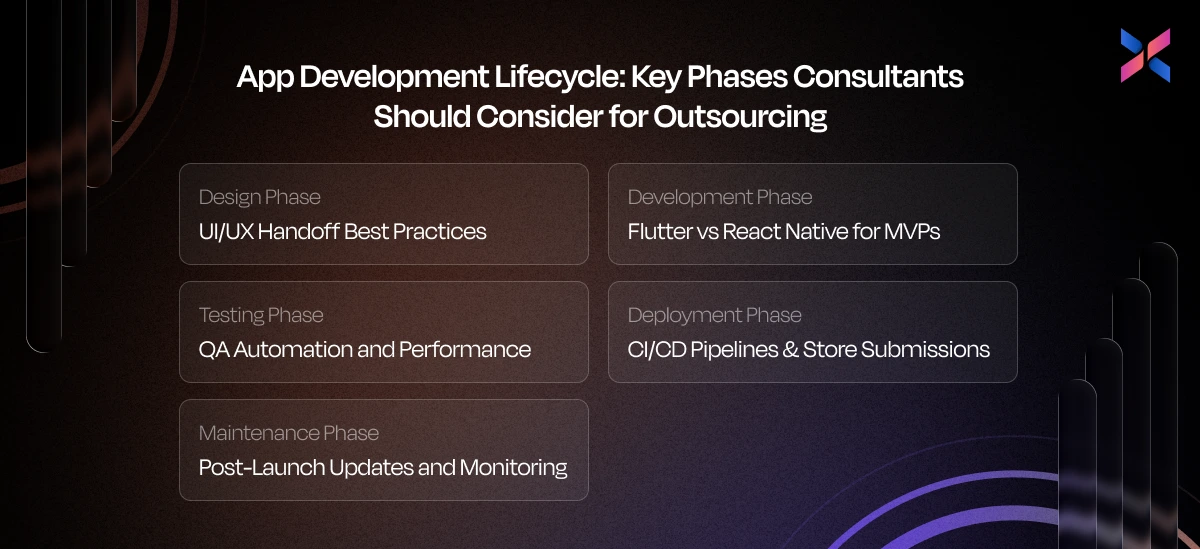
#1. Design Phase: UI/UX Handoff Best Practices
With smooth handoffs between you and the outsourcing partner, you can save time, budget and sanity. Most often delays occur due to poor design-to-dev communication. However, if you use the right tools and practices, you can cut down rework between design and development teams by 40%. An app development consultant ensures that your budget aligns with realistic feature scope and delivery timelines.
You should use developer-friendly tools like Figma, Zeplin and Adobe XD. This will support your design collaboration and clear developer specs as well. it will also make it easier for you to export design assets, measure spacing and view CSS snippets directly.
You can use design tokens like font sizes, colours and spacing units to standardize the designs to translate everything into consistent code. With these building blocks, you can avoid style mismatches that occur during app development.
By using a shared and documented design system, you can detect design issues before development begins. You should include everything from component states, conventions and responsive rules. This will reduce back-and-forth and build a common visual language.
Please note” By aligning on naming structure for layers, assets and components early, you can ensure everyone from developers to QA testers are on the same page. An app development consultant works alongside UI/UX teams to ensure designs match technical feasibility and business goals.
#2. Development Phase: Flutter vs React Native for MVPs
When building MVPs, you must choose the right cross-platform framework to attain success. Flutter and React Native are two popular frameworks that offer code reusability for both iOS and Android with a single codebase.
Flutter is ideal when you focus on design fidelity with performance. The framework uses Dart, which is not very popular among the offshore developers but, this programming language provides consistency.
React Native, on the other hand, is built using JavaScript and has a larger talent pool. This makes scaling teams and switching vendors easier for the consultant. To deliver a native-like performance, you may need to invest in third-party plugins and native modules.
Even during development, an app development consultant plays a key role by reviewing architecture, API contracts, and sprint planning.
Flutter vs React Native for Offshore MVPs
|
Features |
Flutter |
React Native |
|
Code Reuse |
85%+ |
90%+ |
|
Language |
Dart |
JavaScript |
|
UI Performance |
High (custom rendering engine) |
Medium to High (Bridged rendering) |
|
Developer Availability |
Moderate (growing globally) |
High (especially in offshore markets) |
|
Best Use Case |
Custom UI focused apps |
Fast MVPs with standard components |
|
Community & Libraries |
Mature but smaller |
Larger and well-supported |
|
Learning Curve for Teams |
Slightly steeper |
Lower, having JS familiarity helps |
If your MVP requires a quick turnaround with global talent pool availability, choose React Native. However, if you need a polished and UI-driven product with fewer external dependencies, Flutter can help.
READ MORE: Flutter vs React Native: Which is Better for Your Future App and Why
#3. Testing Phase: QA Automation and Performance
It is crucial for the compliance consultants to begin testing from day-one. The reason being a late stage bug will not only break the functionality, it can also deter trust and delay the launch timelines.
With early stage QA, you can identify issues faster before they grow expensive and lead to client-facing problems. In a regulated industry, this is not optional, it is critical.
There are specific tools like BrowserStack, Test Project, JMeter and Postman. BrowserStack is used for cross-browser and real-device testing, while TestProject will help you with a free and cloud-hosted automation platform.
Postman helps with API testing and integration validation while JMeter helps with load and performance testing for diverse loads. If you want to outsource QA, make sure to do it to regions like India and Eastern Europe (Ukraine, Poland and Romania). The testing teams in these regions have QA engineers that specialize in automation and performance testing.
Most of the testers in these regions are familiar with compliance standards like GDPR and HIPAA, making them the best choice for security and quality-driven projects.
Early investment in QA isn’t an overhead for your business; it is a strategic move. When you partner with an offshore team and tools, QA can help safeguard quality, compliance and peace of mind.
A seasoned app development consultant knows which testing strategy (manual, automated, or a mix) fits your product stage.
#4. Deployment Phase: CI/CD Pipelines & Store Submissions
Building the mobile app for your idea is just half the battle; the other half is getting the app to your users. for this, you must invest in deployment excellence. If you are working with an offshore team, you should setup a working CI/CD pipeline that drives faster and repeatable releases with fewer surprises along the way.
CI/CD tools allow you to eliminate the chaos that comes with last-minute builds and manual uploads. It helps automate deployment faster. Bitrise is ideal for mobile CI/CD integration seamlessly. With Fastlane, you can automate the app signing, screenshots and submissions. App store connect APIs help upload scripted metadata faster and ensure status tracking.
Using these tools, the offshore teams can push the builds to the test environment and app stores with minimal manual effort.
Avoid overlooking legal and localization hurdles, especially when considering global rollouts. This would ensure your store submissions are in sync with local laws and cultural expectations.
For example, you should consider using Arabic or RTL metadata for the MENA region. Similarly, you should consider GDPR-compliant privacy policies for EU submissions. Lastly, it is important to consider region-specific age ratings, content declaration and financial disclosure.
When you are working with offshore vendors, brief them early so that they can prepare these assets accurately. If you are not accurate with the scope, your app can get rejected or delayed infinitely.
Before launch, an app development consultant validates the app against performance benchmarks and compliance needs.
Note: Create a store submission checklist and store it within the CI/CD pipeline to save time, avoid rework and ensure consistent delivery.
#5. Maintenance Phase: Post-Launch Updates and Monitoring
There is enough work for you, even after you launch the application. The focus is stability, performance and support, once you have made your app live. As consultants managing outsourced delivery, you should setup the right monitoring systems and support expectations for long-term satisfaction.
You can stay ahead of user complaints by integration crash and error monitoring tools from day-one. Start by using firebase Crashlytics that helps manage real-time crash reports with detailed device logs. Similarly, Instabug can help you with in-app bug reporting, performance monitoring and user feedback collection.
These tools give you complete visibility and can help you react quickly before the users notice issues with the application. Streamline updates and alerts by setting up Version Control to manage hotfixes and feature rollouts. Similarly, you can offer real-time alerting by using Slack, PagerDuty and emails. Lastly, use scheduled update windows to push the fixes without disrupting users.
You should include the following in your SLAs while conducting app support.
- The response time for critical issues like crashes and downtime.
- Frequency of scheduled updates and maintenance checks.
- Tool stack used for monitoring and communication.
- Reporting cadence, such as weekly and monthly summaries.
Consulting shines most after the mobile app launch. Using the right offshore support with the right SLAs in place, you are in control. Your app development consultant also guides optimization decisions database tuning, caching strategy, cloud scaling, etc.
Case Study: From Figma to App Store in 8 Weeks
A GreatLike Media collaborated with the offshore team in India with Expert App Devs to deliver the retail client’s mobile application. The workflow for this collaboration included UI design using Figma, development with Flutter and Firebase as well as deployment.
The agency required someone reliable to turn their static Figma designs into functioning application. Their key priorities were quick turnaround, cost efficiency and minimal revision. They needed an execution team that could handle development and QA while being aligned with the agency’s timelines.
As a result of the collaboration, the project was launched for both iOS and Android in 8 weeks. It helped them save 60% of the typical time while cutting costs by 30%.
The team of android app developers is skilled in android development on the Android platform as well as cross-platform, delivering high-quality apps. Highly recommended android developers because their aim turning in the best possible results. - Justin Rath
Engagement Tip: Matching Resources to Lifecycle Phases
Outsourcing is effective when you match the right resources with the stages of project development. In this section, we will take you through the key resources needed for each phase and how their job looks like in practice.
During the discovery phase, an app development consultant helps convert ideas into structured requirements, user journeys, and technical constraints.
#1. Design Phase
For this phase, you need a UI/UX designer who can translate your ideas into wireframes, mockups and interactive prototypes. The designer is responsible for creating intuitive user journeys and visually consistent screens, aligned with your business goals.
The offshore designers use the hourly or milestone-based models to engage with you. These models provide clear deliverables like user flows and brand-aligned components.
These designs offer to be a blueprint for the developers. Collaboration and feedback loops are critical, as they help deliver designs ready to be converted.
#2. Development Phase
The app takes complete shape at this point. You need skilled mobile app developers who are proficient with cross-platform or native frameworks, such as Flutter or React Native. These developers engage in a monthly or full-time equivalentbasis. This is especially true if you are considering long-term builds and agile sprints.
They can convert the designs into functional, scalable and secure code. Moreover, for MVPs that are well-defined, you can also use fixed-cost models. This is especially true if timelines and features are locked in.
A senior app development consultant can assess scalability, integration needs, and infrastructure choices before development begins.
#3. Testing Phase
You should hire QA engineers and performance testers to validate your app across devices in this phase. The hires would start by writing test cases, automate regression checks and monitor load behaviour.
You can consider fixed-scope or SLA-based model, especially if your clear deliverables are tied to timelines and response SLAs. The offshore QA teams will use tools like Postman, BrowserStack and JMeter to cover both manual and automated testing effectively.
#4. Deployment Phase
You need a DevOps or release engineer who can configure the CI/CD pipelines, manage cloud environments and handle app store submissions. They are responsible for setting up tools like Bitrise or Fastlane, automate the build workflows and prepare the release assets.
These professionals can work on a milestone or sprint-based model as the tasks involved are short-term and high-impact. You should ensure they fulfill the region-specific requirements like GDPR policies or Arabic metadata.
#5. Maintenance Phase
You need a mobile app support specialist after the app is live to help monitor performance, address bugs and roll out patches. The tasks involve fixed crashes reported by Firebase, handling support tickets and ensuring the app stays updated with OS changes.
You need to hire the support team on a monthly retainer or ticket-based model for flexibility and accountability. Define SLAs for response time and reporting so that nothing slips through you that can restrict user base growth.
|
Phase |
Resource Needed |
Ideal Outsourcing Model |
|
Design |
UI/UX Designer |
Milestone/Hourly |
|
Development |
Mobile App Developers |
Monthly/FTE or fixed-cost |
|
Testing |
QA, Performance Eng. |
Fixed scope (SLA-ready) |
|
Deployment |
DevOps/Release Eng. |
Milestone/Sprint-based |
|
Maintenance |
App Support Specialist |
Monthly or ticket-based |
How to Vet Offshore Teams By Phase?
You must think project-fit and not price when choosing a good offshore team for your project. For every phase of the application, you need specific skills, tools and workflows. Here are all the ways in which consultants can vet the offshore teams effectively to meet the client expectations.
#1. Portfolio & Region Expertise
Skim through their portfolio but, don’t stop at surface level screenshots. Ask them if they have built an app like yours in terms of functionality and not just industry.
For instance, you need to build secure login flows for a Fintech application while you should develop scalable backends for marketplace application.
You should look for a team that is familiar with the region-specific compliances. At the same time, they should consider the UX expectations as well to deliver faster and accurate designs. If they have worked with other consultants or white-label clients, it would be a bonus advantage for you.
Ask them to share client references or live walk through of a past project to understand their abilities better.
#2. Security Practices (OWASP Compliance, GDPR)
Security shouldn’t be an afterthought, especially for healthcare, finance and HR applications. You should ask the prospective team if they follow OWASP mobile app security standards. Ask them if they have handled GDPR or HIPAA sensitive data in their earlier projects.
A good offshore partner will mention the security testing, cloud infrastructure, data encryption and secure API usage best practices they use proactively.
As consultants, you should also understand their response process to incidents. Know their understanding of data residency rules, especially when you are planning a multi-region rollout. You can simply look at the documentation and security tools they use to understand their practices.
#3. Tools Familiarity (Figma, JIRA, CI/CD Tools)
If the offshore team doesn’t use the tools you do, collaboration can become chunky. You should confirm with the team if their designer is proficient with Figma, Zeplin or Adobe XD. Check if they can structure the files for handoff, which means adding components, naming and tokens.
In case of developers, you must check if they are familiar with GitHub, Bitrise and Fastlane for builds and CI/CD pipeline. The team should also know how to log bugs in Jira and ClickUp. They should also be able to use tools like Postman and BrowserStack.
Check with them regarding the platforms they have used for projects via screenshots or walkthroughs. You need teams that can effortlessly plug into your system to reduce miscommunications and improve review cycles.
#4. Communication Workflow And Timezone Overlap
Smooth collaboration results from cadence and clarity. You should ask the team how they manage daily and weekly check-ins. Ask them if they offer async updates via Loom, Slack and Notion. Also know how they manage the blockers.
The offshore team shouldn’t just respond but, anticipate issues. You should also look for timezone overlap of at least 2-4 hours between you and the offshore team to ensure real-time alignment. It is a good idea to check if they have a single point-of-contact who can handle the entire work. They will be accountable for both delivery and updates, making the collaboration a success.
#5. Language Proficiency (English Business Fluency)
Communication breakdowns can derail your timelines even when the code is clean. You should insist on a business-level English proficiency from the developers, project managers and QA leads.
Check if the team asks clarifying questions in the early stages of interaction. Can they summarize the points to indicate their understanding of the project? Are they able to write JIRA tickets or Slack updates?
Basically, you need people who can articulate the blockers and explain timelines. This is critical, especially when dealing with app development phases like testing and deployment where clarity and documentation are crucial.
#6. NDA, RFP, SOW, Demo Call Readiness
Professionalism shows up early, even before you begin working on a single code. A reliable offshore team won’t hesitate signing the NDA or responding to a RFP and scope document.
Check if they have worked with consultants earlier. If they have, they would be ready with templates for Statements of Work and budget estimates. You shouldn’t skip the demo call, and ask them to take you through a similar project they have done earlier.
With these steps, you can gauge transparency, team dynamics and delivery process during the vetting.
White-Label Options for Client-Facing Consultants
When you are the face of project delivery but not the person coding or designing, you must consider white-label partnerships with the offshore team. These teams will work behind-the-scenes while you lead with confidence in front of the clients.
#1. Why white-label teams matter for intermediaries?
If you manage the client strategy but outsource execution, you should consider white-label vendors. They allow you to expand your capabilities and services without extending the teams. They act invisible while delivering on your brand and under your direction.
If you are building MVPs, prototypes or enterprise rollouts, you can consider white-label as the product will stay in your name. this approach will free up your team’s bandwidth while letting you maintain control and consistency with every engagement.
#2. NDA, branding protection, communication protocols
You should include a strict non-disclosure agreement (NDA) with your white-label agreement. It should define all the boundaries clearly. Make sure the vendor agrees to not contacting your clients directly or showcasing this work in their portfolio.
You should setup the communication protocols so that every update is filtered through you. It will help keep the chaos and confusion to a minimum.
#3. How to structure contracts so the delivery team stays invisible
You should specifically mention that the vendor is a subcontractor with no client facing privileges in your contract. Include clauses that restrict external communication, brand visibility and platform access to your vendors.
You should also define IP ownership that it will reside with you and your client and not with the vendors. Set clear expectations for handoff formats, approval workflows and timelines with the vendor. If you have a clear scope and reporting structure, it will ensure your team is the only one working with the client.
#4. Support for demo calls, walkthroughs, and live status updates
White-label doesn’t mean silent partner. The offshore teams can take the client through live walkthroughs and demo call support under your banner. You can always loop them in as your team during the key milestone reviews and presentation.
Some vendors can also create white-label reports, progress dashboards and sprint summaries. You must use their expertise without revealing their identity to stay informed and in control across stages.
Role of AI in Development Outsourcing
AI is reimagining how offshore teams can build, test and deliver applications, making the entire development faster and smarter. For consultants, it helps understand these shifts while unlocking major gains with speed and collaboration.
#1. Coding Copilots
There are AI-powered coding assistants like GitHub Copilot and Amazon Code Whisperer that have improved developer’s productivity. The offshore teams can get tasks like writing boilerplate code, generating functions and debugging done 2x faster.
As a result, the consultants can expect quicker MVP development, reduced iteration time and scale effortlessly. This will allow them to deliver enterprise-grade apps with fewer bugs and delays using small and efficient teams.
#2. AI-backed QA
AI uses screenshots, screen flows and other visual models to run their UI tests and improve QA results. The tools like Testim and Applitools help them analyze design-to-dev consistency, catch the layout bugs and autogenerate the test scripts.
It can help them eliminate repetitive manual testing and enable early-stage validation, even before backend logic is live. For the consultants, it can reduce back-and-forth while keeping the QA teams proactive and autonomous.
#3. Improve Remote Team Briefing
You can use prompt engineering to draft briefs, user stories and feature outlines in seconds. With tools like ChatGPT, you can also create the acceptance criteria, architecture notes and testing checklists that are tailored for your project.
It will speed up the onboarding of offshore teams, and reduce ambiguity associated with handoffs. You don’t even need rewrite Jira tickets from scratch. You can create the AI goals and the tool will make the first draft.
How Consultants Can Stay Accountable After Outsourcing?
Outsourcing doesn’t mean you step away from the entire process; it simply means you are shifting the way in which you are control. Using these accountability practices, you can maintain transparency, timelines and trust without micromanaging the teams. Many companies outsource early strategy work to an app development consultant to avoid rework, delays, and cost overruns.
#1. Weekly status reports
You should strike a rhythm for structured updates. Weekly status reports should include all the tasks completed, blockers and upcoming priorities. Use simple templates and review them in sync calls.
It will give you and your clients visibility without chasing the updates or decoding the project jargon. You can repurpose the reports directly for client communication and stakeholder updates.
#2. Shared dashboards
You can use tools like ClickUp, Trello and JIRA to create shared dashboards. These visual boards can help you and your clients track the progress, get milestone health in real-time and also understand sprint burndown.
Make sure the tasks are clearly labeled with assignees and due dates. You should also have dashboards that create accountability throughout the delivery chain and reduce misalignment.
#3. Version control visibility
Get read-only or collaborator level access to GitHub and GitLab. This will give you a complete visibility into code commits, branch activity and deployment cycles.
You can track velocity, catch red flags and verify code maintenance. This will ensure complete control.
#4. SLA benchmarks and alerts
You should tie the performance with service-level benchmarks like bug fix, turnaround time and uptime goals. You should use tools that trigger alerts when SLAs are breached. These include PagerDuty and Slack integrations.
These benchmarks ensure the quality is measurable and not just assumed. With this setup, clients love them and the offshore teams would know what is expected.
#5. Continuous engagement from your consulting end
Don’t go silent after signing the contract. You should be present to review deliverables, ask critical questions and join the demos.
The offshore team can handle execution but, you need to work on client expectations. With consistent consultant engagement, you can improve quality and keep the teams sharp.
Frequently Asked Questions
#1. Can I outsource just one phase of my client’s app?
Absolutely! You can outsource any of the mobile app development phases from the entire development lifecycle, such as app design, development or QA, depending on your internal bandwidth. You should ensure clear scope, documentation and ownership boundaries from the start.
#2. Which country is best for outsourcing UI/UX design?
The most effective countries to outsource your high-quality and cost-effective UI/UX design include India, Poland and the Philippines. You should find people with strong English proficiency and Figma-first workflows.
#3. How do I manage compliance during offshore deployment?
By using CI/CD tools along with audit logs, you can ensure data localization and have the vendors sign off on GDPR, HIPAA and other deployment protocols.
#4. What tools ensure a clean handoff from design to dev?
The tools that ensure clean handoff from design to development include Figma with component libraries, Zeplin for developer specs and shared design systems.
Conclusion
For consultants aiming to scale their delivery without hiring large-scale in-house teams, outsourcing is a strategic move. You can align the lifecycle phase with the right offshore model to stay agile, focused an profitable.
Whether you are developing MVPs or managing complex enterprise rollouts, the key is to select smart vendors, ensure clear communication and manage continuous oversight. Blending AI with white-label support, you can access global talent for your project needs.
As a result, you focus on delivering the apps, while the offshore team manages the development. If you are looking for a trusted technology partner to support your consulting business, get started with Expert App Devs.
We provide full white-label delivery, NDA-backed secure architecture and long-term/phase-wise contract.
Need a senior app development consultant to plan your product roadmap or review your architecture? Get in touch with us to discuss project timelines, resource needs and cost structure. We also welcome new consultants from these regions to partner with us and explore collaborative opportunities. Schedule a consultation with us and our experts will guide you through Design to Deployment, each app development phase planning.





 367
367

 5
5


 228
0
228
0
 490
0
490
0
 221
0
221
0