


- What is an AI-based Flutter App?
- Key AI Features Commonly Used in Flutter Apps
- Factors That Influence the Cost of Developing an AI-Based Flutter App in India
- Cost Breakdown for AI Features in Flutter Apps
- Total Cost to Develop an AI-Based Flutter App in India
- AI Tech Stack Used to Build Flutter Apps
- Flutter App Development with AI Integration Timeline
- Flutter App Development Cost Comparison with AI Solutions : India vs. USA/UK/Europe
- Should Businesses Outsource Flutter Development to India for Enterprise AI Solutions?
- How Expert App Devs Build High-Quality AI-based Flutter Apps?
- Real-World Use Cases of AI-Based Flutter Apps
- Final Verdict: Is India the Best Place to Build Your Flutter App with AI Integrations?
- FAQs for AI-based Flutter App Development Costs
Ready to transform your vision into reality?
Get Started
How Much Does it Cost to Develop AI-based Flutter App in India?

 157
157
 0
17 Dec 2025
41 Min Read
0
17 Dec 2025
41 Min Read


 Share
Share

 Download PDF
Are you still debating if your next app idea needs an AI-powered solution or a standard Flutter build? Here’s a quick reality check: Companies that use AI in their mobile apps notice a 40% higher user engagement. Smart apps are no longer a luxury; they drive stickiness that helps increase conversions and ROI.
Flutter is the perfect vehicle to jumpstart your AI build, as it is fast, offers a single codebase and integrates seamlessly with ML models or API. By outsourcing your app development to India, you get the same engineering quality at a dramatically lower price.
The AI-based Flutter app development in India typically costs between $15,000 and $60,000, depending on APIs and custom requirements. This blog will give you a detailed breakdown on real costs, timelines and how to choose the right development partner.
What is an AI-based Flutter App?
If you try to picture what an AI-based Flutter app really is, you can think of it as a single app that works on both Android and iOS. At the same time, it is smart enough to understand, predict and create things for users.
Flutter can build a beautiful and high-performing interface, while the AI engine helps build a solution on the cloud or directly onto the device via EdgeAI. You can create different types of apps, like data-driven tools for financial prediction, vision-based features like medical image checks or generative AI assistants to write and summarize.
Now, the big question remains: when should a business choose Flutter app development services for AI apps? You can choose it when you need speed, cost-efficiency and seamless AI integration that’s backed by Google.
Key AI Features Commonly Used in Flutter Apps
Now that you know what an AI-based Flutter app is, let’s talk about the part that you are curious about, the actual AI features you build into them. These capabilities can help you shape the app’s user experience and trust in the product.
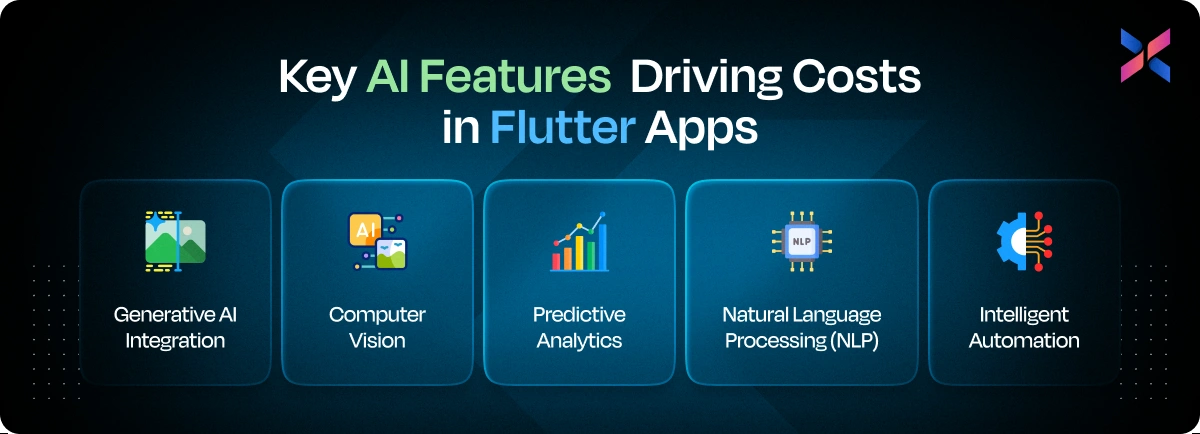
#1. Generative AI Integration
Generative AI should be your starting point if you want to build a truly smart application. Integrating with APIs from tools like ChatGPT and Gemini, you can create conversational chatbots, auto-content, summaries and code assistance. These features boost engagement and make your app feel supportive and intelligent.
#2. Computer Vision
You should use Computer Vision if you want your app to interpret the physical world. Frameworks like ARCore and ARKit can introduce image recognition, barcode scanning and facial authentication into your application. With these capabilities, you can open the door to retail, gaming, healthcare and verification use cases.
#3. Predictive Analytics
Using predictive analytics, you can think ahead. Whether you plan to use recommendation engines like Netflix or incorporate churn prediction, these features help personalize experiences. You can make smart business decisions using real patterns instead of assumptions.
#4. Natural Language Processing
With NLP, your app can also understand the way humans do. The features like voice-to-text, real-time translation and sentiment analysis can make your app accessible, intuitive and contextually aware. It is best for multilingual and high-interaction audiences.
#5. Intelligent Automation
AI will quietly remove the friction from your users’ journey with intelligent automation. Smart sorting, OCR-based automated data entry and personalized push notifications can help save users time and reduce errors, delivering smoother experiences.
Factors That Influence the Cost of Developing an AI-Based Flutter App in India
The next big question after defining the features for your next Flutter App Development with AI Features for Web, Mobile and Desktop is what drives the cost. Answering what factors affect AI Flutter app development cost can help avoid surprises when planning budgets or comparing development partners in India. Let’s break down what impacts your final investment.
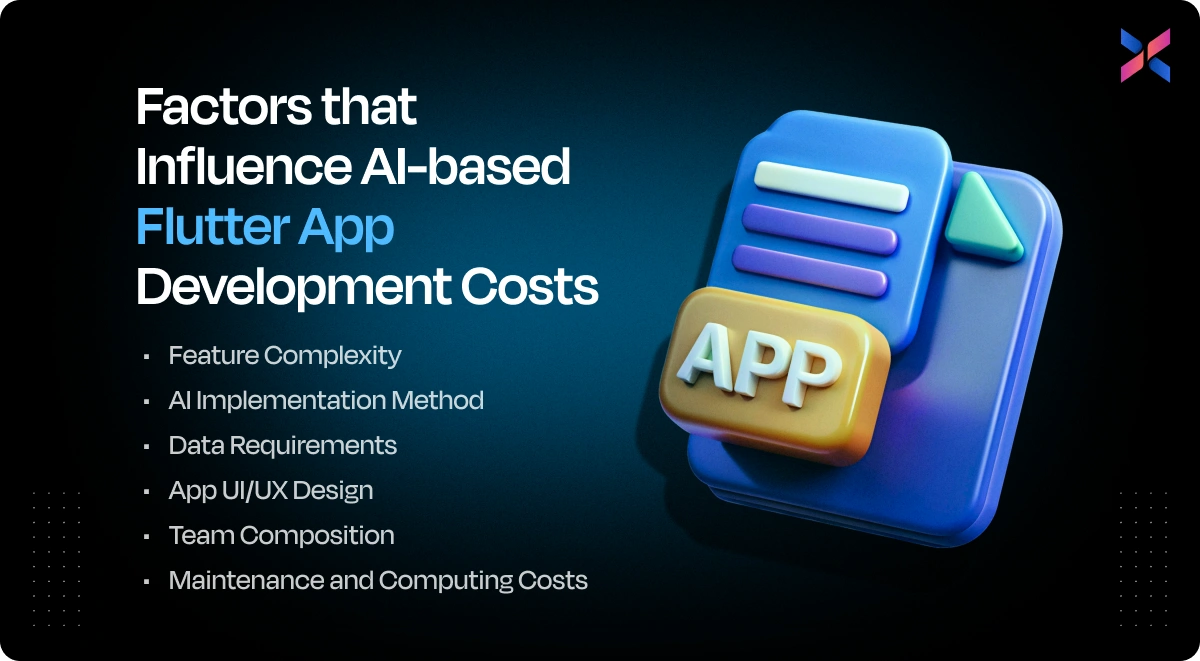
#1. Feature Complexity
The complexity of AI logic is the biggest cost driver. Using a simple rule-based chatbot can prove to be cheaper than a self-learning model that requires tuning, data training and ongoing optimization. If you want to create a human-like app, you need to invest more engineering hours, impacting costs.
#2. AI Implementation Method
The AI implementation approach can also impact the Flutter app development costs. Pre-built APIs like OpenAI, Google Cloud Vision or AWS Rekognition can be cost-effective, reliable and fast. To train bespoke models with frameworks like TensorFlow and PyTorch, you need data scientists and GPU compute that increases costs.
#3. Data Requirements
You need high-quality data to build custom models for your application. Your budget should include costs for collecting, cleaning and labeling the datasets. If you plan to build a specialized AI use case, you need to spend more on preparing the data for your model.
#4. App UI/UX Design
Design plays a pivotal role in defining AI app development costs. If you plan a simple material design interface, it can be affordable. However, if you plan to introduce advanced animations, micro-interactions and visually rich screens to deliver premium AI experiences, you need to increase the budget.
#5. Team Composition
Your team mix matters when defining the AI development costs. Senior AI engineers might cost more than junior Flutter developers. In case you are building a project that needs deep neural networks and model optimization, you need to invest in higher engineering costs.
#6. Maintenance and Computing Costs
Ongoing costs can also impact your budget, especially if you are using GPU-driven models in the app. The cloud platforms like Amazon Web Services or Google Cloud Platform tend to charge you for compute, storage and model hosting. You will overspend when you have a heavier AI workload.
Cost Breakdown for AI Features in Flutter Apps
Developing an AI-based mobile app using Flutter involves multiple elements that contribute to the overall Flutter app development cost. By understanding these components, you can budget effectively and make informed decisions regarding the feature priorities and technology.
So, what is the cost of an AI-based Flutter app in India? The cost to develop an AI-based Flutter app in India starts at $13,000 for pre-trained models and at $59,000 for custom AI models.
#1. AI Model Development
You can initiate AI development with pre-trained APIs or custom model training. The pre-trained API integration is fast and cost-effective, mostly ranging from $1,000 to $3,000. This depends on the complexity of requests and third-party costs.
In case of specialized solutions, you need custom models, leading to rising development costs that are between $8,000 and $25,000. This includes data preparation, model training and mobile deployment optimization.
#2. Backend and Cloud Infrastructure
Robust backend ensures a high-performing AI-based Flutter application. You will need to budget between $3,000 and $8,000 to set up the architecture, cloud services and server management. Building a reliable data pipeline to train AI models and inference costs between $2,000 and $6,000 This depends on the data size, processing needs and cloud provider fees.
#3. Flutter UI/UX Development
You need proper AI features to design a seamless user experience. The UI/UX Flutter app development cost includes frontend coding and interface design that ranges from $5,000 to $15,000. If the interface is well-designed, it will ensure that the AI features are intuitive and engaging.
#4. Testing and QA
AI-based Flutter apps should be tested for model accuracy, bias and reliability. You can allocate $2,000 to $5,000 for rigorous testing and maintaining user trust, ensuring consistent performance across devices.
|
Component |
Cost Range |
|
AI Model Development with Pre-trained API Integration |
$1,000 to $3,000 |
|
AI Model Development with Custom Model Training |
$8,000 to $25,000 |
|
Backend and Cloud Infrastructure Setup |
$3,000 to $8,000 |
|
Backend and Cloud Infrastructure Data Engineering |
$2,000 to $6,000 |
|
Flutter UI/UX Development |
$5,000 to $15,000 |
|
Testing and QA |
$2,000 to $5,000 |
Total Cost to Develop an AI-Based Flutter App in India
It becomes easier for you to budget the AI-based Flutter app when you look at the product tiers instead of the components that make them up. You must know how much it costs to develop AI apps using Flutter. The short answer is that it depends on how deeply AI is integrated and the custom logic the application needs.
In order to plan realistically, here is a complete breakdown of the top three most common cost tiers that will be used by startups and enterprises to build AI apps.
#1. MVP (Minimum Viable Product)
Developing an MVP would cost you around $15,000 to $25,000. This range is ideal when you are validating your idea or adding some AI elements into an existing application. The MVP will include a basic Flutter UI, major navigation aspects and integration with 1-2 pre-built AI APIs like ChatGPT text generation or a simple chatbot.
You will also need to implement the standard database setup to improve data storage and interactions. This tier focuses on getting AI features to the user quickly without overengineering.
#2. Mid-Level Application
Building this application will cost anywhere from $30,000 to $60,000. This tier offers sophistication to the businesses who want to deploy a polished, user-friendly and capable AI experience to their users.
You will get smooth interactions, multiple AI features like voice processing and vision-based detection, along with a polished UI. This application also needs moderate custom backend development, fine-tuned workflows and data handling.
If you have a validated concept and need to scale intelligently, you can use this application.
#3. Advanced or Enterprise App
This tier will cost you about $80,000 to $150,000 and is designed for high-performing, secure and differentiated applications. If you are building custom ML models trained with proprietary data with real-time inference capabilities and enterprise-grade security, you may need to pay more.
This is especially great for Fintech, health or large-scale consumer applications. By adding complex animations and offline capabilities along with an infrastructure that supports a million users, you may expand your budget.
So, how to reduce AI Flutter app development cost? The most effective strategy is to use pre-trained API instead of a custom model. You can start with a narrow feature set, reuse the existing Flutter components, choose serverless and autoscale the infrastructure. You might need to validate a smaller MVP before expanding to reduce costs.
With each of these steps you can avoid unnecessary technical debt while keeping early invest manageable.
|
App Type |
Cost Range |
Key Features |
|
MVP |
$15,000 to $25,000 |
Basic UI, 1-2 AI API integration, standard database |
|
Mid-level |
$30,000 to $60,000 |
Polished UI, voice and vision AI, personalized UX and moderate backend |
|
Advanced Enterprise |
$80,000 to $150,000 |
Custom ML model, real-time processing, high-security. |
AI Tech Stack Used to Build Flutter Apps
When creating an AI-powered Flutter application, you must first answer what technologies are required to build a robust application. Here is a detailed tech stack that can help bring everything together.
#1. Frontend: Flutter (Dart)
Flutter lays the foundation for a solid app experience. With its fast-rendering engine, single codebase to build iOS and Android apps and expressive UI widgets, it is indeed a powerful choice. It is truly a great framework to build responsive and smooth interactions. Additionally, it can reduce costs while accelerating release cycles.
#2. AI/ML Frameworks
You can choose frameworks like TensorFlow Lite and PyTorch Mobile if you want to build on-device intelligence. This will extend features like real-time vision detection, gesture recognition and offline inference. With this tool, you can make your app fast, private and less dependent on Internet access.
#3. AI APIs
You must integrate APIs like Open AI’s GPT4, Azure Cognitive Services or Google Gemini. This would enable natural language, chat, image interpretation and summarization abilities. You can implement the best AI features without training your model, while staying efficient on time and budget.
#4. Backend
You can choose Python for an app that has ML workflows. In the case of Node.js, you can get real-time and event-driven applications. The right backend can improve business logic, help build custom AI workflows and improve authentication.
#5. Database
Firebase offers real-time data sync with Flutter applications while PostgreSQL offers structured data with vector search for AI-driven recommendations.
#6. Cloud
Cloud-based AI platforms can help your AI app perform reliably at enterprise scale and provide with custom model training and scalable inference.

Flutter App Development with AI Integration Timeline
How long does it take to build an AI Flutter app? The answer depends on how complex your AI app needs to be, the amount of data you already have and the amount of reliance it has on ML.
AI development is slightly beyond coding screens; it is about designing, training, validating and aligning your AI system to behave reliably in real environments as well. Here is a detailed breakdown of the timeline to plan realistically.
Phase 1: Discovery & Data Strategy
This phase lays the foundation for the product development. Your team must clarify the problem your AI app is planning to solve. You must identify the available datasets and determine the new data collection needed. You must also conduct feasibility checks to ensure AI performs realistically and as per your vision. It will take about 2 to 4 weeks to accomplish this stage.
Phase 2: UI/UX Design
Your AI interface must feel transparent and trustworthy to your users. designers will create wireframes and user flows to help users understand how and why AI makes decisions. It helps build features like recommendations, predictions and generative inputs swiftly. The phase takes about 3 to 5 weeks.
Phase 3: AI Model Training/Integration
While your designers are working on the application, AI engineers will build or integrate the intelligence layer. This will involve training the custom model and fine-tuning the existing models. At this point, you would be building the app’s intelligence, and it takes about 4 to 8 weeks.
Phase 4: Flutter Development
Your developers will build the app’s architecture, screens and core logic. Post that, they will wire it up with AI APIs and backend. This is your longest phase that goes from 6 to 10 weeks.
Phase 5: Testing and Training Iteration
You need to test AI features for accuracy, bias, hallucinations and reliability. Hire Flutter app developers from India who will iterate till the model performs consistently across diverse scenarios. It takes about 3 to 4 weeks to complete this phase.
Phase 6: Deployment
This is the last phase that goes on for about 1-2 weeks. It is when the app is being prepared for release, optimized for the App Store and monitored after rollout.
|
Phase |
Timeline |
|
Discovery & Data Strategy |
2 to 4 weeks |
|
UI/UX Design |
3 to 5 weeks |
|
AI Model Training/Integration |
4 to 8 weeks |
|
Flutter Development |
6 to 10 weeks |
|
Testing and Iteration |
3 to 4 weeks |
|
Deployment |
1 to 2 weeks |
|
Total Time |
4 to 8 months |
Flutter App Development Cost Comparison with AI Solutions : India vs. USA/UK/Europe
When comparing the global AI Flutter app development costs, it is clear how significant the price shift is across regions. That is also the reason why many companies choose India for AI-based Flutter development. While India offers the best cost-to-value ratio, it is crucial to understand the broader landscape for a more informed decision.
You will pay about $20 to $45 per hour in India, giving you access to skilled and English-speaking engineers. They have deep strengths in ML, mathematics and software engineering. India stands out because it is not just a cheaper option, but also a high-value ecosystem for AI development.
Contrary to India, USA hourly rates are higher at $100 to $180 per hour. The rates are driven by the increasing demand for AI specialists. This trend continues even for UK and broader Europe regions where the hourly rates are between $60 and $120.
If you expand your horizons, you will notice that the hourly rates in Canada are between $80 and $150 per hour because of their strong ecosystems. Markets like Australia average between $70 and $140 while fast-growing tech hubs like the Middle East charge hourly rates between $50 and $100.
Emerging teams in Southeast Asia offer competitive rates that range from $25 to $50. However, the talent pool is still maturing in this region as compared to India’s long-established engineering base.
Across these regions, India continues to deliver strong value, balancing affordability, availability of AI expertise and extending communication-friendly teams.
|
Region |
Hourly Rate |
|
India |
$20 to $45 |
|
USA |
$100 to $180 |
|
UK/Europe |
$60 to $120 |
|
Canada |
$80 to $150 |
|
Australia |
$70 to $140 |
|
Middle East |
$50 to $100 |
|
Southeast Asia |
$25 to $50 |
Should Businesses Outsource Flutter Development to India for Enterprise AI Solutions?
So, should you outsource AI-based Flutter development to India? Yes, if you need high-quality AI expertise without breaking your budget, India is indeed the hub for AI engineering. They are proficient with mobile ecosystems like Flutter as well, as they have a massive pool of developers with knowledge of Machine Learning and scalable app architecture.
Outsourcing to India seems compelling because they blend cost-efficiency with technical depth. You are not just saving money, but also tapping into teams that are efficient with tools like TensorFlow, OpenAI, APIs and Google Vertex AI. These teams can build MVPs and enterprise-grade systems. At the same time, they know how to deliver fast without compromising the app’s reliability.
If you need a smart and scalable Flutter application with predictable timelines and flexible engagement models, India is the best place to hire developers from.
How to Choose the Right AI App Development Partner in India?
By choosing the right Flutter app development partner in India for AI Powered Cross-Platform Solution, you can make or break your product. This is especially true in cases where you are building a sensitive and complex solution backed by AI. That’s why you are not looking for coders alone; you are looking for a team that can combine Machine Learning and mobile experiences together.
You should begin by analyzing their portfolio and see if they have worked on hybrid approaches. For instance, see if they have built great mobile apps and worked with data science or ML pipelines. Why? A team that has built a sleek mobile app and a recommendation engine is equipped to manage your AI roadmap swiftly.
The next step is to evaluate their data privacy practices. Ask them how they store, anonymize and access user data. If they mention compliances like GDPR and DPDP, it means they have a strong understanding of regulatory expectations. It is specifically crucial for apps in healthcare, finance and retail segments.
You must evaluate their tech stack. Most modern AI apps need tools like vector databases and LangChain frameworks. In case the partner company uses outdated tech, then it could pose a red flag for your tech needs.
Lastly, you must ask them about client retainers. AI apps require ongoing tuning like model updates and feedback loop improvements. A good partner will offer post-launch support and not just handoff. With these filters, you can build a team that develops a reliable application, scales intelligently and stays with your after launch.
How Expert App Devs Build High-Quality AI-based Flutter Apps?
By partnering with Expert App Devs, you are not just onboarding a Flutter team; you are also getting engineers who understand how real-world AI apps are built, deployed and improved. We use an edge-first approach, which allows us to push as much AI processing as possible to the device with tools like TensorFlow Lite. This allows us to keep your user data private, reduce cloud costs and give lightning-fast responses.
We use a modular architecture to build applications. In this case, the AI brain lives independently from the Flutter UI. As a result, we can update and fine-tune the ML model without forcing users to download the new updates. It also lets us keep AI experiences agile and release cycles effortlessly.
Our most magical tool is the user feedback loop. By adding simple UI prompts for users to rate and correct AI responses, we create powerful datasets that improve model accuracy.
In short, we build AI-based Flutter apps that learn faster, update swiftly and perform better, giving you a competitive edge.
Real-World Use Cases of AI-Based Flutter Apps
AI-based Flutter apps are already enhancing everyday experiences. If you are exploring ideas to build your own product, these real-world examples can help you imagine what is possible.
In healthcare, AI models can analyze skin images using a smartphone camera to detect potential skin conditions. It is fast and accessible, making clinic visits fewer. EdTech AI Flutter apps include personalized AI tutors that study student behaviours to know weak areas and adapt quizzes in real-time. It also creates a learning experience that feels like one-on-one.
In eCommerce, brands can use AR and face detection to let shoppers try on makeup, accessories and clothes. This reduces return rates and improves confidence in the product. The Fintech industry has released an AI-powered OCR that can scan receipts and financial documents, eliminating hours of manual entry.
These use cases show how AI-based Flutter solutions can turn your idea into something useful, smart and market-ready.
Final Verdict: Is India the Best Place to Build Your Flutter App with AI Integrations?
India has become a “sweet spot” for AI-based Flutter app development, as it offers a rare mix of strong mathematical and data-science talent at affordable rates for all business types and sizes. If you are investing in advanced features or creating custom models, you can ensure cost savings with Indian teams.
This will allow you to strategically reinvest the savings into richer datasets, long training cycles and rigorous experimentation. This will ultimately help you build a smart and competitive product.
This balance of capability and cost will make India a practical destination for AI Flutter development for high-growth companies. If you are looking for a robust Indian company to partner with that has strong engineering abilities with AI expertise and product thinking, EAD should be your best choice.
Expert App Devs offers professional mobile app development services across Android, iOS, Flutter, React Native, and other cross-platform technologies. We deliver high-performance native and hybrid mobile solutions tailored for startups and enterprises. In addition to end-to-end development, we provide a full range of application services, including maintenance, support, and ready-made solutions to clients in North America, Europe, the Middle East, and Oceania through strategic outsourcing from India. We also welcome new consultants from these regions to partner with us and explore collaborative opportunities.
FAQs for AI-based Flutter App Development Costs
#1. Who develops affordable AI-based Flutter apps in India?
ANS: Expert App Devs is the most experienced and reputed company for affordable AI-based Flutter app development services; MindInventory, Hyperlink InfoSystem, Techugo, and AppInventiv are a few other top companies that also develop these apps in India.
#2. Who provides AI integration services for Flutter apps?
ANS: App development agencies, ML engineering teams, and cloud-based AI specialists can help with AI integration services for Flutter applications. Expert App Devs, SoluLab, Simform, and Wipro are some of the top names that provide AI integration solutions.
#3. Where to hire Flutter app developers from India for AI projects?
ANS: You can hire Flutter AI developers through dedicated offshore companies, agencies and vetted talent platforms.
#4. Where can I outsource AI Flutter app development?
ANS: You can outsource AI Flutter app development to Indian development firms, nearshore teams or global AI consulting firms that provide end-to-end build.
#5. Where do startups build AI apps cost-effectively?
ANS: Most cost-conscious startups will choose developers from India or Southeast Asia as these regions possess strong talent availability and reduced engineering costs.
#6. When does AI integration increase Flutter app cost?
ANS: You will notice a rise in Flutter app development cost when you add custom models, real-time processing and complex multi-AI features like vision and NLP.
#7. When is the best time to outsource AI app development?
ANS: You must outsource your AI app development when you have a clear feature list and defined data strategy that allows the offshore team to execute efficiently.
#8. Why is India cost-efficient for AI Flutter apps?
ANS: India offers low hourly rates with a massive engineering workforce that lets businesses enjoy more development hours at a budget.
#9. Why do AI Flutter apps cost more than standard apps?
ANS: As AI Flutter apps involve model integration, testing AI behaviour, data handling and building smart user flows, the logic becomes complex. As a result, they cost more than standard apps.
#10. Why choose Flutter for AI-based mobile applications?
ANS: Flutter accelerates development, helps create consistent UI across platforms and lets your app integrate with on-device and cloud-based AI systems seamlessly.
#11. Can Flutter support advanced AI features?
ANS: Yes, Flutter can handle advanced features like recommendation systems, vision, speech and NLP through APIs and on-device ML systems.
#12. Do AI Flutter apps need backend AI models?
ANS: Not always. The simple apps use APIs while advanced applications use custom backend models.
#13. Does AI increase the total app development cost?
ANS: Yes, AI requires more processing, validation and testing as compared to a standard mobile application.
#14. Will AI-based Flutter apps cost more?
ANS: Yes, they will cost slightly more as AI complexity is increasing. However, competition in India and better tools can keep the costs manageable.





 139
139

 0
0


 163
0
163
0
 136
0
136
0
 175
0
175
0