


- What is App Patent Protection?
- Why Patent an App?
- Can You Patent an App or Only the Idea?
- Types of App Patents for C-Levels & Product Teams
- How to Patent an App Idea? Step-by-Step Guide
- Costs, Budgets and Approval Timelines for Patenting an App Idea
- Common Pitfalls: How C-levels Safeguard IP and Value?
- App Patenting Comparison: U.S. vs. EU vs. India vs. MEA
- Pre-Patent Checklist: Legal, Technical, and Leadership Readiness
- Expert Insights & Attorney Advice
- Patenting an App Idea: Frequently Asked Questions
- Conclusion
- Why Choose Expert App Devs?
Ready to transform your vision into reality?
Get Started
How to Patent an App Idea? C-Level & Startup Legal Guide
 196
196
 0
13 Aug 2025
40 Min Read
0
13 Aug 2025
40 Min Read


 Share
Share

 Download PDF
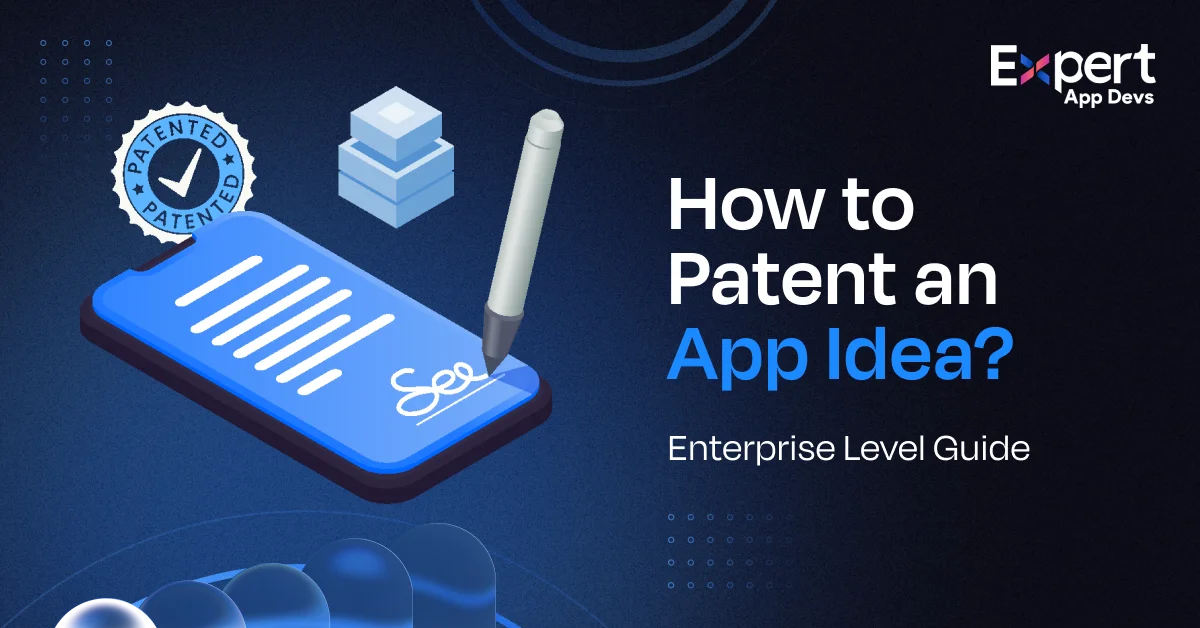
Your app idea is your crown jewel; guard it, or watch it on someone else’s head. If you have an amazing app idea in mind that can change the market, inspire millions, or solve a real-world problem, you must protect it. In the blog, you will learn about how to patent an app idea, the main patent types, the full patenting process, cost, useful statistics, and how to prepare legally and technically before filing.
Today, mobile apps are one of the most crowded and competitive markets. Thousands of apps are launched daily. Hence, protecting your app idea is not a luxury; it is an important necessity to protect your innovation. The patent app concept has existed since ancient Greece.
If you remember, in 2011, Apple claimed in court that Samsung had copied some of their features, like app grid layout, slide to unlock, tap-to-zoom and other features. After a long legal fight, Samsung ended up paying 1 billion dollars as a penalty to Apple Inc. This shows why patenting an app idea is important.
Finding a great idea takes so much effort and time in research. You must know your intellectual property rights and be aware of words like trademark, patent, patent law and mobile app copyright.
If you are a startup or a C-level leaders who have a billion-dollar app idea but doesn't know how to patent an app, then this article is for you. By the end of the article, you will know everything about how you can prevent your app idea from being stolen and launch the app successfully in the market legally.
To understand everything clearly, let's clear some basic terms first to get an idea about how to patent an app idea.
What is App Patent Protection?
App patent protection is a legal right or way to stop others from making, using, or selling your app without your permission. When you patent an app, you can protect the app code, its unique features, designs, functions and many other things to prevent competitors from using it. This is what makes you unique and keeps you competitive.
So, in simple words, it's a legal way to lock your app idea and get ownership of your app idea, so no one in the market can copy that or else you can take legal action against them if you find anyone copying your app concept and its components.
Are you new to patent terminology? Then here’s a quick glossary to help you understand the key terms we’ll use in this guide.
- Patent: It is a legal right to stop others from using your invention without permission.
- Utility Patent: It protects how your app works or functions.
- Design Patent: This is for protecting the visual app design or look of your app.
- Provisional Patent: It is a temporary patent, mainly for 12 months, to secure your filing date while you develop a complete app.
- IP (Intellectual Property): It refers to your invention, design, or brand names.
- NDA (Non-Disclosure Agreement): A legal contract that stops people from sharing your confidential information.
- Prior Art: Any existing product, publication, or technology that’s similar to your idea and could affect your patent approval.
- PCT (Patent Cooperation Treaty): It's an international agreement if you want to file your patents in multiple countries at once.
- Prioritized Examination: It's a quick service to get your patent reviewed quickly than the standard process.
Why Patent an App?
Did you know China, the United States, Japan, South Korea and India are top of the world for patents in 2025.
Patenting an app is an important business decision to prevent idea copying and legally preserve your app's credibility.
Here are the top reasons why you should patent your app.
- Builds Investor Confidence: Investors are more likely to invest in an app with a patent because it shows you own a unique idea and have legal protection against copycats.
- Gives You an Edge in Proposals (RFPs): The Majority of enterprises prefer working with vendors who have patented solutions because it is proof of originality and innovation.
- Strengthens Market Position: A patent app will help you stand out from competitors by offering unique features.
- Supports Expansion into New Regions: you can launch your app globally without worrying about your idea to copied.
- Enables Scalable, Recurring Business Models: Having an app patent offers many business opportunities like licensing deals, partnerships, and recurring revenue streams.
Can You Patent an App or Only the Idea?
Though you cannot patent only an idea, you need to turn it into real and concrete solutions to get it patented and approved legally. To understand more, let's understand what can be patented and what cannot.
You Can Patent
- Unique processes like backend, server connection, etc.
- Algorithms, data structures, and features.
- User interface and design aspects.
- Hardware integrations, custom API, etc.
- Special, novel technical functionality.
In short, anything technical or non-technical that is invented by you that is original and completely new in the market can be patented.
You Can Not Patent
- Abstract ideas
- Minor variation in the existing app
- Basic features like login, signup, notification, etc, which are common in all apps.
- Existing technologies, UI/UX elements.
- General algorithms and business models
In short, you cannot patent something that is common to all apps and already existing and openly accessible to everyone.
There are separate agencies for patents for every country. The USA has the USPTO (United States Patent and Trademark Office) to grant patents. Europe has the European Patent Office (EPO), and the Indian Patent Office (IPO) for India. While there is no suitable patent authority office for the Middle East & Africa (MEA), you need to file through each country’s patent office (e.g., UAE Ministry of Economy, Saudi Authority for Intellectual Property, etc).
They all follow these rules to approve a patent:
- Novelty: Your app must be new, not something that already exists or has been publicly shared.
- Non-obviousness: It should not be an obvious next step for someone skilled in the field.
- Utility: It must have a clear use or solve a real problem.
Lastly, you don't need to create a working app to get patented. A detailed description, technical flow, and working concept are enough to file. But it must show how it works, not just what it does.
Types of App Patents for C-Levels & Product Teams
Officially, there are two types of patents: a Provisional patent application and a non-provisional patent application.
#1. Provisional Patent Application (PPA)
A Provisional Patent Application is one of the common patenting options that most startups and businesses use. It is a temporary filing that helps to secure your “priority date” for a custom development without requiring a full, formal patent.
With PPA, you get temporary protection of 12 months. During this phase, you can test, refine, or develop your app before filing a non-provisional (full) patent.
✅Benefits of a Provisional Patent Application
- It has a lower starting cost than a full patent.
- Secures your invention date while you develop.
- You can pitch investors and start marketing at this phase.
- You get a time for market testing before paying to full patent fees.
- Less formal documentation is needed than a full filing.
✅Essential Things You’ll Need for a PPA
- Detailed description of your app’s unique features and functions
- Drawings or flow diagrams showing how it works
- List of claims (what parts you believe are unique)
- Inventor details and applicant information
- Filing fee (varies by country and entity size)
✅When to Go for a PPA?
- Your app is still in development, but you want to secure rights now.
- You need time to raise funds before a full patent filing.
- You want to see market response before investing.
- You need legal protection before revealing details.
- You want to lock in your priority date before competitors do.
#2. Non-Provisional Patent (Utility Patent)
You should file a non-provisional patent when you have a complete, ready application and you are ready to invest.
NPA is also known as a Utility Patent. It grants enforceable legal rights to your invention and protects how your app works, its features, code logic, processes and technical methods.
It has a time limit of 20 years from the filing date, as long as you keep paying the maintenance fees.
Other than this, a design patent is also a part of NPP; it protects how your app looks, its unique UI elements, icons, screen layouts, and visual styling, rather than its functionality.
It offers protection to all design and user interface elements up to 15 years from the date of grant (in the U.S., without maintenance fees).
✅Benefits of a Non-Provisional Patent
- Provides full legal protection for your invention
- Prevents others from making, using, or selling your patented features
- Covers technical functionality, not just appearance
- Strengthens company valuation for investors or acquisitions
- Can be enforced in court against infringement
✅Essential Things You’ll Need
- Complete technical description of the app’s processes and features
- Precise claims defining the scope of protection
- Technical diagrams or flowcharts showing operations
- Source code excerpts or algorithms (if applicable)
- Filing fee and legal drafting by a patent attorney (highly recommended)
✅When to Go for a Non-Provisional Patent
- Your app’s technical functionality is final or close to final
- You’ve already filed a Provisional Patent Application and are ready to convert
- You want long-term legal protection in key markets
- Your app’s innovation lies in unique technical processes
- You are ready to enforce or license your technology?
How to Patent an App Idea? Step-by-Step Guide
If you want to patent your app and make sure your concept stays only yours, then here are the steps on how to patent an app.
Step 1: Patent Search
Before you spend money on filing, make sure your app idea is actually new and original. A patent search checks if a similar idea already exists.
You can search databases like USPTO (USA), EPO (Europe), MEA(GCC) and India yourself, or hire a patent attorney for a deeper review.
As we discussed above, keep in mind what can't be patented to make sure you only spend money and time on what is possible to patent.
Step 2: Detailed Documentation
Prepare a detailed documentation of your app patent, including every small detail.
Include problem statement, functionalities that solve the problem, workflows, diagrams, how different parts of your app connect and technical architecture.
Include even small but unique features. The more specific you are, the stronger your protection will be.
Step 3: File a Provisional Patent
Once you know your app idea and functionalities in detail, decide between PPA and NPA, whichever suits your requirements and meets your business goals.
Usually, everybody goes for provisional patent filing because it is a great way to develop a mobile app, get a response from users, and affordably proceed the development.
File PPA at USPTO, EPO, MEA offices, whichever is relevant to you.
As you have 12 months of sufficient time, you can raise funds, test the market, and refine your app.
Step 4: Build an MVP/Prototype
Once you file a provisional patent, you will have 12 months.
Use this wisely to create an MVP to present as solid evidence for RFPs (Requests for Proposal), enterprise evaluations, or pitching to large clients.
You can show this working prototype to investors and enterprise partners how your app idea works to set a good base in the beginning.
Step 5: File a Utility Patent
As this includes protection for features, logic, and processes. You will need a well-prepared team:
- Legal to draft and file the patent.
- Tech experts to create proper app descriptions and technical details.
- Project managers to coordinate everything.
You’ll also need a Scope of Work (SOW) to clearly define what’s being protected. Filing may take months, but once approved, your rights are much stronger and last up to 20 years.
Step 6: Handle Patent Office Actions
Once you have submitted a patent filing, the patent examiner will read everything and get back to you if they need further clarifications, changes, or objections.
You’ll work with your legal team and, in some cases, change management consultants to update your documentation or make adjustments.
Your patent application must describe everything. Here are some important things.
- Oath/Declaration
- Title Abstract
- Background and Problem Statement
- Inventor and Ownership
- Supporting Evidence
- Entity Status Form
- Claims-Most Important
- Information Disclosure Statement
- Drawings and Diagrams
Costs, Budgets and Approval Timelines for Patenting an App Idea
The cost to patent an app depends on many factors, such as how complex your app is, the type of patent you choose, where you want protection and the fees for attorneys, patent searches, and patent offices.
Filing fees in the USPTO are usually around $65 to $325, and in case you need attorney help, it may add around $5,000 or more.
If you go for a non-provisional patent application, government fees (filing, search, and examination) plus legal help can range from $6,000 up to $15,000 or more.
If you go for international filings, it can cost $8,000+, and filing via EPO may exceed €10,000, depending on design and translation.
Also, there are many things to consider while budgeting.
You may need a consultant or patent lawyers, so expect hourly rates or some flat fees.
And if you are planning to develop your product over several years in multiple regions, then make sure you commit to ongoing support.
Common Pitfalls: How C-levels Safeguard IP and Value?
You need to follow the right patent process at the correct time. Otherwise, it may cause a huge business loss. Keep these common pitfalls in mind to prevent patent mistakes.
- Don't file your idea too early. Do enough research and document every point, then file.
- Don't talk about your idea publicly or with partners before filing. Always secure protections (like NDAs or provisional filings) before revealing your details.
- Understand that patent approval will take time, so plan your app development cycle accordingly.
- Never try to save on legal fees or on hiring an experienced patent lawyer.
- Keep your compliance and technical teams involved.
- Use a retainer or managed service to always have an expert support on hand whenever needed.
App Patenting Comparison: U.S. vs. EU vs. India vs. MEA
|
Factor |
United States (U.S.) |
European Union (EU) |
India |
MEA |
|
Patent Process |
Centralized under USPTO, with clear provisional and utility filing steps |
Central filing via European Patent Office; EU’s Unified Patent Court streamlines cross-border enforcement. |
Requires hardware or technical implementation proof for software-related patents; filing through the Indian Patent Office. |
Country-specific patent offices, often tied to tender or government approval processes |
|
Cost Range |
Filing fees: $65 to $325 (USPTO) for provisional. |
Mid-to-high: €6,000 to €12,000 for filing; translation and country validation costs add up. |
Lower. Govt fees start from ₹1,600 for startups. ₹8,000 for large entities. While professional fees can add to ₹10,000 to ₹35,000 |
$8,000 to $18,000depends on country and legal support. |
|
Local Vendor Collaboration |
may work directly with U.S.-based patent attorneys. |
Local agents help with translations, local rules, and validations in each EU state. |
Local patent agents go through specific procedural and documentation needs. |
Depends on local legal partners and regional IP consultants for filings. |
|
Enforcement Strength |
Robust legal system and precedent for IP protection. |
Unified Patent Court improves cross-border enforcement, but is still adapting. |
Focuses on improving, but can be slower. |
strong in Gulf countries(GCC nation), less consistent in parts of Africa |
|
Unique Requirements / Protocols |
No mandatory hardware proof for software patents. |
Unified Patent Court (UPC) for multiple national lawsuits. |
Hardware/technical proof required for software patents; focus on practical implementation. |
They follow strong WIPO-aligned procedures; timelines may be tied to government project approvals. May require Arabic translation. |
Pre-Patent Checklist: Legal, Technical, and Leadership Readiness
So, if you have finally decided to patent an app, then go through this checklist.
- Make sure your idea is original, unique, and no one else has patented it.
- Explain clearly how your invention works and what makes it unique from others.
- Sign an NDA (Non-Disclosure Agreement) with the concerned people before sharing.
- Have a working model to show your app idea is gonna work and function.
- Your invention should meet local and international requirements.
- Know your market and research who will buy it and why.
- Always take advice from a patent attorney or consultant and get everything reviewed before you file.
Expert Insights & Attorney Advice
Expert Advice 1
The advice that I would give to founders or CTOs is to examine what the company has prior to filing. Patent applications are ruthless in cases where a previous disclosure or informal agreement is brought into the limelight. I also observed businessmen lose millions of dollars within days of an investor presentation or a website launch being weeks away from the application. In my case, I ought to make sure that I do not go public before I am sure that the date of filing is permanent.
Furthermore, the definite definition of the inventorship is also stressed by me. Vague ownership claims are the typical source of trouble with estate work. Patents also are of the kind. Improper listing of contributors may disqualify a filing or raise legal problems that cast a cloud on the introduction of a product. With that, make sure that claims are commercial. A patent with broad claims but not the actual revenue maker is no good, as it cannot be used as an estate plan that makes no reference to the most valuable asset of the family.
Oliver Morrisey, Estate Lawyer | Owner & Director, Empower Wills and Estate Lawyers
Expert Advice 2
The biggest misconception about app patents is that they are the best form of intellectual property protection for software innovations. Initially I felt a lot of pressure to secure a patent to satisfy questions from potential investors. Instead, I found that many investors were satisfied when we explained that "we protect our IP through copyright and trade secret laws" without requiring formal patents.
Patents certainly have their place in a comprehensive IP strategy, but founders should carefully consider whether the time, cost, and public disclosure required for patent filing aligns with their business objectives. Especially when factoring in the stage of a startup, since patents can be costly and time consuming for an early stage startup that may pivot or change.
For many software companies, a strategic combination of trade secrets, copyrights, and selective patenting often provides more practical protection than pursuing patents for every innovation.
Brett Farmiloe, CEO, Featured
Expert Advice 3
The biggest misconception about app patents is believing they give you the right to use your invention freely. A patent only grants you the right to prevent others from making, using, or selling your invention; it doesn't give you "freedom to operate." A prime example is the Apple vs. Samsung patent disputes, where both companies, despite having their own patents, accused the other of infringement on various smartphone features.
Before filing a patent, a founder or CTO should conduct a thorough patent search to confirm the app is new. It is crucial to document every technical detail, as a vague application is a common reason for rejection.
Most software patents are rejected or delayed because they are considered too abstract. A strong application must present a specific, non-obvious technical solution rather than just a business idea. The famous Amazon "one-click" patent is a good example of an application that was both innovative and specific enough to be granted, even though it was highly controversial and often challenged as a business method.
A strong app patent application clearly defines the invention's unique technical solution and how it improves upon existing technology. It includes detailed descriptions of the underlying processes and algorithms, proving the invention is a concrete, functional system. Companies like Snap Inc. (Snapchat) have built significant portfolios by patenting specific, novel features like their "Live Stories" content curation technology, protecting their competitive edge.
Curtis Smith, CEO, mBurse
Patenting an App Idea: Frequently Asked Questions
#1. How do you patent an app idea?
Start by checking if your idea is unique and not already patented. Then, prepare detailed documents explaining how your app works and what makes it special. File these with the patent office in your country, usually with help from a patent attorney. The office will review, ask questions, and decide whether to grant you a patent.
#2. What does it cost to patent an app?
The cost to patent an app can fluctuate depending on the region and complexity. You can expect charges for filing, examination, and legal help. You will also need to consider attorney fees and extra budget if there are revisions or if international filings are needed.
#3. Can a startup patent without a working app/prototype?
Yes, you can patent because, according to the US patent system, the authorities mostly focus on innovation with a clear explanation of the concept, features, and technical process in detail. Make sure you have strong documentation and a diagram to get your patent filing approved.
#4. Timeline for approval, can you speed it up for a go-live launch this quarter?
The timeline to get patent approval depends on the country or region. Usually, you can expect 1 to 3 years of time duration for approval. If your launch is soon, you can request to speed up the review for urgent business needs. This may shorten the process to a few months, but be ready to pay an extra cost.
#5. Should you use copyright or patent, or both?
It depends on what kind of invention it is. Copyright protects your app’s code, design, and content, while a patent protects the unique idea, process, or method behind the app. If you only use copyright, others can still copy your idea by writing different code. If you only use a patent, your design or code may be unprotected. Hence, it would be best to use both for stronger protection.
#6. Is an international patent necessary for multi-region rollout?
There’s no single “global patent.” You need to file in each target country or use systems like the Patent Cooperation Treaty (PCT) to cover multiple regions.
Conclusion
Hope by reading the above blog, you now know how to patent an app.
Anyone can patent their app, not an idea, but you must fulfill the patent filing criteria and have strong proof of a prototype and explanation to get easy patent approval.
Today's app market is highly competitive and growing as every small and big business is making an app. It's tough to think about a new and original app idea that doesn't exist in the market.
You need to study detailed problem statements of various industries to find a great app idea.
Keep the above steps, common mistakes, and important patent terminology in mind, and take patent expert help wherever needed.
Why Choose Expert App Devs?
Expert App Devs have been serving clients globally across the USA, UK, Canada, Germany, UAE, KSA, and many more regions.
For 14 years, we have helped thousands of clients successfully launch their app idea with an NDA and patent protection.
We have a team of experienced consultants, business analysts, developers, designers and marketers who can help you with great marketing strategies and guide you to get started with your app idea.
Being a leading mobile app development company, we have already delivered over 2500 apps and are counting.
If you have any questions about app development, converting your idea into an app or patent-related doubts, simply fill out our contact form, and our sales representative or consultant will reach out for a free consultation according to your budget and timeline.




 224
224

 0
0


 231
0
231
0
 434
14
434
14
 182
0
182
0