



- TL;DR
- What Does “Millions of Users” Actually Mean for Backend Architecture?
- What Skills Do Backend Developers Need to Handle Millions of Users?
- Red Flags When Hiring Backend Developers
- How to Assess Backend Developers for Scalability (Practical Framework)
- How Enterprises Test Scalability Thinking (Interview Tasks)
- Dedicated Backend Team vs Individual Hiring
- Latest Backend Stack
- Evaluating a Backend Team (Not Just Individuals)
- What Is the Cost of Hiring the Wrong Backend Team?
- Build vs Hire vs Partner – Making the Right Scaling Decision
- Latest Backend Trends You Can’t Ignore
- How Expert App Devs Designs Backends That Scale to Millions
- When Should You Reassess or Upgrade Your Backend Team?
- Backend Hiring Checklist (Quick Self-Assessment)
- Conclusion
- FAQs for Backend Hiring, Scalability & Dedicated Teams
Ready to transform your vision into reality?
Get Started
Hire Backend Developers for Systems That Scale to Millions of Users

 288
288
 1
02 Mar 2026
43 Min Read
1
02 Mar 2026
43 Min Read


 Share
Share

 Download PDF
According to Amazon Web Services architecture reviews, most performance failures stem from database bottlenecks and poor horizontal scaling, not server capacity.
Everything runs smoothly when you have 5,000 users using the application. However, at 50,000 users the response time increases and when the user base reaches 500,000, your system starts falling apart under pressure. At 5 million they fail completely.
The failure isn’t caused by increasing traffic; it is because of the architecture. Developers may be well-versed at entry-level skills like CRUD and API integrations as compared to designing distributed systems, database scaling and fault tolerance.
These features together make the product usable and create a sustainable architecture. As a founder or CTO who expects rapid growth, backend hiring shouldn’t be about filling up a developer role; it should be about protecting revenue, building user trust and scaling the systems. To achieve growth goals, you must ensure backend engineering is built for millions from day one.
In this article, we will discuss the way to hire backend developers that can handle millions of users.
TL;DR
- Prevent outages and revenue loss by building architectures that reliably support millions of concurrent users
- Faster response times and lower costs through caching, sharding, horizontal scaling and observability
- Hire backend developers with system design, distributed systems and production incident experience
- Avoid framework-only coders, monolithic designs and zero exposure to real traffic
- Use a dedicated backend team, structured interviews and load testing from day one
What Does “Millions of Users” Actually Mean for Backend Architecture?
Millions of users isn’t just another vanity metric; this is the metric that transform everything along the backend.
To understand the term millions of users, you must know the difference between concurrency, throughput and latency. Concurrency means when multiple users are active at the same time while throughput is the number requests sent to the system every second. Latency is how fast your system can respond to these requests. When you scale your system, all three elements matter.
Next, you need to think through the workload type. Determine if your system is read-heavy or write-heavy as each demands distinct database and caching strategies.
At the same time, when your users multiply, the data compounds. Millions of users signify exploding logs, transaction messages and media files. When you combine this with their real-time expectations, you will notice how it raises the bar.
This means Fintech apps cannot delay transactions and food delivery platforms may face spikes during lunch or dinner. Millions of users across time zones may mean a backend that performs everywhere. Eventually, scale isn’t traffic; it is also about managing these complexities.
What Skills Do Backend Developers Need to Handle Millions of Users?
Scaling your application to a million users isn’t about writing more code; it is about creating smarter systems. You need a team with backend skills that go beyond basic development understanding.
Introduction to Backend Developer
Backend developers are basically engineers who build and manage server-side logic that powers software applications. These developers manage everything from APIs, authentication, databases and business logic to infrastructure that users don’t get to see but, rely upon.
A backend developer enables smooth and efficient data flow between servers and users. For instance, when someone places a food order on a food-delivery application or transfers money using fintech app, it is the backend system that processes the request, validates data and returns response immediately.
At scale, the role of a backend developer expands beyond functionality to build systems that are fast and resilient even when traffic increases.
Must-Have Scalability Skills (Non-Negotiable)
When you are hiring a team while scaling, resumes and frameworks aren’t as important as architectural depth. Here are some of the non-negotiable backend competencies that separate feature builders from system engineers.
- System Design Thinking: Your developer must think beyond individual features and design; they must understand how services interact, scale, fail and recover. This would help them plan for redundancy, load balancing and future growth instead of just fixing issues later.
- Distributed Architecture: Backend developers you are hiring must understand service communication, consistency trade-offs and microservices. So, instead of designing one large monolith, they can design systems that distribute workload intelligently and survive failures
- Caching (Redis/Memcached): Databases alone cannot handle sale. With smart caching techniques, they can reduce latency, offload traffic and prevent bottlenecks especially at scale in read-heavy applications.
- Database Scaling: Development teams should understand indexing, partitioning, replication and sharding. As data grows to millions, the developers ensure performance is predictable and increasing queries don’t cripple the backend system.
- Message Queues: Using tools like Kafka and RabbitMQ, they decouple services and manage asynchronous workloads. This ensures spikes and background tasks don’t slow down user-centric operations.
- Observability: The backend developer should build systems complete with monitoring, logging and tracing from day-one. This would help the team detect issues early.
- Security-first Mindset: Backend developers should design systems using encryption, access-control and secure APIs to protect user data and business credibility as traffic increases.
Architecture Knowledge That Separates Coders from Engineers
Your backend success depends on the architectural decisions your team makes in the early stages. With the right architecture, you can prevent downtime, bottlenecks and excruciating rewrites that slow progress while accelerating growth.
- Microservices: By breaking applications into independent services, your teams can deploy, scale and maintain components separately. This will reduce system-wide risk, ensuring one failing service doesn’t impact the other systems.
- Event-driven Systems: Instead of using tight coupling, the services communicate via events. This helps enhance scalability and responsiveness, especially with high-activity systems.
- API gateways: With an API gateway, developers can authenticate, route and monitor the systems. It also simplifies client interactions, enhances security control and manages traffic efficiently.
- Rate Limiting: Understanding this component can help you protect systems from overload or abuse by controlling the request volumes. It also prevents the system from malicious attacks to ensure fair usage even during spikes.
- Horizontal Scaling: Instead of upgrading a single powerful server, you can use horizontal scaling to add more machines. This distributes load effectively to ensure high availability even during unpredictable traffic growth.
- Cloud-native Infra: This infrastructure can leverage containers, managed services and even orchestration tools. With this architecture, you can automate scaling, build resilience and enable faster deployments without infrastructure management.
Which Backend Skills Are Overrated at Scale?
Not all impressive skills can translate into functionality at scale. Some capabilities are strong on paper; however, it can fall apart from there is an actual traffic spike.
- Only knowing frameworks: While being comfortable with Django, Spring Boot and Nodejs is useful, these frameworks don’t help build architecture. That’s why if someone knows how to use these tools without understanding system fundamentals, these frameworks would expose gaps at scale.
- Only CRUD APIs: Building a create-read-update-delete endpoint is entry-level backend skill. At scale, complexity comes from consistency, caching, concurrency and distributed endpoints, not just database operations.
- Only ORM Expertise: Knowing how to use an ORM efficiently isn’t just about understanding database performance. Your team should also interpret the indexing strategies, query optimization and data partitioning as the traffic grows exponentially.
- Copying Tutorials: By following tutorials, you can build familiarity. However, scaling systems need an understanding of problem-solving in the midst of uncertainty along with debugging skills.
Red Flags When Hiring Backend Developers
When you are hire backend developers for scale, don’t scan through tech stacks. You must understand how candidates think, explain their decisions and respond to failures to determine red flags. With wrong hiring, you will slow down the growth of the product.
Warning Signs
If the developer struggles to explain their design choices, it signifies a major red flag. Backend engineers who are working at scale should be able to discuss aspects like load balancing, database strategies and even failure handling confidently.
Zero exposure to real production traffic is also a red flag. It is important for you to know that building a solution is different from managing live systems with multiple users. You should also be cautious about their response to outages and incident responses.
You should choose developers who are experienced at scaling the application despite failures. If they don’t have a working understanding of caching signals, it can indicate performance blind spots.
If the developer has a monolithic mindset, it can limit the flexibility at scale. Additionally, if they rely on libraries heavily without knowing the trade-offs, you would be hiring coder and not an architect.
How to Assess Backend Developers for Scalability (Practical Framework)
When hiring for scalability, you need structure. You are not testing their syntax ability; you need to test architectural thinking especially under stress. Here is a practical framework you should use instantly.
Step 1 – System Design Interviews
Ask them to build a complex solution like the Uber backend. Check for service separation, real-time tracking, surge handling and database choices in the solution. Depth of the solution is more important than diagrams.
Step 2 – Performance Scenarios
Start considering scale hypotheticals. For instance, ask them how you would manage 1 Mn concurrent users. A strong candidate would talk about horizontal scaling, load balancer and even caching layers; they wouldn’t restrict their conversations to bigger servers.
Step 3 – Database Scaling Problems
Talk about growth challenges as well. Ask them what they would do when the database starts slowing at 200Mn records. Evaluate if they begin talking about indexing, replication, sharding and partitioning strategies.
Step 4 – Tradeoff Discussions
Scalability discussions should also comprise trade-offs that might occur. You should carry discussions on consistency vs availability, monolith vs microservices, SQL vs NoSQL. Only mature backend engineers would be able to explain the reasons in detail.
Step 5 – Past Production Experience
Ask them to share real incidents. Ask them if they have handled outages, traffic spikes and performance failures. You should check their experience under pressure to reveal practical judgment.
Backend Scalability Interview Checklist
- Can they explain scaling issues properly?
- Are they able to anticipate failure points?
- Will they prioritize reliability?
- Have they solved real production issues in the past?
This checklist can help separate backend coders from architects.
How Enterprises Test Scalability Thinking (Interview Tasks)
Strong backend engineers think system-first instead of features. You should interview the candidates to assess this mindset. Instead of asking them to share the code, test their architectural depth.
Ask the candidate to design an Uber-like real-time system or to create an outline for a 1Mn user scaling strategy. You can even ask them to explain the caching layers ideally used. interview them regarding database failover plans, traffic spike management and event-driven architecture. The idea is to check how they connect the components, anticipate the bottlenecks and plan for failures.
If your candidate jumps straight to writing code instead of designing the architecture or trade-offs, it signals a red flag.
Dedicated Backend Team vs Individual Hiring
In case of high-scale systems, the backend team will outperform a solo hire. Scaling to million is about building a shared ownership, thinking redundancy and architectural discipline.
Let’s take a look at how it works when you hire an individual vs a dedicated backend team.
|
Factor |
Individual Hire |
Dedicated Backend Team |
|
Ramp-up Time |
Slower learning curve |
Faster collective onboarding |
|
Delivery Risk |
High dependency on a single person |
Distributed responsibility |
|
Knowledge Continuity |
Leaves with the employee |
Institutional memory |
|
Architectural Consistency |
Varies due to individual decisions |
Standardized review approach |
|
Scalability Potential |
Limited by a single perspective |
Designed collaboratively for scale |
An individual can build the features but a team builds systems. With peer reviews, shared documentation and DevOps alignment, you will notice reduced risks. At scale, reliability is a result of structured collaboration and collective accountability.
Latest Backend Stack
Backend stack is fast-evolving and scalability expectations are continuously rising. Moern systems are no longer built as single deployable units; these systems rely on microservices to isolate the functionality and offer independent scaling.
Serverless architecture can reduce infrastructure overhead and enable automatic scaling during unpredictable traffic spikes. Event-driven systems are standard for managing asynchronous workflows and notifications.
Distributed caching layers enhance performance while AI-backed observability tools can detect anomalies before outages occur. Auto-scaling infrastructure can also reallocate the resources dynamically without manual intervention.
Edge computing is being used to reduce latency for global users and real-time streaming can improve fintech transactions.
Backend hiring should reflect this shift in technology stack. Your developers should understand CRUD operations as well as modern distributed ecosystems that evolve with technology.
Evaluating a Backend Team (Not Just Individuals)
As a CTO who is planning for serious growth, you must evaluate the backend team with broader lens. A strong developer can build features into the solutions; however, you need mature teams with aligned processes to create scalable systems. Architectural strength is built on collaboration.
Here is what to assess when building your strong backend team.
- DevOps Maturity: Check if they automate deployments, manage infrastructure-as-a-code and handle rollbacks effectively. A mature DevOps can reduce downtime and deployment risk.
- CI/CD Pipelines: Evaluate if builds, tests and releases are automated. With frequent and stable releases, you can gain engineering discipline.
- Monitoring and Observability: Know if they proactively track performance, logs and metrics. It is equally important to note if they react only after receiving user complaints.
- Security Practices: It is crucial to note if encryption is standard and access controls are enforced. Make sure they follow secure coding and compliance guidelines.
- Testing Culture: Make note if they invest in unit, integration and load testing. Scaling without testing can feel like a risk.
- Documentation Standards: Is architecture documented properly? Knowledge continuity is important when teams grow.
- Reliability comes from system thinking and shared accountability, especially at scale.
What Is the Cost of Hiring the Wrong Backend Team?
You will not notice the actual cost of a weak backend team on the payroll; it becomes noticeable during damage control. Due to poor architectural decisions, you might face outages during peak traffic, unexpected downtime and even expensive re-architecture projects during growth phase.
When you app begins to slow down during growth phase, you will begin noticing customer churn. It might also lead to security breaches that destroy trust. In worst case scenario, companies need to rebuild their backends that can result in exponential incrase of their development budget.
|
Approach |
Year 1 Investment |
Scalability Risk |
|
In-house |
High as you need to pay for recruitment, salaries and tooling |
Medium |
|
Freelancers |
Medium, upfront budget |
Very high |
|
Dedicated Backend Team |
Optimized and predictable |
Low |
In-house teams need extra time and cost investment. Freelancers reduce short-term costs while increasing long-term risks. At the same time, dedicated backend team blends expertise with shared accountability and scalability discipline.
Backend mistakes aren’t technical issues, they become business liabilities when millions of users depend on your system.
Build vs Hire vs Partner – Making the Right Scaling Decision
When scaling your business with the right technology stack, you aren’t just hiring to fill the roles. You need a structure that is fit for the growth, speed and stability needs posed by your business. That’s why when planning the right structure from build, hire and partner, you must consider factors like cost, control and flexibility.
Build in-house
One of the ways to get started with scaling is by building an in-house team. This structure gives you maximum control as the developer are fully aligned with your company’s vision, culture and processes. Moreover, communication is direct and collaboration occurs seamlessly.
However, this approach can be slow and expensive. The recruitment cycles, salaries and even benefits cost can add up quickly. It will reduce flexibility in case workload fluctuates. Scaling the resources is complex and financially demanding.
Hiring Freelancers
Freelancers are great when you are planning short-term tasks with clear scopes. You can hire them quickly, pay for the particular task and avoid long-term recruitments. This model is best when you need a specialized skill for limited timeline.
The flip side to the model is inconsistency and varied availability. The long-term accountability is also limited as freelancers tend to manage multiple projects. You would face fragmentation and communication gaps in case of large and evolving projects.
Dedicated Partner
This approach brings forth a balanced and scalable approach. You can access ready teams with proven processes while avoiding lengthy recruitment cycles and enabling faster onboarding.
The dedicated hiring partner will offer structured project management with technical oversight and quality standards backed by an organization. It will increase reliability while reducing execution risks.
You can even benefit from the low operational costs and the flexibility to scale your resources as needed.
Latest Backend Trends You Can’t Ignore
Backend architecture is advancing and the scalability expectations are equally high. If you want to hire developers for long-term growth, you should take into consideration these trends. They will help you plan for the right skills.
#1. AI-assisted APIs
APIs are smarter, offering in-built AI capabilities for personalization, fraud detection and recommendations. Your backend system can integrate AI models into request flows that need optimized response times, intelligent resource allocation and scalable inference management.
#2. Real-time Event Streaming
Most modern applications need a continuous flow of data instead of batch processing. Streaming platforms relying on instant notifications, financial updates and activity feeds require resilient pipelines with fault-tolerant distributed systems.
#3. Edge computing
Global users are continuously seek near-zero latency. That’s why edge computing processes data closer to the users instead of the centralized server. Backend systems can distribute workload geographically while managing synchronization and security across regions as a result.
#4. Serverless Backends
Serverless architecture can automate scaling without the need to manage infrastructure manually. This is ideal trend for systems with unpredictable workload. However, it needs strong architectural planning and controlled cold starts as well as service coordination for better outcomes.
#5. ML Pipelines
Machine learning is moving to the production stages. Several backend engineers have started designing data pipelines that can manage model training, its validation, deployment and even real-time inference when needed at scale.
#6. IoT-scale Ingestion
Data streams are sent from multiple devices continuously. That’s why you need backend systems that can manage this massive ingestion, real-time processing and reliable storage without compromising the app’s performance.
#7. AR/VR Real-time Systems
Immersive applications require synchronized multi-user environments along with ultra-low latency. You should invest in backend infrastructure that can support high concurrency and real-time state updates.
How Expert App Devs Designs Backends That Scale to Millions
Scaling shouldn’t be an afterthought. It should be part of your design principle from day one. That’s why at Expert App Devs, we build backend systems prioritizing long-term growth along with MVP speed.
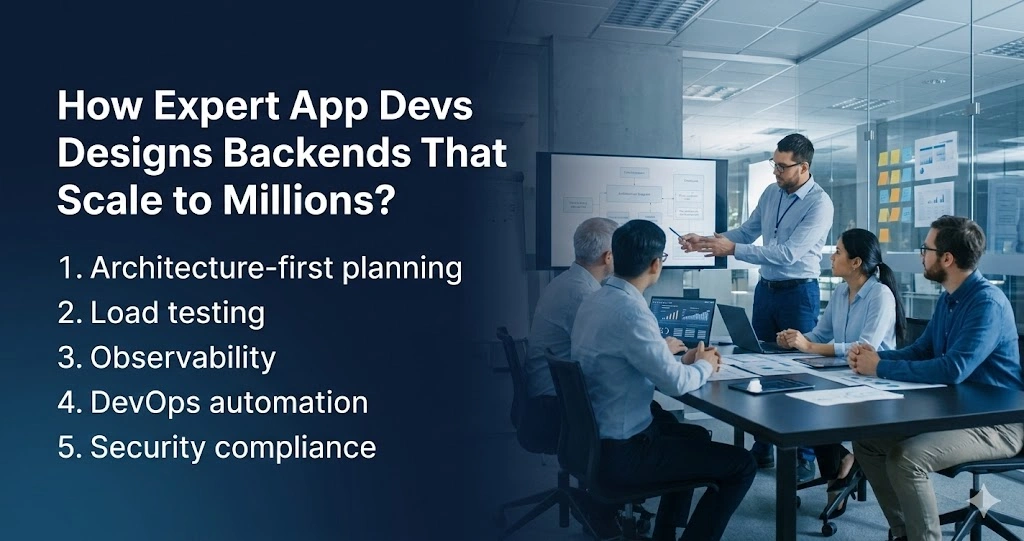
- With architecture-first planning, we define the system boundaries, data flow, failure recovery strategies and scaling paths from the start. This establishes a strong foundation to support thousands to millions of users
- Our team conducts load testing by simulating real-world traffic spikes in the early stages to determine bottlenecks before the production stage. This maintains performance at the core of the development.
- We focus on horizontal scaling, cloud-native environments and distributed systems to build a scalable infrastructure that adapts to the usage
- To maintain complete observability, we implement monitoring, real-time alerts and logging. This helps us identify issues proactively instead of working on customer complaints.
- Deployments are streamlined with CI/CD pipelines, infrastructure-as-a-code and safe rollback mechanisms through DevOps automation.
- Lastly, we build security and compliance into the architecture to ensure encryption, access control and regulatory standards.
As a result of these processes, we are able to design backend systems that grow confidently and reliably.
When Should You Reassess or Upgrade Your Backend Team?
Backend issues don’t explode overnight. You will receive small warning signs till it explodes and magnifies itself. That’s why it is important to know when to reassess your backend team to save from expensive rebuilds later.
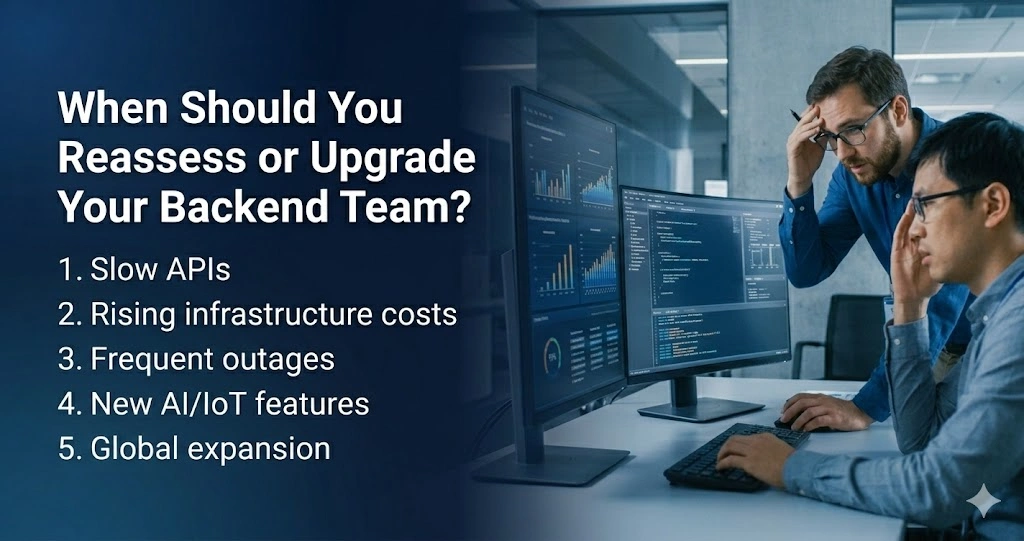
- If you are noticing slower APIs as you add features, this signals performance degradation resulting from architectural strains and optimization gaps.
- Poor scaling strategies might result in wasted infrastructure resources, leading to higher server costs as your user base grows
- Frequent outages or emergency fixes may be considered as a red flag as stable systems don’t need continuous firefighting.
- You will need new architectural layers and scalability planning if you aim to introduce AI-backed features or IoT device integrations
- Lastly, if you are expanding globally, you must consider multi-region deployment, latency optimization and data compliance.
Reassessing your backend is all about ensuring the current architecture matches your long-term vision. When growth accelerates, you should make sure the backend capabilities also evolve.
Backend Hiring Checklist (Quick Self-Assessment)
Before you proceed with the backend hiring, you should run a quick evaluation on your own. It is crucial to note that scaling is all about proven capability by the developer. That’s why it is important to tick off this checklist before finalizing.
- Has the team handled systems that serve 100k+ users in production stage?
- Can they explain their system design decisions for the high-scale apps?
- Do they have hands-on experience with caching using tools like Redis to reduce the strain on database?
- Are they comfortable building cloud-native architecture using horizontal scaling?
- Have they setup monitoring or logging systems to detect issues?
- Do they use strong security practices like encryption or access control?
- Have they conducted load testing prior to this project?
If you haven’t ticked off these boxes on the list, you may not be hiring developers for scalability; this team can build the backend functionality.
Conclusion
Scaling isn’t just about hiring developers, but also about building a stable architecture. You cannot solve million user issues by hiring more developers who can write code. You need engineers who can think in terms of systems, anticipate the issues and design for resilience from the start.
It is crucial to validate scalability from the start. Conduct stress-test assumptions, evaluate the architectural trade-offs and prepare your infrastructure for growth before it starts. Backend hiring should prioritize system-first thinking over superficial and framework-level expertise.
If your vision involves 10x growth, you should have a solid backend that supports it. That’s where the right technology partner can make a different. Connect with our business development specialist team at ExpertAppDevs to build scalable backends that are designed for performance, reliability and long-term vision.
FAQs for Backend Hiring, Scalability & Dedicated Teams
#1. How Much Does It Cost To Hire Backend Developers For A Scalable System?
The ballpark cost to hire dedicated backend development teams from India is
|
Type |
Monthly Cost (approx.) |
|
Mid-level developer |
$2,000 to $3,500 |
|
Senior developer |
$3,500 to $6,000 |
|
Architect or Tech lead |
$5,000 to $6,000 |
|
Full team |
$12,000 to $25,000+ |
The actual cost depends on the developer’s experience and chosen engagement model.
#2. How Long Does It Take To Scale A Backend To Support Millions Of Users?
It takes about 4-6 months to build a scalable backend. Architecture planning takes 2-4 weeks, MVP development 8-12 weeks and scaling optimization about 6-12 weeks. You need another 4-6 weeks to complete load testing and hardening.
#3. Which Is Better Between Dedicated Backend Team Vs In-House Hiring?
In-house hiring offers better control but, it is expensive and slow to scale. Freelancers are cheaper but their availability and accountability can pose risks. Dedicated teams offer faster ramp-up combined with predictable costs and proven processes.
#4. When Should We Refactor Or Rebuild Our Backend?
If API latency exceeds 500ms consistently or you experience frequent outages and increased monthly server costs, you can start considering rebuilding or refactoring the backend. Other factors include inability to add new features, monolithic architecture that block releases and instability on scaling beyond 50k users.
#5. What Backend Architecture Best Works For AI Or ML Powered Apps?
AI-ML powered apps require event-driven architecture, scalable data pipelines, async queues, real-time processing and GPU/cloud integration. The traditional monolithic backends cannot support.
#6. How Is Backend Development Different For Iot Apps?
IoT backends must be able to handle millions of device connections along with continuous data streaming, edge processing, real-time ingestion and message brokers like Kafka. All this requires high concurrency and fault tolerance that cannot be managed by standard APIs.
#7. How Many Backend Developers Do We Need For 1mn Users?
To enable a typical scalable setup, you need one architect or tech lead, two-three senior backend engineers, a DevOps engineer and a QA specialist. It takes a team of about 4-6 specialists to support your architecture, deployment and performance.
#8. What Are The Top Backend Development Trends?
The key backend development trends include serverless architecture, event streaming, microservices, real-time analytics, API-first ecosystems and edge computing. All these demands distributed systems expertise that go beyond traditional REST APIs.
#9. What Do Top Agencies And Enterprises Look For When Hiring Dedicated Backend Teams?
The top agencies look for system design expertise, understanding of distributed architecture and cloud-native deployment along with DevOps automation, CI/CD maturity and testing discipline while hiring dedicated backend teams.
#10. What Should We Include In Backend Technical Tasks And Interviews?
You should use real-world tasks like design a backend for 1 Mn users, optimize slow queries, implement caching strategy, build rate-limited API, discuss database sharding or explain failure recovery plan as part of backend technical tasks or interviews.
#11. When Should We Hire A Dedicated Backend Partner Instead Of Scaling The Solution Internally?
You should opt for a dedicated partner when time-to-market is critical, local hiring is slow and you need to scale your app to millions at the earliest. If you don’t have experienced system architects internally, you should go with dedicated hiring.
#12. Can One Partner Handle Both Mobile Apps And Scalable Backend Systems?
Yes. A single partner can help you manage integration issues, accelerate releases and even offer architectural consistency while lowering coordination costs between mobile and backend development.




 214
214

 0
0


 339
0
339
0
 241
0
241
0
 328
0
328
0