


Ready to transform your vision into reality?
Get Started
How to Validate a Mobile App Startup Idea Without Spending Money?
 218
218
 0
06 Jan 2026
28 Min Read
0
06 Jan 2026
28 Min Read


 Share
Share

 Download PDF
Why Most Mobile App Ideas Fail Before Launch?
Every successful app running today was once just an idea that needed validation and the right implementation. Getting a mobile app idea is easy, but it's exciting and risky at the same time. About 34% of startups fail because they build a product that people don’t really need or want. There are a lot of mistakes startup founders do jumping straight into development, assuming users will come later. In reality, this “build first, validate later” approach often leads to wasted time, money, and energy.
I have seen a lot of discussion going on in discussion forums like Quora and Reddit for topics validating mobile app ideas. Founders often ask if my mobile app idea is good. Do users really need it? Am I solving a real problem, and will people actually download and use the app?
In this article, we discuss the practical ways to test demand, gather real user feedback, and make smarter decisions to help you validate an app idea without money.
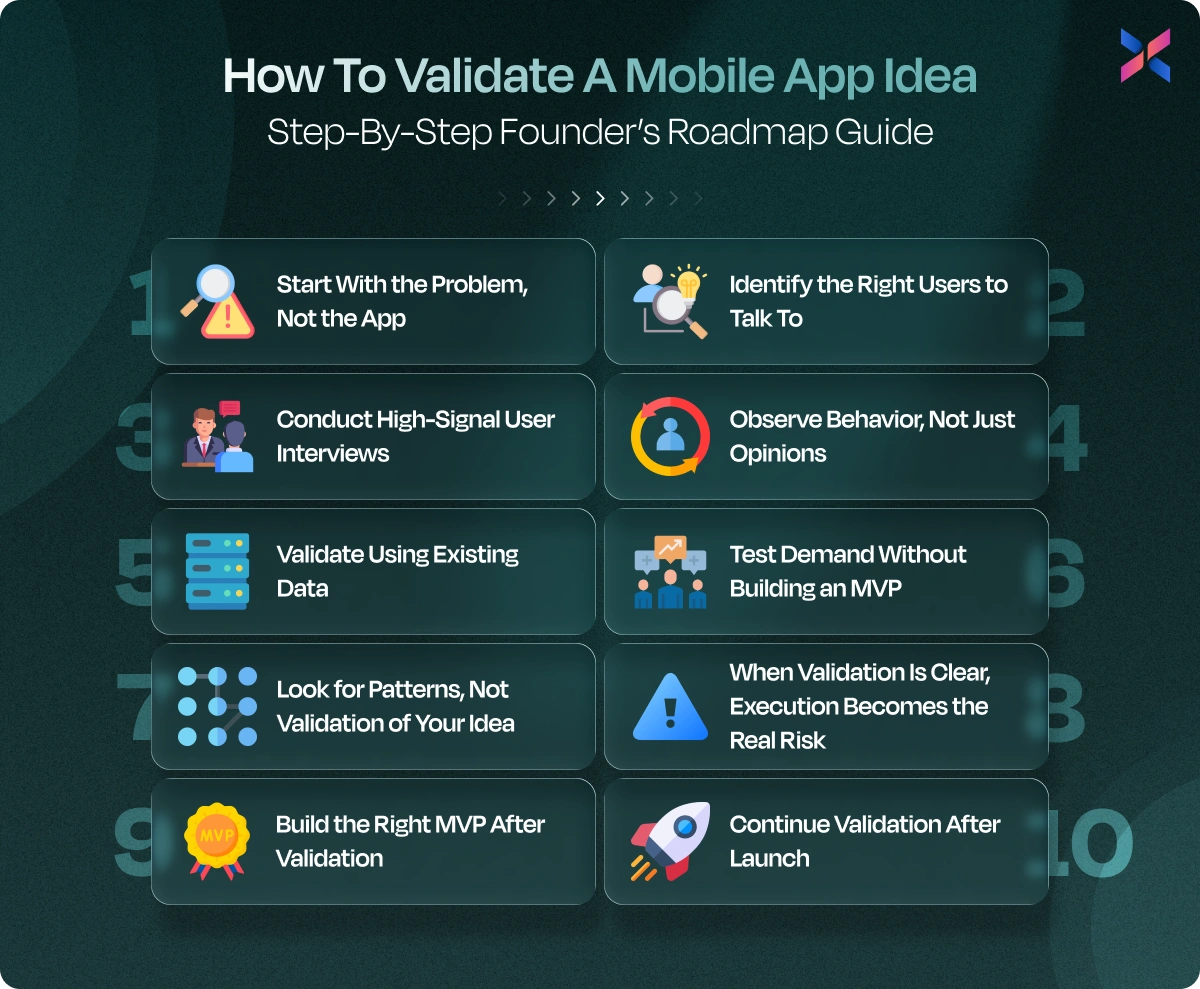
How To Validate A Mobile App Idea: Step-By-Step Founder’s Roadmap Guide
Mobile app idea validation doesn’t require a big budget, but it requires the right process before starting mobile app development. By following the 10 steps below, startup founders can validate a mobile app idea, understand real user needs, and identify potential risks before investing time and money in building the app.
Step 1: Start With the Problem, Not the App
Research about the problem is the very first and important phase of the startup app validation process. The app idea must solve real problems rather than going with trends, features, look, and other things. Focus on identifying the pain points that need frequent solutions, are urgent, and unresolved.
Spend enough time on research, such as reading discussion forums like Reddit, Discord and Quora where people are discussing the real problems. Look for repeated complaints, workarounds, and frustrations. Read App Store and Google Play Store reviews of similar apps to know gaps in that type of app.
You can also check out competitor apps, their features, pricing, and user feedback. Public blogs, case studies, and industry reports to get an idea about repeating problems. Do a detailed analysis using free research tools and smart surveys to get as much information as possible.
This will help you find the real and rare problems that people are actually seeking solutions for.
Step 2: Identify the Right Users to Talk To
Once you know the problem, find the people who are actually experiencing that problem. They can explain the pain points in a better way. As a startup, your target users will usually be early adopters when you launch the app. You need to find the audience that faces a problem using any newly launched app.
Search for target users at Reddit, Discord, Slack, and Facebook groups or in your personal and professional network. Use LinkedIn, Twitter, or Instagram to identify niche audiences. Search hashtags or keywords related to your problem. The best users are those who have experienced the problem recently. Focus on those who take action to solve it. Analyze the users' geographic location wise to know different patterns.
Step 3: Conduct High-Signal User Interviews
Once you know the target users who are facing the problem, have meaningful conversations with them. You can check out App Store or Google Play Store comments for apps and see the detailed complaints or suggestions from the users. The goal of your interview should be to understand real behaviour. Don't sell your app idea.
Prepare a list of questionnaires based on the user groups. You can schedule the interview on Google Meet, Zoom, or by phone calls, group-wise to collect different feedback. Keep the interview to 10–15 minutes and ask logical questions like.
- When was the last time this problem happened?
- What triggered it?
- What did you do to solve it?
- What tools or apps did you use? And more.
If the user is repeating the same problem again and again, then it is the actual pain point that you must focus on.
Step 4: Observe Behavior, Not Just Opinions
Instead of asking for opinions, focus on their behaviours. Behaviour does not lie; it reveals whether the problem is painful enough to justify a mobile app. Manual effort is one of the strongest signals of real pain. If users spend time, money, and put effort into dealing with a problem, it’s a strong signal that the problem is real.
Look for people using spreadsheets, notes apps, screenshots, reminders or multiple apps to solve one problem. During interviews, ask them to narrate their last experience step by step. If that app has poor ratings and frustrated reviews, that is the pain point you can consider as your idea.
Other than this, pay attention to:
- Questions people ask repeatedly,
- Advice others given for improvement,
- Tools or hacks recommended by users.
Step 5: Validate Using Existing Data
Once you have done the interview and observed behaviour, confirm that the problem is not just personal or limited to a few people. The Internet is a goldmine for intent data; you can validate your app idea without spending money.
Directly check into the ratings and review section and filter it by 1 to 3 stars. Read the angry customers and comment like I love this app, but I wish it did [X]"? That X is the market gap you have found and can be your core idea. Use free SEO tools to check the volume and analytics of those problem keywords over time. If people are searching for those specific keywords, then your app idea is unique and worth implementing.
Try the AnswerThePublic tool to see specific questions people type into Google. If you see dozens of "How do I..." questions related to your app idea, that might be a good app idea to implement.
Below are the other places to analyze:
- Competitor FAQs and pricing pages,
- Product Hunt comments,
- Public case studies.
Step 6: Test Demand Without Building an MVP
Building an MVP is affordable, but it still costs hundreds and thousands of dollars. Here are the free ways to test the demand of your app idea.
Create a simple landing page using free tools, like your app already exists. Ask users to join a waitlist. Here, your goal is to just get user attention and see if they sign up with their email and join waiting lists.
Use tools like Zapier, Google Sheets, and Typeform, and connect a form to a spreadsheet. You can automate emails to solve business problems before developing the app.
Create a high-fidelity prototype in Figma. Send the link to a user during the interview or Zoom call, and you can check where users click, and where they hesitate or get confused.
Lastly, measure these things:
- Follow-ups: If users are emailing you about the app, then it shows they are genuinely interested in that kind of app idea.
- Repeat usage, not one-time interest: Time is the most precious resource for everyone. If a user is interested in a demo or an onboarding call, it means they are serious about your app.
- Willingness to Share Details: On your sign-up form, ask 1–2 specific questions (e.g., "What is your biggest frustration with [Problem]?"). If a user takes the time to write a detailed answer, then it's worth spending on MVP development.
Step 7: Look for Patterns, Not Validation of Your Idea
As founders, we tend to fall in love with our mobile app ideas, but here we must be honest with the signals users give us. The best mobile app idea validation comes from identifying repeating patterns among users.
Consider these questions to get more clarity:
- Are different people describing the exact same repeated pain?
- Do they follow similar workflows or workarounds?
- Are they using the same emotional language, like frustrating, expensive, etc.?
These patterns will help you decide if the pain is deep and consistent.
Follow this formula:
- Pivot: If they want the goal but dislike your method.
- Pause: If the data is less or limited.
- Kill: If your idea and the user's problem do not match.
Case Study: How Two Founders Built a Fitness App That's Making $30k/Month Using a "Fake" Video And Zero Code?
This is the real case study published on the Starter Story channel that perfectly shows how to validate a mobile app idea without spending money on development first. The founders, Alejandro and Mario, built a fitness app called Push Scroll that generates $30,000/month, that too without writing a single line of code.
Instead of building the app, they created a fake product video on TikTok showing the concept using fake footage and AI push-up detection. The hook was simple:
"What if you could stop your doom-scrolling addiction by doing 20 push-ups?"
The video got 80,000 views and 500+ comments, proving people were interested. Their core idea was validating content first and building a product later.
Once the video went viral, they created a Discord community and a waitlist to keep potential users engaged. Seeing the demand, they created a simple MVP with only three screens and launched on TikTok:
- Select apps to block,
- Basic exercise tracking,
- Blocking screen.
They kept it free for initial users for the first week. The MVP launch gave 20k-30k organic downloads and then scaled it with ads.
Before developing the full app, they identified:
- Repeated pain points: Users identified with the "doom-scrolling" addiction.
- Willingness to Pay: They set a $30/year paywall from day one, and users were ready to pay this price.
This simple MVP idea shows users don't care how you solve the problem, what matters is that it should solve their problem and should be understandable.
So, here is what you can learn from the above case study.
- Distribution First: Solve the marketing and "virality" before the engineering.
- Visual Value: You don't need a working app to show value; you just need to visualize the benefit for the user.
- Speed Over Perfection: They hit $10,000/month in revenue from a single viral video, even with a simple product.
I hope you liked this case study and understand the app idea validation steps we discussed earlier. Let’s move on to the next step of the startup app idea validation process.
Step 8: When Validation Is Clear, Execution Becomes the Real Risk
Congratulations! If you have reached this step, you have done about 90% of the app idea validation process. Now you might not have any doubt, “Is your app idea good or not?”. Now the risk is how well you execute this idea and make it useful.
How do you know the mobile app idea validation is officially complete? Look for these below three important points below:
- A Sharp Problem Definition: Your app idea explains the gap in the market in one sentence.
- Consistent User Behavior: Your testers use your idea using your manual workarounds and click your "Fake Door" buttons.
- Early Demand Signals: You have a list of curious users who are waiting for the app to launch.
I know now you are excited to build an MVP and show it to the world. But keep in mind, you don't need to develop a perfect app in the beginning. Just implement core features that actually solve the pain points efficiently.
At this stage, your goal should be speed and flexibility. Hire dedicated mobile app developers rather than full-time hires or cheap freelancers to build the MVP in weeks without high cost.
Step 9: Build the Right MVP After Validation
Your Minimum Viable Product (MVP) should be the smallest version of your app idea that provides a complete solution to the core problems you identified. The best MVPs are short and offer value in time.
The app must solve the problem the moment the user opens your app. Your MVP can be a communication tool where you can interact with users and improve the idea accordingly.
- Include a "Send Feedback" button.
- Use basic analytics (like PostHog or Amplitude) to see where people drop off.
- If users are not using the app in a way you expected, learn from them.
Learn More About: MVP vs MLP vs MMP: Choosing the Right Minimal Product Strategy for Your Startup
Step 10: Continue Validation After Launch
Validating an app idea is a continuous fine-tuning process. It does not end with launching your app. You only win when your users use your app regularly and keep coming back.
The most critical post-launch signals are:
- Retention (are people coming back?)
- feature usage (which parts of the app do they actually visit?).
- What confuses users and how?
Analyze drop-offs in your user journey, such as where users quit during onboarding. This tells you where your product fails to meet expectations. Collect feedback through in-app messages, reviews, and support requests.
To succeed, you should continuously iterate on your MVP and implement user feedback immediately.
Conclusion: The Best Mobile App Founders Learn Faster Than Others
From identifying the problem to testing demand, this guide shows you how to validate your idea and take action without guessing. Validating an app idea is not about building something perfect, but it's about understanding what works for your users and what does not. Focus on learning from real users, observing behavior, and testing demand before building features. Lastly, don't rush the startup app validation process, offer solutions uniquely so users remember your app idea.
Take enough time to do research and refine your app idea, even if it takes weeks and months. This can save you thousands of dollars from wasting and develop a super app concept that people always wanted.
If you want expert advice on your app idea, reach out to Expert App Devs to validate your mobile app ideas and move into the right direction. Our mobile app development consultants can guide you on patterns and opportunities and help you invest in features that your potential users actually want.

Further Reading for Mobile App Founders
Once you’ve validated your app idea and are ready to think about funding or pitching to investors, these guides can help you take the next step:
FAQs related to Mobile App Idea Validation
Q1. How do I validate a mobile app idea without spending money?
You can validate a mobile app idea for free by talking to real users, observing how they currently solve the problem, analyzing competitor app reviews, and testing demand with manual workflows or simple prototypes.
Q2. How many user interviews are enough to validate a mobile app idea?
10 to 20 high-quality user interviews are enough to spot repeated patterns around the same problem, behavior, and frustration.
Q3. Should I build an MVP before validating my mobile app idea?
No, you should never build an MVP before validating a mobile app idea because it will only waste time and money. Always validate demand using interviews, no-code tools, Figma prototypes, or even manual solutions before starting app development.
Q4. What are the biggest mistakes founders make when validating mobile app ideas?
Common mistakes include asking hypothetical questions, relying on surveys too early, talking to the wrong users, seeking validation instead of truth, and starting development before confirming real user behavior.
Q5. How do I know if a mobile app problem is worth solving?
A problem is worth solving if it happens frequently, causes real frustration, leads users to create workarounds, and affects a specific group consistently. You will easily find strong problems with multiple conversations and constant interviews.
Q6. When should a founder start building the mobile app after validation?
Founders should consider building only after the problem is clearly defined, user behavior confirms the pain, and demand signals are consistent. At this stage, execution speed and flexibility become more important than idea exploration.
Q7. Is hiring dedicated mobile app developers better than building an in-house team early?
If you are an early-stage startup, working with dedicated mobile app developers is the most affordable and fastest option for faster execution. It has lower risk and more flexibility than hiring a full in-house team, especially after validation but before product-market fit.




 162
162

 0
0


 163
0
163
0
 187
0
187
0
 152
0
152
0