



Ready to transform your vision into reality?
Get Started
MVP vs MLP vs MMP: Choosing the Right Minimal Product Strategy for Your Startup
 230
230
 0
02 Dec 2025
Min Read
0
02 Dec 2025
Min Read


 Share
Share

 Download PDF
Imagine pouring six figures into building an application, only to discover that no one actually wants it. That’s the harsh reality! Approximately 90% of startups fail (designrush), and most often it is because the startups or key decision makers didn’t validate their idea before going all in.
As a startup owner or a key decision maker with a solid concept, you want to build the entire app right away. However, that would mean skyrocketing costs, delayed launches and even exposing your idea to the competition. That’s where minimal strategies become invaluable to your business.
You can start small, reduce the risks involved and pivot faster. There are three powerful paths you can choose from, such as MLP (Minimum Lovable Product), MVP (Minimum Viable Product) and MMP (Minimum Marketable Product).
- Minimum Viable Products help you test core assumptions in a cost-effective manner, ensuring product-market fit
- MLP or minimum lovable product delights the early users, creating an emotional connection and loyalty, making it ideal for competitive niches.
- MMP or minimum marketable product gives you a version that is ready to monetize, addressing your concerns of generating revenue while validating the business model.
In this blog, we will unpack these minimal strategies, discuss their trade-offs and show how you can pick the right one to validate your idea and launch confidently.
Definitions & Core Concepts
When you take your app from idea to execution, minimal development strategies are your strategic shortcut.
When you’re taking an app from idea to execution, minimal-product strategies act as strategic shortcuts, giving you clarity, reducing financial risk, and preventing those infamous never-ending development cycles.
After working with countless founders across industries, one thing is clear: the startups that validate early move faster, spend smarter, and pivot with confidence. Let’s break down the three strategies that enable this.
Minimum Viable Product (MVP)
An MVP is a lean version of your mobile app idea that delivers the core value your users expect. It helps you test your assumptions quickly to help avoid long development cycles and hefty investments before you know whether the idea resonates with your users.
By launching a functional but minimal version of the app idea, you gather feedback from real users instead of relying on internal assumptions. With this approach, you can protect your business while accelerating decision-making, which is critical given that at least 42% of startups fail due to no market need for them.
Dropbox validated the demand for its product with a simple demo video before building a full-fledged product. MVP can prevent months of wasted efforts and let founders pivot early with clarity.
Minimum Lovable Product (MLP)
An MLP goes beyond checking for viability; it aims to create a version of the application your users can enjoy. While you keep the features to a minimum, the experience is polished in areas that are critical to your end users. You will find MLP a great way to enter into a competitive market where emotional connections and early engagement can increase your chances of retention and traction.
Slack executed this minimum strategy brilliantly by launching a simple, clean, and delightful chat experience that teams loved immediately. With MLPs, you can reduce churn, build an early loyal user group and give startup founders the confidence that users prefer their product.
With MLPs, you can transform every feedback into deep user engagement by elevating experiential touchpoints.
Minimum Marketable Product (MMP)
An MMP (Minimum Marketable Product) is the smallest version of your product that is ready to sell and revenue-generating. It is somewhere between validating the concept and scaling fast. It is lean so you can build it fast and complete to test your business model. You can avoid premature scaling, increased engineering costs and pricing your product effectively.
Buffer validated the market with a simple landing page and a minimal feature set that users wanted to pay for, proving demand for the platform before beginning to build it. With MMP, you are building something your users like and are willing to buy. For diverse industries, this approach offers decision-makers financial clarity before they commit to the huge budget.
READ MORE: Prototype vs. MVP vs. Proof of Concept: Choosing the Right Path for Your Product
Comparative Overview: MVP vs MLP vs MMP
Have you ever noticed how two startups can start off with the same idea and end up with completely distinctive outcomes? It is the luck that leads to this difference; rather, it is the strategy they choose to bring their first version to life that makes all the difference.
After working with several founders, product heads and engineering leaders across industries, we have noticed a pattern that stands out. Teams that truly understand the nuances between MLP, MVP and MMP are able to make smart decisions and avoid missteps, launching products with greater confidence.
Now that you understand each of these minimal strategies, it is time to put them side-by-side. This section will give you a comparative analysis without overwhelming you with jargon, helping you see which approach fits your stage, budget, risk and market conditions.
This could be your decision matrix that product teams need before committing to months of development.
MVP vs MLP vs MMP: A Detailed Comparison Table
|
Aspect |
MVP |
MLP |
MMP |
|
Primary Focus |
Validate the core assumptions with minimum effort |
Create an emotional connection with users and delight them |
Launch a minimal version that is market-ready |
|
Goal |
Tests the feasibility and actual demand among the users |
Increases retention rate and loyalty for the application |
Starts generating revenue and tests the business model you are choosing |
|
Feature Depth |
The bare essential features are added |
Essential features, along with small high-impact enhancements |
Essential features along with must-have marketable functionality |
|
User Feedback Type |
Functional feedback, understanding whether the app actually works for the users. |
Emotional and experiential feedback to understand if your users enjoy the app. |
A detailed market feedback, to help understand if the users would pay for your app |
|
Time-to-market |
It accelerates your development and launch |
It is a fast but slightly more refined version of MVP |
Moderate launch pace, but comes with a slightly more complete version of MVP and MLP |
|
Risk Reduction |
You can avoid building the wrong product |
It helps you avoid losing your early adopters |
Makes you avoid scaling before you are able to validate the revenue model |
|
Best For |
Early validation, especially when you are uncertain about the concept |
Competitive markets and experience-backed products |
Monetization-ready launches and completely investor-proof. |
|
Success Indicator |
Clear understanding of the app’s value proposition |
Positive retention via word-of-mouth |
Paying customers with a scalable app demand. |
A Detailed Understanding of the Comparison: MVP vs MLP vs MMP
With this table, you, as the key decision maker, will eventually learn that you are not just choosing a product but a strategy. An MVP saves you from overbuilding by determining whether the idea is worth pursuing. The MLP sharpens your advantage by helping you build a loyal base of early advocates who will stay, engage and promote your products organically. Lastly, MMP brings discipline to the business aspect of the application by ensuring users appreciate the idea and pay for it.
Each approach has strengths and trade-offs, allowing the smartest founders to move through these approaches in sequence. With this clarity, you can make the decision to use one strategic approach to spend smartly, move faster and create a product that launches and lands.
#1. Strengths and Trade-offs
Here is a detailed understanding of the strengths, trade-offs and real-world examples for each of these minimum strategies.
Minimum Viable Product (MVP)
With MVP, you gain speed and clarity about your mobile app idea. It can even help you validate assumptions before investing in them, making it ideal, especially when you are unsure about product-market fit. It cuts through the internal opinions regarding applications, forcing you to test with actual users.
The trade-off would be in terms of the experience you get. Since it is intentionally bare minimum, you might have a rough experience. It may even turn the users away in markets where the expectations are high. While MVP validates the feasibility and viability, it doesn’t determine the desirability or long-term engagement for the product.
Airbnb had first created a basic website with photos of the founder’s apartment without a polished UI or automated payments. It validated the core hypothesis that people are ready to stay in someone else’s home, which helped them invest more.
Minimum Lovable Product
The MLP aims to make users love the experience from the beginning. You can keep the scope small and elevate the product for targeted areas like a polished UI, smoother onboarding and a delightful feature. With this approach, you can boost retention, gain advocacy for the application and foster organic growth.
The trade-off in this case would be the time, as you need to go beyond core functionality, which needs more time. If you are in a nascent market, you will end up polishing a product that still needs to be validated.
Notion entered the crowded productivity market. That’s why they focused on delivering a clean and beautiful interface that resonated with early users, making lovability a growth engine for them.
Minimum Marketable Product
An MMP is designed to sell the application. While it is minimal, it is not rough. With this strategy, you can validate your business model, the user’s willingness to pay and the pricing strategy. This is critical for investors and the scaling teams. You will build credibility because you will launch something that feels akin to an actual product.
The trade-off would be the added time taken to build the product as it needs more completeness as compared to MVP and MLP. If your concept is not too clear, you may not want to jump straight to MMP.
Buffer launched their minimal feature set, inclusive of scheduled tweets and add posts, but charged for it from day one. This validated the demand and also tested the monetization potential.
With this comparison, you understand that each strategy aims to solve a different risk. MVP reduces the risk of assumption, while MLP reduces experience risk and MMP reduces the risk associated with revenue generation. As a founder, you must choose based on complete clarity of the strategy potential, market maturity and what they need to learn next to enhance their product.
READ MORE: How to Pitch Your Business App Idea to Investors: A C-Level Playbook
Strategic Goals and Use Cases for MVP, MLP and MMP
Now that you are aware of each of these minimum strategies, you must know when to use each of them. Most founders or tech leaders get stuck at this point. It is not because these concepts are complex; rather, it is because each product journey carries diverse risks, timelines and expectations.
This section will help you choose a strategy that perfectly aligns with your market’s conditions, level of concept validation and business objectives.
When to Use MVP?
It is a strategy most often associated with validation and early feedback. You should go with it when answering this question: “Will my users use the product I am about to create?” is crucial for you. If you plan to launch something that is innovative, technically heavy and into an uncertain market, proceeding with an MVP can reduce your costs in case you are wrong.
You will release the mobile application with the essential functionality and study the quantitative usage data. These metrics include feature adoption, activation rate, drop-offs and session time. Using this data, you can validate the assumptions without risking the costs or resource wastage.
Dropbox is an excellent example of how MVP can help test the waters before developing a fully functional application. They released a demo video to see if users find their idea relevant. Only when they were fully satisfied with the validation received did they start development. MVP is the right call if your goal is to gain proof before perfection.
When to Choose an MLP?
If, after validating the product, you plan to enter a competitive market, you need to differentiate yourself from others. That’s where MLP can help. They don’t focus on functionality; rather, they aim to create a delightful and emotionally resonant product that users can enjoy.
The qualitative signals like NPS, customer reviews, sentiment from interviews, direct conversations with users and user’s advocacy matter in this case. Notion and Slack used this qualitative data to build their early loyalty. They aimed to deliver a useful application that delights their users and makes them product evangelists.
If you aim to engage, retain and increase product affinity, you will gain an edge by developing the MLP.
When to Launch an MMP?
After validating the product and stabilizing usage patterns, you should move to building an MMP. This is the smallest version of your application that people may pay for. Your key milestone at this point is ensuring a product-market fit.
The MMP can help measure if there will be revenue retention for your application. Moreover, it will check the willingness to pay for the features among end users along with CAC vs LTV. You can also assess the conversion associated with paid tiers, along with churn rate using this minimum strategy.
Figma and Canva used this strategy to pivot their applications. When your goal becomes scaling and securing product-market fit along with generating predictable revenue, you should choose MMP.
Real-World Examples of MVP, MLP and MMP
Real-world examples are often used to make sense of these strategies and understand them better. By studying how iconic companies applied MVP, MLP and MMP thinking, you start noticing a pattern about how teams that focus, validate early and build intentionally win faster. This is also the same lens seasoned product development partners bring when guiding startup founders and tech enthusiasts through early decisions.
#1. Uber’s Success with MVP Strategy
When Uber started out, it wasn’t the global network as we know it today. They built a simple MVP in San Francisco, a basic app to connect riders with black car drivers. They didn’t have features like automated payments, fare splitting or live tracking. Their goal was proof of demand.
This is what you get with a strong MVP mindset. It reduces the engineering hours, eliminates assumptions and helps gather quantitative data early. Having guided startup founders through similar early-stage validations, we see how launching focused MVPs can save months of development cost while accelerating learning cycles. This is the advantage that encouraged Uber’s rapid early adoption.
#2. Instagram’s Win with MLP Strategy
Instagram didn’t start as a feature-rich platform either. The defining moment for Instagram was when it moved beyond the check-in app to create an MLP that made photo sharing fun, effortless and beautiful. Using filters, smooth posting solutions and a clean interface, it immediately connected with the users, showcasing the essence of a minimal lovable product.
This is what an experienced team brings to the table. They don’t just identify what users need, but also help implement what will make them fall in love with your application. This MLP strategy works effectively in competitive markets where differentiation is a result of experience and not feature addition.
#3. Slack’s Impact with MMP Strategy
While users loved the early version of Slack, the real shift happened when they built an MMP, the smallest version users will pay for. They provided users with a clear value, offered seamless onboarding and a usage-based pricing strategy. This helped their team reach product-market fit easily.
A strategic partner can add real value, transitioning your product from “users like it” to “users are buying it” phase. You must understand the monetization triggers along with the user’s willingness to pay. Slack assessed this brilliantly with their MMP strategy.
Decision Criteria and Frameworks for MVP, MLP and MMP
By the time you reach this stage, you are not learning but deciding the strategy that best fits you. Choosing between MVP, MLP and MMP is no longer a jargon or theory anymore; it is about gaining clarity. The right choice can save months of development and thousands in cost. However, the wrong choice will put you in endless cycles of development with no outcome.
To help you avoid the wrong choice and move forward confidently, we have come forth with an actionable decision framework we use with product teams regularly.
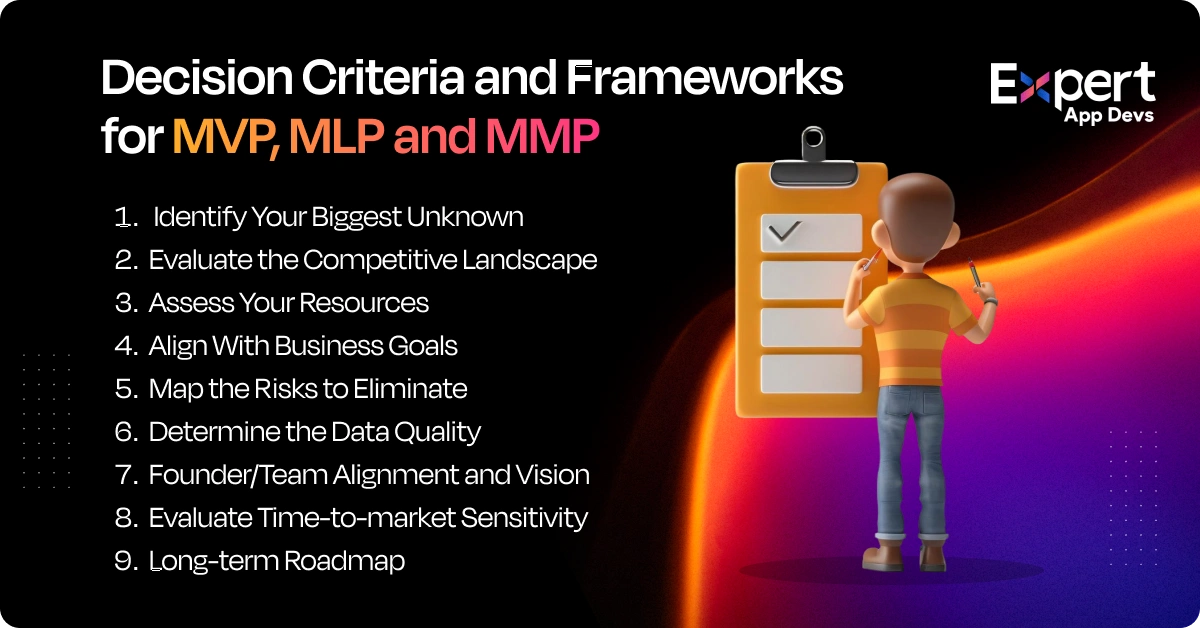
#1. Identify Your Biggest Unknown
Every product starts with uncertainty. You must know yours and the right strategy will become obvious. If you are unsure whether the users really need your product, go ahead with MVP.
As a leader, you have created a product that users need, but now you are uncertain if the users will love it enough to engage. That’s when you should explore MLP. However, if you want to know whether users will pay for the application, choose MMP.
If you identify the unknown in the early stages, you will be able to create a lean strategy.
#2. Evaluate the Competitive Landscape
Not all markets work the same way. In the case of a blue-ocean space, you can go with an MVP as accelerating the launch is important. For crowded competitive landscapes, you should use MLP that gives you a differentiation advantage.
Lastly, if competitors are monetizing, you should use MMP. This helps start small with revenue retention. A seasoned mobile app developer will always evaluate the competition before committing to the scope. This prevents under-delivering as well as over-building an application.
#3. Assess Your Resources
The timeline, team capacity and budget will influence the choice of strategy. If you have a shorter timeline with a limited budget, MVP can accelerate learning without investing a lot. In case you need to ensure a standout application with a strong design, MLP pays off. In case you must monetize while sharing a clear value proposition, you should choose MMP.
#4. Align With Business Goals
You should ensure that the minimal strategy matches the business goal. If you want to prove a hypothesis, go with MVP. To win early superfans, it is MLP and in order to generate revenue, choose MMP. Let your goals drive the strategy for better execution.
#5. Map the Risks to Eliminate
Each strategy eliminates a certain risk associated with product development. For instance, MVP eliminates demand uncertainty, while MLP eliminates abandonment risk and MMP eliminates business viability risks. You should choose the one that reduces the high-cost risk for your business.
#6. Determine the Data Quality
This step is often ignored when choosing the minimal strategy. MVP offers quantitative validation to provide usage, behaviour and retention data. MLP offers qualitative data that includes NPS, emotional resonance and reviews. Lastly, MMP uses business metrics like conversion and ARPU to help you gather an understanding. You should use the data to guide your build size.
#7. Founder/Team Alignment and Vision
This is where partnering with experienced mobile app development teams can make a difference. When your teams want different outcomes like speed vs polish vs revenue, your strategy can start feeling chaotic.
That’s why you should ensure the chosen approach is aligned with the business vision, technical roadmap, UX goals and your budget. This alignment would reduce rework and development drift.
#8. Evaluate Time-to-market Sensitivity
If you are entering a market where speed is a concern, MVP is the strategy to use. In case competitors are thinking aggressively, you may want to implement the MLP strategy. MMP works best if everything is tied to funding and monetization is the goal. Time sensitivity and the market needs will also govern the choice.
#9. Long-term Roadmap
When choosing the minimal strategy, you should also ensure it offers scalable growth. This is where an experienced partner brings in value. They will ensure the minimal version is not a dead-end but a launchpad for your application.
Common Pitfalls of MVP, MLP and MMP
Even with the right minimal strategy, you can stumble during execution. This occurs because of the way the strategy was actually applied. Here are a few common mistakes you must avoid while navigating the product journey.
MVP Pitfalls
A classic mistake you might make with MVP is overbuilding it. You may add just too many features in the assuming that users may need it. This turns your validation strategy into a mini product that is slow and expensive. At the same time, it is not aligned with the goal.
On the other hand, you may create an MVP that doesn’t validate anything because you ignored basic usability, user journeys and even clarity while building it. This way, you have created a sloppy product that no one wants to use.
MLP Pitfalls
The biggest assumption while building an MLP is that you need to create a pretty product. However, users don’t fall for aesthetics alone; they want ease, delight and the emotional payoff too. When you spend a lot of money and resources on visuals, ignoring the onboarding and clarity, you might end up building a decorative product.
MMP Pitfalls
You may rush into MMP because your investors want revenue. However, if your core experience isn’t great, you cannot convert your users. With premature monetization, you may send misleading signals to the users.
On the contrary, if you have a user base ready to pay but develop a complex monetization feature set, you may not be able to retain the revenue. Your MMP is the way to validate if people will use and not a chance to create a billing empire for your business.
Cross-strategy Pitfall
If you choose a strategy because it feels right instead of choosing one that helps answer the unknowns, you might end up choosing the wrong strategy. You should let the data shape the direction of the product to create a great one.
FAQs for MVP, MLP and MMP
Here are some of the frequently asked questions regarding minimal product strategies answered by experienced teams.
#1. What is the key difference between MVP, MLP and MMP?
ANS: MVP validates the problem, while MLP validates the engagement and MMP validates monetization. Each answers a different uncertainty regarding development, reducing wasted time and money.
#2. How do I know which strategy is right for my app idea?
ANS: You must start with your biggest unknown. If you are unsure whether the app is needed, choose MVP. You can go with MLP if you are unsure whether users will love the product and MMP if you don’t know whether users will pay. An experienced mobile app development team will always choose the strategy based on data and not assumptions.
#3. How long should MVP, MLP and MMP take to build?
ANS: The timelines will vary according to the scope, design needs and integrations. Generally, MVP takes about 4 to 12 weeks, MLP 8 to 16 weeks and MMP about 12 to 20+ weeks.
#4. Isn’t MVP enough? Why should I go with MLP and MMP?
ANS: With MVP, you will know if people need your product. However, MLP tells you whether they will stick around or abandon it and MMP will tell you if they will pay for the product.
#5. Should I include design polish when building an MVP?
ANS: No, you should not polish the design, but make sure it is usable and clear. A confusing MVP can result in bad data.
#6. Is MMP only about adding payments?
ANS: No, MMP is about validating the business model. You will assess the pricing strategy, willingness to pay and early conversion patterns along with retention behaviour and value perception.
#7. Can I skip straight to MMP if I am confident in my idea?
ANS: No, you shouldn’t ideally skip to MMP. By making this mistake, you will be working on an unstable foundation and increasing rework.
Conclusion
Choosing between MVP, MLP and MMP is no longer just about product development; it is a growth decision. With the right approach, you learn faster and move forward with clarity instead of assumptions. It’s time to take the next steps with a partner who understands how to turn early versions into long-term success.
Expert App Devs offers professional mobile app development services across Android, iOS, Flutter, React Native, and other cross-platform technologies. We deliver high-performance native and hybrid mobile solutions tailored for startups and enterprises. In addition to end-to-end development, we provide a full range of application services, including maintenance, support, and ready-made solutions to clients in North America, Europe, the Middle East, and Oceania through strategic outsourcing from India. Connect with us to build an app that sets new benchmarks for engagement and performance.
READ MORE: How to Get Investors For Your App Idea to Reality?




 261
261

 0
0


 258
0
258
0
 210
0
210
0
 228
0
228
0