



- Introduction to Rapid App Prototyping
- Why Use Rapid Prototyping? (Business & Technical Benefits)
- Rapid Prototyping Process and Methodology
- Types of App Prototypes (Fidelity Levels)
- When and Where to Use App Prototyping?
- Best Practices for Rapid App Prototyping
- Common Challenges and Pitfalls
- Examples and Case Studies
- Conclusion
Ready to transform your vision into reality?
Get Started
A Detailed Rapid Prototyping Guide for App Development
 203
203
 0
11 Dec 2025
Min Read
0
11 Dec 2025
Min Read


 Share
Share

 Download PDF
Every early-stage development team feels the pressure to move fast, impress the investors and keep up with the competition. However, moving fast can lead to rushed decisions, unclear requirements and unimpressive product features that don’t work for your business. Suddenly, you will notice that your teams feel misaligned, and you are spending more time reworking than building.
Rapid prototyping flips the scrip. Instead of guessing, you create quick and visually interactive versions of your app idea that you can test immediately. You can validate concepts early, refine the flows before development and offer something tangible to the teams. It is not just about the speed; it is also about accelerating the product development intelligently.
This blog is your rapid prototyping guide, where you will learn how this approach reduces product risk and helps teams transform their ideas into clear products that support market success.
Introduction to Rapid App Prototyping
Rapid application prototyping provides you a practical approach to convert your app ideas into products early, long before you development locks your idea in. Instead of relying on abstract app descriptions or long debates with other team members, you can create quick and interactive models that show you how the product will look, feel, behave and flow. You can make confident decisions, validating what features work and revealing what will be a waste of your money and effort.
By committing to rapid prototyping, you will notice a remarkable difference in your product journey and app phases. Your team aligns smoothly because they know what to create. Stakeholders can offer clearer feedback as their vision is much more than conversations or slides. You can identify usability issues and the unnecessary features before you even enter design phase.
With this approach, you get an accurate sense of what users really want. As a result, it becomes easier to further development with speed and clarity, reducing product risks and strengthening quality of decisions you take in the early stages.
Why Use Rapid Prototyping? (Business & Technical Benefits)
You need clarity and validation before you invest months into developing the product. Mobile app rapid prototyping can give you these details. Here’s why you should adopt this approach to build or launch your product.
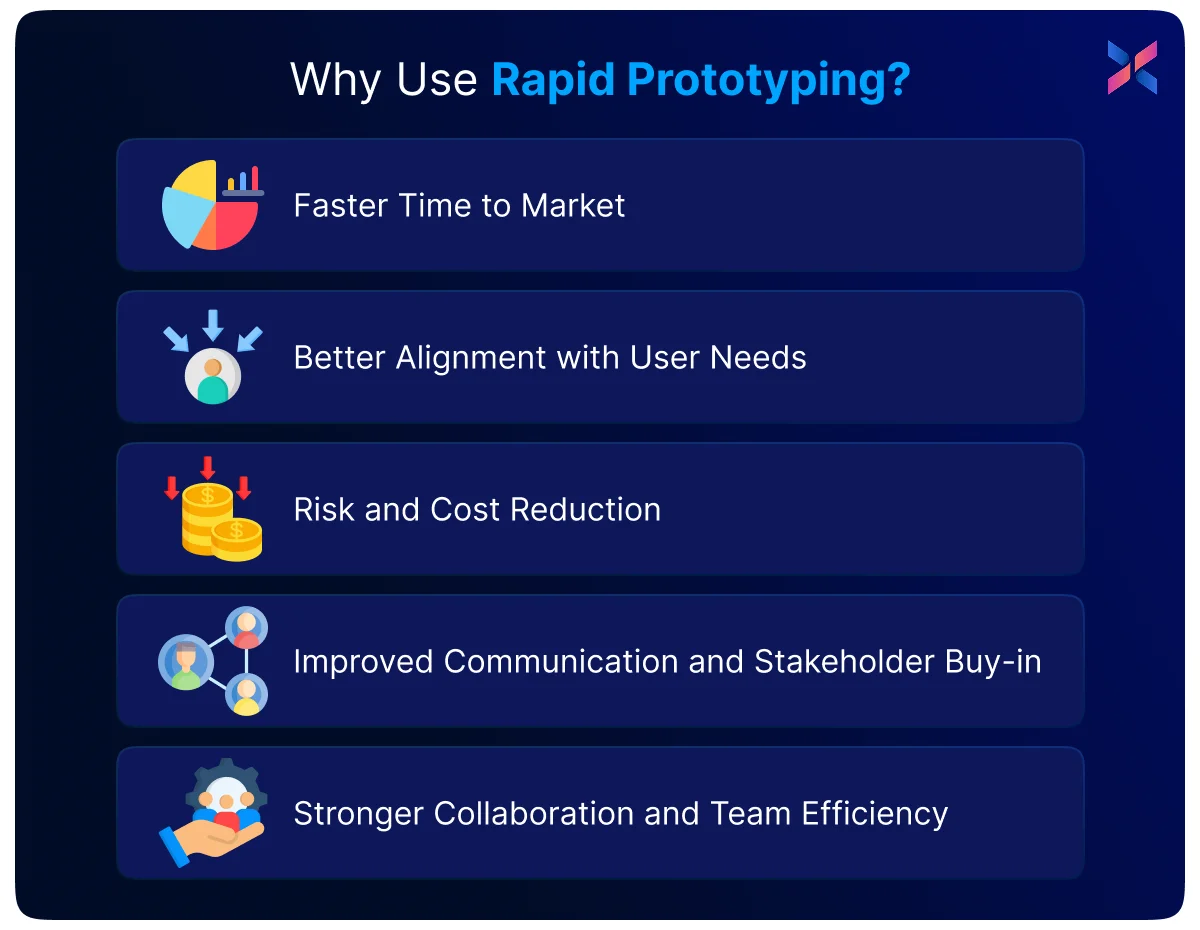
#1. Faster Time to Market
With rapid prototyping, you can accelerate the path from idea to a validated product. Instead of waiting for the developer to actually learn more about your product, you can test concepts with users, quickly refine them and eliminate the delays caused by uncertainty. With this momentum, you can reach your market way ahead of competitors who are slower and use guesswork.
#2. Better Alignment with User Needs
Prototypes help you get real user reactions in the early stages. You can observe where they hesitate while using the app, what they are able to interpret immediately and where they drop off. With this insight, you can shape the features so that it resonates with the user and eliminate friction before it causes conversion issues. Eventually, you build a product that users genuinely want.
#3. Risk and Cost Reduction
Prototyping exposes flaws and false assumptions as well as UX issues before they increase your rework costs. By validating the concept early and the design often, you can avoid unnecessary build, reduce financial risks and ensure intentional investments. You will notice that finding a mistake early can make it cheaper to fix them.
#4. Improved Communication and Stakeholder Buy-in
With prototypes, you can turn abstract ideas into something more tangible, making way for clearer conversations and sharper decisions. Stakeholders can identify with your vision instantly, and feedback is more meaningful, aligning teams faster for smoother approvals and reduced rework.
#5. Stronger Collaboration and Team Efficiency
Cross-functional teams collaborate better when they have a shared mobile app prototype as reference. Designers, developers and product owners can stay aligned, resolve issues and work with clarity, minimizing confusion and accelerating progress.
READ MORE: MVP vs MLP vs MMP: Choosing the Right Minimal Product Strategy for Your Startup
Rapid Prototyping Process and Methodology
Before you commit yourself to app development, you need a repeatable process that allows you to explore the app ideas quickly. This approach should help validate them reliably and refine these ideas with confidence. You are not just creating mockups; you will follow a disciplined and iterative methodology to make consistently better product decisions.
Iterative Cycles
At the core of rapid app prototyping is a simple yet powerful loop, build, test and learn. First you build a quick version of the idea, observe how users or stakeholders interact with it and use these insights to refine the next version.
You can repeat this loop till your concept is validated, usable and strategically defined. With an emphasis on continuous improvement and not perfection, you will learn with every cycle instead of waiting till the development concludes.
Step#1: Plan & Research
You start rapid application prototyping by defining the problem, identifying use cases and aligning the goals. This will ensure every prototype you create supports the broader business outcomes. With clarity, you will know what you aim to test and why.
Step#2: Design the Prototype
You must transform your idea into a screen, user flow or interaction. Most teams will begin with a low-fidelity sketch or wireframe as you can build them faster and change them easily. As you grow confident of your idea, fidelity increases, letting you simulate realistic experiences.
Step#3: Gather Feedback
You can share the prototype with the users, stakeholders and internal teams to gather real interactions. You can unveil the friction points, opportunities and misunderstandings for your users throughout the application. What they actually do while using your app helps you gather real insights.
Step#4: Iterate Rapidly
Based on the feedback you derived from the real users, you must refine the users, rethink user flows and enhance experience. Each iteration cycle will improve the prototype and enhance your understanding of what to add or not add into development phase.
Step#5: Validate & Finalize
Once the obvious patterns emerging and assumptions you had during hypothesis validated, your prototype can become the blueprint for development. At this point, the teams have the clarity, alignment and confidence to move in the right direction.
Step#6: Time-Boxing
Each cycle is intentionally short, from a few days to a week. Time-boxing allows you to stay focused on learning and not polishing, maintaining the momentum.
Step#7: Lean Startup Alignment
You should think of each prototype as an experiment. Even when it fails, you win as you learned early about these issues and can avoid expensive mistakes.
Types of App Prototypes (Fidelity Levels)
You have multiple ways to visualize your idea and gather early feedback before you invest your time or resources into development. However, each prototype fidelity level serves a different purpose, letting you learn fast, validate your assumptions and refine the app with clarity.
#1. Low Fidelity Prototypes
They are quick, simple and intentionally rough. Imagine sketches, paper, mockups and whiteboard flows when planning low-fidelity prototypes. The purpose of app prototyping type is not to imperess, but to explore your ideas and cost-efficiently.
These lightweight models let you interpret the structure, screen hierarchy and user flow without being distracted by visuals. Moreover, they are easy to create or change, making them perfect to identify early UX issues and align teams.
#2. Mid Fidelity Prototypes
These prototypes help bring more clarity and interactivity to your idea. These are usually digital wireframes or mockup, complete with clickable elements and placeholder content, illustrating how users can move through your application.
While this may not be a polished version of your app, ready for design, it provides enough details to evaluate navigation, content layout or spacing. Your stakeholders can even see how your product works, helping you get structured feedback.
#3. High Fidelity Prototypes
These prototypes look and feel like the actual product. You will notice that they include a detailed interface design, animations, realistic interactions and complete branding elements. They will not include the fully-functional code.
You can use this prototype to test usability and offer real experience to users. They are also great for stakeholder demos, helping secure buy-ins and during funding.
#4. Functional Prototypes
Sometimes, you need to check the app’s feasibility. With functional prototypes that include minimal working code, you can validate core technical elements like login flows, API and data interactions. They are built using rapid development or low-code tools, helping de-risk engineering decisions and confirm crucial features perform as expected.
READ MORE: Prototype vs. MVP vs. Proof of Concept: Choosing the Right Path for Your Product
When and Where to Use App Prototyping?
It is crucial to know when to use mobile application prototyping. This way you can invest your time where it will create the highest impact, reduce risks and clarify directions, letting you move forth with confidence. Here are the use cases that help you use prototyping as a strategic advantage for your app development.
#1. Early Concept and MVP Design
Prototyping delivers maximum value when you use it in the early stages of product journey, where ideas are being shaped and nothing is completely defined. Prototypes can help understand user needs, the features that will delight them or workflows needed for smooth user movement.
You can quickly explore possibilities, visualize the app structure and validate assumptions, before committing to development. In case of MVP, this means building what matters to your users.
#2. New or Innovative Features
Whenever you introduce a new, complex or unproven feature, prototyping will help decide easily. you can understand how users interact with unfamiliar features or whether it solves their problems effectively.
While you may not need to invest heavily to create basic features like login or checkout, delivering innovation-heavy features need extensive resources and detailed insights. You cannot release unfamiliar features using guesswork.
#3. Startups and MVP-stage Teams
If you are an early-stage entrepreneur or startup founder, prototyping is crucial. It helps validate demand quickly, test value propositions and refine product without draining resources. Prototypes can become a powerful storytelling tool for your business. Using prototypes, you can pitch your product to the investors, onboard customers in the early stages and align your first hires around product’s direction.
#4. Enterprise & Complex Projects
Complexity is the biggest blocker for large organizations. Prototyping can reduce risks involved in multi-team projects, integrations and feature rollouts. Financial institutions or healthcare systems can simulate experiences and gain early feedback from partners to reduce rework or delays. It aligns the engineering, design and product teams to validate requirements and close gaps.
You shouldn’t consider prototyping for everything. Small UI tweaks or low-risk enhancements that are completely understood don’t need prototypes. Consider taking the prototyping approach only when the stakes are high and uncertainty is large involving real risks.
Best Practices for Rapid App Prototyping
Rapid app prototyping works best when you use the approach with a clear intent. As you move faster, you need to ensure that every iteration brings you closer to clarity. Implementing these best practices can help build prototypes that generate insight, accelerate decision-making and reduce risks.
#1. Define Clear Goals
Before you jump into creating screens and flows, you should know what you are testing and why. Are you evaluating if your onboarding is intuitive? Do you want to know if your users can discover the core features? Is this your way to check if the navigation feels natural? With specific objectives and time-boxed stop, your team can avoid endless iterations and know when to move forward with the idea.
#2. Focus on Core Features
You don’t need to prototype the entire application; just create it for the parts that matter most to your business. Prioritize critical paths users need to complete for engagement and onboarding. You can skip edge cases or secondary screens, anything that doesn’t support your learning needs. with a focused prototype, you can iterate faster and refine your product to deliver value.
#3. Stay User-Centric
Neither your designers and investors nor your opinion matters more than what your users actually do on the app. You should ideally bring real users into the process early. Observe their behaviour on the app, note where they show hesitation and dig into their confusion and delight. This user feedback will help you direct your product development along the right path.
#4. Collaborate Across Functions
Great prototypes aren’t just design artifacts; they are alignment tools as well. you should pull in all teams, design, development, product and QA in the early stages. With this cross-functional involvement, you can ensure feasibility, reduce miscommunication and prevent late-stage development surprises.
#5. Iterate Quickly and Purposefully
Rapid prototyping uses short and focused cycles. You must follow the build, test, learn and refine cycle again and again. For each cycle, you need a clear hypothesis that yield actionable insights. Momentum is important to achieve success with this approach. Faster feedback can help de-risk decisions quickly.
#6. Document Everything You Learn
At the end of each iteration, you must capture insights, user quotes and design decisions. This will help keep your team aligned, prevent repeated mistakes and create knowledge trail you can use for future development.
#7. Choose Tools for Your Workflow
Whether you use simple sketching applications or low-code builders, the right tools can help you prototype faster and revise easily. The right tool can help your team use it efficiently without friction.
#8. Protect Code Quality with Functional Prototypes
If your prototype uses real code, don’t hack these things together. Instead, you should maintain basic structure, modularity and naming. Don’t confuse rapid for reckless. With clean coding, you can prevent technical debt and let your prototype evolve into production-grade software without rewriting them.
Common Challenges and Pitfalls
While rapid application development prototyping isn’t entirely flawless. As you implement this fast-paced approach, you might encounter a few predictable traps that slow you down. Knowing these challenges will help avoid them with confidence.
#1. Limited Scope Misunderstandings
As rapid prototyping focuses on key flows, stakeholders can assume that they are looking at the early version of the application. This misunderstanding leads to increasing and unnecessary feature requests and eventually derailing the exercise on purpose. With clear upfront confrontation, you can keep everyone aligned on what prototype is or isn’t meant to validate.
#2. Accidental Technical Debt
When you move fast through development, your team might write quick and disposable code. The danger appears when this temporary code slips into production, causing rework and instability. You should always treat your prototype code as a throwaway unless you have structured it for evolution. Speed shouldn’t compromise the maintainability of the code.
#3. Over-Optimizing Early
It is natural for you to make the prototype look polished and perfect. However, by adding too much visual finesse or obsessing over micro-details can slow down the learning process. You should understand that the goal isn’t to impress the users but understand them. Keep the prototype simple and flexible.
#4. Insufficient Testing Awareness
Since prototypes aren’t production-ready, you may not notice performance issues or deeper bugs. That is possible at this phase. That’s why you plan for thorough testing before moving into proper development. Prototyping validates direction but not stability.
#5. Communication Gaps
Tight looks and shared understanding is the backbone of rapid prototyping. When designers, business teams and developers aren’t consistently aligned, it can breakdown the feedback cycle, slowing the pact. With distributed teams, miscommunication can cause more delays. That’s why you need to invest in smooth internal collaboration.
#6. Scope Creep
When you don’t have firm objectives or timeboxes, your prototypes can become small side projects that consume a lot of your time and resources. This will delay learning and exhaust your teams. Defining your boundries in the early stages can keep the prototype lightweight and purpose driven.
#7. Misaligned or Missing Feedback
Prototypes can deliver value when tested with the right users. by gathering insights from non-representative users, you can get false insights. You should always gather insights from people within the target audience.
Examples and Case Studies
Rapid prototyping becomes more powerful when you see how real teams, from startups to enterprises, use it to accelerate clarity and reduce risks for smarter decisions. These examples will give you a clearer picture of how to apply this approach intentionally.
UX Design Case (Beauty Retail App)
A global beauty retailer wanted to design a new feature within a week. Instead of jumping into a polished interface design, the UX team sketched three quick paper prototypes and tested them with new employees who portrayed as fresh users. This tabbed layout outperformed the others. With this early validation, they were able to refine faster and deliver a UI in days instead of weeks. It helped them gain user feedback and make improvements as needed.
Mobile App Case (Pet Community App)
The pet-owner community application was a strong concept. However, it was stuck in development because they used the waterfall workflow. When the team switched to rapid prototyping with agile sprints, things changed. They could iterate every feature flow quickly and improve designs continuously. In just six sprints, they were able to launch a full-fledged commercial app.
Enterprise Case: FinTech Payments
A major payment provider wanted to build and test their partner integrations quickly. They prototyped new payment flows, reducing tasks that took weeks to minutes or hours. The partners would even test new promotions immediately, accelerating the rollout timeline and eliminating bottlenecks associated with slow backend builds.
Startup MVP Case: AI Credit Scoring Prototype
A Fintech startup build their AI prototype for credit scoring with a two-week focused effort. They tested it using pilot data, revealing major data-quality issues alongside incorrect assumptions. Had they not analyzed it at the start, it would have sunk into the build. Prototyping helped them uncover 90% of the risks early, enabling the team to pivot to leaner analytics feature, thus saving months of wasted development.
SaaS Dashboard Redesign
A B2B SaaS company wanted to redesign their analytics dashboard but, they weren’t sure how the customers interpreted their existing layout. The product team worked on three low-fidelity screen flows, and tested them on 12 power users. within two days, they were able to understand that users valued quick snapshots rather than deep drill-downs.
Conclusion
Sometimes the biggest risk in mobile app development isn’t what you build; it is building the wrong thing aesthetically and with perfection. That’s exactly what mobile app rapid prototyping helps avoid. In this guide, you learned how prototypes cut through guesswork to reveal user needs early and fast-track alignment across teams.
But the real magic occurs when the validated insights transition smoothly into full-scale development without your team losing clarity or intent. That requires a seasoned partner.
Expert App Devs offers professional mobile app development services across Android, iOS, Flutter, React Native, and other cross-platform technologies. We deliver high-performance native and hybrid mobile solutions tailored for startups and enterprises. In addition to end-to-end development, we provide a full range of application services, including maintenance, support, and ready-made solutions to clients in North America, Europe, the Middle East, and Oceania through strategic outsourcing from India. Connect with us to build an app that sets new benchmarks for engagement and performance.






 211
211

 0
0


 281
0
281
0
 223
0
223
0
 234
0
234
0