



 Blog
ERP-Integrated Mobile Apps: Opportunities in the GCC Mobile Application Market and EU Consulting
Blog
ERP-Integrated Mobile Apps: Opportunities in the GCC Mobile Application Market and EU Consulting
- The Rise of ERP with Mobile Integration in the GCC Mobile App Development Market
- Global and Regional Market Trends: GCC Mobile Application Market vs EU Market
- SAP/Oracle ERP App Extensions: What Can Be Outsourced in the Mobile App Development Market?
- Mobile Architecture Choices for ERP Extensions in Mobile Application Market
- ERP Localization Essentials for Mobile App Development Market
- Security and Compliance Requirements in the GCC Mobile Application Market and EU Market
- NetSuite vs. Local ERPs: Mobile Cost-Benefit for EU Clients
- Case Study: Bahrain Consultant Leverages Mobile App Development Market with Oracle Mobile Extension
- Fixed-Cost ERP App Templates in GCC Mobile Application Market: When Consultants Should Use Them
- Performance Optimization for ERP Mobile Integrations in Mobile App Development Market
- Frequently Asked Questions for ERP Integration in App
- Conclusion
Ready to transform your vision into reality?
Get Started
ERP-Integrated Mobile Apps: Opportunities in the GCC Mobile Application Market and EU Consulting
 241
241
 0
08 Sep 2025
35 Min Read
0
08 Sep 2025
35 Min Read


 Share
Share

 Download PDF
This is your hands-on playbook as ERP consultants or SAP professionals who work directly with clients from Kuwait, Bahrain and Germany.
It will help you use smart outsourcing models, incorporate practical localization strategies and include ready-to-use delivery templates.
When packed with insights and shortcuts, you can manage smoother rollouts and provide stronger client impact.
Localization errors and compliance missteps can quickly derail your ERP project.
If you have been working with GCC and EU clients, you are aware of the issues.
What works for Bahrain may not work in Germany and vice versa.
That’s why you must create a balance of cost, speed and compliance when extending your Oracle, SAP and NetSuite systems into mobile.
You must take the API-first approach to extend smartly.
Next, implement middleware, reusable app shells and CI/CD pipelines that help accelerate delivery.
With offshore app development, you get a cost advantage as the core team would focus on high-end customizations instead of reinventing the wheel.
Consequently, the mobile ERP can reduce the redundant sales cycle by 28% while enhancing the returns by 26%. (Wikipedia)
However, compliance plays a decisive role, especially when you are rolling out an app in multiple regions.
That’s why you must build a mobile ERP with embedded data consent flows and region-specific audit logs.
The question is, how do you cut down, move faster and stay compliant while extending your ERP system into a mobile application? This guide will cover everything from outsourcing models to localization strategies to help rollout the ERP mobile for GCC and EU.
The Rise of ERP with Mobile Integration in the GCC Mobile App Development Market
With the growing need for ERP and real-time mobile integration, clients from GCC and EU markets demand a mobile-first ERP experience.
Your desktop-only system has transformed into a pocket-sized solution that helps executives and managers make faster and smarter decisions.
This is because real-time decision-making is the need of the hour.
Let’s look at some of the most common use cases that have driven this shift.
- Field Reporting in GCC Oil & Gas: Engineers must capture their production data directly from remote sites to accelerate their reporting cycles.
- Inventory & Purchase Approval Workflows for EU Manufacturing: The managers must be able to approve procurement requests instantly, thus reducing bottlenecks and enabling the supply chain movement.
- HRMS Access for Remote and Shift-based Teams: Employees can check their pay slips, submit their requests for leave and manage schedules to enhance the workforce engagement.
While there is a clear need for mobile-first ERP solutions, you need to build them without expensive in-house development teams.
You must lean on outsourcing models, pre-built templates and vendor-backed mobile stacks to build these solutions.
By using these approaches, you can speed up delivery while establishing compliance across the diverse markets within the GCC and EU.
Global and Regional Market Trends: GCC Mobile Application Market vs EU Market
Global and regional trends reimagine your mobile ERP integration with a stronger momentum.
For the EU and GCC markets, mobile ERP adoption is no longer a future goal; it is an immediate priority.
The oil & gas, retail and manufacturing industries are looking at their biggest shift with mobile access.
Leaders are providing immediate ERP access to their workforce so that they can get the insights anytime and anywhere.
Eventually, it will help the teams provide instant decisions and responses to the clients.
As regulations vary across the markets, a mobile-first strategy can be challenging.
You must understand the different compliances and regulations carefully before proceeding.
For example, in the EU, you must adhere to the GDPR rules as they define how and where you must store the data.
In GCC markets such as Bahrain and Saudi Arabia, there are specific data privacy laws and residency requirements.
When rolling out your mobile ERP, you should ensure built-in compliance across the app’s lifecycle.
If you adopt mobile ERP integration in the early stages of your business, you will get the desired edge over the competition.
It will also mean faster approvals, better reporting and engagement teams that enhance productivity.
For fast-moving markets, this means efficient businesses that deliver sustainable and secure long-term growth.
SAP/Oracle ERP App Extensions: What Can Be Outsourced in the Mobile App Development Market?
By outsourcing app extensions, you can improve ERP delivery.
Offshore development teams work on design and ERP integrations while you focus on strategy and compliance. Here’s what outsourcing looks like for key platforms.
#1. SAP Fiori
This is your perfect extension for outsourcing as it works on UI/UX and creating mobile-friendly designs.
Your offshore development team can use it to build clean interfaces with customized workflows that are tested quickly.
All this happens without changing the ERP core.
As a result, you will experience faster rollouts and smoother user adoption at a low cost.
#2. Oracle SCM
Oracle SCM is great for front-end tasks.
Your offshore development team can use it to extend the API, build order tracking or develop approval dashboards.
You can keep the compliance-heavy and sensitive integrations in-house.
This helps balance speed with control.
#3. SAP S/4HANA
You can use it to build extensions like approval flows, mobile dashboards and role-based reporting into your application offshore.
This allows you to define the logic while the offshore team executes them quickly.
As a result, you can deliver a full-fledged application to your clients without an in-house team.
#4. NetSuite
This extension provides a straightforward outsourcing setup.
The offshore development partners use REST APIs to deliver mobile apps with reporting tools and approval workflows.
This allows you to stay focused on custom business needs that help accelerate project delivery.
|
Module |
Outsourcable via Offshore |
Notes |
|
SAP Fiori |
✅ Yes |
UI/UX + dev outsourcing possible |
|
Oracle SCM |
✅ Partial |
APIs + frontend extension only |
|
SAP S/4HANA |
✅ Yes |
App-based approval flows, dashboards |
|
NetSuite |
✅ Yes |
REST integration with mobile |
Consultant Tip: Use certified offshore teams for SAPUI5 or Oracle Jet-based mobile UI.
Mobile Architecture Choices for ERP Extensions in Mobile Application Market
When you are planning ERP-integrated mobile apps, architecture choices play a pivotal role.
You must balance cost, performance and compliance when choosing them.
Here are some of the commonly used architecture choices.
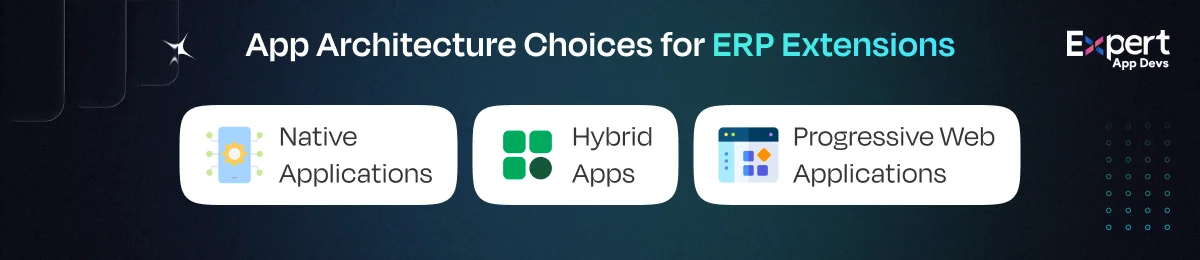
#1. Native Applications
You can secure top-notch performance, offline-first support and proper integration using the device-specific features like GPS and biometrics.
It is ideal for the GCC oil & gas industries where engineers require data even in low-connectivity zones.
The costs are higher when you use this platform but you embrace reliability and compliance even in mission-critical workflows.
#2. Hybrid Apps
These apps use a single codebase that can be delivered on multiple platforms.
It helps speed up delivery while staying cost-effective.
You can use it to build ERP workflows for purchase approvals and dashboards where performance is crucial.
Adding offline-first capabilities allows managers to approve the requests and review inventory even when there is no connectivity.
You can use the hybrid approach to enable offshore teams to reuse frameworks and accelerate delivery.
#3. Progressive Web Applications
These applications run in browsers but are like applications that offer caching, push notifications and easy updates without app store approvals.
You can use them for HRMS access, scheduling and simple reporting.
They may lack device-specific integration.
However, they are compliant and budget-friendly, which makes them suited for GCC and EU.
ERP Localization Essentials for Mobile App Development Market
When you are working within the GCC region, localization goes slightly beyond translation.
It includes compliance, adherence and user adoption.
Your clients expect native-like ERP-integrated mobile apps that can handle Arabic seamlessly while embracing the country-specific VAT laws.
If you ignore them, you will face poor user adoption, reporting errors and compliance risks.
#1. Arabic UI Best Practices
You must think beyond translation when you are designing ERP applications for Arabic users.
To make the screens feel natural to the native readers, you must include the RTL (right-to-left) layouts.
Include support for Hijri calendar along with Gregorian dates, which is useful for HR, payroll and legal records.
Lastly, you must include mobile-friendly Arabic fonts like Noto Naksh and Droid Arabic to offer clarity on smaller screens.
This will reduce user friction and improve usability while customizing the application for GCC users.
#2. VAT Compliance by Country
VAT is different across the GCC, and your ERP app must reflect these differences.
Kuwait is currently VAT-free; however, businesses are preparing for the potential rollout.
In Bahrain, 10% VAT is enforced, while it is 15% in Saudi Arabia and the UAE.
The ERP systems should include configurable tax engines that help you adapt to the country-specific rules.
You should build this flexibility into the mobile extension to deliver smooth invoicing and accurate reporting while reducing compliance errors.
#3. Data Hosting & SAMA Readiness
For the GCC clients, data hosting is not just a technical choice; it is a regulatory requirement as well.
SAMA (Saudi Arabia Monetary Authority) has specific guidelines wherein you are required to store the financial and ERP data inside the Kingdom or approved regional clouds.
Choosing an appropriate cloud is crucial for ERP-mobile strategy, especially when you are working with banks, insurers and enterprises in Saudi markets.
Regional cloud providers, such as Oracle Cloud GCC or AWS Bahrain, have become the prominent options.
Oracle Cloud offers region-specific tenancy, which allows you to run your ERP workloads locally while benefiting from global scalability.
AWS Bahrain is best for compliant hosting, as it can help you with localization in multiple GCC countries with data residency.
These providers align with SAAM guidelines, PDPL and GDPR-specific controls.
You get both flexibility and peace of mind as a result.
When you ensure proper data hosting and SAMA readiness, your clients will get fully compliant hosting that adheres to the financial regulations and delivers customer trust.
Additionally, it helps you create ERP extensions that connect with local clouds securely without compromising on performance.
When you incorporate regional hosting in your architecture, you assure regulatory readiness and enterprise-grade scalability.
Security and Compliance Requirements in the GCC Mobile Application Market and EU Market
Your ERP mobile rollout may slow down if there are security or compliance issues.
GCC and EU clients expect you to deliver apps that protect data, adhere to local laws and are audit-ready.
That’s why you must implement security-first strategies when building applications.
#1. GCC Data Residency Laws and Cloud Mandates
Security starts with where and how data is stored for GCC.
In countries like Saudi Arabia and the UAE, data residency laws are enforced, wherein you need to host the sensitive financial and personal information locally.
You must look for local or regional cloud hosting that has been approved by SAMA in Saudi and PDPL in Bahrain.
That’s why you must ensure that the rollouts are integrated with region-approved cloud providers to deliver reliable performance.
#2. Role-Based Access
In the GCC and EU, you must provide granular access control to protect your ERP data.
Role-based access control allows employees to see what they need.
For instance, an HR associate can view the payroll, while the plant manager would be allowed into the purchase orders.
The consultants must design mobile ERP extensions that include configurable role hierarchies, logging and robust authentication.
With this, you can support GDPR accountability in the EU and follow the strict audit requirements for GCC industries.
#3. Securing the API Endpoints
APIs provide real-time connectivity in mobile ERP, which also leads to security vulnerabilities.
You should implement the best practices like token-based authentication, regular penetration testing and encryption to strengthen the endpoints.
In the case of GCC clients, API security is connected with residency and banking rules.
On the other hand, for EU GDPR will safeguard data transfers. When you embed these secure API practices into your mobile ERP, you can deliver high-speed integration while establishing compliance.
NetSuite vs. Local ERPs: Mobile Cost-Benefit for EU Clients
In the case of EU clients, you need to decide whether you want to stick to local ERP vendors or look for global platforms like NetSuite for mobile integration.
There are trade-offs in terms of cost, scalability and compliance, depending on your choice.
#1. Cloud-Native
NetSuite is built for the cloud, which makes your integration smooth and fast.
EU consultants can easily extend the functionality without investing in infrastructure or creating local server dependencies.
On the other hand, local ERPs in Germany or Bahrain take the on-premise option.
This translates to increased infrastructure, expensive maintenance and slower mobile integration.
In case your clients need a mobile-first strategy, you must think cloud-native as it offers flexibility.
This makes NetSuite the perfect choice.
#2. Mobile SDK/API
Mobile extensions are growing successfully using the developer toolkits.
NetSuite comes with strong SDKs and documented REST APIs that help consultants build, test and roll out mobile workflows with exceptional speed.
In the case of local ERPs, they rely on limited or outdated APIs. This makes mobile rollouts clunky and expensive.
As a consultant from the EU, you are constantly under pressure to deliver faster while keeping the costs lower. NetSuite is the perfect ecosystem for you.
#3. EU Localization
The local ERPs are perfect from the localization perspective.
German ERP solutions come with deep localization that offers GoBD compliance, VAT nuances and country-specific add-ons.
NetSuite covers all the key frameworks like GoBD and France’s FED.
However, it needs further configuration for detailed compliance.
You must bridge the gap using add-ons and outsourcing.
While NetSuite is great for global integration, you might need local ERPs for country-specific accuracy.
#4. Outsourcing Options
NetSuite offers a global outsourcing ecosystem that can help you scale your projects.
Most offshore teams are well-versed in NetSuite integrations that help reduce costs and speed up delivery.
Local ERPs, on the other hand, offer niche support that is limited to local markets.
It is difficult to find mobile expertise in this case.
If you are operating under strict budgets, you might need to conduct a cost-benefit analysis before choosing.
|
Factor |
NetSuite |
Local ERP (Germany/Bahrain) |
|
Cloud-native |
✅ Yes |
❌ Mostly on-prem |
|
Mobile SDK/API |
✅ Robust |
⚠️ Limited or outdated |
|
EU Localization |
✅ GoBD, FEC |
✅ Country-specific add-ons |
|
Outsourcing Options |
Wide |
Niche or unavailable |
Case Study: Bahrain Consultant Leverages Mobile App Development Market with Oracle Mobile Extension
A Bahrain-based ERP consultant was hired to modernize the oil logistics firm that relied on Oracle to complete their operations.
The field staff didn’t have a mobile tool that could manage the job dispatch or asset tracking, which led to delays. It also caused frequent calls to the HQ.
The consultant chose to partner with an offshore development team from India to speed up the delivery.
By combining the in-house and offshore team, the consultant delivered a hybrid mobile solution with Flutter and REST APIs to seamlessly integrate with Oracle.
The mobile app used the Oracle Cloud infrastructure for backend and Firebase notifications to send real-time alerts.
They were able to roll out the mobile app in six months without any hassles.
This helped them deliver 99% accuracy in job assignments while cutting down the headquarters calls by 40%.
The client was able to enhance efficiency and visibility with this solution.
Fixed-Cost ERP App Templates in GCC Mobile Application Market: When Consultants Should Use Them
The fixed-cost ERP app template can become a game-changer for you.
However, they may not be suitable for every project that you are planning.
Let’s look at all the times you can use it versus when to avoid it.
When to Use
When speed and affordability are your priorities, you should use these fixed-cost ERP templates.
They help with repetitive workflows like purchase order approvals, expense claims and attendance tracking.
Basically, all the workflows where you don’t need deep customizations.
If you are working with a budget-conscious GCC startup that needs quick mobile integration without a lot of investment, this is a great choice.
You can also use them in cases where the scope is limited to the dashboard or reporting.
This will help you offer mobile visibility into KPIs without investing in transactional functionality.
When to Avoid
Your templates may not be useful when your client’s ERP needs go beyond basic workflows.
In case the project involves customized ERP logic, rigid templates can block flexibility and increase the rework.
This can add to your expenses.
For enterprises that require SAP BTP, templates may not be able to capture the complexity of advanced extensions.
If your client needs full-scale transactional access like procurement or inventory management, you must think beyond templates.
You should consider a custom mobile app as it can offer scalability, compliance and integration.
|
When to Use |
When to Avoid |
|
Repetitive workflows (e.g., PO approvals, attendance) |
Highly customized ERP logic |
|
Low-budget clients in GCC startups |
Heavy SAP BTP usage |
|
Mobile dashboards only |
Full-scale transactional access |
Performance Optimization for ERP Mobile Integrations in Mobile App Development Market
The performance of your mobile app extensions is extremely crucial for successful mobile integration.
If the app lags or crashes, you may notice a reduced user adoption.
That’s why you must emphasize keeping your apps lightning fast and reliable.
#1. Data Caching to Increase Load Times
Your users may not want to wait for ten seconds to view a report.
That’s why you must implement smart data caching that stores the frequently accessed ERP data, like approval lists or KPIs, locally.
This would also include the frequent calls sent to the ERP backend, thus reducing load times.
When you include proper cache refresh rules, your users will get an instant response while maintaining data accuracy.
#2. Minimizing API Latency
The APIs for your ERP can be slow, especially when they operate across regions.
You can minimize latency by using API gateways that are closer to your users’ locations.
This would reduce the travel time for the data.
When you combine it with lightweight payloads and batching requests, you can enhance the app’s performance.
For GCC, where cross-border data laws are complex, you can include edge caching and regional cloud APIs to deliver a seamless mobile experience.
#3. Strategies To Manage High-Volume ERP Transactions
If multiple HR records or purchase orders come to the system at once, managing these transactions can be challenging.
You must queue and process the data efficiently to avoid ERP overloading.
Using techniques like async processing and job schedulers for buffering, you can deliver responsive ERP app development.
Frequently Asked Questions for ERP Integration in App
#1. Can I Outsource SAP Fiori ERP App Development?
Yes, both UI/UX and development for the SAP Fiori app can be outsourced.
You should ideally ensure that the business logic stays in-house for this extension.
#2. What Mobile Tools are Compatible with Oracle ERP?
Oracle Mobile Hub, REST APIs and hybrid frameworks like Flutter work well with Oracle ERP.
#3. How do I localize mobile ERP apps for Bahrain?
By supporting the Arabic RTL layout, incorporating Hijri calendars and implementing the region-specific VAT rules, you can localize ERP for Bahrain.
#4. Is Flutter Good for ERP-based Mobile Apps?
Yes, Flutter can offer high-speed delivery using a single codebase.
It can also manage the complex ERP workflows.
#5. What’s the Cost of a Fixed-Scope Oracle Mobile Extension?
The cost of a fixed-scope ERP mobile extension is anywhere between $10k and $50k.
The cost depends on integrations, workflows and localization.
Conclusion
ERP-mobile integration is the backbone for the GCC and EU clients as it helps them operate securely in 2026 and beyond. From ensuring faster approvals to providing localized compliance and role-based security, the consultants can adapt easily to stay ahead of the curve with this integration.
The real challenge remains on how to deliver these mobile extensions without increasing the cost or delays.
That’s why you need a compliance-first strategy partner who can roll-out the integration with proven templates and offshore expertise.
Expert App Devs offers professional mobile app development services across Android, iOS, Flutter, React Native and other cross-platform technologies.
We deliver high-performance native and hybrid mobile solutions tailored for startups and enterprises.
In addition to end-to-end development, we provide a full range of application services, including maintenance, support and ready-made solutions to clients in North America, Europe, the Middle East (KSA, UAE, Oman), and Oceania through strategic outsourcing from India.
We also welcome new IT Industry consultants from Palestine, Kuwait, Bahrain, Oman, Jordan, United Kingdom, Switzerland, Germany, France, Italy, Spain, the Netherlands, Belgium, Finland, Portugal, Ireland, Greece, Slovakia, the United States, the Bahamas, Panama, El Salvador, Puerto Rico, Micronesia, Marshall Islands, Palau and Norway to partner with us for local software development projects and explore collaborative opportunities.






 225
225

 0
0


 267
0
267
0
 223
0
223
0
 260
0
260
0