


- Exclusive Summary
- Introduction
- The Consultant’s Role in Ensuring Compliance
- Compliance Risks in App Development
- Overview of Legal Liability for Consultants
- Top 6 Compliance Violations in Mobile Apps
- Hidden Compliance Traps in Popular SDKs and APIs
- GDPR & HIPAA Requirements for Mobile Apps
- Case Study: GDPR-Compliant App for Swiss Bank by Ukrainian Team
- Compliance Readiness Checklist for Consultants
- How to Prepare for Compliance Audits?
- Conclusion
- Frequently Asked Questions
Ready to transform your vision into reality?
Get Started
GDPR, HIPAA & Security-First App Development for Consultants
 215
215
 0
07 Aug 2025
49 Min Read
0
07 Aug 2025
49 Min Read


 Share
Share

 Download PDF
Exclusive Summary
Consultants cannot afford to overlook privacy and security. Using this guide, you can build mobile apps that meet the GDPR, HIPAA and other global compliance standards without slowing down innovation.
Introduction
Don’t we all want to launch our apps fast? But what use is rushing into app development if it means missing out on crucial things like compliance and security?
Consider a situation where your healthcare app shared crucial patient data with a third-party unsecured vendor without encryption. This data breach can break your app’s reputation and eat into your millions.
Just last year, GDPR fines crossed € 2.1 billion, which is a massive amount. If your app handles sensitive or personal data, you must play by the rules mentioned by the regulatory bodies. This will help avoid unnecessary hassles and issues.
This guide will help you build an app with a security-first mindset so that you stay compliant from the start.
If your app deals with sensitive or personal data, you need to play by the secure app development rules. This guide walks you through the must-know regulations and how to build with a security-first mindset, so you can move fast without breaking things.
The Consultant’s Role in Ensuring Compliance
Your role is to bridge the gap between vision and execution so that you can build regulation-ready solutions for your clients. That’s why your role isn’t restricted to offering technical direction to your execution team.
The clients expect you to identify the risks in the early stages, ask the stakeholders all the difficult questions and ensure nothing critical is ignored in the process.
Establishing app compliance and regulation isn’t a developer’s job alone; it is yours too. You must piece together all the components needed for the regulatory landscape across geographies to launch an audit-ready application.
That’s why you should be aware of GDPR, HIPAA and other data laws that apply across the mobile app development lifecycle. You should follow compliance carefully if you are working with sensitive workflows so that you can avoid production delays and audit issues.
Create efficient and fully regulated workflows to set data boundaries and provide access roles so that your vendors follow all the industry-specific regulations. You can deliver a secure application if you build a compliance strategy to follow.
Compliance Risks in App Development
Following a compliance checklist doesn’t guarantee a regulated application. Avoid development errors, align with regulations and take a compliance-first approach to prevent damaging your client’s reputation.
Think about all the things that can go wrong while building an app. What will happen if you ignore compliance while designing data flows or access for the application? The answer would help you plan your compliance better.
Here, you will learn the risks you would face for non-compliance along with the ways to build a GDPR/HIPAA ready mobile application.
Overview of Legal Liability for Consultants
Consultants have to offer more than just advice to their clients. You direct the strategy, manage offshore teams and even approve app architecture. That’s why you are also part of the legal chain.
The GDPR and HIPAA regulators will not look at the people who coded the application; instead, they will look at the person who set the direction in case key privacy safeguards are missing.
You must be completely aware of the potential risks and necessary regulations while creating the mobile app solution.
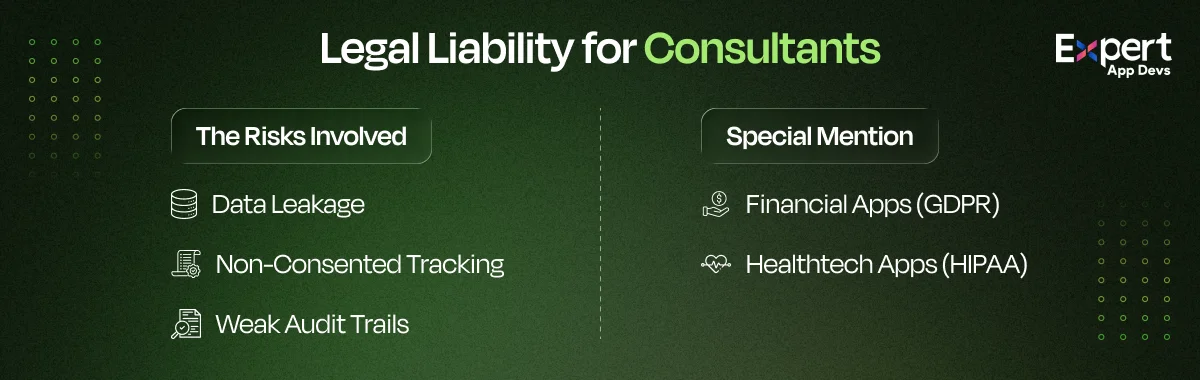
The Risks Involved
You may run into serious trouble with your solution if you haven’t embedded compliance to the core development strategy. Here are some of the common pitfalls you must look out for while planning the application.
#1. Data Leakage
If your app doesn't store the data safely or pass it without encrypting it first, you will face data breaches. You should align your data with HIPAA and GDPR regulations to ensure proper storage and movement of healthcare, financial and other crucial data.
At the same time, you should use end-to-end encryption, role-based access and strong data retention policies to ensure security is at the core of your design.
#2. Non-Consented Tracking
If you haven’t taken consent from users for embedding SDK or analytics in your mobile application, it will flag non-compliance for GDPR in apps. For example, if a mobile application contains PHI, HIPAA is applicable.
Start by setting up clear consent workflows to collect user data. Prioritize anonymizing the personal identifiers and include default opt-ins wherever needed.
While your clients are protecting the data, data regulators are focused on knowing if it is being collected responsibly and ethically.
#3. Weak Audit Trails
HIPAA and GDPR regulations want to see accurate records of who did what and when. You risk failing app compliance audits if your app doesn’t store secure and tamper-proof logs along with traceable version histories.
These logs become very crucial if your app manages user-generated content and system-wide updates. You cannot prove app compliance or detect misuse without a robust audit tracking system in place.
Special Mention
For some app categories or industries, you need tighter controls as they handle sensitive and important data.
#1. Financial Apps (GDPR)
The financial apps include sensitive personal and transactional data. That’s why you need to follow through pseudonymization, usage transparency and breach protocols put forth by GDPR.
You should include robust KYC workflows, local data residency compliance and a clear consent architecture while integrating third-party APIs.
#2. Healthtech Apps (HIPAA)
If you are building a health app that can collect, store and transmit Protected Health Information (PHI), it falls under HIPAA regulation. Encryption and access logs are no longer optional for healthcare applications.
Whether you are working for a US hospital or a global health startup, you should vet the data flow maps and verify if the business associate agreement (BAA) is in place.
Top 6 Compliance Violations in Mobile Apps
|
Violation |
Regulation Breached |
What it Means? |
|
Missing User Consent |
GDPR |
Your user’s data is collected without their permission |
|
Weak Data Encryption |
GDPR/HIPAA |
Sensitive data is vulnerable whether you have stored it or exchanged it across systems |
|
No Audit Logging |
HIPAA |
You are unable to track data access and changes |
|
Insecure 3rd Party SDKs |
GDPR |
The tracking tools you have added collect private data |
|
PHI Shared without BAA |
HIPAA |
You send health information without the requisite contact details |
|
No Breach Response Plan |
GDPR/HIPAA |
Delayed reporting leads to fines. |
Hidden Compliance Traps in Popular SDKs and APIs
Adding a plug-and-play SDK to get quick analytics seems like a smart idea till that SDK sends out crucial user data to an overseas server.
It’s no surprise that several popular SDKs, especially the ones that provide push notifications and analytics, collect PHI in a hidden way. That’s why they can be termed risky.
Just because some SDK or library is popular among developers doesn’t mean it is GDPR or HIPAA compliant. Several SDKS use broad data collection premises but skip the essential consent prompts that hampers app development security. In some cases, they may bury the data sharing part deep into their terms, thus not letting the user know.
If your app contains sensitive data, poorly vetted integration can cause compliance issues. So, you should assess the compliance for every component you are adding. Review the SDK documentation, check how/where the data is stored and understand their encryption & consent flows. Avoiding this can increase the costs and even penalties for you.
Make sure to include third-party tools in your compliance checklist so that you can vet it before shipping it.
GDPR & HIPAA Requirements for Mobile Apps
Before you build or approve anything, you should understand HIPAA and GDPR in apps in detail. In this section, you will learn the must-haves for handling sensitive data in your mobile app.
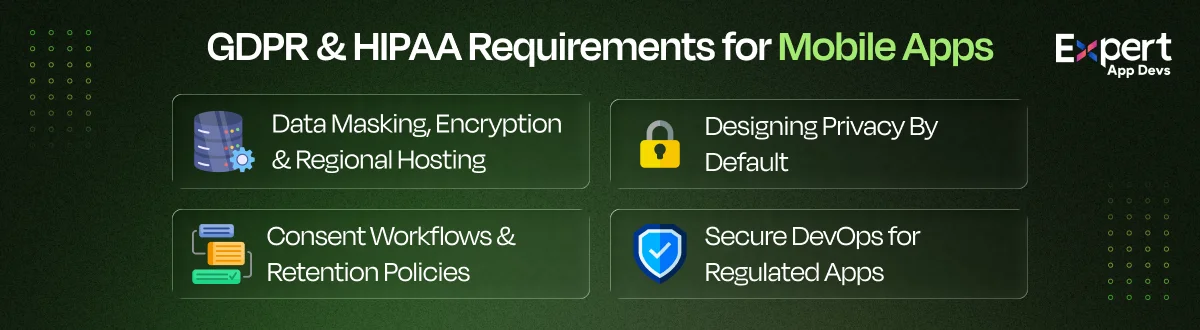
#1. Data Masking, Encryption & Regional Hosting
Storing your data securely may not be enough anymore. You need to understand how, where and home much data is stored, especially when you are dealing with sensitive health, transactional and personal data.
Verify if your app checks all the boxes for GDPR and HIPAA compliance before you go live. Start by masking all sensitive fields, such as names, email, SSN and medical notes. Your systems can use this data but, with this masking, it will stay hidden from people who aren’t authorized
Keep everything from app to the database encrypted. Use end-to-end encryption as it will ensure data safety.
Don’t forget data hosting as it is critical in ensuring safe storage and access. For example, if you store EU data outside its approved regions, you violate the GDPR laws. Likewise, if US patient’s health data ends up being stored in a non-HIPAA compliant location, it could pose data breach risk.
To avoid these risks, plan your hosting strategy early. Use compliant zones like AWS Frankfurt, Azure EU or Google Cloud Switzerland to serve your European clients.
App compliance begins with your infrastructure choices. Regional hosting, masking and encryption are primary to building trust and avoiding fines.
#2. Designing Privacy By Default
Users shouldn’t have to fight for their privacy; it is their right. GDPR and HIPAA regulatory bodies push for privacy by default. That’s why you should make the right UX choices to ensure privacy is embedded within the mobile app strategy.
Use patterns that minimize data collection from the beginning. Don’t grab every detail from the user as they enter the application; use designs that ask for only necessary and relevant information.
Avoid pre-filled and pre-checked boxes in your design. Include opt-in as your default, especially if you are including features like tracking, sharing and other sensitive permissions.
The user dashboards allow users to see what data is being collected, handle their preferences and request data deletion. While GDPR mentions this as data subject control, HIPAA calls it the patient’s rights.
These designs should be built into your app from the start. Privacy planning should begin as early as your wireframe stage. As you design each screen, from sign up to consent, verify your design respects legal boundaries and guarantees users control over their data.
#3. Consent Workflows & Retention Policies
Consent isn’t just another pop-up that you would throw on the screen; it is something you build into the app from the beginning. Implement clear, flexible and easy-to-manage consent flows for the user to stay HIPAA and GDPR compliant as part of secure app development.
Think beyond a simple “yes” or “no” to sync with GDPR. Allow users to choose the kind of tracking and data usage they are fine with. If your user wants to change their preferences, you should allow it and keep the process simple.
For apps that use ads and third-party tracking, it is important to follow the IAB Europe TCF v2.2 standards. Likewise, when including cookies on your website, use clear and precise messaging. Let the users decide if they are comfortable with data sharing.
HIPAA is stricter when it comes to data retention. You are expected to keep user audit logs with user records for a period of six years. These logs should be secure, tamper-proof and traceable. You must plan your infrastructure while keeping these rules in mind.
At the end, consent and retention aren’t about following a design checklist. It is core to building trust among users, protecting them and strengthening the app’s reputation.
When something goes wrong inside the app, it is never about what happened. Rather, it is about who did it, when and how. That’s why you need a strong logging and audit system for GDPR and HIPAA-compliant applications.
Think of your immutable logs as a digital paper trail that you can’t edit. They will lock in every action with a precise timestamp, providing you with a clear and tamper-proof record. It is useful for the finance and healthcare industries, where every accidental access must be tracked and explained.
Use tools like Splunk or AWS CloudWatch to spot unusual behaviour and send alerts in real-time. Track access closely using tools like Amazon CloudTrail or AWS KMS. You will know who accessed which data and when, making audits easier and transparent for your business.
You create a secure and audit-ready system that processes legal requests and compliance checks effortlessly with the right logging and auditing system.
#4. Secure DevOps for Regulated Apps
Your app could quickly become a risk if you are moving fast with app development but skipping security. This is especially true for healthcare, finance or any other industry that deals with sensitive data. That’s where secure DevOps becomes crucial for audit-ready app development.
Use tools like Terraform or CloudFormation to manage your infrastructure as code, as it is cleaner, safer and easier to audit when needed.
Don’t push your code directly to production. You can set up secure pipelines to automatically test every build and control its access. When it comes to secrets like your API keys and credentials, you can work with tools like HashiCorp Vault or AWS Secrets Manager.
As consultants, you should create a DevOps stack that is fast, secure and compliant right from the beginning.
Security Tools & Stack for Compliance-Ready App Development
The compliance strategy for your mobile app would be a success if you select the right tools. This guide will help you select the tools for all aspects, including encryption, code quality and secure infrastructure, to build audit-ready apps faster.
#1. AWS KMS
Strong encryption is a must if your app handles sensitive data. AWS Key Management Service allows you to manage it without adding complexity.
The tool helps you create and manage encryption keys easily, without hardcoding them into your application. Additionally, it can help secure your logs, databases and personal user data.
It can integrate with AWS CloudTrail, enabling you to track access and edits in real-time, helping you stay compliant with GDPR and HIPAA.
#2. SonarQube
Every app has bugs. But some can turn into serious security or compliance issues. SonarQube can help you catch these bugs in the early stages.
The tool scans your entire code for issues, such as hardcoded passwords, insecure functions and injection risks. You can go live with a bug-free application.
Integrating the tool with your CI/CD pipeline keeps your code clean, minimizes security risks and keeps you ahead of compliance problems.
#3. Burp Suite
Don’t wait for a breach to happen to know if your app is weak. Burp Suite helps you find security gaps like poor authentication or leaky APIs in the early stages.
You get a clear picture of your app’s defence mechanism with in-built tools for penetration testing and attack simulation. This means fewer risks and better alignment with HIPAA and GDPR standards.
#4. Terraform
You can set up your cloud infrastructure with just a code using the Terraform tool. Eventually, everything becomes trackable, consistent and easy to audit.
It lets you build security within the setup by blocking open ports and ensuring storage is encrypted. It is a smart way to keep your app safe and compliant.
#5. Firebase App Check
Not every request sent to your app’s backend is safe. That’s why you need Firebase App Check. It helps catch every bad request sent to the backend.
It verifies that the requests are coming from genuine and untampered applications. This tool blocks bots, spoofed clients and rooted devices using attestation and reCAPTCHA. As a result, it helps tighten the security and protect app’s backend.
|
Tool |
Use Case |
|
AWS KMS |
Encrypted logs & database key storage |
|
SonarQube |
Code quality, security vulnerability scans |
|
Burp Suite |
Penetration testing |
|
Terraform |
Infrastructure as code (secure by design) |
|
Firebase App Check |
Preventing unauthorized API access |
Case Study: GDPR-Compliant App for Swiss Bank by Ukrainian Team
A Swiss fintech startup wanted to launch their mobile banking app for which they prioritized compliance by design. The company was operating out of EU, which meant it had to follow the stringent GDPR requirements from day-one without shortcuts or gaps.
This was an ambitious project. They outsourced their development to a highly skilled Ukrainian team, which came with its cross-border compliance challenges. That’s where we stepped in as their consultants.
We managed with as sub parner everything from project management to QA coordination and strategy development. As consultants, we enabled in-region hosting with AWS Frankfurt and oversaw the Burp Suite penetration tests. We also implemented secure DevOps pipelines, keeping compliance at the forefront of every choice.
Our team also helped the offshore development team with audit-friendly documentation and privacy UX patterns that conformed with legal reviewers. With this coordinated approach, the app passed the GDPR compliance audit on the first attempt.
This audit-ready product was delivered within 90 days with airtight security and smooth offshore collaboration.
Testimonial: “We managed compliance without hiring full-time security engineers: thanks to a capable offshore stack.” - By Lavorg Decision Makers (München, Germany)
Compliance Readiness Checklist for Consultants
You should verify if your app ticks every box on the compliance checklist before giving the final sign-off. With this compliance readiness checklist, you can verify the app for core HIPAA and GDPR areas so that you don’t miss out on crucial vulnerabilities.
#1. Data Storage
Storing your data in the right region is a legal requirement. According to GDPR regulation, the personal data of users from EU region should stay within approved jurisdictions. You should use cloud services like AWS EU Central or Google Cloud Germany so that data doesn’t flow outside these regions without proper safeguards. It helps build trust among privacy-conscious users.
#2. Logging
Traceability is important for compliance. You should check if all your logging systems can capture the key events like access, changes and deletion with tamper-proof and timestamped entries. The systems should use encrypted logs during transit and storage.
You can also incorporate tools like AWS CloudTrail to create immutable logs as they are crucial for cyber hygiene. It can also help with audits in a HIPAA-regulated environment.
#3. Consent
You can no longer rely on vague or passive consent screens. To ensure GDPR compliance, you must create explicit, informed and revocable consent. That’s why your design UX must include opt-in defaults and log the timestamp as well as the user consent context.
You should store them properly for audit trails. Make sure to review every touchpoint, including marketing, analytics and features, to validate that consent is properly captured and withdrawn.
#4. Testing
If your app leaks data, even the best design aesthetics cannot save it. Proper penetration testing allows you to simulate real-world attacks to identify the vulnerabilities in your application before launch. You must confirm that professionals are conducting these tests and that they are patching the issues before release.
This step is crucial for HIPAA-compliant apps and should be conducted as part of security risk assessments.
#5. Documentation
Paperwork is integral to compliance. Make sure your app/platform includes all the required legal documentation, such as Data Processing Agreements for GDPR and Business Associate Agreement for HIPAA.
You should also link a clear privacy policy that explains which data is collected, how it is used and the user’s rights.
|
Area |
Consultant Checklist Item |
|
Data Storage |
✅ Hosted in-region (AWS EU, GCP Germany) |
|
Logging |
✅ Immutable, timestamped logs w/ encryption |
|
Consent |
✅ Dynamic opt-in UX + storage of consent timestamp |
|
Testing |
✅ Penetration test performed pre-launch |
|
Documentation |
✅ DPA, BAA, privacy policy links included |
How to Prepare for Compliance Audits?
Audits are not optional if you are building applications for the regulated industries like healthcare and finance. The compliance checks are conducted by internal legal teams, third-party certifiers and client-side stakeholders.
You need to support them when they want to check for compliance and other elements of the application. Your app should be audit-ready from the start, whether you are building applications for the healthcare or financial services segment.
Key Documentation & System Evidence
Auditors won’t ask if your app is compliant; they need proof backing that yes. Here is all that you should have to showcase audit readiness.
- Risk Assessments: Run the DPIA or Data Protection Impact Assessments in the early stages of your project to show how you manage GDPR and HIPAA risks.
- Third-party Agreements: Own copies of all agreements, such as BAAs and DPAs, you have signed with third-party vendors and providers.
- Access and Data Logs: Maintain a complete record of who accessed what and how data moves through the system for clarity.
- Consent and Retention Records: Store your user’s consent details and the data retention policy. This will help you prove that your app records data legally.
Tips to Stay Audit-Ready
You must build a proactive system to prove compliance during all types of verification and audits. Here are all the tips to ensure your system is audit-ready.
- Run internal mock audits on a quarterly basis to identify issues before the actual audit. You can use this to simulate real-world scenarios, test access logs and walk through consent flows like the real auditor.
- You should take pre-launch screenshots of all critical UX elements like opt-in checkboxes, cookie banners and data permission prompts. You can prove that the users were in control and fully informed with these visuals.
- Use tools like AWS CloudTrail, Azure Monitor and Google Cloud to enable cloud audit trails.
- Make sure to version control your policies so that you can keep track of the changes made to your privacy policy, terms of use and data handling practices. If there is no changelog, maintaining records of policy updates it could pose as a red flag to your auditors.
- You must use a centralized system to track compliance. There are tools like Drata, Vanta and AuditBoard that help monitor the gaps and maintain the documentation in a single place.
- If you use SDKs or APIs, validate if the practices of your third-party vendor align with your compliance obligations. You should maintain an audit trail of the third-party tools to ensure due diligence.
Conclusion
One missed checkbox on your compliance checklist can sink your entire project. Launching fast is not enough; your clients need you to launch the app smartly. That means you should embed GDPR, HIPAA and security into your app, and not patch it in.
As consultants, you are not just managing the vendors or the sprints; you are the ones steering the ship to provide data privacy, secure architecture and audit-ready delivery. You need clarity on everything, from consent flows to cloud hosting that can enable a compliance-backed application from day one.
Don’t wait for an audit to fix the gaps. Talk to a compliance expert for secure app development. They
Expert App Devs offers professional mobile app development services across Android, iOS, Flutter, React Native and Cross-platform technologies.
We deliver high-performance native and hybrid mobile solutions tailored for startups and enterprises. In addition to end-to-end development, we provide a full range of application services, including maintenance, support, and ready-made solutions to clients in North America, Europe, the Middle East, and Oceania through strategic outsourcing from India.
We also welcome new consultants from these regions to partner with us and explore collaborative opportunities. Schedule a consultation with us and our experts will guide you on how compliance can become integral to your strategy from the first day itself.
Frequently Asked Questions
#1. What are the GDPR requirements for mobile apps?
Apps should collect the data they actually need, get clear opt-in from their users and store the data securely in approved regions. They should also provide privacy controls and clear policies aligned with GDPR for app development security.
#2. How do I ensure my client's healthcare app meets HIPAA standards?
You should have encrypted storage, secure APIs and six years of audit logs to meet HIPAA standards. Allow the right people to access personal data and sign BAAs with your vendors.
#3. Which tools help with app security compliance?
Use tools like AWS KMS for encrypted key storage, SonarQube for code scanning and Burp Suite for penetration testing to ensure compliance.
#4. Can offshore teams handle GDPR or HIPAA delivery?
Yes, offshore teams can handle GDPR and HIPAA delivery by adhering to strict protocols like regional hosting, secure data flow and a signed compliance agreement.
#5. What mobile app intelligence tools support HIPAA or GDPR compliance?
Several analytics and app-intelligence tools come with built-in privacy controls. For example, you can use Segment, Countly, Amplitude or Mixpanel. These platforms support things like encryption, consent management, data minimization and audit logs. When set up correctly, they help you meet HIPAA and GDPR requirements. Other tools such as CleverTap, UXCam or even Firebase (with the right configuration) can also support compliant data handling.
#6. Are there mobile app intelligence tools that support HIPAA or GDPR compliance?
Yes. This is the same as question one. Tools like Segment, Countly, Amplitude and Mixpanel already offer HIPAA and GDPR-friendly features. You just need to enable their privacy settings and sign the required agreements, such as BAAs or DPAs.
#7. GDPR checklist for mobile games
To make a mobile game GDPR-compliant, focus on five key steps:
- Review all SDKs and trackers. Know exactly what each one collects and why.
- Publish a clear and easy-to-read privacy policy that explains your data practices.
- Show a consent banner before loading any non-essential SDK, like ads or analytics. Let users opt in by choice.
- Only load tracking SDKs after the user agrees. If they say no, the game should still work.
- Keep a record of each consent decision. These logs help prove compliance during an audit.
In short, be transparent, keep data collection minimal and always respect the player’s consent.
#8. How to handle regulatory compliance with SDKs (HIPAA, GDPR)?
Treat every third-party SDK like a potential risk. Here’s a simple approach:
- Check each vendor before using their SDK. Look at what data they collect and whether they support encryption and consent controls.
- Add every SDK to your compliance checklist. Keep documents like BAAs, DPAs or vendor policies on file.
- Continuously scan the app to catch new SDKs or changes in data flow. Tools like Privado can help flag risks early.
- Make sure your consent system blocks non-essential SDKs until the user opts in.
- Keep audit logs that show how each SDK is used and tested.
The goal is simple: verify every SDK, monitor it regularly and ensure it follows HIPAA and GDPR rules.
#9. Mobile app protection solutions compliant with RBI, GDPR, HIPAA
If you’re building apps under RBI guidelines (especially payments or banking apps), tools like Guardsquare’s DexGuard and iXGuard help meet requirements. They handle things like code obfuscation, tamper protection, root/jailbreak checks and encryption.
For GDPR and HIPAA, the focus is protecting sensitive data. This often means combining strong app-hardening, encrypted storage, secure key management, and compliant cloud services such as AWS KMS or Azure Key Vault. Many teams also add consent-management tools to meet GDPR rules. When used together, these measures create a protection stack strong enough for RBI, GDPR and HIPAA.
#10. How can I hire GDPR consultants?
A GDPR consultant helps you follow data protection laws. They handle things like risk assessments, data-flow mapping, consent design, policies and training.
You can find them through consulting firms, cybersecurity companies or directories like Clutch. Many big firms (Deloitte, PwC, EY) have privacy teams, but there are also strong boutique agencies. Look for experience in your industry, clear case studies and solid client references. The right consultant should understand your product and guide you through compliant app development from day one.
#11. HIPAA-compliant app development what to consider?
If your app handles PHI, you must follow HIPAA rules at every stage. Focus on:
- Using cloud services that sign BAAs (AWS, GCP, Azure).
- Separating PHI from other data and encrypting it in storage and in transit.
- Running vulnerability scans and pen tests often, with tools suited for healthcare.
- Applying strict access controls like RBAC and multi-factor authentication.
- Logging every access to PHI and monitoring unusual activity.
- Setting clear data-retention rules and securely deleting old PHI.
- Ensuring every vendor or SDK handling PHI is also HIPAA-compliant.
The easiest way to think about it: build for privacy from day one, not at the end.
#12. How do consultancies ensure data privacy in the apps they build?
Good consultancies bake privacy into the development process. Here’s how they handle it:
- Start by identifying which regulations apply, such as GDPR or HIPAA.
- Collect only the data the app truly needs.
- Add strong access controls so only the right people can see sensitive data.
- Encrypt everything, both on the device and in transit.
- Protect APIs with tokens and validate all inputs.
- Give users full transparency through clear permission dialogs and privacy settings.
- Follow secure coding practices and run regular reviews to catch issues early.
- Continue monitoring the app after launch and patch vulnerabilities quickly.
This full lifecycle approach ensures the final app is safe, transparent and compliant.





 149
149

 0
0


 186
0
186
0
 358
0
358
0
 340
0
340
0