


- Key Factors Influencing Offshore Delivery Model Selection
- Monthly Dedicated Development Team Offshore Delivery Model: When Consultants Need Flexibility
- Fixed-Cost Offshore Delivery Model: When to Use and Why It Works
- Milestone-Based Offshore Delivery Model: Balancing Progress and Accountability
- Time & Material (T&M) Offshore Delivery Model: Best for Innovation and R&D Projects
- Comparative Analysis: Strengths and Weaknesses of Each Offshore Delivery Model
- Handoff Matrix: Which Offshore Delivery Model Suits Your Project Type?
- Budget Estimations: Typical Cost Ranges Per Offshore Delivery Model
- Risk Management Across Offshore Delivery Models
- Hybrid Offshore Delivery Model for Complex Projects
- Final Tips for Choosing the Right Offshore Delivery Model
- FAQs About Offshore Delivery Models in Software Development
- Conclusion: Selecting the Best Offshore Delivery Model for Sustainable Success
Ready to transform your vision into reality?
Get Started
Offshore Delivery Model Guide: Choosing the Right Approach for Consultant-Led App Projects
 170
170
 0
15 Sep 2025
Min Read
0
15 Sep 2025
Min Read


 Share
Share

 Download PDF
As consultants managing software projects across the US, MENA and Europe regions, you must choose a practical delivery model.
This guide evaluates the various offshore options, including monthly hire, fixed-cost, milestone-driven and time & materials, allowing consultants to match delivery models with their client needs.
You will learn of approaches that minimize risks while safeguarding profitability.
Imagine your consulting app project goes off the rails even before the coding starts.
It is because you chose the wrong contracting model with your offshore partner.
As consultants leading app projects across Europe, MENA and the US, the real challenge is far beyond coding.
For European regions, you need to navigate the compliance pressures.
It is the data localization challenge when operating in MENA, while strict budget oversight adds complexities in US.
You are pressured to choose the right offshore delivery model from monthly hire, fixed cost, milestone-backed and T&M.
The risk associated with wrong offshore delivery app business model choice is real. At least 65 to 80% IT projects fail to meet their goals or overshoot budgets with the wrong choice. (source: clickup)
Most companies have drained their profits or put their reputation on line owing to their choices.
To avoid this, you need to think of a delivery model as more than just a contract with the partner company. It is a strategic decision for your business.
This guide will take a look at the risks involved in wrong choices, the ways to make an effective choice and how to align it with your goals.
Key Factors Influencing Offshore Delivery Model Selection
There is no one-size-fits-all for delivery models.
You must weigh in multiple factors that impact your profitability, clients’ satisfaction and long-term project success.
Let’s look at the considerations to make the right choice.
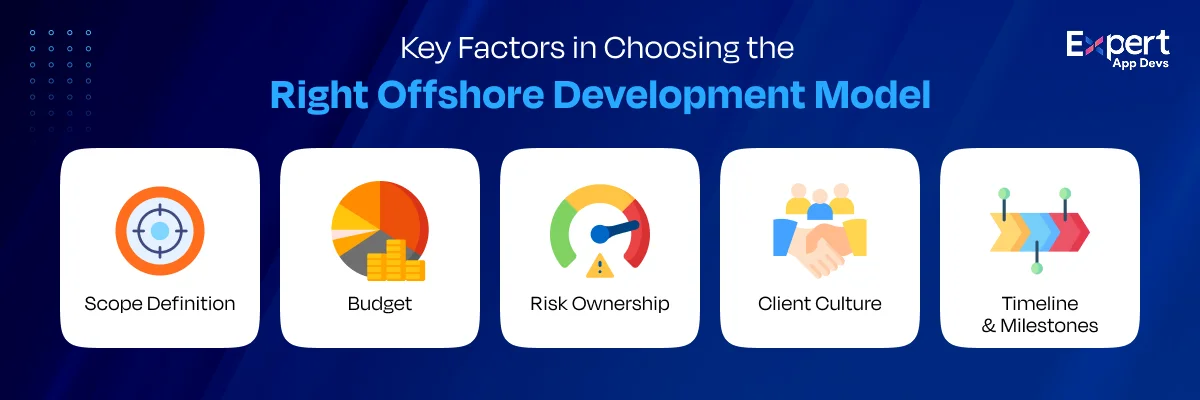
#1. Scope Definition
When you have a well-defined scope, you can choose either a fixed-cost and a milestone-based model.
In both cases, you can reduce the uncertainty with a clear scope.
However, if the scope will evolve as the project progresses, you should consider time & material or a monthly hire.
In both cases, you need a more agile environment as the focus remains on innovative solutions.
You should ideally assess the level of flexibility needed by your client while judging if the requirements will change mid-project.
A properly defined scope can help navigate you towards the delivery app business model aligned with your client's expectations and project needs.
#2. Budget
If you have a client with financial boundaries, you should look for a delivery model that balances predictability and adaptability.
The fixed-cost model can help the client with a strict budget by offering them certainty.
If you have to allocate budgets as the project evolves, you can go with the time & material model.
In case of misalignment, you can feel the friction as the clients feel blindsided by the cost escalations.
However, you might need to face losses if your estimate is conservative.
That’s why you need to understand the budget along with the flexibility it offers to select the right approach.
#3. Risk Ownership
It is crucial to understand who will shoulder the risk while choosing the right delivery model.
Fixed-model costs place the risk on you as you deliver within the agreed scope.
However, time & material or monthly hire models will distribute the risk evenly.
That’s because clients tend to pay for the effort rather than guaranteed outcomes.
In the case of a milestone-based model, you will notice that it takes a middle ground.
The risk is broken down into manageable stages.
You should ideally assess whether they can absorb risks without hampering the margins or whether the risk would be shared for a healthier collaboration.
#4. Client Culture
The expectations of your client, along with the organizational culture, will also shape the way the delivery model will be perceived or executed.
For clients in the European region, structure and strict compliance are important.
That’s why they look for fixed cost or milestone-based approaches.
The fast-paced markets like the US prioritize flexibility and innovation, which makes time & material model ideal for them.
In the case of MENA region, trust and relationship-driven agreements are important, which makes milestone-based models ideal.
You should consider whether the client leans towards predictability or adaptability to make the final decision to ensure smooth collaboration.
#5. Timeline and Milestones
The timeline of the project can influence the choice of your delivery model.
If you have rigid deadlines and deliverables, you should look for milestone-based models where structure and momentum are important.
Fixed cost contracts can help if you have a clear scope and timeline.
However, in the case of long-term contracts, you should choose the time & material model.
If you have mismatched models, you will miss deadlines or rush through the project.
Monthly Dedicated Development Team Offshore Delivery Model: When Consultants Need Flexibility
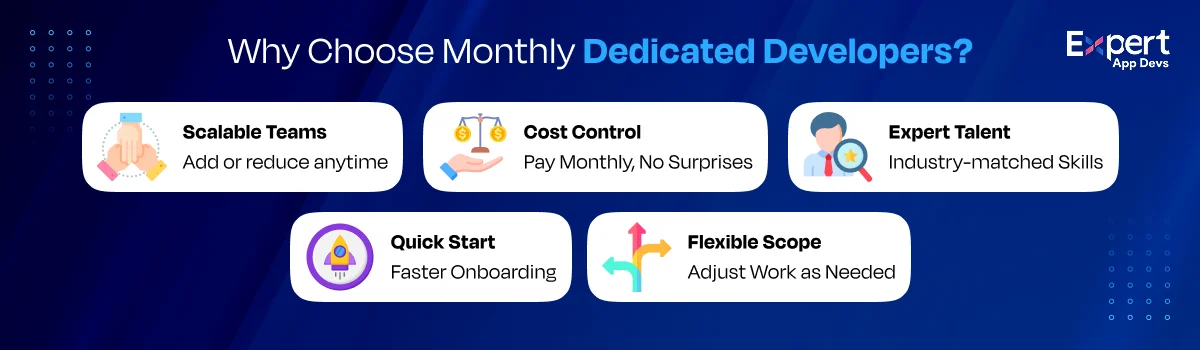
Sometimes all you need is an app developer who will be supporting your project month after month without being locked into a rigid contract.
The monthly dedicated team model supports this aspect. You can hire the developers full-time and they will integrate into your existing teams, becoming an extension.
This would help improve the flexibility and stability of your team and project.
According to recent research, organizations have used this model to report a 30% boost in the product quality and user satisfaction while reducing development time by 20%. (source: moldstud)
At least 62% software companies who have adopted remote work policies rely on dedicated developers for reliable and long-term support. (source: gitnux)
The dedicated model is ideal in case of a long-term and evolving project.
For instance, agile MVP development or ERP rollouts can benefit from this model.
In the case of ERP rollouts, the projects typically run for months and need incremental integration.
When dedicated developers work with you and your client’s IT teams, they can manage the complex modules in a step-by-step fashion.
You can avoid knowledge gaps and maintain continuity, thus ensuring thorough compliance and audit-ready solutions.
For agile MVP development, you need to gather client or end user feedback while reiterating the solution without renegotiating the terms.
With a monthly hire, you can scale the team effectively while keeping the costs predictable.
A real-life scenario involves a Germany-based project manager who contracted with two full-time React developers on a monthly basis.
They collaborated with the UX team for rapid iteration and backend integration. This would help deliver the project on time.
Let’s look at the month-by-month view of a dedicated development team model arrangement.
|
Month |
Activities & Deliverables |
Team Size/Velocity |
|
1 |
Onboarding your React developers; alignment with UX workshop |
2 developers |
|
2 to 3 |
Working on core UI components; initial MVP spring |
2 developers |
|
4 to 5 |
Expansion on features like auth and API; QA added for sprint testing |
2 developers and 1 QA |
|
6 |
MVP is ready. Client review with feedback cycles |
2 developers and 1 QA |
|
7 to 8 |
Scalable improvements. Backend development with data flows |
2 developers, 1 QA and 1 backend developer |
|
9 to 12 |
Continuous iteration |
4+ team members |
Fixed-Cost Offshore Delivery Model: When to Use and Why It Works
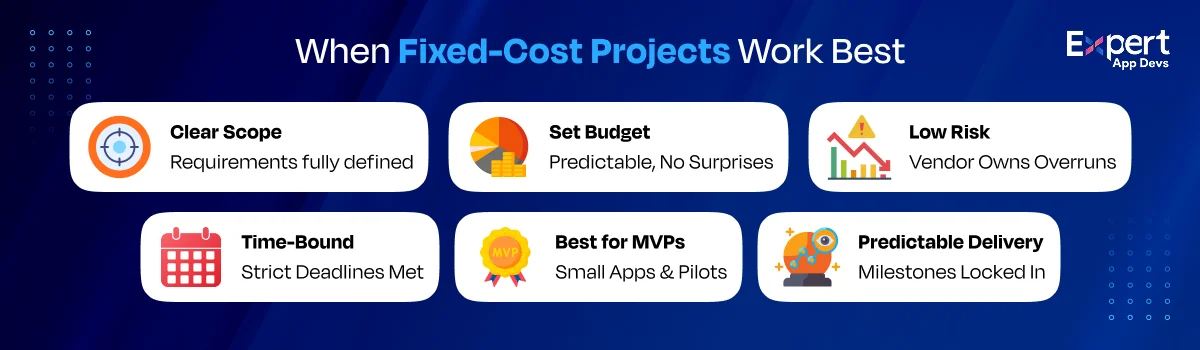
Imagine you have signed a project contract where all the stakeholders are aware of the cost, timeline and deliverables.
This means there is no room for surprises or hidden risks.
That’s what fixed-cost projects offer, clarity from day one.
In a fixed cost model, you will note that consultants and clients agree on the scope of work, milestones and total budget upfront.
As soon as both sides have signed the contract, they will be bound by it.
This makes up for predictability in consulting and IT projects. According to the MoldStud report, 78% of the clients prefer a fixed cost project as they offer transparency and budget control.
There are specific conditions under which you will find success with this model.
Your scope should be clearly defined.
By scope, we mean the features, module and requirements should be mapped to perfection.
At the same time, you should lock in the timeline and deliverables that include milestone payments so that both sides are accountable.
If the foundation is solid, you can ensure that the fixed cost project works like a clockwork.
The fixed-cost model is perfect for MVP development, where the features are well-planned and the goal is to deliver fast.
It is also ideal for legacy modernization pilots, where your objectives are specific.
It is a popular model in the MENA region, especially in Kuwait and Bahrain.
That’s because public-sector clients prefer working with rigid and pre-approved budgets that leave no space for time and material contracts.
The fixed cost can fit into these constraints while adhering to procurement compliance.
It also provides you with a clear framework to operate.
However, the financial risk in this model lies with the consultant, offering the clients peace of mind.
As consultants, you will gain successful outcomes if you have planned well and defined the scope properly.
Milestone-Based Offshore Delivery Model: Balancing Progress and Accountability
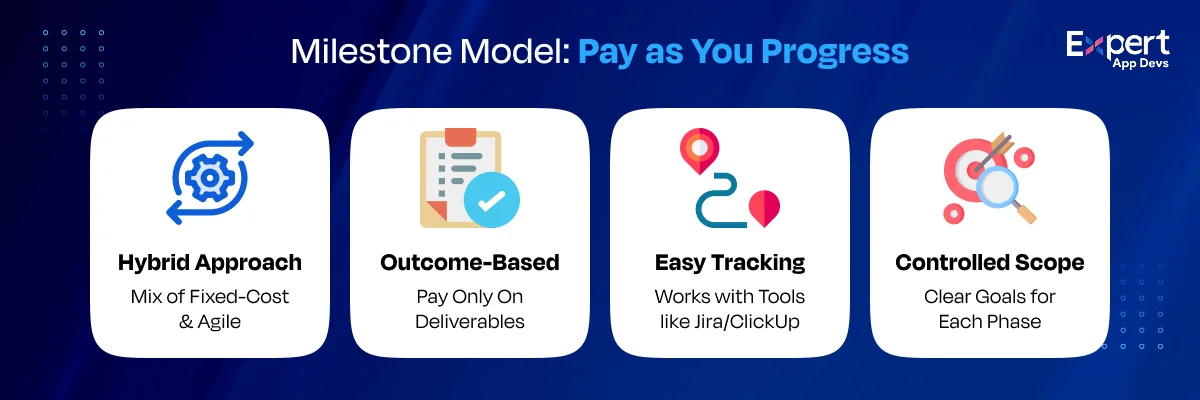
Sometimes your project needs a fixed-cost structure with agile delivery flexibility.
That’s when you should use milestone-based engagements.
You can tie your payments to measurable outcomes to allow consultants and clients to stay aligned.
It allows you to progress with the project without losing accountability.
#1. Combines The Benefits Of Fixed-Cost + Agile
Milestone-based contracts are a hybrid delivery model.
It gives your clients the predictability regarding budgets that usually comes with fixed-cost solutions.
At the same time, like agile models, they allow your projects to evolve with new requirements.
The milestones are properly scoped, priced and delivered, allowing you to pivot after every phase without renegotiating the contracts.
With this approach, the clients remain confident of the project and the consultants can deliver iterative value.
#2. Payment Tied To Outcomes
Milestone models depend on the results and not the hours of work done.
The typical flow of this model looks like this: Figma → UI Dev → Backend API → UAT
In this case, the checkpoints become mini contracts.
As the consultant achieves these milestones, the client will pay.
It will eventually reduce the risk for clients and the consultants can benefit from a steady cash flow.
#3. Works Best When Paired With ClickUp or Jira Tracking
Transparency is crucial in milestone-based projects.
When you combine this model with project management tools like ClickUp or Jira, you can improve task assignment, velocity tracking and document deliverables for each stage.
With this approach, your clients get complete visibility into the progress and the consultants can avoid status update calls.
The clear dashboards can ensure the milestones are accomplished on time, tying them to tangible outcomes.
#4. Reduce Scope Creep By Setting Contractual Phase Goals
Scope creep is your biggest headache as a consultant.
With the milestone-based model, you will lock the scope for each phase.
As new requirements come by, you will push them to a future milestone without derailing the current one.
As a result, all involved stay focused and avoid budget overruns.
It will also ensure that you don’t absorb unplanned work without being compensated for that.
|
Milestone |
Tasks Included |
Timeline |
Payment Trigger |
% of Project Fee |
|
Discovery & SOW |
Requirements gathering, functional spec and wireframe development, finalizing the tech stack |
1 to 2 weeks |
Approved SOW and signed off wireframes |
10% of the total budget |
|
UI/UX Design |
High fidelity screens using prototyping tools, clickable prototypes and a design system |
Week 3 and 4, two weeks needed |
Sign off on prototypes and design approvals |
15% of the total budget |
|
Frontend Development |
Implementing the UI using React or Flutter layouts, basic navigation development |
3 weeks, from the fifth to the seventh |
Provide a demo of a working frontend screen |
20% of the total budget |
|
Backend Development |
API development, database management, authentication development and core business logic implementation |
3 weeks from week 8 to 10 |
A functional backend integrated with the frontend |
20% of the total budget |
|
Integration & UAT |
Payment gateways, third-party APIs and multi-language support |
Weeks 11 to 13, 3 weeks |
UAT completion with client sign-off |
20% of the total budget |
|
Deployment & Handover |
App store submission and production release |
3 weeks from week 14 to 16 |
Successful deployment with complete documentation transfer |
15% of the total budget trigger |
A chart like this will help you tie all the payments to tangible outcomes, thus reducing disputes. It can also help you improve cash flow. Clients will notice steady progress throughout the process while maintaining accountability.
Time & Material (T&M) Offshore Delivery Model: Best for Innovation and R&D Projects
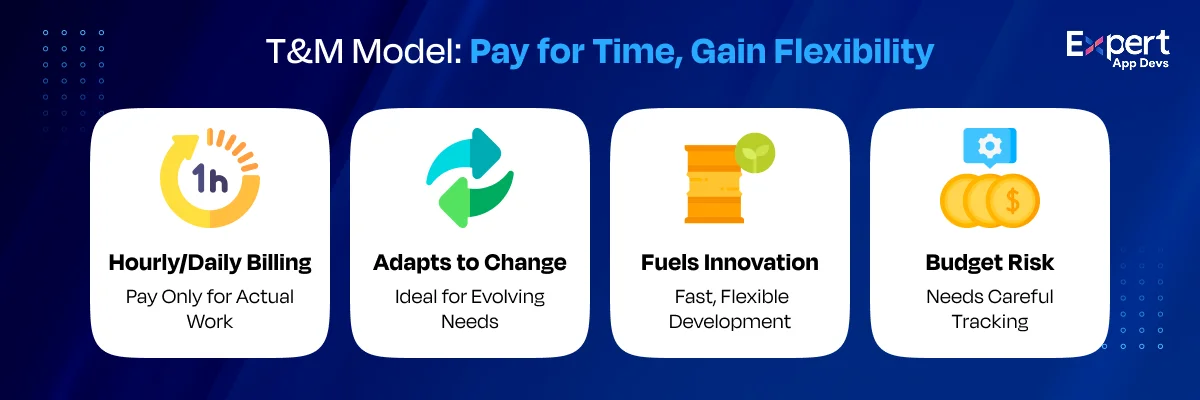
You cannot use a rigid contract model when you have fluid requirements and prioritize innovation.
For such requirements, you should choose T&M model.
It is a flexible engagement style that thrives on speed and adaptability.
#1. Hourly/Daily Billing For Undefined Or Changing Requirements
T&M is a straightforward model where the clients pay for the actual hours or days that the consultant or developer has worked.
That’s why it is ideal for projects where you have undefined project requirements or one with evolving needs.
In this model, consultants and developers can explore various solutions to make adjustments without amending the contracts.
#2. Allows Flexibility And Speed
Innovation would need rapid pivots and that’s where T&M matches perfectly.
Whether you want to test the new backend integration in a week or switch to a new API, this model works immediately.
T&M allows you to adapt client feedback in real-time while ensuring the project is relevant in a fast-changing market.
This agility will result in faster iterations and a creative problem-solving method.
#3. Risk: Budget Overrun If Not Carefully Scoped
Flexibility comes with its flip side.
There are no guardrails in this delivery model, which means you can easily go over budget.
As billing is completely defined by the time spent, if the project drags on, you may need to pay more.
You should set the expectations early in the project.
Including regular check-ins, burn-down charts and time tracking can also prevent you from spiraling out of control.
#4. Used By Us-Based Digital Agencies For Short-Term Backend Builds
T&M is very popular in the US, especially when they are looking for short-term and backend-heavy projects.
If an agency needs rapid server-side support for a campaign, they will hire developers using the T&M model.
Quick Tip: You can pair T&M with bybrid teams where the onshore consultant drives the strategy and offshore developers execute them.
Use this model for fast ideation cycles. In this setup, the delivery would be lean and responsive.
Comparative Analysis: Strengths and Weaknesses of Each Offshore Delivery Model
Project mechanics alone don’t define the delivery models for your project.
You must balance your profitability with client satisfaction while looking for models.
Each model offers specific strengths and trade-offs. What works for one project may not work for another.
Your goal should be to reduce risk while keeping margins healthy and maintaining control over deliverables.
Your client may be concerned about predictability, cost transparency and timely deliveries.
You might want to find the model that balances the two while building on your trust.
Here is a detailed look of how each model helps.
|
Model |
Pros |
Cons |
Best For |
|
Monthly Dedicated Developers |
Prioritize client projects full-time. can easily scale your teams and offers strong collaboration with in-house teams |
You need to pay monthly even when workload goes low. It requires a clear task pipeline. |
Long-term projects, ERP rollouts and MVP development. |
|
Fixed Cost |
Predictable budget with locked timelines. Low financial risks for clients |
High risk for the consultants if scope is unclear. Less adaptable. |
MVPs, Pilots and projects with rigid scope. |
|
Milestone-based |
Balanced risk and flexibility. Reduces scope creep |
Strong management needed. Delays in a single milestone can impact another. |
Structure and agility is important |
|
Time & Material |
Maximum flexibility and easily adapts to evolving scope |
Risks of budget overruns and requires careful time tracking. |
R&D, Innovation Projects and short-term builds. |
In short, the fixed-time model is predictable while T&M offers innovation.
Milestone-based contracts offer a healthy middle ground and monthly developers can help maintain project continuity.
Handoff Matrix: Which Offshore Delivery Model Suits Your Project Type?
All projects don’t play by the same rules.
That’s why you must choose the right delivery model.
The handoff matrix can help you map the project types to the model that can help balance risk, cost and delivery success.
Let’s understand them in detail.
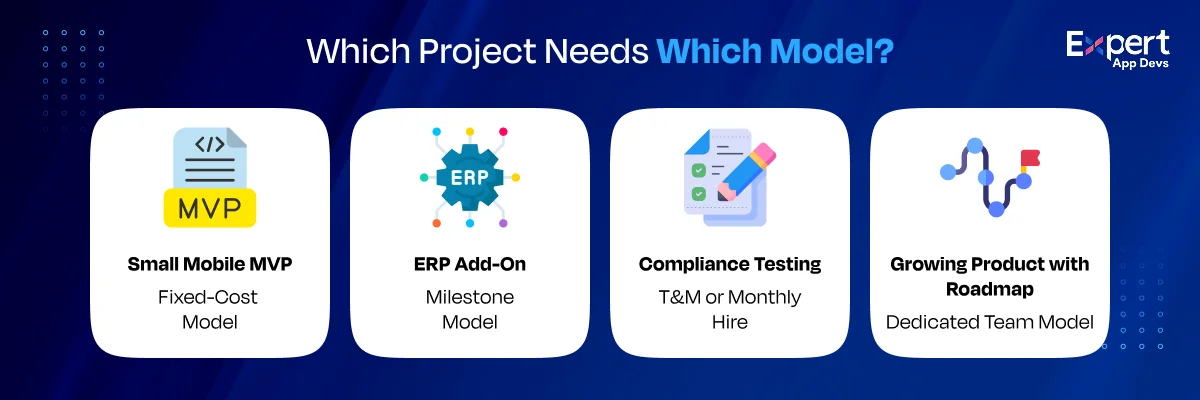
#1. Mobile MVP with Fixed Scope
If you are creating a mobile MVP using a clearly defined feature set, you should go with a fixed-cost model.
Everything from the scope, deliverables to the timeline is locked in to let everyone know what’s expected.
These projects take up to 12 weeks, which makes them manageable and predictable.
You can focus on execution without worrying about scope creep.
#2. ERP Extension with Arabic UI
The large ERP systems need more targeted extensions.
For example, you are adding an Arabic user interface to ensure regional compliance.
This is where milestone-based contracts can help.
There would be a milestone for each phase, like UI wireframes, integration testing and others.
As a result, each aspect is tracked and billed separately to manage cross-functional delivery.
This will ensure that consultants don’t face risks while clients follow a structured process.
#3. Compliance Testing (GDPR/HIPAA)
If you prioritize compliance, requirements cannot be fixed.
To ensure GDPR and HIPAA regulations adherence, you need to onboard niche experts.
This might need anywhere between a few weeks to months.
Time & Material or a monthly hire setup can help you in this case.
The clients will pay for the time spent on the work, while consultants can get specialists for the job.
#4. Product with Evolving Backlog
If you are building a product using a proper roadmap that can shift as the market evolves, you must maintain continuity.
Using the monthly hire model, you can retain control while the dedicated team makes steady progress.
|
Project Type |
Best Model |
Notes |
|
Mobile MVP with fixed scope |
Fixed-Cost |
Up to 12 weeks dev time |
|
ERP extension with Arabic UI |
Milestone-Based |
Ideal for cross-functional delivery |
|
Compliance testing (GDPR/HIPAA) |
T&M or Monthly Hire |
Access to niche experts |
|
Product with evolving backlog |
Monthly Hire |
Consultant retains roadmap control |
Budget Estimations: Typical Cost Ranges Per Offshore Delivery Model
You will get the budget right by knowing what the delivery model costs.
Here is a detailed breakdown of the typical ranges for each model so consultants and clients align their expectations.
|
Model |
Cost Range (USD) |
Best For |
|
Monthly Hire Pricing |
$2,500–$6,000/mo/dev |
EU/US consultants |
|
Fixed-Cost Pricing |
$8,000–$25,000/project |
MVP, SAP/Oracle apps |
|
Milestone Pricing |
$10,000+ phased |
ERP, integrations |
|
Time & Material Pricing |
$22/hr–$40/hr |
Short-term needs, testing |
Risk Management Across Offshore Delivery Models
Every delivery model comes with specific risks.
Each of them offers unique advantages for both consultants and clients.
Here are all the typical risks you are likely to face and ways to stay ahead of them.
#1. Underestimating The Effort In Fixed Costs
Fixed costs can be attractive as they assure budget certainty. However, if you have underestimated the scope of work, you will need to put in extra effort without the additional pay.
As a result, you will face rushed delivery and can compromise on quality.
The key to success is a clear scope, a realistic timeline and change control clauses in the contract.
#2. Monthly Hire Talent Churn
In this case, your major challenge is people.
You may find that your offshore developer or specialist has churned mid-project if you haven’t engaged them properly or offered better opportunities.
This risk can lead to delivery delays and extra onboarding costs for you.
To avoid this risk, you should work with vendors who guarantee replacements and have strong engagement practices.
#3. Payment Disputes
In milestone-based contracts, the payments are tied to the deliverables.
This can backfire if you haven’t defined completion of the milestone.
The clients may push back on acceptance and can delay the payments. You should always align the milestone definitions with the payments using project management tools like ClickUp and Jira to set the objectives of acceptance.
#4. Budget Overrun In T&M
While there is a lot of flexibility in T&M, you might experience a budget overrun.
The absence of guardrails can lead clients to burn more hours in project completion.
That’s why you should set weekly or monthly caps for spending.
Share regular reports and have transparent check-ins to monitor the costs.
The bottom line is that clear contracts, transparency and proactive management can help reduce the risks.
Hybrid Offshore Delivery Model for Complex Projects
Sometimes you may not get success by choosing a single delivery model.
You need to blend smart teams and match them with suitable models to accomplish your complex projects.
For example, when building an MVP, you must choose the fixed-cost model.
This will help define the scope and timelines clearly.
But when the MVP goes live, the post-launch story is different.
The features evolve based on user feedback, and you need to embrace the monthly hire model to tackle this increasing backlog.
Let’s consider compliance, wherein you need to adhere to GDPR or HIPAA.
It doesn’t come with a playbook.
The T&M model can help you engage the specialists without overspending or investing a lot of time.
In case of large enterprise rollouts, like an ERP extension, you need a milestone-based model.
This will provide you with the much-needed accountability and progress tracking.
This means every phase from UI to integration will be delivered and then paid for using structured steps.
With a hybrid approach, you can align the right model to the project stage to maintain balance.
It would reduce risks while keeping the costs under control.
Final Tips for Choosing the Right Offshore Delivery Model
Choosing the right model is half the battle won.
The other half depends on the safeguards and practices you incorporate to make the delivery smoother and client relationships stronger.
It will also help manage the risks.
Let’s look at the top four practical tips.
#1. Always Request White-Label-Ready Devs (Invisible To End-Clients)
Choose white-label ready talent when hiring offshore professionals.
They can work invisibly while consulting under your brand.
You can keep the client’s trust intact and avoid awkward questions regarding outsourcing with this.
It will also help you scale your team without revealing the operational details that dilute your value.
#2. Use Project-Specific NDAs
Generic NDAs may not protect you when you are dealing with a complex project.
You should always create project-specific NDAs that outline the IP ownership with data confidentiality and client consultant boundaries.
It will help you reduce the legal ambiguities and assure your clients that the sensitive business logic won’t be leaked outside the ecosystem.
#3. Set Timezone Alignment Rules
Timezone misalignment can become a silent productivity killer.
Set the overlap rules from the start.
For example, if you are considering an overlap between India and the MENA regions, you might have a four-hour window.
A few hours of real-time collaboration can help you coordinate faster and overcome the blockers without causing delays.
#4. Recommended Slack, Google Meet and Notion
You should use tools that can help with collaboration.
Slack for instance deals streamlines daily communication, while Google Meet can improve client calls.
Notion centralizes all your project docs and task management.
FAQs About Offshore Delivery Models in Software Development
#1. Which Model Gives Consultants The Most Control?
The monthly hiring model is the one that gives you maximum control as it helps you manage the team, backlog and delivery pace. It is an ideal model for projects that use evolving roadmaps.
#2. Is Fixed-Cost Risky For ERP Mobile Apps?
Yes, as ERP extensions involve hidden dependencies and shifting requirements fixed-cost can be risky. You should consider milestone-based models that reduce risks while keeping budgets predictable.
#3. How Do I Price A Milestone-Based App Work?
You should break the entire project into clear and manageable phases while assigning the costs per milestone. You can tie your payments to deliverables while defining the acceptance criteria to avoid disputes.
#4. Can I Mix T&M With Fixed-Cost In The Same Project?
Yes, most consultants use fixed-cost for MVP and T&M for compliance or R&D where scope is uncertain.
#5. How Do I White-Label A Dedicated Dev Team?
You should work with vendors that provide white-label ready developers. They will operate under your brand with no exposure to the clients.
#6. Can The Clients Switch Models Mid-Project?
Yes, but only when the change agreements are completely clear. The consultants can shift from fixed-cost MVP to a monthly hire to manage backlog work.
#7. What Are The Legal Clauses Used To Protect Consultants In Offshore Deals?
The key clauses like NDA, IP ownership, scope-change controls and payment milestones can safeguard consultants against scope creep and delayed payments.
Conclusion: Selecting the Best Offshore Delivery Model for Sustainable Success
Choosing the right delivery model isn’t about budgets alone.
You must have a balance between control, flexibility and client satisfaction.
Whether you are looking for fixed-cost predictability or milestone-based accountability, the right choice can help you ensure project success.
The consultants across Europe, MENA and the US must weigh in risks, client culture and scope before committing to the delivery model.
When you make the right decision, you can save time, money and relationships.
You should partner with the right app development experts to choose the right delivery model for your app project.
Expert App Devs offers professional mobile app development services across Android, iOS, Flutter, React Native and other cross-platform technologies.
We deliver high-performance native and hybrid mobile solutions tailored for startups and enterprises.
In addition to end-to-end development, we provide a full range of application services, including maintenance, support and ready-made solutions to clients in North America, Europe, the Middle East, and Oceania through strategic outsourcing from India.
We also welcome new consultants from these regions to partner with us and explore collaborative opportunities.





 172
172

 0
0


 177
0
177
0
 139
0
139
0
 198
0
198
0