


- Executive Summary
- Introduction: Why App KPIs Are Non-Negotiable at the C-Level?
- What Makes a KPI Worth Tracking?
- Top 10 KPIs for Enterprise App Success
- How to Monitor and Analyze KPIs Effectively?
- From KPI Data to Strategic C-Level Action
- Commercial vs Informational KPIs
- Common Mistakes by Executives When Tracking KPIs
- Frequently Asked Questions for Executives
- Conclusion & Strategic Next Steps
Ready to transform your vision into reality?
Get Started
Top 10 KPIs to Track for Enterprise App Success at the C-Level
 167
167
 0
03 Jul 2025
Min Read
0
03 Jul 2025
Min Read


 Share
Share

 Download PDF
Executive Summary
Your enterprise application isn’t just another IT asset; it is a revenue engine for your business. But without tracking the right mobile app KPIs, you risk flying blind. This blog will outline the top 10 metrics every CTO and CIO should monitor to connect their app’s performance with business impact. From adoption rates to ROI, these KPIs give you a clear visibility into what’s working. If you cannot measure it, you cannot improve the app, thus risking revenue leakage.
Introduction: Why App KPIs Are Non-Negotiable at the C-Level?
What you cannot measure today in your mobile app KPIs could be your $935 billion miss tomorrow for your enterprise. Your enterprise apps are powering everything, from the fintech apps in the Middle East to the supply chains of North America and the collaboration suites of Europe.
While it can prove to be risky to depend on your gut and generic logs to improve these apps, consider that the global app economy is soon to reach $935 billion by the end of 2025. Tracking core mobile app KPIs/metrics like DAU/MAU, crash-free sessions and average response time isn’t just an operational hygiene anymore; it is a strategic intelligence.
Using these numbers, you will know where to scale the infrastructure, how to improve the app’s security and when to accelerate innovation. By turning data into actionable insights, you can shift from reactive firefighting into proactive growth.
If you want to track the right mobile app KPIs is critical for large enterprises that want measurable visibility into adoption, performance, ROI, security and more.
Top monitor app KPI metrics like Turnover and retention or ensuring mobile app KPI dashboards support compliance, C-level executives need clarity for budget justification and vendor evaluation.
If you cannot measure the impact of your business, you will notice more gaps that cost you money and reputation.
According to industry experts, coordinating mobile app KPI metrics with enterprise rollouts helps reduce churn, accelerate timelines, and strengthen ROI.
What Makes a KPI Worth Tracking?
Your KPIs are only as valuable as the decisions they enable. High-impact KPIs are directly tied to your business goals like growth, user satisfaction, security and ROI. On the other hand, vanity metrics are impressive but lack substance as they don’t give you a complete picture of the app’s performance.
For you to be tracking a KPI at the C-level, you need to make sure the metric is actionable, aligned with the strategic priorities and measured consistently.
Let’s take a look at the difference between a vanity metric and high-impact mobile app KPIs.
Vanity Metrics
You’ll notice that these metrics capture the attention of your stakeholders, but they don’t offer clarity or direction to your enterprise app. Let’s take a look at some of them.
- App Downloads: While a million downloads is good for your business, if even 5% of them aren’t active, it will stall your app’s growth.
- Page Views: A spike in traffic doesn’t mean your users are converting or finding value with your application.
- Feature Release: Feature adoption is the most important thing and not the total features you have released.
High Impact and Actionable KPIs
With these metrics, you will know what is working and what’s not for your application.
- Monthly vs Daily Active Users: This will signal the app’s engagement and retention strength.
- Cost per Active User: It ties the total usage to the investment and helps you justify the budget.
- Crash-free Sessions: It can impact the user’s trust, NPS score for the app and its reliability.
- Average Resolution Time: It informs how quickly the app tech team will mitigate the situation.
Here’s a quick checklist to identify high-impact app metrics.
- Does the KPI tie to revenue, efficiency or user value?
- Will it help with resource allocation and investment?
- Can the team take action using these metrics?
If the answer to these questions is no, you are not evaluating a metric but noise. You should always focus on metrics that help you know how to act and understand what happened with the app.
Top 10 KPIs for Enterprise App Success
To deliver a successful enterprise app at the C-level, you need KPIs that fall into these broad five strategic categories- adoption, performance, engagement, ROI and security. They would reveal the key insights for the entire app’s lifecycle. Here is a complete breakdown of the top 10 essential mobile app KPIs/metrics.
✅ADOPTION & ENGAGEMENT
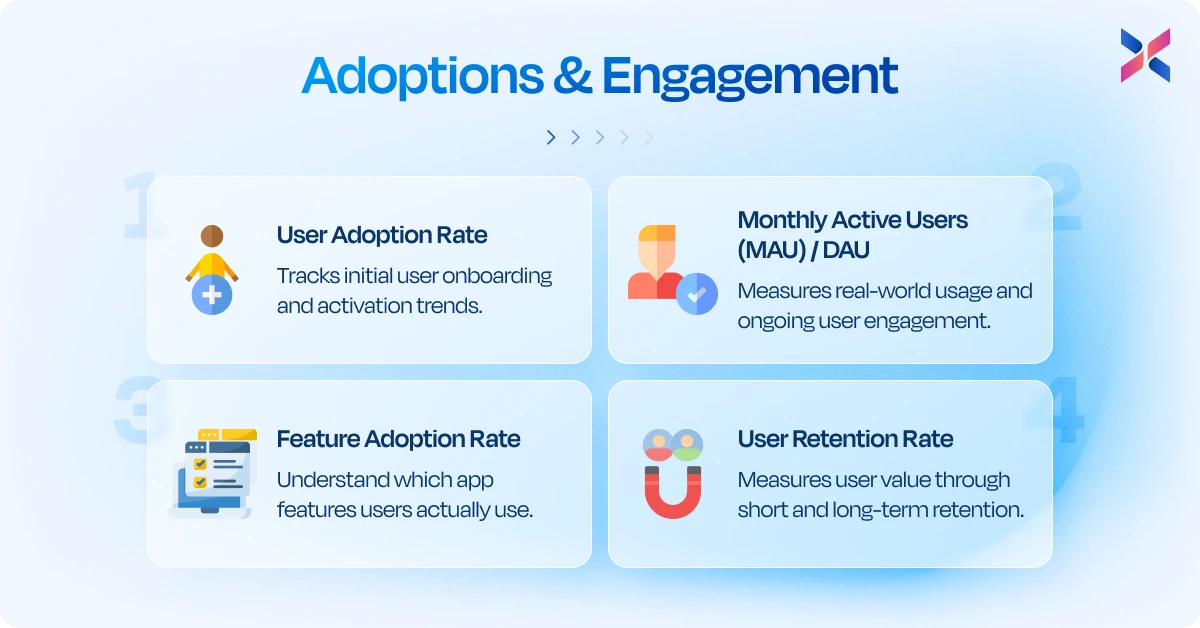
KPI 1: User Adoption Rate
Did you know that 78% of enterprise mobile apps are abandoned after a single use? Only 5% of the users who have downloaded it stick around for 30 days. That is a red flag for you as a C-level executive in an enterprise.
Along with user adoption rates, you can track initial buy-in after the app has been deployed. It tracks download vs activation metrics along with the first login of the user. The idea is to understand if people are using the enterprise app or have just downloaded it. Their first session is your tipping point.
Downloads might increase, but they are not indicative of growth or ROI. If only 20% of those who have downloaded tend to log in, you might notice a shrinking ROI. By tracking activation, you can improve the onboarding, reduce friction and simplify the workflow.
A global bank rolled out its data management app for the risk team. They measured the activation rates and noticed a slow and low onboarding. They simplified the access flows and included in-app prompts. They noticed that the usage increased from 50 to 3000 employees across 12 departments, which helped them generate $15Mn+ in revenue.
Track the user’s download, activation and first login. Identify where the users drop off and iterate on onboarding. You will convert the installs into long-term value customers with this.
KPI 2: Monthly Active Users (MAU) / DAU
For enterprise apps, downloads are very easy; daily use of the app may not be. If you don’t see your users logging into your app regularly, it is not mission-critical for them as yet. Monthly Active Users and Daily Active Users are essential as they show how often the app is used by your users.
MAU mentions the broad engagement, while DAU gives you a pulse into the daily use of the application. Together, these ratios will help you determine how sticky your application is. A low DAU/MAU ratio indicates that the user may not check in regularly. On the other hand, a higher ratio means it is embedded in their daily workflows.
There are some industry benchmarks you need to know. Retail enterprise apps like POS and inventory often hit a 60% on the DAU/MAU ratio. Healthcare tools can hit around 40-55% while logistics tends to hit 75%.
You can use this metric to determine the app dependency and identify where/how the usage dips. Build a trend chart to see if the app is growing to become vital or quietly fading for users.
KPI 3: Feature Adoption Rate
If only 20% of your users are using 80% of the features, you should know that you have not created a product but a clutter. Feature adoption can help you understand what truly matters to your users. By tracking feature adoption, you can learn how specific functions or modules are used in an enterprise application.
You will learn if the most critical features within an application are gaining traction. You will also know if they are buried among the extras for the user. A higher user adoption indicates successful onboarding of the users and a complete product-market fit. In case of low adoption, you might need to focus on training gaps and UX friction. At the same time, you should also look for misaligned development priorities.
Using pathway and heatmap analysis, you will learn where the users click, scroll or drop off. If only a handful are able to access the analytics dashboard, you can prioritize training for the feature. Lastly, you could double down on the features with maximum traction while retiring those with minimum interaction.
There was a logistics company that noticed less than 30% dispatchers were using their route optimization feature. When they added tooltips and offered micro-training, they noticed an 85% increase in adoption.
KPI 4: User Retention Rate
Downloads may not help generate revenue; retention does. If your users don’t come back to the app after the first week, your app may be failing to deliver them value.
User retention helps you analyze how many users are continuously using the app over a period of time. Typically, it is measured at 7, 30 and 90 days after first use. Using this, you will get the real-world value your app needs beyond the initial impressions.
With strong retention, you can enjoy sustained engagement and lower support costs. It can also help increase the ROI. A weak retention rate means you are offering a poor onboarding experience or lack of relevance.
You can use cohort-based tracking that helps you compare retention rates by role, region or department. You can even spot early drop-off trends. For example, you will learn if the 30-day retention dips in quarter 3. Lastly, you can identify the most loyal user segments for your enterprise app and replicate them.
When a retail enterprise's inventory scanning app improved its offline mode features and added batch scanning, it noticed a growth from 40% to 78% in its 30-day retention rate.
✅PERFORMANCE & RELIABILITY
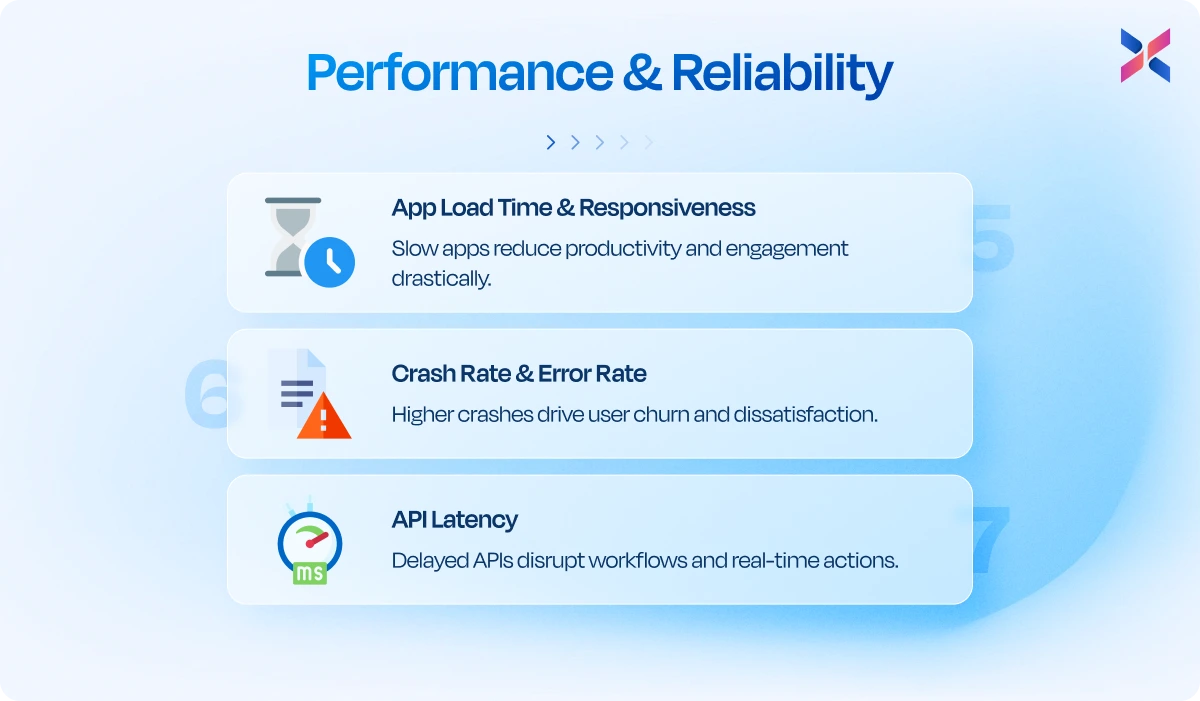
KPI 5: App Load Time & Responsiveness
Every second of delay can cost your business in terms of productivity, satisfaction and revenue. If you have a sluggish application, you are not annoying users; you are owning a liability.
Using this application performance metrics/KPIs, you can track the time it takes to launch the application, load key screens, and respond to user inputs. You will learn how efficient and usable your app is in real-world scenarios.
Speed is critical for an enterprise, whether you are a healthcare worker or a field technician. Lag can kill the efficiency of your users and frustrate them. You should ideally set the load time thresholds. For example, have a <2 for login and a <1 for tab switches. You should monitor the responsiveness of the app during peak and low bandwidth hours.
Finally, use synthetic and real-user monitoring to find performance bottlenecks.
Slack reduced their desktop load time by 33% in 2020 after they identified the delays and local cache handling. As a result, they were able to deliver faster user access and higher daily engagement.
KPI 6: Crash Rate & Error Rate
A 1% crash rate can cause about 15% user churn for your business, especially when you are dealing with high-pressure enterprise environments and an increasing need for reliability.
The crash rate metric tracks the total percentage of app sessions that end due to a failure in the system. The error rate in this case would include all the client-side issues, such as broken API calls or page errors. This will indicate the technical stability and reliability of the application, in turn marking the user’s trust.
If your app crashes frequently, it can erode your users’ confidence and drive them away. If you have a high error rate, it indicates an unstable backend or poor code management.
You should frequently monitor crash-free sessions across all the platforms. Segment the crashes into OS version, device type and app version. It is a good idea to set up alerts to understand error spikes after the app’s release.
Here’s a quick checklist that should help you prevent app crashes.
- Automate testing for each version release.
- Conduct real-time crash logging and alerting.
- Handle errors gracefully for the failed networks or API calls.
- Go for targeted patch releases in case of high-impact crashes.
KPI 7: API Latency
A tap on your enterprise app can trigger an API call. If there is a millisecond delay in this process, it will impact the transaction or the entire workflow. API latency is the time taken by your enterprise app to send a request to the server and receive its response.
It will evaluate the backend processing time along with network delays. This metric is crucial for real-time operations and apps where data syncing is important.
When you have a slow API, it can stall everything, from dashboard loads to order submissions and report generation. If you are operating in a highly sensitive environment, you might notice that the high latency can lead to frustrated users.
Set thresholds for latency by function. For instance, in case of critical operations, the threshold should be less than 300ms. Track the endpoint and user volume to identify bottlenecks. Lastly, monitor the API spikes after deployment or during load peaks.
Netflix is one such business that invested in edge API caching and request collapsing, which has led to reduced latency. This has helped improve streaming experiences and faster loads, even during peak traffic.
✅SECURITY & COMPLIANCE
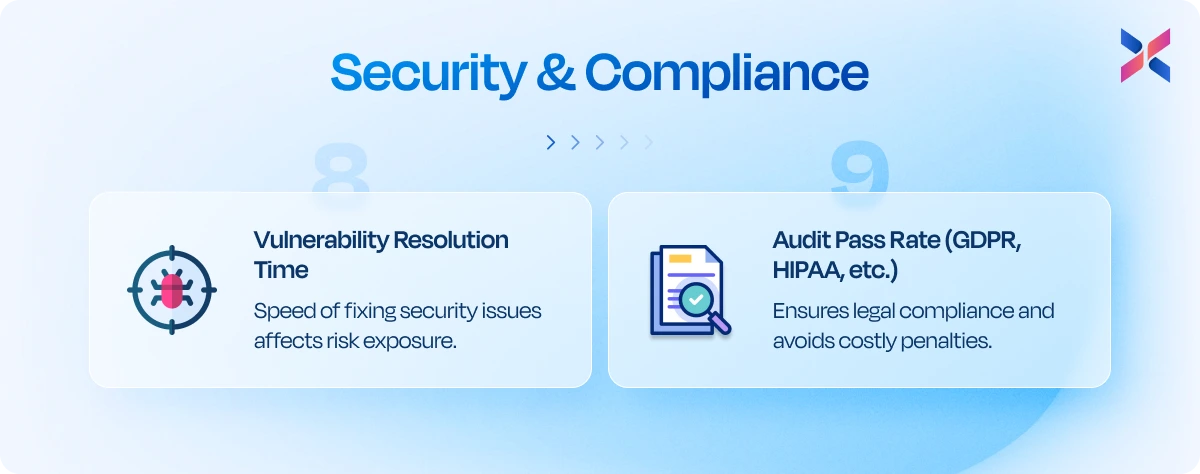
KPI 8: Vulnerability Resolution Time
According to a report by IBM, the average cost of a data breach in 2023 had reached $4.45 million globally. For sectors like finance and healthcare, delayed patching was risky and a regulatory failure.
With this KPI, you can track how long does it take for the team to determine, triage and solve the security issues in the application. It also reflects the risk readiness and governance maturity exhibited by your application.
If you have a long patch cycle, you leave your enterprise exposed to attackers and downtime that causes reputational damage. It is also critical for compliance-heavy industries, where security issues indicate non-compliance.
You should track vulnerabilities across security levels. Make sure to measure the mean time to patch and compare it across all the product teams. Finally, monitor the frequency and closure rates for common vulnerabilities and exposures.
In 2017, Equifax’s breach exposed around 147 million records. It was caused due to a known vulnerability in Apache Struts. The delay in resolving this breach became expensive for the company, leading to a $700 million settlement and remediation cost.
KPI 9: Audit Pass Rate (GDPR, HIPAA, etc.)
GDPR fines exceeded 2.1 billion pounds in 2023, with the likes of Meta, TikTok and local banks being fined for non-compliance. If you are operating in a regulated market, an audit pass may not be another IT concern; it is a business-critical safeguard.
With the audit pass rate, you measure the percentage of compliance audits your enterprise app has passed without critical findings. This metric will reflect how aligned your app is with industry-specific regulations like GDPR and HIPAA.
When you fail the audits, you attract huge fines and operational trust. Additionally, you will lose the client’s trust in your business and your reputation. A high pass rate indicates that the app handles all the data responsibly and ensures an audit-ready system.
You should track a pass or fail status for all business units and platforms. Make sure to identify recurring non-compliance themes, like logging gaps or access control issues. Finally, use the metric to prioritize security investments for the application.
✅COMMERCIAL ROI
KPI 10: Infrastructure Cost Efficiency
According to a report by Gartner shared in 2022, nearly 32% of cloud spend is wasted due to underutilized resources or unoptimized app performance. As a C-level executive, tracking how your enterprise app infrastructure can translate into ROI is an important financial strategy.
These mobile app metrics can help you track how efficiently the app uses backend infrastructure like servers and cloud services in relation to app’s performance and usage. It will help identify resource waste, scalability issues and cost-saving opportunities for the business app.
An inefficient architecture will lead to increased IT costs and budget overruns. With a well-optimized application, you can use the budget for innovation and reduce TCO.
For this purpose, you should monitor the cost for each API call per active user or transaction. Implement autoscaling, containerization and performance benchmarking tools. Adopt technology like the single codebase of Flutter that can help reduce your development and maintenance costs.
Why It Matters: Inefficient architecture leads to ballooning IT costs and budget overruns. On the flip side, well-optimized apps free up budget for innovation, reduce TCO, and boost agility.
How to Monitor and Analyze KPIs Effectively?
APIs are the performance levers of your enterprise app that directly influence the customer’s experience, your operational efficiency and the revenue you generate. Yet, it is buried within the engineering dashboards, disconnected from everyday executive-level conversations.
If you want to make your enterprise app perform at scale, you need real-time API insights that are clearly visualized, owned and tied to your goals/outcomes.
The first step in this process happens to be selecting tools that offer the right mobile app KPIs/metrics to you as a stakeholder. We have curated the top tools along with their relevance.
|
Tool |
The Purpose |
Used For |
|
Firebase |
Helps with tracking real-time app and crash performance |
Crash diagnostics, error rate handling, mobile/web latency |
|
Mixpanel |
Offers behavioural analytics tied to user’s actions |
Feature usage tracking that is tied with API performance |
|
Dynatrace |
Provides end-to-end observability from frontend to the infrastructure level |
Enterprise-scale monitoring along with root-cause analysis. |
|
Tableau |
Offers executive-level data visualization |
C-suite reporting for API and financial data |
Using these tools, you can easily bridge the gap between technical performance and business outcomes, allowing the CTOs and CIOs to look into performance bottlenecks. CFOs can easily understand the infrastructure-driven ROI along with the cost per API call.
However, these tools are effective only when they are paired with accountability. You should assign ownership across departments to ensure API health is a shared responsibility and not just an IT concern.
For example, product teams can own feature adoption KPIs while finance can track infrastructure cost per transaction.
|
KPI |
Responsible |
Accountable |
Consulted |
Informed |
|
API Latency |
IT |
CTO |
Product Head |
CFO |
|
Infrastructure Cost Efficiency |
Finance |
CFO |
CTO |
Product Head |
|
Feature Level API Error Rate |
Product |
Product head |
Engineering Lead |
CTO,CFO |
|
AuditAPI Uptime |
compliance |
CIO |
IT |
CISO, CFO |
Once you have assigned clear responsibilities, you should make the API insights executive-friendly. Make sure to move it beyond dev logs, into the C-suite dashboard. They should provide latency spikes post-release, insights into cost per API transaction, and error-prone endpoints that impact user experience.
If you have a well-designed dashboard that offers a single source of truth for quarterly reviews, you can make informed investment decisions.
From KPI Data to Strategic C-Level Action
At the C-level, your data is as valuable as the decisions it influences. Mobile app KPIs are no longer operational checks but strategic signals that can help you determine the direction of your app and its business outcomes. You should be able to transform raw insights into timely actions.
For example, if there is a dip in feature adoption, it can trigger a redesign of your onboarding or postpone the feature rollout. If there is a high API latency in a particular region, you might need to improve infrastructure investment or shift the traffic routes.
To maximize the impact, you should ensure the KPI reviews are synced with executive decision-making cycles. If you build app data into your quarterly planning or product launch meetings, you can ensure faster and clearer decisions.
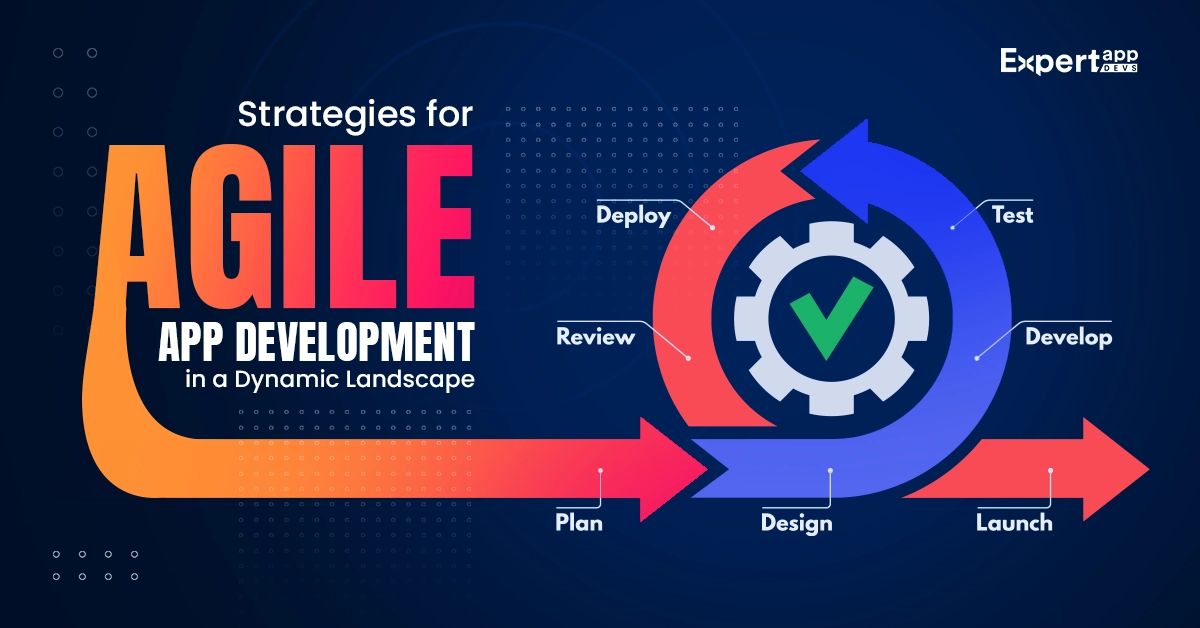
Implement agile feedback loops that move from tracking key performance indicators to analyzing, iterating and continuous improvement. You must partner with a Mobile App Development Services company that ties your delivery milestones to KPIs. This means they will not only build features but deliver measurable business value.
Commercial vs Informational KPIs
Each KPI carries a distinctive strategic weight at the C-level. While some impact the revenue or ROI of the business (the commercial KPIs), there are others that offer supporting context (Informational KPIs). You must understand this distinction to make the right high-stakes decision.
The commercial KPIs include Customer Acquisition Cost (CAC), Customer Lifetime Value (CLV) and Conversion Rate. It can impact your business’s bottom line. As a CFO or CMO, you can use these metrics to evaluate the marketing spend, pricing strategies or monetization models. It can prepare you for investment and scaling.
The informational KPIs include the Daily Active Users (DAU), app load time and engagement rates. Each is an early indicator of app health, its usability and adoption. While they may not translate into revenue for your business, they can help you analyze the enterprise app in depth.
As a C-level leader, you must track both these application performance metrics while prioritizing commercial KPIs.
Common Mistakes by Executives When Tracking KPIs
As a C-level executive, you can fall into the trap of tracking what is an easy metric instead of the essential one. If your KPI tracking is a checklist, it may not help drive high-quality decisions or measurable outcomes.
One of the most common mistakes made during KPI tracking is prioritizing vanity metrics like downloads and page views. If they are not connected to user retention or conversion, they may not help reveal the actual performance of the enterprise application.
You are flying blind when you choose to neglect security and compliance KPIs. If the metrics tied to GDPR and HIPAA are not given priority, you may go through data breaches or fines. These metrics are non-negotiable in the regulated industry and should be tracked along with the commercial metrics.
Most teams make the mistake of looking at product and financial KPIs in silos. If you track feature usage without knowing the cost per feature or its engagement, you may not know the cost of acquiring users or the churn rate. This can lead to fragmented decision-making.
Frequently Asked Questions for Executives
Que 1. How Do I Check App Metrics for ROI as a Non-Technical Leader?
You can use executive dashboards like Tableau or Power BI to check app metrics. This helps by translating the tech KPIs into business impact visuals. You can visualize the metrics like cost per user and conversion rate using these tools. Make sure to focus on metrics that are tied to acquisition, retention and infrastructure spend.
Que 2. What Is the Most Critical KPI for CTOs/CIOs in Regulated Industries?
The audit pass rate is crucial as it helps determine compliance with frameworks like GDPR and HIPAA. If the audit fails, it means reputational damage, legal issues and a lot of penalties for your business.
Que 3. How Can I Align KPIs across Different Global Regions?
By localizing the KPI baselines using market maturity and user behavior, you can align the KPIs across global regions. It will also happen smoothly if you use a global dashboard framework. You must use unified market definitions with data sources while reviewing the region-specific outliers during your executive check-ins.
Que 4. What Does It Cost To Implement KPI Tracking in an Enterprise App?
The cost to implement KPI tracking for your enterprise app can vary with the tech stack you are using and the scale of your application. The starting range is between $10k and $50k*. Using this amount, you get a custom dashboard along with analytics setup and tools like Mixpanel or Dynatrace.
Que 5. Why is a “People-First” KPI Approach Critical For C-Levels?
When you use metrics that are user behavior-centric, like adoption or retention, you can connect tech with human impact. People-first KPIs help reveal what drives engagement, satisfaction and loyalty. This helps you decide which ones are important for the growth strategy.
Que 6. What are mobile app KPIs?
Mobile app KPIs are measurable indicators like employee or customer retention, crash rate or ROI that track how well an app achieves enterprise goals. These app KPIs guide procurement teams when selecting vendors or approving budgets and other decision things.
Que 7. What is the difference between mobile app KPIs and mobile game KPIs?
Mobile app KPIs measure adoption, security and ROI for enterprise apps and the mobile game KPIs focus more on session length, in-game purchases and user engagement. Mobile app KPI and Mobile game KPI require reliable KPI dashboards to connect performance with growth.
Que 8. How do C-level executives use app KPI metrics?
Maximum C-Level executives use app KPI metrics like churn, lifetime value and compliance rates to evaluate vendor performance, manage contracts and justify IT budgets during RFP or proposal stages.
Que 9. What are the most important mobile app KPI metrics for large-scale rollouts?
The most important mobile app KPI metrics include adoption rate, crash-free sessions, churn, latency, and compliance pass rates. These all help to manage multi-region rollouts and evaluate vendor delivery milestones and more.
Que 10. Should enterprises outsource KPI tracking for mobile apps?
Yes, In Some of case. Whenever Outsource KPI tracking to a trusted app development company, ensure real-time visibility into KPI mobile app dashboards and provides managed service support for ongoing optimization and more.
Que 11. How much budget should be allocated for mobile app KPI monitoring?
It is totally depends of Industry, Generally Enterprises typically allocate less than 5% of app development services budget to implement mobile app KPI dashboards that cover adoption, performance and compliance metrics and some other kpi stuff.
Que 12. What is the CTR (Click-Through Rate) in mobile app KPIs?
CTR (Click-Through Rate) measures how many targeted GEO users act on an app prompt or paid advertisement. In mobile app KPI metrics, CTR helps link marketing investment to genuine user engagement and ROI.
Que 13. Can KPI mobile app dashboards support compliance?
Yes, Customized and enterprise-level KPI mobile app dashboards to track audit pass rates, incident response times, and data security. Enterprises often use retainer or managed service model for continuous monitoring.
Que 14. What is the role of an app development partner in mobile app KPI success?
Most of the top app development partners from India provide consulting, integration and managed services models to monitor app KPI metrics. Expert App Devs recommends long-term partnerships to ensure ongoing ROI.
Conclusion & Strategic Next Steps
By not tracking key performance indicators for your enterprise app, you are still relying on guesswork to grow or scale your application. From user adoption to compliance, performance, and infrastructure, there are KPIs that act as the vital signs for your application.
By building a KPI-first and people-first culture, you can create a system where every metric drives a smart decision.
As a Flutter enterprise specialist since 2011, we bring forth deep expertise in security, analytics, UX and performance. Our team understands infrastructure management and checks on feature adoption before scaling.
As our enterprise app development is backed by mobile app KPIs, data and actionable insights, we ensure sustainable and promising growth for your business. Schedule a free KPI audit consultation with us to start building an app that will transform your business.






 310
310

 0
0


 422
0
422
0
 131
0
131
0
 152
0
152
0