



Ready to transform your vision into reality?
Get Started
Fix These 10 App Mistakes to Boost eCommerce Conversions

 236
236
 0
01 Aug 2025
Min Read
0
01 Aug 2025
Min Read


 Share
Share

 Download PDF
Do you know there are over 1.65 billion mobile shoppers globally? (source: sellerscommerce) As mobiles are easily accessible to everyone, mobile users play a big part in making the e-commerce industry successful. Over 72% of the US population loves to shop on smartphones. Hence, if you are a DTC owner or own an e-commerce app, focusing on a great mobile experience can give you lifelong customers. The e-commerce market is growing and evolving day by day. According to Statista research, the US ecommerce market is likely to reach $1.5 trillion by 2027. So, with the growing competition, you need to focus on some extraordinary points; just a mobile experience is not enough.
In this blog, we will discuss 10 eCommerce app pain points that every e-commerce app owner faces and how to solve them.
What Are the Most Common Customer Pain Points in E-Commerce Apps?
Anything in your e-commerce app that has stopped a customer from making a purchase is called a customer pain point. It can be anything like boring onboarding, collecting too many details, sluggy UX, responsive issues, lengthy checkout, not having enough payment modes, high price or hidden prices during checkout, poor customer support, and much more.
Common User Pain Points in eCommerce Apps – And How to Spot Them
The straight and simple answer is to keep yourself in the customer’s shoes and feel the problems that might come from start to end. You must think like a customer mindset to identify the right points.
Other practical ways to find out the e-commerce app problems are:
#1. Track Analytics: Use tools like Google Analytics, Mixpanel, or Firebase to monitor why users drop off, abandon carts, or uninstall the app.
#2. Heatmaps & Session Recordings: Use tools like Hotjar to see how users interact with your app. This will help you find usability issues.
#3. Customer Feedback & Reviews: Take customers’ feedback seriously, and keep fixing them on the spot.
#4. A/B Testing: Run experiments to see which features work better or worse.
#5. Performance Metrics: Monitor load times, crash rates, and conversion funnels to find technical or UX bottlenecks.
Top 10 Pain Points That E-Commerce Apps Face
Over 70% of people leave the cart during online shopping. Behind every abandoned cart or deleted app, there is a pain point you have missed. Below are the top 10 eCommerce app pain points that you might fix as soon as possible to retain customers and profit.
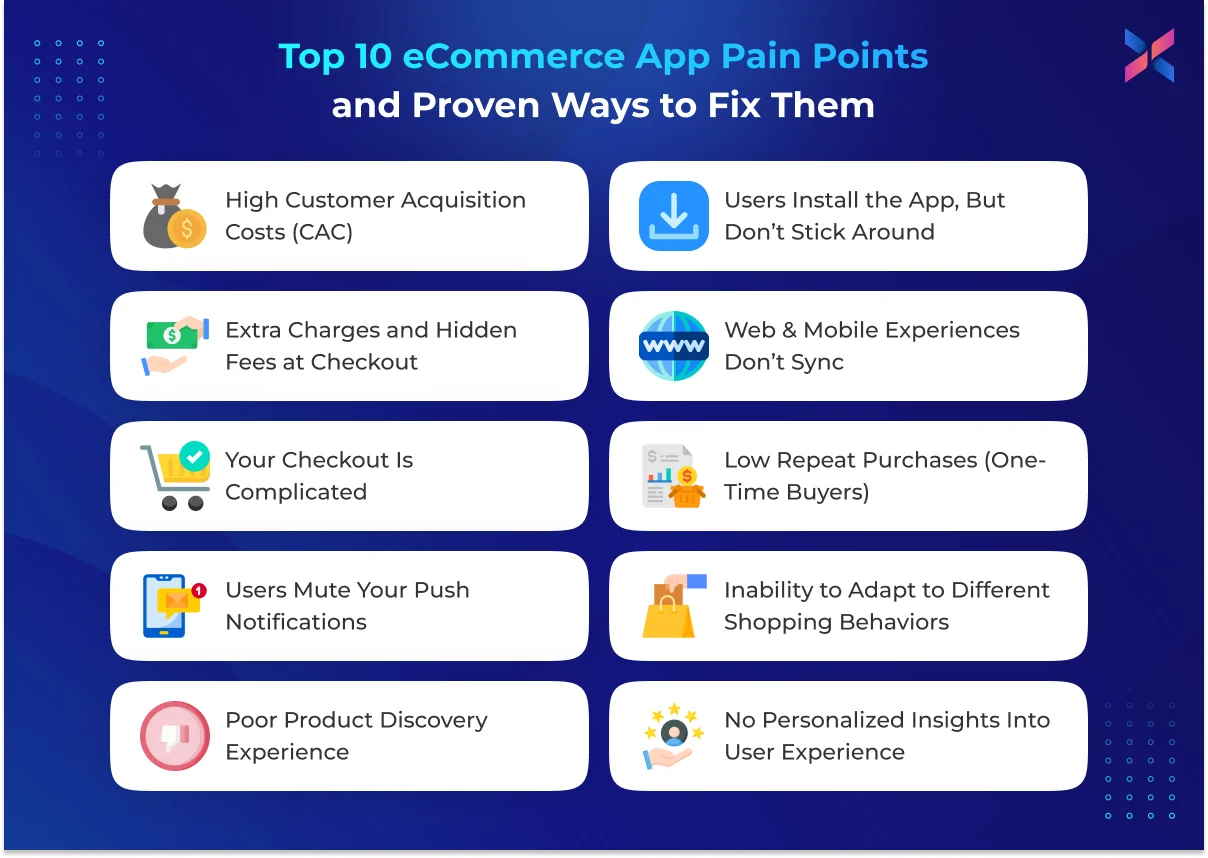
#1. High Customer Acquisition Costs (CAC)
High customer acquisition cost is the money spent on bringing customers. Today majority of e-commerce businesses spend a lot of money on marketing and advertising, but it might make users download your app, but many of them don't buy from the app, or leave.
Overall, you will not get any returns when customers don't make a purchase or use the app.
Solutions
- Firstly, make sure the user onboards smoothly. Have a clear guide of instruction/ tooltip, and CTA.
- Monitor user action and send smart messages like discounts or relevant suggestions to them.
- Show them personalized product suggestions by analyzing scrolling patterns and types of interests.
#2. Users Install the App, But Don’t Stick Around
The user may download the app by looking at the attractive marketing and design, but if there is no engagement or action taken from the user’s side, then it's of no use. There are multiple reasons why users don't use the app, such as a bad first-time experience, a lack of personalized onboarding, the user is not able to find a relevant product, and more.
Solutions
- Avoid using long sign-up forms.
- Show a quick tutorial or guide at the beginning.
- Only recommend the product of the user’s interest.
#3. Extra Charges and Hidden Fees at Checkout
Suppose you have added your favorite product to the cart, and suddenly you see extra shipping, GST and other charges added, would you like it? This is the reason why the majority of users leave the cart.
There are multiple other reasons for cart abandonment, such as a long or complicated checkout process, hidden charges, a lack of urgency, and more.
Solution
- Send timely and personalized reminders about their abandoned cart.
- Add limited-time offers or free shipping to motivate users take quick action.
- You can also use AI to make suggestions like “People who bought this also got…”
Sometimes users just need a gentle push, like only 2 items left or you can set a timer for a limited deal.
#4. Web & Mobile Experiences Don’t Sync
Many users just randomly browse on mobile phones but prefer to buy from bigger screens, like a laptop. If the cart, wishlist, and preferences are not synced on all devices, this can create disconnected experiences.
Solution
- Enable cross-device syncing for cart, wishlist, and browsing history.
- Continue session suggestions: “Pick up where you left off.”
- Shared account login experience with persistent progress.
#5. Your Checkout Is Complicated
60% shoppers abandon the cart if the checkout process is long. If your e-commerce forces users to create an account, has a lengthy registration process, or unclear steps. Your checkout process must be fast and smooth.
Solution
- Use autofill, guest checkout, and offer multiple payment options.
- Break the process into small, easy-to-follow steps.
- Add a progress bar so users know how close they are to finishing.
#6. Low Repeat Purchases (One-Time Buyers)
Lack of repeat purchase is the most common issue usually any business can face. The market is already getting competitive day by day. Possibly, the user may have found a better shopping website than yours. Maybe they are getting better deals somewhere else. Or another app is easy to use.
Repeat customers are more crucial as compared to new ones.
Solution
- Based on past behaviour, set up follow-up emails, personalized offers, and loyalty rewards.
- Make users feel remembered, and build long-term relationships.
#7. Users Mute Your Push Notifications
Push notifications are a great way to remind users about deals, discounts, and their favorite products. But it can be disturbing if you frequently send unnecessary ads that the user is not interested in. As a result, the user will either mute the notification or uninstall the app if it's over.
Solution
- Use AI personalization to send the right message at the right time.
- Prefer quality over quantity.
- Divide push messages by product interest and previous actions.
- Add deep links to specific deals inside the app.
#8. Inability to Adapt to Different Shopping Behaviors
Every shopper shops differently; some like to scroll multiple items, while others specifically search by name or category of product. Your e-commerce app must adapt to different shopping patterns and support their purchase journey.
AI is a powerful thing that can be used to analyze and predict the shoppers' behaviour. Based on the behavioural insights and what's trending right now, you can adjust your app to serve various types of audiences.
Solution
- Use personalized banners/CTAs triggered by scroll depth, time, and category views.
- Add "Just for You" carousels on the homepage.
- A/B test layouts based on shopper personas (browsers vs. quick buyers).
#9. Poor Product Discovery Experience
Lack of filters is the biggest pain point of an e-commerce app. If users are not finding what they are looking for, they will not buy. Poor product discovery is due to a weak search function.
Solution
- Make sure your app has multiple drop-downs with filters.
- Add AI-powered smart search with typo correction and autosuggestions.
- Show filters based on trending categories or user intent.
- Allow the user to voice search.
#10. No Personalized Insights Into User Experience
Most users don't wish to shop from an e-commerce app that doesn't understand them. It's important to improve the shopping journey based on how your users feel or behave. For this, you will need to implement AI in your e-commerce app that tracks who’s dropping off, who’s ready to buy, and what users are loving or ignoring.
Solution
- Run a personalized campaign targeted to specific audiences.
- Based on the user, personalize every small detail you can, such as the product.
- recommendations, preferred payment method. Time of shopping, etc.
Other Useful Tips To Avoid Customer Disappointment
Apart from the above points, keep these useful tips in mind to prevent customer disappointment.
- Mention clear shipping rates, return policies, and product information. Show the pricing with shipping in bold. The price must justify the charges you are charging.
- First onboarding should be easy, contain fewer steps, and be smooth. Make it simple, guided and welcoming.
- Use live chat or AI chatbots to offer real-time support and solve problems quickly.
- You can keep the short preference form at the onboarding. This will help to show relevant products, deals, and messages based on user behavior.
- Keep fewer steps and autofill in the checkout module. Keep all popular payment options.
- Send valuable updates like order status or price drops.
- Show customers you care and want to improve. Ask for feedback on a regular basis to know the pain points.
Conclusion
Now, by reading the blog, you must be aware of the top eCommerce app challenges. There is no big rocket science in understanding customers' pain points.
You just need to continuously monitor the buyers' searching and buying patterns to understand what’s making them drop the cart. As we have learned above, the most common mobile commerce problems, like high CAC, poor user retention, and low repeat purchases can be fixed with the right mix of AI, user behavior tracking, and smarter UX.
The best thing you can do is think by keeping yourself in the place of the customer and identify the issues.
At Expert App Devs, we can guide you with the best marketing strategies, checkout process, and other e-commerce app factors. If you're a DTC or e-commerce app owner looking to improve the customer shopping experience, book a consultation call with us.
Frequently Asked Questions
#1. How can I reduce customer acquisition costs without sacrificing growth?
If you want to reduce your customer acquisition cost, here are the tips:
- Create strategies that retain customers.
- Implement AI wherever you feel to personalize the app experience.
- Invest in loyalty, referrals, and upsell flows to drive repeat business at lower costs.
- Optimize your marketing channel and sales funnel.
#2. Why are users abandoning the app after installing it?
Users usually abandon your app due to various reasons: poor onboarding, lack of personalization, privacy concerns, design issues, technical bugs, lack of flexibility, and much more.
#3. How do I know what features are driving revenue and what’s just useless?
If you want to know which features are actually generating revenue, then use product analytics and cohort tracking tools to map usage patterns to conversions. Look at which modules lead to purchases or long-term engagement and optimize the experience around those.
#4. Can AI really personalize the shopping experience at scale?
Yes. You can personalize the shopping experience using AI, exactly how the user wants to. An AI algorithm can track browsing, clicks, and even scroll behavior to personalize banners, product recommendations, notifications, and CTAs in real-time. In fact, it will work 24/7 to adapt each customer’s journey based on their unique preferences.
#5. How do I keep users coming back after their first purchase?
The first important thing is to create a positive and engaging customer experience that makes users feel like shopping again from your app. Other things you can do are:
- Send thank-you notes after purchase.
- Give rewards and extra discounts to repeat and loyal customers.
- Provide good customer service, give quick responses and solve issues quickly.
- Keep sharing useful blogs, insights, tips and upcoming deals to customers.
- Implement strategies to give free shipping on specific order values.





 275
275

 0
0


 446
0
446
0
 927
0
927
0
 407
0
407
0